Abdominal MRI in China: Cost, Prep, and What to Expect
Key Takeaways
- An abdominal MRI in China typically runs $300–$900 at a top public hospital, versus $1,500–$4,000 in the United States — often the same 3.0T scanner, same contrast agent, same diagnostic standard.
- China’s top-ranked hospitals see enormous imaging volume, which means experienced radiologists, fast scheduling, and reports that can be ready within 24–48 hours.
- Language and logistics are the real barriers, not the scan itself. Public hospitals rarely offer English-language scheduling for walk-in imaging, and the paperwork is in Chinese.
- If you are considering an abdominal MRI in China, understand the preparation rules, the visa category (S2, not M), and how payment works before you book anything.
The Problem: Paying Too Much, Waiting Too Long
According to the International Society for Pharmacoeconomics and Outcomes Research, medical imaging prices in the United States have grown roughly three times faster than general inflation over the past two decades. An abdominal MRI with contrast in a U.S. hospital can bill out at $2,500 to $4,000 before insurance adjustments. Even with coverage, a high-deductible plan can leave a patient owing $1,200 or more for a single scan.
And the wait. In parts of Canada and the UK, a non-urgent abdominal MRI can take 8 to 16 weeks to schedule. That is a long time to sit with unexplained abdominal pain, a suspicious liver lesion, or a pancreatic finding that needs clarification.
For patients paying out of pocket — expats, self-employed workers, people between insurance plans, or those from countries where advanced imaging is scarce — the math gets painful fast. A single diagnostic scan can cost more than a round-trip flight to Asia.
Why China Delivers Results for Diagnostic Imaging
China’s top hospitals are not a budget compromise. They are high-volume imaging centers where 3.0T MRI machines run from early morning into the evening, and where radiologists read hundreds of abdominal studies per week.
Clinical Volume and Radiologist Experience
A subspecialty abdominal radiologist at a major Chinese tertiary hospital may interpret 40 to 80 abdominal MRI studies per day. That repetition builds pattern recognition. For complex cases — liver lesions, pancreatic cysts, biliary strictures, Crohn’s disease staging — volume matters.
Hospitals like the Fudan-ranked Top 100 maintain dedicated abdominal imaging divisions. Several are equipped with the latest 3.0T and even 5.0T platforms, plus MR elastography for liver fibrosis assessment.
Technology at Scale
Walk into the imaging department of a top Shanghai or Beijing hospital and you will see a workflow built for throughput: multiple MRI suites, digital scheduling, PACS systems that push images to the radiologist’s screen within minutes of the scan finishing.
Contrast agents — gadolinium-based, the same families used in the U.S. and Europe — are standard. Hepatobiliary-specific contrast (such as gadoxetate disodium) is available at major centers for liver lesion characterization.
Cost Advantage Without Quality Compromise
Why is an abdominal MRI so much cheaper in China? Not because of inferior equipment. The structural reasons are straightforward: lower labor costs, higher machine utilization rates, and hospital pricing that is set within a national fee schedule rather than negotiated with insurers.
The same 3.0T scanner that costs $3 million in the U.S. costs roughly the same in China. But when that machine scans 25 patients a day instead of 8, the per-scan cost drops dramatically.
Abdominal MRI Cost in China: What You Actually Pay
Prices vary by hospital tier, city, whether contrast is used, and whether you need additional sequences (MRCP for bile ducts, MR enterography for bowel, etc.). Here is a realistic range based on public hospital pricing at major tertiary centers.
| Service | China (Top Public Hospital) | United States | United Kingdom (Private) |
|---|---|---|---|
| Abdominal MRI (non-contrast) | $300 – $550 | $1,500 – $2,800 | £600 – £1,200 |
| Abdominal MRI with contrast | $450 – $900 | $2,000 – $4,000 | £800 – £1,800 |
| MRCP (bile duct imaging) | $350 – $700 | $1,800 – $3,500 | £700 – £1,500 |
| MR Enterography (bowel) | $400 – $800 | $1,800 – $3,200 | £750 – £1,600 |
| Radiologist report (English) | $50 – $150 | Included | Included |
| Same-week scheduling | Usually available | Varies, often 2–6 weeks | 1–3 weeks |
So how much does abdominal MRI cost in China at a private international hospital? Expect $900 to $1,800 — still well below U.S. rates, with English-speaking staff and direct insurance billing. For patients who want a Western-style experience, that is the trade-off.
Note that prices are quoted in RMB at the hospital and converted here at approximate rates. Final cost varies by hospital and case complexity. Additional sequences, sedation, or extended scan time will affect the total.
Is Abdominal MRI Safe in China? Safety Standards and Contrast Use
Yes — with the same caveats that apply anywhere. MRI does not use ionizing radiation. The safety profile is well established. The main considerations are contrast agent tolerance, metal implants, and claustrophobia.
Chinese tertiary hospitals follow MRI safety protocols aligned with international guidelines. Screening questionnaires cover pacemakers, cochlear implants, aneurysm clips, and metallic foreign bodies. If you have an implanted device, bring documentation of its MRI compatibility.
Gadolinium contrast carries a small risk of allergic reaction — roughly 0.1% to 0.3% for mild reactions. Major centers have resuscitation equipment on site. For patients with reduced kidney function, radiologists will assess eGFR before administering contrast, consistent with American College of Radiology guidance.
One practical note: if you do not speak Mandarin, you will need someone to help you complete the safety questionnaire accurately. Misunderstanding a question about implants is not a small thing.
What to Expect During Abdominal MRI in China: Step by Step
The scan itself is identical to what you would experience in any modern imaging center. The differences are in the logistics around it.
Step 1: Scheduling. At a public hospital, MRI appointments are typically made in person or through the hospital’s imaging department. Some top hospitals now allow online booking through their international departments or official apps — but these are in Chinese. Private international hospitals offer English-language scheduling by phone or email.
Step 2: Preparation. Most abdominal MRI protocols require fasting for 4 to 6 hours before the scan. If your exam includes MRCP, you may be asked to fast longer. Drink water as instructed — hydration helps image quality. Tell the radiology team about any medications, especially if you take insulin or have diabetes.
Step 3: Arrival and screening. Arrive 30 to 45 minutes early. You will complete a safety questionnaire, change into a hospital gown, and remove all metal objects. Lockers are provided. Bring your passport and any prior imaging CDs or reports.
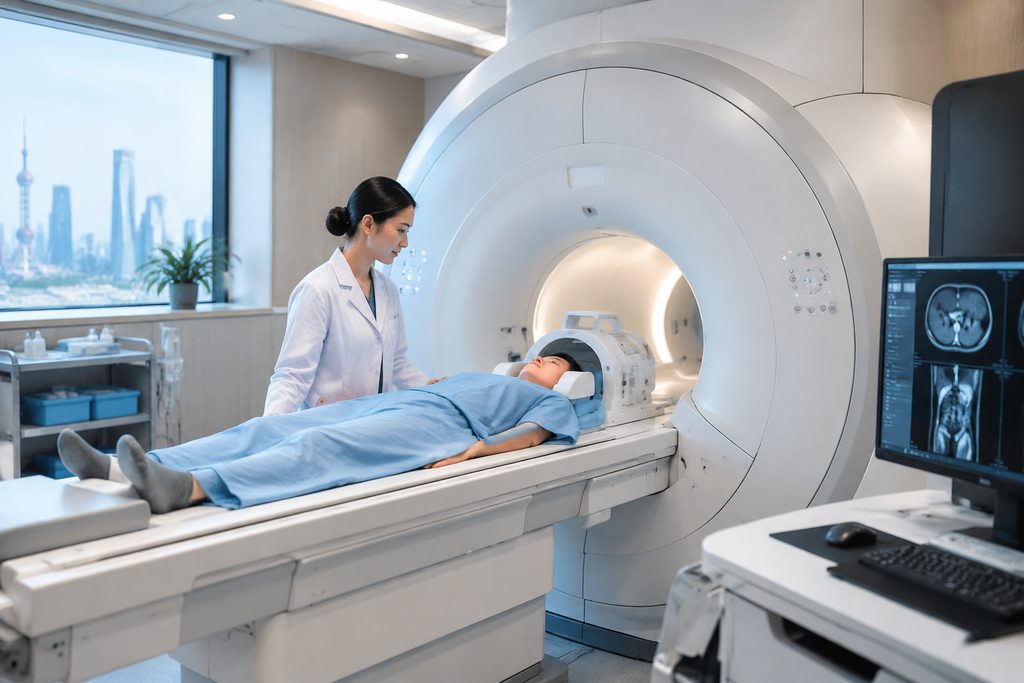
Step 4: The scan. An abdominal MRI takes 30 to 60 minutes. You lie still on a table that slides into the scanner. The machine is noisy — earplugs or headphones are provided. For contrast studies, an IV line is placed in your arm, and the contrast is injected partway through. You may feel a brief warm sensation. That is normal.
Step 5: Breathing instructions. Abdominal imaging requires breath-holds. The technologist will ask you to breathe in, breathe out, and hold — sometimes in Chinese. If you do not understand the timing, the images can blur. This is where a bilingual companion makes a measurable difference.
Step 6: After the scan. You can eat and drink normally unless told otherwise. Results are typically available within 24 to 48 hours. At public hospitals, you may need to return in person to collect the report and films. Some hospitals offer digital delivery.
How to Book Abdominal MRI in China: Options and Trade-Offs
There are three realistic paths, and they suit different patients.
Direct booking at a public hospital. Cheapest option. You handle scheduling, payment, and communication yourself. Requires Mandarin or a Mandarin-speaking helper. Reports are in Chinese unless you request translation.
Private international hospital. English-speaking staff, JCI accreditation, direct insurance billing, comfortable facilities. Costs 1.5 to 2 times more than the public route but still far below U.S. prices. Hospitals like United Family, Jiahui, and Parkway operate this way in major cities. See our private hospital directory for details.
Coordinated service. A bilingual medical companion handles registration, queue management, payment, translation during the scan, and report collection. This is the middle path — public hospital pricing plus language and logistics support. Our team at China Medical Services arranges this for international patients every week.
One more thing: abdominal MRI scan price in Shanghai tends to run slightly higher than in Chengdu or Wuhan. Beijing is comparable to Shanghai. If cost is the primary concern and you are flexible on city, second-tier cities with strong medical schools — like Chengdu, Hangzhou, or Nanjing — can offer excellent imaging at lower prices.
Practical Considerations: Visa, Payment, and Follow-Up
Visa. For medical treatment in China, the applicable short-stay category is the S2 visa, which covers medical treatment and private affairs. The M visa is for commercial and trade activities and is not the correct category for medical travel. Requirements change — check with the nearest Chinese embassy or consulate for the latest rules and required hospital documents. Accompanying family members typically apply under the same S2 category.
Payment. Public hospitals require prepayment before the scan. Cash, UnionPay, and major credit cards are accepted at most international departments. Private hospitals often bill insurance directly. Keep all receipts for reimbursement claims with your home insurer.
Insurance. Most international health insurance plans reimburse overseas diagnostic imaging, but policies vary. Check whether pre-authorization is required. Some plans exclude China entirely — confirm before you travel.
Follow-up. If your scan reveals something that needs treatment, you will want a specialist consultation. That usually requires an in-person visit at a public hospital. Telemedicine follow-ups with Chinese specialists are possible through video consultation services, but complex decisions often need face-to-face evaluation.
Language. This is the single biggest practical hurdle. Radiology reports are written in Chinese. A translated report from a qualified medical translator costs $50 to $150 and is worth every cent if you plan to share results with your doctor at home.
Frequently Asked Questions
At top-tier hospitals, yes. The scanners are the same models from Siemens, GE, and Philips. The contrast agents meet the same standards. The main variable is the radiologist’s experience, and at high-volume Chinese centers, that experience is substantial. For routine abdominal imaging, quality is comparable.
At private international hospitals, yes — English-language booking is standard. At public hospitals, it is difficult without assistance. You will need someone to help with registration, the safety questionnaire, breath-hold instructions during the scan, and report collection. A bilingual medical companion service bridges that gap for a fee, typically from $300 per day.
That is exactly why you are doing the scan. If a finding requires treatment, the next step is a specialist consultation. Chinese tertiary hospitals have dedicated departments for hepatobiliary disease, gastroenterology, and oncology. Our role is to help you understand the options and coordinate the next appointment — not to interpret your images or recommend treatment. That is the radiologist’s and your physician’s job.
At public hospitals, a non-urgent abdominal MRI can often be scheduled within 3 to 7 days. Private hospitals may offer same-week or even next-day slots. Compare that to the 4-to-12-week waits common in some public systems. If you are traveling specifically for imaging, plan for a 5-to-7-day stay to cover the scan, report, and any follow-up consultation.
Your Next Step
An abdominal MRI in China costs a fraction of Western prices, and the technology and expertise at top hospitals are genuinely world-class. The barriers are logistical, not clinical — language, scheduling, and knowing which hospital fits your case. That is the gap we exist to close. We are a medical concierge service, not a hospital, and we do not provide diagnoses. If you would like help understanding your options, start with a free consultation and we will walk you through the realistic paths.
This article is for informational purposes only and does not constitute medical advice. Always consult a qualified physician about your individual health situation before making treatment decisions.
For more medical information and treatment options in China, visit chinamedservices.com (China Medical Services).
