Acne Scar Treatment Cost China: Which Laser and Microneedling Options Work
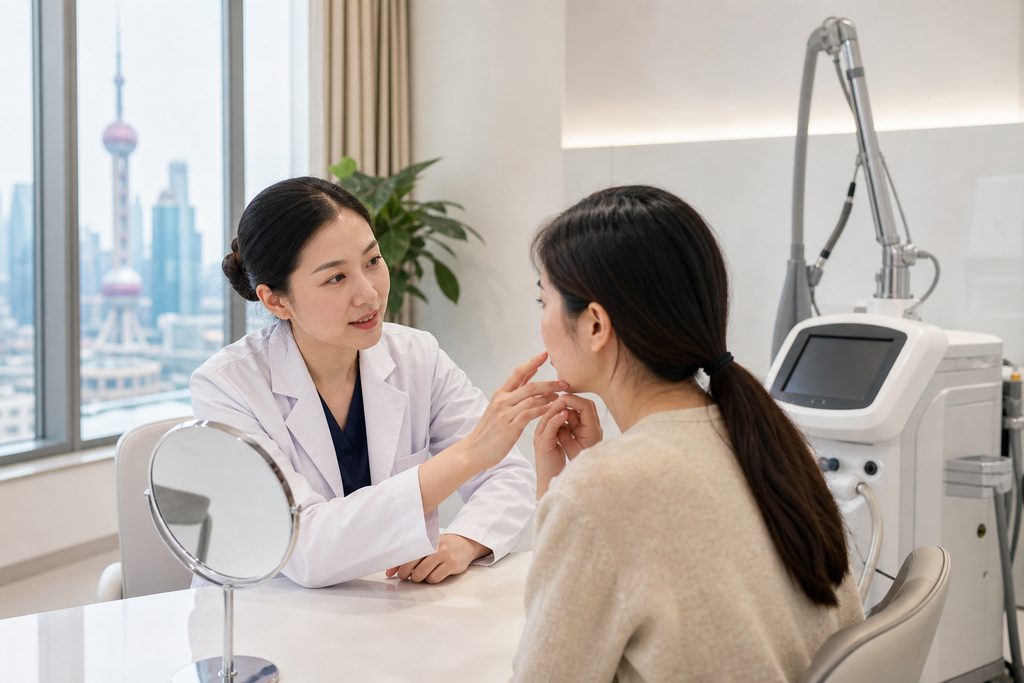
Which Treatment Works for Acne Scars? A Data-Driven Look at Options and Acne Scar Treatment Cost China
Acne affects roughly 85% of people aged 12 to 24 at some point, and studies suggest that up to 95% of those individuals develop some degree of scarring. For many, the emotional toll outlasts the active breakouts by years. If you are searching for which treatment works for acne scars, you have likely already spent money on creams that promised too much. The real answer depends on your scar type, your skin tone, and increasingly, where you are willing to travel. The acne scar treatment cost China is often 60% to 80% lower than comparable procedures in the United States or Western Europe, without a corresponding drop in technology or clinical expertise.
Key Takeaways
- Fractional CO2 laser and RF microneedling show the strongest evidence for atrophic (indented) scars, with 50–75% improvement after 3–4 sessions in most clinical studies.
- Top-tier dermatology departments in Shanghai and Beijing run the same devices used in the US (Fraxel, Picoway, Infini, Morpheus8) but at $150–$400 per session versus $800–$1,500 in the US.
- No single treatment fixes every scar type. Boxcar, rolling, and icepick scars respond to different combinations of energy devices, subcision, and fillers.
- Darker skin tones (Fitzpatrick IV–VI) need careful parameter selection to avoid post-inflammatory hyperpigmentation — a real risk with aggressive ablative lasers.
The Problem: Acne Scars Are Structurally Different From What Most People Think
A 2021 systematic review in the Journal of the American Academy of Dermatology found that the majority of patients underestimate the depth and type of their scarring before a professional assessment. What looks like “just a few red marks” often turns out to be a mix of rolling scars tethered to underlying tissue and boxcar scars with sharp vertical edges. The wrong treatment can waste a year and thousands of dollars.
In the US, a single session of fractional CO2 laser for acne scars typically runs between $800 and $1,500 depending on the city. A full package of four sessions, which most dermatologists recommend, easily exceeds $4,000 before adding numbing, aftercare, or follow-up appointments. That is the reality pushing more patients to evaluate options abroad. But price is only half the equation. The other half is whether the clinic has the right device for your specific scar morphology — and whether the operator has enough reps on that device to adjust settings safely for your skin tone.
Why Chinese Dermatology Departments Deliver Comparable Results at a Fraction of the Price
Clinical Volume Drives Operator Experience
Dermatology departments at major public hospitals in China see staggering patient volumes. A single laser room at a top-tier hospital in Shanghai may treat 40 to 60 patients per day. That is not an exaggeration — it is the operational reality of a system serving a population of 1.4 billion. The physician operating the fractional laser has likely performed more acne scar procedures in one month than many Western dermatologists perform in a year.
Volume alone does not guarantee quality. But when paired with standardized protocols and the same FDA-cleared devices used in Western clinics, repetition produces a specific kind of competence: knowing how to adjust fluence, density, and pulse duration for Fitzpatrick skin types III through V without causing burns or hypopigmentation. That matters. A 2020 study in Lasers in Surgery and Medicine found that operator experience was the single strongest predictor of post-laser complication rates, more than device brand or patient age.
Technology Parity: The Same Devices, Different Price Structure
Walk into a dermatology department at Huashan Hospital in Shanghai or Peking Union Medical College Hospital in Beijing and you will see equipment that would be familiar to any Beverly Hills dermatologist: fractional CO2 lasers, erbium YAG platforms, picosecond lasers, and radiofrequency microneedling devices like Infini and Morpheus8. These are not older-generation machines. Chinese hospitals purchase current-generation equipment from the same manufacturers — Lumenis, Cynosure, Candela, Syneron — that supply US and European clinics.
Why the price gap? Labor costs are structurally lower, hospital real estate is not priced at Manhattan levels, and the sheer patient volume spreads fixed equipment costs across far more procedures. A fractional CO2 session that costs $1,200 in New York might cost $250 to $400 in Shanghai. That is not a discount for lower quality. It is a different economic model.
Cost Advantage Without Quality Compromise
Let us address the obvious objection directly. Lower cost does not mean lower quality when the cost difference comes from structural economics, not from cutting corners. Chinese hospitals do not use cheaper laser consumables — the tips and handpieces are the same OEM parts. They do not hire less-trained staff — the physicians are board-certified dermatologists who completed the same length of residency training as their Western counterparts. The difference is that a Chinese hospital can amortize a $150,000 laser across 3,000 procedures per year instead of 500.
| Treatment | Typical US Price (per session) | Typical China Price (per session) | Evidence Level for Atrophic Scars |
|---|---|---|---|
| Fractional CO2 Laser | $800–$1,500 | $180–$400 | High — 50–70% improvement after 3–4 sessions |
| RF Microneedling (e.g., Infini, Morpheus8) | $700–$1,200 | $150–$350 | High — comparable to fractional CO2 for rolling scars |
| Picosecond Laser (e.g., Picoway) | $400–$800 | $100–$250 | Moderate — better for pigmented scars, less for deep boxcar |
| Subcision + Filler | $600–$1,500 | $150–$500 | High for rolling scars — but temporary filler needs repeat |
| Chemical Peel (TCA Cross) | $150–$400 | $50–$150 | Moderate — best for icepick scars, requires multiple sessions |
Prices vary by hospital and case complexity. A package of three fractional laser sessions at a top Shanghai hospital might run $600 to $1,000 total — less than a single session in many US cities. That is the acne scar treatment cost China advantage in concrete terms.
Which Treatment Actually Works for Your Scar Type
Here is the part most articles skip. The question “which treatment works for acne scars” has no single answer because acne scars are not a single problem. They fall into three main categories, and each responds to different energy modalities.
Rolling Scars: Subcision First, Then Energy
Rolling scars are wide, shallow depressions with sloping edges. They form when fibrous bands tether the skin to deeper tissue. No laser can cut those bands effectively. The standard approach is subcision — a needle or cannula inserted under the skin to break the tethers — followed by fractional laser or RF microneedling to resurface the surface texture. Some dermatologists combine subcision with a small amount of hyaluronic acid filler to prevent re-tethering during healing. This combination approach shows the highest patient satisfaction for rolling scars in most comparative studies.
Boxcar Scars: Fractional Ablative Laser Is the Workhorse
Boxcar scars have sharp, defined edges and a flat base. They respond best to fractional ablative lasers — CO2 or erbium YAG — which remove microscopic columns of skin and trigger collagen remodeling. Three to four sessions spaced 4 to 6 weeks apart typically produce 50% to 70% improvement, measured by standard scar grading scales. The downtime is real: 5 to 7 days of redness, swelling, and crusting per session. But the results are also the most predictable of any acne scar treatment.
Icepick Scars: TCA Cross or Punch Excision
Icepick scars are narrow, deep, and notoriously difficult to treat with lasers alone. The beam cannot reach the bottom of the scar without damaging surrounding skin. The standard approach is TCA Cross — applying a high-concentration trichloroacetic acid directly into the scar base to stimulate collagen from the bottom up. Multiple sessions are required, usually 3 to 6, spaced a month apart. For very deep icepick scars, punch excision — literally cutting out the scar and suturing the skin — may be the better option, though it leaves a small linear scar that fades over time.
Is Fractional Laser Safe for Acne Scars in China? What the Data Shows
The short answer is yes, with two caveats. Fractional laser has been used in Chinese dermatology departments for over 15 years. The complication rate is low — a 2019 multicenter study from China involving over 2,000 fractional CO2 treatments reported a post-inflammatory hyperpigmentation rate of 3.2% and a hypopigmentation rate of 0.8%. Those numbers are consistent with Western benchmarks. The caveats: darker skin tones need lower energy settings and longer intervals between sessions, and any active acne must be controlled before laser treatment begins. Treating active inflammatory acne with a laser can spread bacteria and worsen scarring.
So is fractional laser safe for acne scars in China? For Fitzpatrick skin types I through IV, yes, with a properly trained operator. For types V and VI, a conservative approach with RF microneedling is often preferred because it delivers energy below the epidermis, sparing the melanin-rich surface layer. A good clinic will tell you this upfront. A bad one will promise one-size-fits-all results.
How Much Does Microneedling Cost in Beijing? And What About Packages?
RF microneedling — not the cosmetic roller version, but the energy-based device version — has become the preferred first-line treatment for many patients because it offers meaningful improvement with less downtime than fractional CO2. How much does microneedling cost in Beijing? At public hospital dermatology departments, a single RF microneedling session typically runs $150 to $300. At private international clinics like United Family or Jiahui, expect $300 to $500 per session. That is still well below the $700 to $1,200 per session common in the US.
Many hospitals now offer acne scar removal packages China that bundle three to four sessions of a single modality at a discounted rate. A typical package might include three RF microneedling sessions plus two TCA Cross treatments for $800 to $1,200 total, depending on the hospital and the scar assessment. Packages are usually priced after an in-person consultation, not before — because the right combination depends on what the dermatologist sees under magnification and Wood’s lamp examination.
If you are planning to book acne scar treatment abroad China, the practical sequence matters. You cannot simply email a public hospital dermatology department and book a laser session from overseas. Public hospitals in China require in-person registration for outpatient visits, and treatment is scheduled after the dermatologist evaluates your skin. The realistic path is: fly to China, attend a consultation, get a treatment plan and quote, then schedule sessions. Some patients combine this with a longer stay, spacing three sessions across a 6 to 8 week visit. Others make two shorter trips.
Practical Considerations: What You Need to Handle Before and After Treatment
If you are seriously evaluating China for acne scar treatment, there are logistics to manage. None of them are insurmountable, but they require planning.
Medical records and photos. Bring clear, well-lit photos of your scars from multiple angles, plus any records of previous treatments — what was done, when, and how your skin responded. If you have a history of keloid scarring or post-inflammatory hyperpigmentation, say so explicitly. This is not the time to be stoic. A good dermatologist will adjust the treatment plan based on this information.
Visa category. For medical treatment in China, the applicable short-stay visa category is the S2 visa, which covers private affairs including medical treatment. The hospital or clinic can provide a supporting letter confirming your appointment. Processing times vary by embassy and your nationality, so apply at least 4 to 6 weeks before your planned travel. Visa requirements are subject to the latest embassy or consulate guidance, so verify current rules before booking flights.
Payment methods. Public hospitals in China typically require upfront payment for outpatient procedures. International credit cards are not always accepted at public hospital cashier windows — bring a UnionPay card, cash, or confirm in advance whether the hospital’s international department accepts Visa or Mastercard. Private international clinics are more likely to accept international cards and may offer direct insurance billing if you have a policy that covers overseas treatment.
Language and interpretation. Public hospital dermatology departments operate in Mandarin. Even in Beijing and Shanghai, do not assume English-speaking staff will be available at every step. If you do not speak Mandarin, arrange for a bilingual companion or translator before you arrive. The consultation, the consent form, the aftercare instructions — all of these matter, and misunderstanding any of them can affect your outcome.
Follow-up after returning home. Laser and microneedling results continue to improve for 3 to 6 months after the final session as collagen remodels. You do not need to stay in China for that entire period. But you do need a plan for follow-up: photos sent to your treating dermatologist, and if any complications arise — prolonged redness, pigmentation changes, infection — a local dermatologist who can assess you in person. Do not skip this. A good outcome depends as much on aftercare as on the procedure itself.
Frequently Asked Questions
Most patients need 3 to 4 sessions of fractional laser or RF microneedling, spaced 4 to 6 weeks apart, to see 50% to 70% improvement. Icepick scars treated with TCA Cross may need 4 to 6 sessions. Anyone promising dramatic results after one session is either treating very superficial scarring or overselling.
For shallow to moderate boxcar and rolling scars, both work. Fractional CO2 produces faster, more dramatic results but with 5 to 7 days of downtime per session. RF microneedling has less downtime (2 to 3 days) and is safer for darker skin tones, but may require one or two extra sessions to match CO2 results. The best choice depends on your scar type, skin tone, and tolerance for downtime — not on which device is newer.
Post-inflammatory hyperpigmentation is the most common complication, occurring in roughly 3% to 5% of cases, and it is more likely in darker skin tones or after aggressive ablative settings. It usually fades over 3 to 6 months with topical treatment. Hypopigmentation — permanent lightening of the skin — is rarer but can be permanent. This is why operator experience matters more than device brand. A conservative first session with a follow-up assessment before increasing intensity is the responsible approach.
Public hospital dermatology departments generally cannot confirm treatment sessions before an in-person consultation. You can arrange the consultation itself, but the treatment plan, pricing, and schedule are determined after the dermatologist examines your skin. Private international clinics may offer more flexibility for advance booking, but even they will want to see you before committing to a treatment protocol.
If you are planning 3 to 4 sessions, the math is straightforward. A full course of fractional laser in the US might cost $3,500 to $5,000. The same course in Shanghai or Beijing might cost $800 to $1,500, plus travel and accommodation. The savings can be substantial, but only if you are comfortable with the logistics — visa, language, payment, and follow-up. This is not a decision to make based on price alone.
Your Next Step
Acne scar treatment is a decision that rewards research and punishes impulse. The right treatment depends on your scar type, skin tone, and realistic expectations about downtime and results. If you are considering China for the cost advantage, start by getting a clear picture of your scarring from a dermatologist you trust, then compare options with open eyes.
We help international patients navigate the practical side of treatment in China — from identifying suitable dermatology departments among our curated network of top-ranked hospitals to coordinating consultations and arranging bilingual support. We are not a hospital and do not provide diagnoses or treatment recommendations. But if you
For more medical information and treatment options in China, visit chinamedservices.com (China Medical Services).
