AI-Assisted Second Opinion in China: Radiology & Pathology Diagnosis Service for International Patients
Key Takeaways
- AI-assisted second opinions from Chinese hospitals combine deep learning algorithms with specialist review, often identifying findings missed in initial reads — one 2023 study in The Lancet Digital Health found AI-assisted radiology reviews improved breast cancer detection rates by 9.4% compared to standard double-reading.
- China’s top hospitals process imaging volumes that dwarf most Western institutions. A single major Shanghai radiology department may read over 4,000 studies daily. That volume trains both the AI models and the physicians reviewing your case.
- You cannot simply email scans to a Chinese hospital and receive a report. The process requires formal registration, medical record translation, and routing through the hospital’s international department — something most patients cannot navigate alone.
- Any second opinion from China — whether AI-assisted or traditional — is for reference only. It does not constitute a prescription or treatment order, and you should always discuss findings with your local physician before acting on them.
The Problem: Diagnostic Uncertainty Has Real Consequences
Roughly 1 in 20 radiology interpretations contains a clinically significant discrepancy, according to a 2022 meta-analysis published in BMJ Quality & Safety. That is not a typo. Five percent of imaging reads — CT scans, MRIs, mammograms, chest X-rays — miss something that matters. For pathology, the numbers are similarly sobering. A 2021 study in JAMA examining second-opinion pathology reviews at major US academic centers found a 7.8% rate of clinically significant diagnostic disagreements, with 1.6% representing major changes that altered treatment plans entirely.
Most patients never learn about these error rates. They receive a report, their doctor acts on it, and the path forward is set. But what happens when the diagnosis is wrong? Delayed treatment. Unnecessary surgery. Missed cancers. The patient absorbs the consequences.
Getting a second opinion has always been the smart move. The problem is access. In Canada, the median wait time for an MRI is 10.6 weeks, and that is just to get the scan — never mind a second read. In the UK, the NHS target of 28 days for cancer diagnosis from referral is missed for tens of thousands of patients annually. In the United States, a second opinion radiology review from a top academic center can cost $500 to over $1,000 out of pocket, with turnaround times stretching to two weeks or more.
Patients are stuck. They know a second read could change everything. They also know the system makes it slow, expensive, or both.
This is where AI-assisted diagnosis services in Chinese hospitals enter the conversation. Not as a replacement for your local care. As a parallel track — fast, affordable, and powered by technology most Western hospitals have not yet deployed at scale.
Who We Are
We are China Medical Services. We are not a hospital. We do not provide medical treatment, we do not issue clinical diagnoses, and we do not employ physicians. What we do is straightforward: we connect international patients with China’s top-tier hospitals — 340+ institutions across 37 cities — and we handle every logistical barrier between you and a credible second opinion. That means document translation, hospital selection, appointment coordination through official international department channels, and bilingual support throughout. Think of us as your in-country operational team. You bring the medical need. We clear the path.
How AI-Assisted Diagnosis Actually Works in Chinese Hospitals
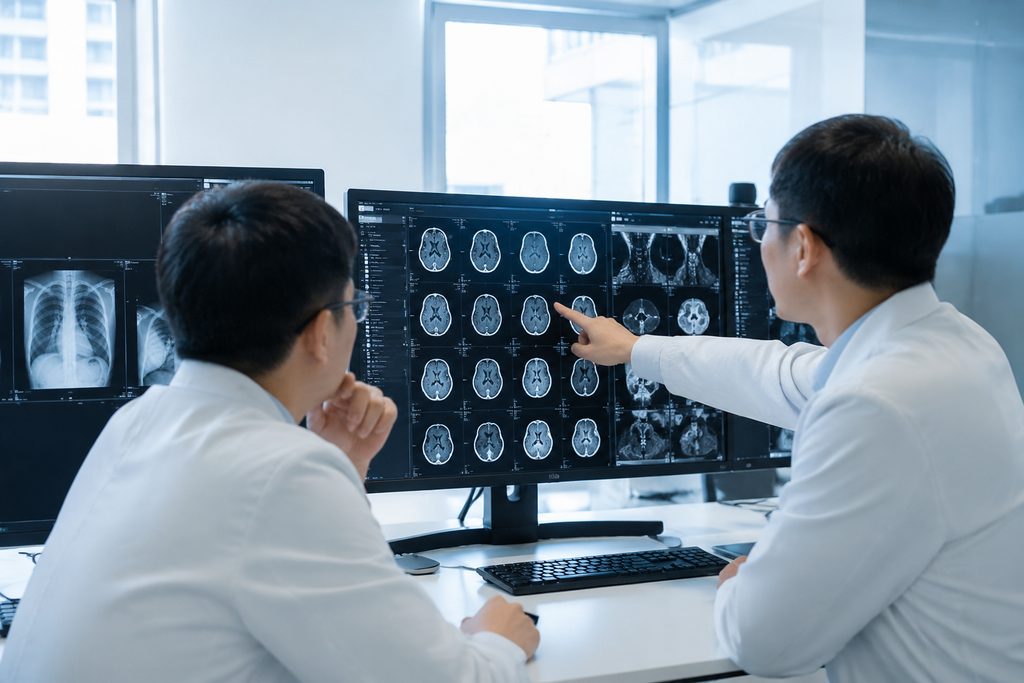
The term “AI diagnosis” conjures images of a computer replacing the doctor. That is not what happens. In practice, AI-assisted radiology and pathology diagnosis in China follows a specific workflow: the algorithm analyzes the image first, flags regions of interest, generates a preliminary finding list, and then a board-certified specialist reviews everything — the original image, the AI annotations, and the clinical context — before issuing a final report. The AI is a second set of eyes, not a replacement for human judgment.
What makes Chinese hospitals unusually good at this? Three structural advantages.
Volume Breeds Accuracy — For Both Machines and Humans
AI models trained on larger, more diverse datasets simply perform better. Chinese hospitals generate imaging data at a scale unmatched anywhere. A single radiology department at a top-tier Shanghai hospital reads over 4,000 studies every day. Chest CTs alone can exceed 1,000 daily during peak periods. Every scan, every biopsy slide, every annotated finding feeds back into training datasets that refine the algorithms.
The physicians benefit from this volume too. A thoracic radiologist at a major Chinese cancer center may review more lung nodule cases in one year than a counterpart at a typical Western teaching hospital sees in five. When you ask how does AI assisted pathology diagnosis work in China, the answer starts with scale. The AI learns faster because the data stream is enormous. The pathologists see more rare presentations because the patient pool is vast. Both factors contribute to diagnostic precision.
Technology Deployed at Operational Scale, Not Pilot Projects
Many Western hospitals have AI tools in research settings. A pilot here, a grant-funded trial there. Chinese top-tier hospitals have moved well past experimentation. AI-assisted lung nodule detection on CT is standard workflow in dozens of major institutions, not a research protocol. AI-powered digital pathology platforms that scan whole-slide images and pre-screen for malignancy are in daily clinical use at hospitals like Fudan University Shanghai Cancer Center and Peking Union Medical College Hospital.
This matters for a second opinion. When you send medical images to China for AI analysis, the price reflects an operational system, not a bespoke research project. The turnaround is faster because the integration is routine, not exceptional. A written second opinion that includes AI-assisted review typically takes 3 to 5 business days once all materials are received and translated.
Cost Structure That Makes a Second Opinion Accessible
Let us address the obvious question. The ai diagnosis second opinion cost China offers is substantially lower than comparable services in the US or Europe. A written second opinion from a top-tier specialist — which includes AI-assisted image review where clinically appropriate — ranges from $300 to $500. A video consultation with that same specialist runs $500 to $800. A multidisciplinary team review, where a radiologist, pathologist, and clinical specialist review your case together via video, costs $1,500 to $2,000.
These are not discount prices for discount medicine. The economics reflect structural differences: lower physician labor costs, higher patient volumes spreading fixed costs, and hospital systems built for efficiency rather than billing complexity. The clinical outcomes at China’s top hospitals — the ones in our network, ranked in the top 5% of the country’s 35,000+ hospitals by Fudan University’s hospital rankings — are comparable to leading Western centers. The price tag is not.
What You Need to Know Before Sending Images to China
This section is where we earn your trust by telling you the hard parts. Getting an AI-assisted second opinion from a Chinese hospital is not as simple as uploading files to a website. There are real barriers.
- Hospital Registration Requirements: Chinese public hospitals require formal patient registration before any diagnostic service is rendered. This means your passport information, medical history, and imaging files must be submitted through the hospital’s international department. You cannot bypass this step. It exists for regulatory and medico-legal reasons, and no legitimate hospital will issue a second opinion report without it.
- Medical Record Translation: Your existing reports, clinical notes, and referral letters must be translated into Chinese. Machine translation is not acceptable for clinical documents. Professional medical translation is required, and it adds both cost and time. We handle this as part of our coordination service, but patients attempting a DIY approach often underestimate this step.
- Image Format and Transfer: Chinese hospital PACS (Picture Archiving and Communication Systems) typically require DICOM format — not JPEGs, not PDFs of your scans. If your original facility only provided you with a CD of images, those files must be extracted, verified for format compatibility, and transferred securely. Some hospitals also have file size limits on their receiving portals. We manage this, but it is a friction point worth understanding.
- Payment Before Service: Public hospitals in China operate on a prepayment model. The consultation fee must be paid before the specialist reviews your case. International wire transfers can take days. We facilitate payment through channels that avoid delays, but the prepayment reality is non-negotiable.
These barriers exist for structural reasons. They are not arbitrary. And they are all solvable with the right support.
Best Hospital for AI Radiology Review Shanghai and Beyond
Patients frequently ask us to name the best hospital for AI radiology review Shanghai offers. The honest answer: there is no single best hospital for every case. The right institution depends on your specific clinical question. A lung nodule review belongs at a different center than a brain tumor second opinion. A breast pathology re-read requires a pathologist who specializes in breast tissue, not a generalist.
What we can tell you is the landscape. Shanghai hosts several institutions with mature AI-assisted diagnostic programs. Fudan University Shanghai Cancer Center has integrated AI into both radiology and pathology workflows for oncology cases. Ruijin Hospital, affiliated with Shanghai Jiao Tong University School of Medicine, runs one of the largest AI-assisted radiology operations in the country. Zhongshan Hospital Fudan University has particular strength in cardiovascular and hepatic imaging with AI augmentation.
Beijing offers comparable depth. Peking Union Medical College Hospital — consistently ranked in the top tier of the Fudan hospital rankings — deploys AI across multiple diagnostic departments. The Cancer Hospital Chinese Academy of Medical Sciences has developed proprietary AI pathology tools trained on one of the world’s largest cancer tissue archives.
The key is matching your specific case to the right department at the right hospital. That matching process is exactly what our free consultation addresses. We review your existing diagnosis, identify the relevant subspecialty, and recommend hospitals where both the AI tools and the human expertise align with your needs.
Can I Get an Online Second Opinion from Chinese Doctors Without Traveling?
Yes. This is one of the most common questions we field, and the answer is straightforward. You can get an online second opinion from Chinese doctors without ever boarding a plane. The entire process — image transfer, report translation, specialist review, and delivery of the second opinion report — happens remotely. Video consultations likewise occur via secure telemedicine platforms.
The process typically follows this path. You contact us with your diagnostic imaging and clinical history. We translate your records and submit them to the appropriate hospital’s international department. The hospital registers you as an international patient. The specialist — often with AI-assisted pre-review — examines your case and produces a written second opinion. You receive the report in English, typically within 3 to 5 business days for a standard written opinion. Video consultations are scheduled based on specialist availability, usually within 7 to 10 days.
There is an important nuance. A written second opinion is for reference only. It is not a prescription, not a treatment order, and not a substitute for in-person evaluation if your local physician determines that is necessary. Think of it as high-quality intelligence — data you and your doctor can use to make better decisions.
For patients who do decide to travel, there is a financial bridge. Any consultation fee you pay — whether for a written second opinion or a video consultation — is credited in full toward our on-the-ground coordination service if you choose to come to China for treatment within 90 days. This applies to the coordination fee only, never to hospital treatment charges. It means your second opinion is effectively free if you proceed to in-person care.
How We Handle the Entire Process
We only work with hospitals ranked in the top 5% of China’s 35,000+ hospitals, as assessed by the Fudan University hospital ranking system or holding JCI accreditation. These are the same institutions that train China’s leading specialists and publish in international peer-reviewed journals. You receive the hospital’s official report on their letterhead, signed by a named specialist. We encourage patients to verify credentials independently.
This happens — and it is precisely why second opinions exist. If the Chinese second opinion differs from your original diagnosis, you now have two data points to discuss with your local physician. Neither report automatically overrides the other. The appropriate next step depends on the clinical context: sometimes a third opinion is warranted, sometimes additional testing resolves the discrepancy, and sometimes the second opinion simply provides a more nuanced interpretation that your local doctor can integrate into your care plan. We never advise patients to disregard their original diagnosis. We provide additional information for you and your doctor to weigh.
Both radiology and pathology second opinions are available with AI assistance. For pathology, this typically involves digitizing your glass slides into whole-slide images, which are then analyzed by AI algorithms that screen for cellular abnormalities before the pathologist reviews the case. Not every hospital offers AI-assisted pathology — it requires digital pathology infrastructure that is less widespread than AI radiology tools. We can tell you during the initial consultation whether AI-assisted pathology review is available for your specific case type.
A written second opinion that includes AI-assisted review ranges from $300 to $500. This covers the specialist’s time, the AI analysis where applicable, and the final report. It does not include medical record translation (which we provide as part of our coordination service) or any follow-up video consultation. If you want to discuss the findings directly with the specialist via video, that runs $500 to $800. All fees are prepaid, and all are credited toward our coordination service if you proceed to in-person treatment within 90 days. The send medical images to China for AI analysis price is transparent — no hidden charges, no surprise billing.
Your Next Step
A second opinion is not a sign of distrust in your doctor. It is a sign that you take your health seriously enough to verify the roadmap before you travel down it. China’s top hospitals offer something genuinely difficult to find elsewhere: AI-augmented specialist review at scale, delivered quickly, at a cost that does not require a second mortgage.
If you have imaging or pathology results and you want a second set of eyes — human and machine — on your diagnosis, we can make that happen. Start with a free consultation. Tell us what you have, what you are worried about, and what you need. We will tell you honestly whether a Chinese second opinion makes sense for your case. No pressure. Just clarity.
Medical Disclaimer: All second opinion reports provided through Chinese hospitals are for reference only. They do not constitute a prescription, a treatment recommendation, or a substitute for in-person medical evaluation. Always discuss second opinion findings with your local treating physician before making any changes to your care plan. China Medical Services does not employ physicians, does not provide clinical diagnoses, and makes no claims about treatment outcomes.
Frequently Asked Questions
Yes. We work with JCI-accredited and major Grade 3A tertiary hospitals that follow international safety standards comparable to top hospitals in the US and Europe. Surgical teams perform high volumes of procedures — often more than their Western counterparts — which studies show leads to better outcomes.
Costs vary by procedure and hospital, but international patients typically save 40-80% compared to US prices — even when factoring in travel and accommodation. A consultation with our team will give you an exact, all-inclusive quote with no hidden fees.
Send us your existing medical reports and we will map out the options with the relevant specialty, from a written opinion to a video consultation or an in-person proxy appointment. Your medical records are reviewed by the specialist before you even book a flight.
For more medical information and treatment options in China, visit chinamedservices.com (China Medical Services).
