Airport to Hospital Bed — Our Door-to-Door Medical Transfer & Check-In Service
Key Takeaways
- Navigating a Chinese hospital independently after a long-haul flight can take 4-6 hours of queuing and language barriers — our door-to-door service cuts this to under 90 minutes from gate to bed.
- China’s top-tier hospitals perform surgical volumes that dwarf Western institutions — Fuwai Hospital alone completes over 14,000 cardiac surgeries annually — yet accessing them requires local logistical expertise, not just a referral.
- Public hospital registration desks rarely accept foreign credit cards, and most forms are in Mandarin only; arriving without a bilingual coordinator means you risk being turned away at the admissions counter.
- The S2 medical visa requires a stamped invitation letter from the admitting hospital — a document no hospital issues without a confirmed appointment, creating a circular problem we resolve before you board your flight.
The Problem: You Land Exhausted, in Pain, and Nobody Speaks Your Language
You have just stepped off a 12-hour flight. Your back aches from the economy seat. You are carrying a folder of translated medical records you are not entirely sure are accurate. Outside baggage claim, the humidity hits you. The signs are in characters you cannot read. Your phone will not connect to the local network. And somewhere in this city of 26 million people, a surgeon is waiting to review your case — but first, you have to find the right hospital entrance, fill out a registration form in Mandarin, pay a deposit through a payment system that rejects your Visa card, and locate a ward that may be in Building 7, Floor 12, Section B. All while managing whatever medical condition brought you here in the first place.
This is not an exaggeration. Shanghai Pudong International Airport handled over 76 million passengers in 2023. A significant fraction arrived for medical purposes. Yet the journey from arrival gate to hospital admission is almost entirely undocumented in English. There is no universal patient shuttle. No multilingual welcome desk. No standardized international patient pathway across China’s 3,400 public hospitals. What exists instead is a patchwork of hospital-specific international departments, each with its own registration protocols, payment systems, and document requirements. Getting it wrong means delays. Sometimes, getting it wrong means being told to come back tomorrow.
Our organization exists because that gap — between a world-class surgical team waiting inside the hospital and a disoriented patient standing on the curb outside — is where medical travel falls apart. We close it.
Who We Are
We are not a hospital. We do not provide medical treatment, prescribe medication, or offer clinical diagnoses. China Medical Services is a medical concierge organization that connects international patients with China’s top-ranked hospitals — 340+ institutions across 37 cities, selected from the top 5% of the country’s 35,000+ hospitals based on Fudan University rankings and JCI accreditation. Our team handles the architecture of your medical journey: hospital matching, appointment coordination, visa invitation letters, bilingual medical companions, and the physical transfer from airport to hospital bed. Think of us as the logistical layer between you and China’s medical expertise. We are the reason you walk into the right building, on the right day, with the right paperwork, and a translator at your side.
What Exactly Is a Medical Transfer Service China Airport to Hospital?
A medical transfer service China airport to hospital is not an ambulance ride. It is a coordinated patient logistics operation that begins the moment your flight lands and ends when you are registered, admitted, and settled in your hospital room — with all administrative formalities completed. For international patients traveling to China for scheduled treatment, this service bridges the critical hours between arrival and care delivery.
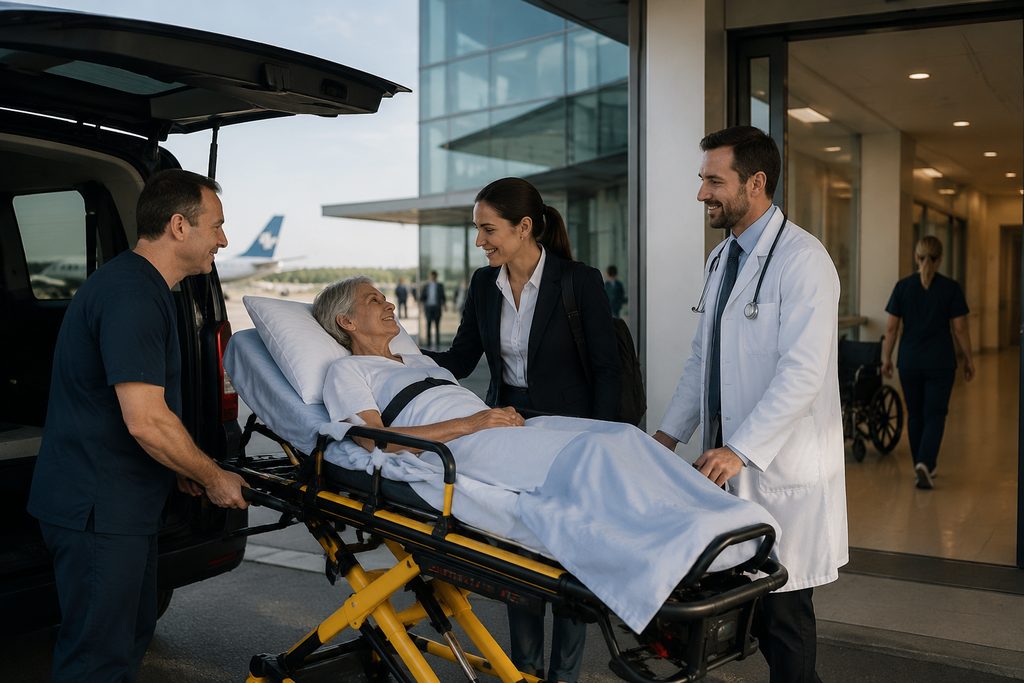
The typical sequence looks like this: our bilingual coordinator tracks your flight in real time. They are standing at the arrival gate with a name sign in both English and your native language. They have already confirmed your hospital admission slot that morning. Your medical records — translated into Mandarin by our team — are pre-filed with the international patient department. The hospital knows you are coming. Your room is reserved. The deposit amount has been calculated. All that remains is getting you there, getting you checked in, and ensuring the clinical handover happens without a single piece of information lost in translation.
Does this sound like something you could arrange yourself? In theory, yes. In practice, the coordination involves phone calls in Mandarin to hospital admissions offices that do not publish international contact numbers, WeChat-based scheduling with department heads who do not use email, and real-time problem-solving when, for example, the hospital’s registration system rejects a foreign passport number format. These are not hypotheticals. They happen routinely.
How Does Door to Door Medical Check In Work in China?
The question we hear most often is some variation of how does door to door medical check in work in China. Patients want to know the granular steps. They have read about China’s medical capabilities. They have seen the surgical volume statistics. What they cannot visualize is the actual Monday morning of their arrival.
Here is that Monday morning.
Your flight lands at 06:40. By 07:00, you have cleared immigration — our team has briefed you in advance on exactly what to say at the border, and you are carrying the hospital invitation letter required for S2 medical visa holders. Our coordinator meets you at the arrivals hall exit. A pre-booked vehicle — not a taxi queue gamble — takes you directly to the hospital. The drive from Pudong International to Zhongshan Hospital, for example, takes roughly 45 minutes in morning traffic. During that drive, your coordinator briefs you on the day’s schedule: which department you will visit first, who the attending physician is, what tests are already ordered, and what documents the registration desk will need.
At the hospital, you bypass the general registration queue. The international patient department — or VIP channel, depending on the hospital — has a separate admissions desk. Your coordinator handles the deposit payment, which in Chinese public hospitals is almost always required upfront. This is where many independent travelers hit a wall: hospital payment terminals frequently reject foreign-issued credit cards. We resolve this through pre-arranged payment channels. Your coordinator translates every form, explains every consent document, and escorts you to your ward. The nursing handover happens in Mandarin, then your coordinator translates the care plan back to you in English. By 08:30, you are in your bed. The clinical team has your complete history. Treatment begins.
Without this service, the same process takes four to six hours. Sometimes longer. We have seen patients spend an entire day shuttling between registration windows, payment counters, and department waiting rooms — all while managing post-flight exhaustion and an untreated medical condition.
China Hospital Pickup from Airport Price: What Should You Budget?
Patients researching China hospital pickup from airport price will find a wide range of figures, from informal driver services charging $50 to comprehensive medical concierge packages running into the thousands. The variance reflects a fundamental difference in what is being offered.
A basic airport transfer is just a car. A driver meets you, drives you to a hospital entrance, and leaves. This costs around $200 round-trip. It solves exactly one problem: transportation. It does not solve registration. It does not solve language. It does not solve payment. It does not confirm your admission slot is still valid after a flight delay. For a patient traveling to China for medical treatment, a car without coordination is a half-solution — and a half-solution in a foreign hospital system can mean a full day of frustration.
Our door-to-door medical transfer and check-in service is priced as part of a broader coordination package. Hospital appointment coordination starts from $300, which includes confirming your admission date and time, pre-filing your translated medical records, and ensuring the international patient department is prepared for your arrival. The bilingual medical companion — the person who meets you at the airport and stays with you through admission — costs from $200 per day. The airport transfer itself is $200 round-trip. For a patient arriving for a scheduled procedure, the combined cost of being met at the airport, driven to the hospital, and checked in with full translation support typically falls between $700 and $900.
Compare this to the cost of a wasted day. Or a missed admission slot. Or a consent form signed without understanding.
| Service Component | Independent Attempt | Coordinated Service |
|---|---|---|
| Airport pickup | Taxi queue, language barrier, unknown fare | Pre-booked vehicle, coordinator at gate, fixed price |
| Hospital registration | General queue, Mandarin forms, foreign card rejection risk | VIP/international desk, pre-filed records, payment handled |
| Time from landing to admission | 4-6 hours typical | Under 90 minutes typical |
| Translation support | None; reliance on hospital staff availability | Dedicated bilingual companion throughout |
| Approximate total cost | $50-100 (transport only; risk of failure high) | $700-900 (transport + coordination + companion) |
These figures are starting points. Final pricing varies by hospital, city, and case complexity. A patient arriving at a private international hospital in Shanghai with English-speaking staff will require less hands-on coordination than a patient admitted to a public top-tier hospital in Guangzhou where the international department operates limited hours. We quote specific pricing only after understanding your case.
International Patient Airport Transfer Shanghai Hospital Package: What It Covers
Shanghai receives more international medical travelers than any other Chinese city. Its airport infrastructure — two major international airports, Pudong and Hongqiao — and its concentration of Fudan-ranked hospitals make it the default entry point for many patients. An international patient airport transfer Shanghai hospital package should cover more than the drive from PVG to Huashan Hospital.
Our Shanghai packages include three layers of service. First, pre-arrival coordination: we confirm your admission date with the hospital’s international department, submit your translated medical records and imaging, obtain the stamped invitation letter required for your S2 visa application, and brief you on exactly which documents to carry in your hand luggage. Second, arrival day execution: the airport pickup, the hospital transfer, the registration and admission process, the deposit payment, and the clinical handover to your attending team. Third, ongoing support: your bilingual companion remains available for the duration of your hospital stay, attending daily rounds with you, translating physician updates, and handling any administrative issues that arise.
This is not a luxury add-on. For a patient who does not speak Mandarin, the daily ward round — when the attending physician and their team discuss your case, adjust medications, and order tests — is a clinically critical conversation happening in a language you cannot understand. Missing a detail because of a language gap is not an inconvenience. It is a patient safety issue.
Is Medical Airport Transfer Safe in China?
Patients ask is medical airport transfer safe in China with good reason. They are placing themselves in the hands of strangers in an unfamiliar country while medically vulnerable. The question deserves a direct answer.
Yes — when arranged through a verified medical concierge organization with established hospital relationships. No — when relying on ad-hoc drivers or unvetted intermediaries who lack hospital coordination capability. The safety concern is not about physical danger during the drive. China’s highways and urban roads are well-maintained, and professional drivers are licensed and insured. The safety concern is about what happens at the hospital end of the journey. A driver who drops you at the wrong entrance of a 3,000-bed hospital complex has left you with a problem you may not be able to solve independently. A coordinator who does not have a direct contact in the international patient department cannot resolve a registration issue if your name is misspelled in the admission system or if the hospital’s records do not match your passport.
We mitigate these risks through pre-established relationships. Our team confirms admission details with the hospital on the morning of your arrival. If your flight is delayed — and long-haul flights frequently are — we communicate that delay to the admissions office in real time so your slot is not given away. If the hospital’s payment terminal rejects your card, we have backup payment channels. If the attending physician has been called to an emergency surgery and cannot meet you at the scheduled time, we reorganize the day’s sequence so you are settled in your room rather than waiting in a corridor. Safety in medical travel is not about the vehicle. It is about the contingency planning.
Book Medical Travel Concierge China: The Timeline
Patients who book medical travel concierge China services often underestimate the lead time required. This is not a hotel reservation. Coordinating a hospital admission for an international patient involves multiple parties — the hospital’s international department, the admitting physician’s team, the nursing unit, the billing office — and each operates on its own timeline.
We recommend initiating contact at least four weeks before your intended travel date. The sequence runs as follows: first, we review your medical records and match your case to the appropriate hospital and department. This takes three to five business days and draws on our database of 340+ hospitals, cross-referenced against the Fudan University specialty rankings across 45 clinical departments. Second, we submit your case to the hospital’s international department for review. The hospital confirms whether they will accept your case and proposes an admission date. This step typically takes one to two weeks, depending on the hospital and the complexity of your case. Third, we obtain the official invitation letter — a stamped hospital document required for your S2 medical visa application. Fourth, we coordinate the logistics: your flight arrival, the airport pickup, the admission time slot, and the bilingual companion assignment.
Can this be done faster? Sometimes. Emergency cases can be expedited, particularly at hospitals with dedicated international emergency departments. But for scheduled procedures — joint replacements, cardiac surgeries, oncology consultations, organ transplants — the four-week timeline is realistic and necessary. Rushing the process means cutting corners on the hospital’s internal review, which no reputable institution will do.
What You Need to Know Before Going Alone
Some patients consider arranging their own medical travel to China. The impulse is understandable. Why pay for coordination when you can email a hospital directly? Here is what that independent path actually requires:
- Visa Complexity: China’s S2 medical visa requires a stamped invitation letter from the admitting hospital. No hospital issues this letter without a confirmed appointment. No appointment is confirmed without a physician reviewing your case. No physician reviews your case without a formal submission through the hospital’s international department — which, at many public hospitals, does not maintain an English-language website or a publicly listed email address. The circularity is real. We break it because we have direct contact channels with international patient departments that are not accessible to the general public.
- Payment Infrastructure: Chinese public hospitals operate on a prepayment model. You deposit funds at admission, and treatment costs are deducted from that deposit. The payment terminal at the admissions counter may only accept UnionPay — China’s domestic card network. Foreign Visa, Mastercard, and American Express cards are frequently rejected. Cash is accepted but impractical for deposits that can run to $10,000 or more. We facilitate payment through channels that work.
- Medical Record Translation: Your existing medical records — imaging reports, pathology results, surgical histories, medication lists — must be translated into Mandarin with clinical accuracy. A general translation service will not know that “heart failure” should be rendered as the specific clinical term understood by Chinese cardiologists, not the colloquial equivalent. Mistranslation at this level can affect clinical decision-making.
Important: Public hospital general outpatient clinics in China cannot be booked from overseas. Walk-in registration on the day of consultation is the norm, and appointments are not held for international travelers who have not gone through the international department or VIP channel. Attempting to navigate the general outpatient system without local support will almost certainly result in failure to see the specialist you traveled to consult.
How We Help You Navigate This
These barriers exist for structural reasons, not because anyone is trying to make international patient access difficult. China’s hospital system is designed to serve a domestic population of 1.4 billion people at extraordinary scale — a top-tier public hospital may see 10,000 outpatient visits in a single day. The international patient pathway is a specialized overlay on that system, not its default mode. Our job is to operate that overlay on your behalf.
Before you travel, we handle the hospital matching, the case submission, the invitation letter, the visa guidance, and the record translation. On arrival day, we execute the physical transfer and admission. During your hospital stay, your bilingual companion attends rounds, translates clinical updates, and handles any administrative friction. After discharge, we coordinate follow-up appointments, medication procurement, and your return transfer to the airport. The service is end-to-end because a broken link anywhere in that chain — a missed admission, a misunderstood consent form, a payment failure — negates the value of the entire journey.
And if you have already had a remote consultation through our video second opinion service, the coordination fee you paid is credited in full toward your on-the-ground service within 90 days. You do not pay twice for the same case management.
Frequently Asked Questions
We track your flight in real time and communicate delays to the hospital’s international department immediately. In most cases, the admission slot can be shifted to later the same day or the following morning. If the delay is severe — an overnight cancellation, for example — we rebook the admission for the next available slot and adjust all downstream logistics. This is why having a coordinator on the ground matters: the hospital needs to hear about the delay from someone they know, in Mandarin, before they reassign your bed.
No — and any service that makes that guarantee without first confirming with the hospital is not being honest. Hospital admission dates depend on bed availability, surgeon schedules, and the hospital’s internal review of your case. We confirm a date only after the hospital’s international department has accepted your case and issued the invitation letter. What we do guarantee is this: if we cannot secure an admission date within the timeframe we have quoted you, our hospital appointment coordination fee is refunded in full.
Some private international hospitals — United Family, Jiahui, Parkway — have English-speaking clinical staff and can manage your care without an external translator. At public hospitals, including their international departments, English proficiency among nursing and administrative staff varies widely. A physician may speak excellent medical English, but the nurse managing your medication schedule, the technician performing your imaging, and the billing clerk processing your deposit may not. Your bilingual companion fills every communication gap, not just the physician consultation. For a hospital stay of any duration, those gaps accumulate.
Private international hospitals in China frequently offer direct insurance billing with major international insurers. Public hospitals, including their international departments, almost always operate on a prepayment model: you pay upfront, and you seek reimbursement from your insurer afterward. We provide you with properly coded invoices and medical documentation formatted for international insurance claims, but we do not process claims on your behalf. Check with your insurer before traveling to confirm whether treatment in China is covered and what documentation they require for reimbursement.
We operate in all 37 cities where our partner hospitals are located, including Beijing, Shanghai, Guangzhou, Shenzhen, Chengdu, Hangzhou, and Wuhan. The airport transfer logistics are standardized across all locations, though the specific hospital admission protocols vary by institution. Our coordinators are city-specific — the person meeting you at Shanghai Pudong knows Zhongshan Hospital’s international department procedures intimately because they work that hospital every week.
Your Next Step
Traveling to another country for medical treatment is a significant decision. The clinical outcome depends on the surgeon and the hospital. But the experience — whether you arrive calm and prepared or stressed and disoriented — depends on the logistics. A world-class surgical team is only accessible if you can get through the right door, at the right time, with the right paperwork, and understand every word of what happens next.
If you are considering treatment in China, start with a conversation. Tell us about your case. We will tell you honestly whether China’s hospitals can help, what the likely timeline looks like, and what the coordination will cost. There is no charge for the initial consultation, and no pressure to commit. Speak with our patient coordination team — we will help you understand your options, even if that means telling you that another destination makes more sense for your specific situation.
For more medical information and treatment options in China, visit chinamedservices.com (China Medical Services).
