Airport Transfer After China Discharge: A Complete Arrangement Guide for International Patients
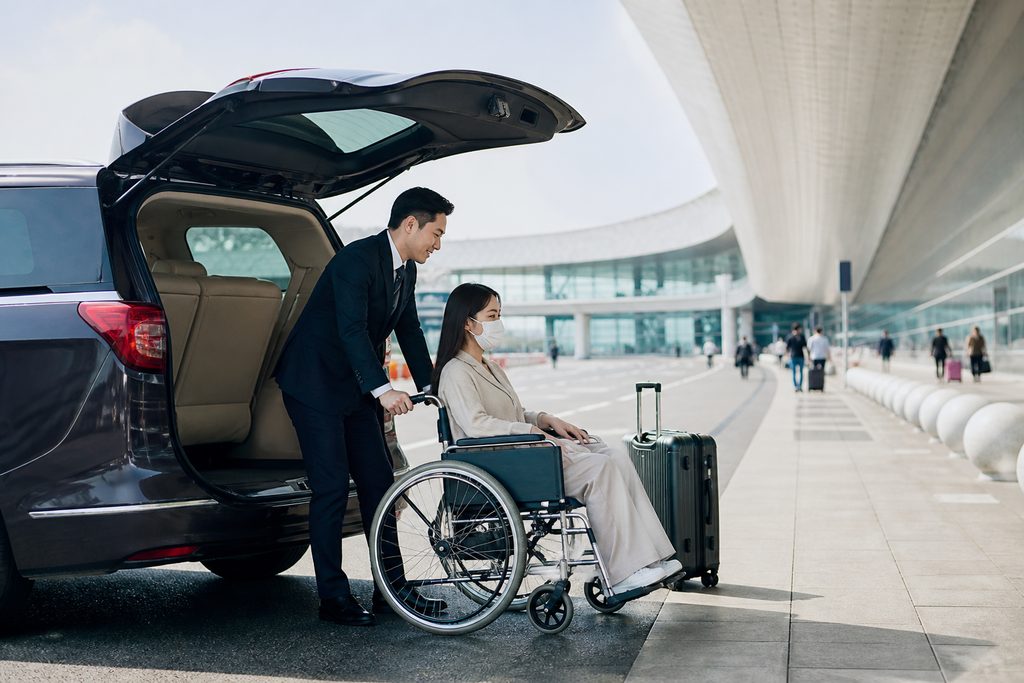
A patient leaving a U.S. hospital after major surgery typically gets wheeled to the curb by a staff member, helped into a car, and sent home. The logistics are familiar. Discharge from a hospital in Shanghai or Beijing works differently — and for an international patient still recovering, the gap between “medically cleared” and “safely seated at the departure gate” can feel wide. A standard taxi queue outside a Chinese public hospital at 4 p.m. is not where you want to be two days after a knee replacement. We have coordinated post-discharge transfers for patients from over 30 countries. The single most common question we hear is not about the hospital bill. It is: “How do I actually get to the airport?”
Key Takeaways
- A private medical transfer from hospital to airport in major Chinese cities costs approximately $200 round-trip, a fraction of what similar medical transport commands in North America or Europe.
- Wheelchair-accessible vans with bilingual drivers exist in Beijing, Shanghai, and Guangzhou — but they rarely appear on English-language booking platforms and almost never accept last-minute requests.
- No Chinese public hospital routinely provides airport transfer as part of discharge. The responsibility falls entirely on the patient. Language barriers turn a simple car booking into a genuine safety risk if your driver cannot understand “go slower” or “I feel nauseous.”
- The right vehicle, the right timing, and a driver who knows both the hospital’s discharge workflow and the airport’s international departure layout are what separate a smooth exit from a dangerous scramble.
The Problem: Discharge Day Is the Wrong Day to Figure Out Transport
Chinese public hospitals operate on a throughput model that most Western patients have never encountered. A top-tier facility like Peking Union Medical College Hospital handles over 15,000 outpatient visits daily. Inpatient beds turn over fast. When a surgeon signs your discharge papers, the expectation is that you vacate the room within hours — not because anyone is unkind, but because the bed is needed for the next patient who may have traveled 1,000 kilometers to get there. You are medically stable. You are also likely tired, possibly in pain, and standing in a hallway where every sign is in Chinese characters.
Hailing a Didi (China’s Uber) on your phone requires a Chinese payment app. Street taxis are abundant but drivers rarely speak English. If you have limited mobility, a standard sedan back seat is an obstacle course. And if your flight departs from Beijing Capital International Airport’s Terminal 3 — one of the largest airport buildings on earth — the walk from curbside drop-off to your check-in counter can exceed 800 meters. Doing that walk on post-surgical legs is not a test of resilience. It is a bad decision.
Why a Pre-Arranged Airport Transfer After Hospital Discharge in China Changes the Equation
The core issue is not the distance between hospital and airport. In most major cities, that drive is 40 to 70 minutes. The issue is the sequence of micro-logistics that start the moment your hospital room door closes behind you: luggage, mobility aids, medication that requires timing, a driver who understands you, and an airport navigation plan. A pre-booked transfer collapses all of that into a single coordinated step. Here is what that looks like in practice.
Vehicle Type Matters More Than You Think
A standard sedan works for a healthy traveler with one suitcase. It does not work for someone who cannot bend their knee past 90 degrees or who needs to keep a surgical site elevated. For patients discharged after orthopedic procedures, spinal surgery, or abdominal operations, a wheelchair-accessible van or a spacious MPV with flat-reclining rear seats is the difference between a tolerable ride and genuine agony. These vehicles exist in Beijing, Shanghai, and Guangzhou. The challenge is booking one through an English-language channel that confirms the vehicle spec in advance — not just “a big car” but a specific model with measured rear-cabin dimensions.
The Driver Is Part of the Clinical Safety Net
A bilingual driver who has done hospital-to-airport runs before knows things that a standard rideshare driver does not. They know that Pudong International Airport’s international terminal requires a longer walk from drop-off than the domestic terminal. They know that some hospitals have multiple discharge exits and that the one near Building 3 is closed for construction. They understand “please pull over, I need to take my anti-nausea medication.” In a medical transfer context, the driver is not just operating a vehicle. They are the only English-speaking person between your hospital bed and the check-in counter. That matters.
Airport Transfer After Hospital Discharge China Price: What to Expect
The phrase “airport transfer after hospital discharge China price” gets searched because patients want a real number — not a contact form, not a callback, not a “it depends.” Here are the real numbers, based on current market rates in the three cities where international patients most frequently receive treatment.
| City | Vehicle Type | One-Way Price (USD) | Round-Trip Price (USD) | Wheelchair Access |
|---|---|---|---|---|
| Beijing | Standard Sedan | $80–120 | $160–200 | No |
| Beijing | Wheelchair-Accessible Van | $150–200 | $250–350 | Yes |
| Shanghai | Standard Sedan | $70–110 | $140–200 | No |
| Shanghai | Wheelchair-Accessible Van | $140–190 | $240–330 | Yes |
| Guangzhou | Standard Sedan | $60–100 | $120–180 | No |
| Guangzhou | Wheelchair-Accessible Van | $130–180 | $220–300 | Yes |
These figures reflect private-hire vehicles with an English-speaking driver, booked in advance. The round-trip price covers the pickup from hospital and the return of the vehicle — not a second passenger trip. Prices fluctuate during Chinese national holidays, particularly the week of Spring Festival (late January or February) and the first week of October (Golden Week), when driver availability drops and rates can rise 30–50%. The private medical transfer service Shanghai cost tends to sit at the higher end of the sedan range because Pudong International Airport is farther from most central hospitals than its Beijing counterpart.
For context: a comparable non-emergency medical transport van in the United States typically charges $300–500 for a one-way trip of similar distance. The structural reason for the difference is straightforward — driver labor costs and vehicle operating expenses in China are lower, not because safety standards are lower. The vehicles used for our coordinated transfers are late-model Buick GL8s or Mercedes V-Class vans with commercial insurance, not repurposed private cars.
How to Arrange Transport from Hospital to Airport in China: The Step-by-Step Timeline
Searching “how to arrange transport from hospital to airport China” implies you want a sequence you can follow. Here is the sequence that works, based on hundreds of patient discharges we have coordinated.
72 Hours Before Discharge: Confirm the Date and Time Window
Chinese surgeons typically give a discharge date 1–2 days in advance, but the exact time of day is often a moving target. Morning rounds happen between 8:00 and 10:00 a.m. The discharge paperwork and final billing usually complete by 11:00 a.m., but can slip to 2:00 p.m. if the pharmacy is backed up or the billing office has a queue. Do not book a transfer for a hard 10:30 a.m. pickup. Book a window: 11:00 a.m. to 1:00 p.m., with the driver on standby and reachable by phone. Tell your nurse coordinator the day before that you have a car arranged and ask her to call the driver 30 minutes before you are actually ready to leave.
48 Hours Before Discharge: Book the Vehicle and Specify Medical Needs
This is when you answer the question “can I book a wheelchair van after surgery in Beijing” — and the answer is yes, but only with advance notice. Wheelchair-accessible vans are a niche vehicle type in China. There are not hundreds of them idling at the airport. The major providers in Beijing and Shanghai maintain small fleets, and they book out. Reserve yours at least two days ahead. When you book, specify: the patient’s mobility status (walking unassisted, walking with crutches, requires wheelchair), the number of accompanying family members, luggage count, and any special positioning needs (cannot sit upright, needs leg extended, etc.).
24 Hours Before Discharge: Reconfirm and Share Flight Details
Send the driver your flight number and departure terminal. This sounds obvious, but international patients sometimes book transfers to the wrong terminal because they assume all international flights leave from one building. At Beijing Capital Airport, Terminal 2 and Terminal 3 both handle international departures depending on the airline. A wrong-terminal drop-off adds 20–30 minutes of shuttle bus transit. Confirm the terminal with your airline, not with Google Maps.
Discharge Day: Final Hospital Coordination
The driver arrives at the agreed window and waits at the hospital’s designated pickup area — usually the main lobby entrance or the inpatient building exit. A bilingual coordinator calls the nursing station 15 minutes before the driver’s arrival to confirm the patient is discharged and ready. The driver helps with luggage and any mobility transfer. The vehicle departs. The drive to the airport includes a pre-arranged rest stop if needed — something a taxi meter does not accommodate.
Medical Escort to Airport China Packages: When a Driver Is Not Enough
Some patients search for “medical escort to airport China packages” because they sense that a driver alone cannot handle their situation. They are often right. A medical escort is a bilingual professional — not a doctor, but someone trained in patient transfer — who accompanies you from the hospital room all the way through airport security and to the gate. This is relevant for several specific scenarios.
A patient traveling alone after surgery has no one to carry bags, handle check-in, or advocate if something goes wrong. A patient on strong pain medication should not be navigating a massive international terminal unassisted. An elderly patient who speaks no Chinese and limited English needs someone to bridge communication with airline staff. Medical escort packages typically bundle the vehicle transfer with a companion who stays with the patient for 2–4 hours at the airport. Pricing for a bundled medical escort and transfer package starts around $350–500 depending on city, distance, and time required at the airport.
This is not a luxury add-on. For a post-surgical patient traveling solo, it is a safety decision. Airline wheelchair services operate inside the terminal — they do not help you out of the car, carry your medication bag, or communicate with the check-in agent about your need for an aisle seat near the lavatory. A medical escort does all three.
International Patient Airport Transfer China: The Pre-Flight Medical Checklist
An international patient airport transfer in China ends at the terminal curb, but the patient’s journey continues through security, onto a long-haul flight, and home. What happens between the car door and the aircraft door is worth planning.
Medication and Documentation
Carry all post-operative medications in your hand luggage, not checked baggage. Bring a copy of your discharge summary in both Chinese and English — Chinese hospital discharge summaries are typically written in Chinese, and an English translation may not be provided unless you request it. This document is what you will show to your doctor at home and, if necessary, to airport security if you are carrying liquid medications, syringes, or controlled substances. Also carry a letter from your treating surgeon stating that you are fit to fly. Some airlines require this for passengers who have undergone surgery within the preceding 10–14 days. Check your airline’s medical clearance policy before discharge day.
Compression and Mobility
Long-haul flights after surgery carry a well-documented risk of deep vein thrombosis. The risk is elevated after orthopedic procedures on the lower limbs, abdominal surgery, and any operation that reduces mobility. Wear compression stockings if prescribed. Set a timer to stand and walk the aisle every 90 minutes if your mobility allows. Request an aisle seat at check-in — do not wait until you board to discover you are in a window seat and cannot get up without climbing over two strangers.
Airport Wheelchair Services
Every major international airport offers complimentary wheelchair assistance from check-in to gate. Request this service through your airline at least 48 hours before departure. The wheelchair attendant will push you through security and to the gate. But understand the limits: the attendant does not speak your language in most cases, will not stop at a pharmacy or restaurant, and will not wait with you if your flight is delayed by two hours. The service gets you from Point A to Point B inside the terminal. It does not provide companionship, translation, or medical oversight. For patients who need those things, the medical escort option described above fills the gap.
Frequently Asked Questions
You can, and many patients do. But if you cannot communicate in Chinese, cannot bend easily into a low sedan seat, or are carrying medical equipment, a standard taxi introduces risks that are easy to avoid with a pre-booked transfer. Ride-hailing apps like Didi require a Chinese bank card or Alipay account linked to a Chinese phone number — something most short-term international patients do not have. Cash payments are possible in taxis, but drivers rarely carry change for large bills, and the language barrier makes explaining your destination terminal difficult.
This is why booking through a service that includes standby time matters. Most private transfer providers include 60–90 minutes of complimentary waiting time from the scheduled pickup. After that, an hourly waiting fee applies — typically $15–25 per hour. A good coordinator will be in phone contact with the nursing station and can adjust the driver’s arrival time dynamically. If you book a non-medical car service with a hard pickup time and no flexibility, a 90-minute discharge delay can mean the driver leaves and you are back to square one.
Ask your surgeon. If you can sit upright with your knees bent at 90 degrees for the duration of the drive, a sedan is fine. If you have had a hip replacement, knee surgery, spinal fusion, or any procedure that restricts your sitting position, a van with a flat or reclining surface is strongly advisable. The drive to the airport is 40–70 minutes. Sitting in the wrong position for that long can cause pain, swelling, and in rare cases, compromise the surgical site. The cost difference between a sedan and an accessible van is roughly $60–100. That is a small premium for not undoing a week of recovery in one car ride.
Your Next Step
Discharge day logistics are not a footnote to your treatment. They are the final step in a process you traveled thousands of miles to complete, and getting them right protects the outcome you came for. Our team at China Medical Services coordinates the full discharge-to-departure sequence for international patients at hospitals across 37 cities — from booking the right vehicle with a bilingual driver to arranging a medical escort who stays with you through airport security. We do not provide medical treatment, and we do not make clinical decisions. We handle the logistics so you can focus on recovery. If you are planning treatment in China and want to understand your transfer options before you arrive, we can walk you through what is available at your specific hospital and airport. Contact our coordination team — no commitment, just a clear plan.
For more medical information and treatment options in China, visit chinamedservices.com (China Medical Services).
