Airport Transfer: Your Questions Answered for Medical Travelers
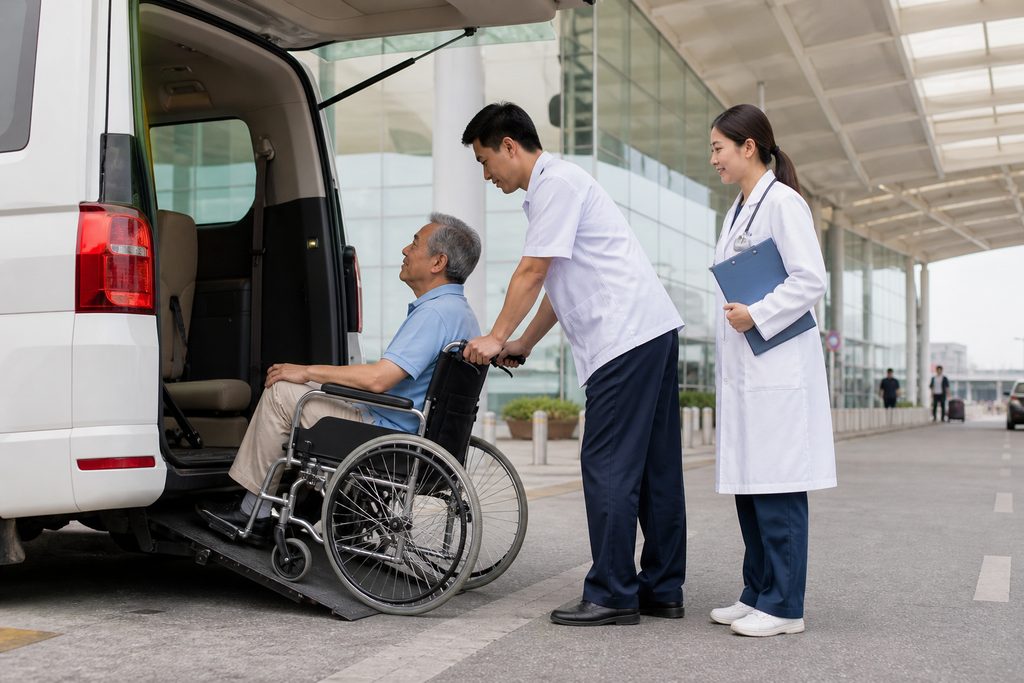
According to the China National Tourism Administration, over 300,000 international patients traveled to China for medical care in 2023. Nearly every one of them landed at an airport first. And the first question most ask is not about surgery or specialists — it is about how to get from the gate to the hospital bed. An airport pickup service for medical tourism China is not a luxury add-on. It is the first clinical decision you make on Chinese soil. Get it wrong, and you start treatment exhausted, lost, and late. Get it right, and the entire journey feels manageable.
This article answers the practical questions patients ask us before they book a flight. No marketing fluff. Just how transfers work, what they cost, what is included, and where things go wrong.
Airport Transfer for Medical Travel: The Short Answer
Yes, airport transfers are available for medical travelers in China. A private car service from Shanghai Pudong International Airport (PVG) to a downtown hospital typically costs $80–150 one way, or $200 round-trip when booked as part of a coordinated medical visit. Beijing Capital International Airport (PEK) transfers run $70–130 depending on distance and vehicle type. Public options exist — the Maglev, metro, taxi — but they demand navigation in Chinese and physical stamina you may not have after a long-haul flight.
The caveat: not all transfers are equal. A standard hotel shuttle is not a medical transfer. A medical transfer may include a bilingual coordinator, wheelchair assistance, hospital check-in support, and luggage handling. You need to know exactly what you are paying for.
Who This Transfer Service Is Right For — and Who It Isn’t
Most patients arriving for treatment benefit from a pre-arranged pickup. But some do not need it. Be honest about your situation.
Good candidates for a private medical transfer:
- First-time visitors to China who do not read or speak Mandarin
- Patients arriving after surgery in another country, or in pain or reduced mobility
- Elderly patients traveling alone or with a single companion
- Families landing late at night or during peak holiday periods
- Patients carrying medical records, imaging discs, and medication that should not be left in a taxi
Who should skip it:
- Seasoned travelers fluent in Chinese and familiar with the metro system
- Patients staying at international hotels with confirmed, reliable shuttle service
- Travelers on a very tight budget who are physically fit and traveling light
If you land at PVG at 5 a.m. after a 14-hour flight and need to reach a hospital in Pudong by 8 a.m., the math is simple. A private transfer is the only rational choice.
The Options, Compared
You have four realistic ways to get from the airport to your hospital or hotel. Here is the honest comparison.
| Option | Cost (USD) | Time to Downtown | Language Support | Best For |
|---|---|---|---|---|
| Metro / Maglev | $1–8 | 30–70 min | None | Fit, fluent travelers |
| Taxi (official queue) | $40–80 | 45–90 min | Minimal | Budget-conscious patients |
| Ride-hailing app (Didi) | $35–75 | 45–90 min | App-based, partial | Travelers with Chinese SIM |
| Private medical transfer | $70–150 | 40–75 min | Full bilingual | Patients needing support |
The metro is cheap. It is also crowded, requires multiple transfers, and has no English signage at every station. A taxi works if you have the hospital address printed in Chinese characters. But a private transfer — especially one arranged through a medical coordination service — includes a driver who knows which hospital entrance to use, which building to drop you at, and a coordinator who can call the hospital if your flight is delayed. That is the difference between a ride and a handoff.
Airport Pickup Service for Medical Tourism China: What to Ask Before You Book
You have read the comparison. Now the practical checklist. When you contact any provider about an airport pickup service for medical tourism China, ask these five questions.
First, ask whether the driver waits inside the arrivals hall with a name sign or parks outside and calls you. This matters. At PVG and PEK, the arrivals area is chaotic. A driver holding a sign with your name is worth the extra cost.
Second, confirm the vehicle. A standard sedan cannot fit a patient in a wheelchair plus two suitcases and a companion. If you need a minivan or accessible vehicle, say so before you land.
Third, ask about flight delay policy. Your flight will be delayed. It happens. A good service monitors your flight number and adjusts pickup time automatically. A bad service charges you a waiting fee after 30 minutes.
Fourth, clarify what “transfer” includes. Does the driver just drop you at the hospital gate? Or does someone walk you to the registration desk, help with paperwork, and translate your first conversation with the intake nurse? The second option costs more but saves hours.
Fifth, confirm payment method. Some drivers accept cash only. Others take WeChat or Alipay. International credit cards are rarely accepted for ad-hoc transfers. If you book through a medical coordination service, the transfer fee is usually included in your invoice and paid in advance.
What Airport Transfers Cost — and What Drives the Price
No top-tier public hospital in China offers free airport pickup as a standard service for international patients. Some private international hospitals — such as United Family Healthcare or Jiahui International Hospital — may arrange a transfer for patients booking certain packages, but it is usually billed into the package cost, not free. The honest answer: if a free transfer is your deciding factor, you are optimizing for the wrong thing. Choose the hospital based on medical expertise, not transportation perks. You can arrange a transfer separately for $70–150.
A professional transfer service monitors your flight number in real time. If your flight is delayed, the pickup time adjusts automatically. If you booked through a medical coordination service, a coordinator will contact the driver and the hospital to update your arrival time. If you booked a private driver directly and did not provide your flight number, you may be charged a waiting fee or lose the booking. Always provide your flight number when you book.
Sometimes, but not always. Independent drivers often prefer cash in yuan or payment through WeChat or Alipay. International credit cards are not widely accepted for ad-hoc transfers. If you book through an international medical coordination service, you can usually pay in advance in USD by card or wire transfer. That removes the stress of finding an ATM or currency exchange immediately after landing.
Your Next Step
Airport transfers are a small line item in a medical travel budget. But they set the tone for everything that follows. A smooth arrival means you start your consultation calm and on time. A chaotic arrival means you start behind.
Our team at China Medical Services coordinates airport transfers as part of a broader medical travel plan. We are not a hospital and we do not provide medical advice or diagnoses. What we do is handle the logistics — hospital matching, appointment coordination, bilingual companions, and yes, getting you from the airport to the right door. If you are planning treatment in China and want the first hour on the ground to go smoothly, start with a conversation. Tell us your arrival city, your hospital, and your mobility needs. We will tell you exactly what a transfer would cost and whether it makes sense for your situation.
Traveling for medical care is hard enough. Arriving should not be the hardest part.
Frequently Asked Questions
Yes. The hospitals used for international patients are JCI-accredited and follow the same international safety standards as top hospitals in the US and Europe. Surgical teams perform high volumes of procedures — often more than their Western counterparts — which studies show leads to better outcomes.
Costs vary by procedure and hospital, but international patients typically save 40-80% compared to US prices — even when factoring in travel and accommodation. A consultation with our team will give you an exact, all-inclusive quote with no hidden fees.
Send us your existing medical reports to get started. We handle everything from hospital selection and appointment scheduling to visa assistance and post-operative recovery planning. Your medical records are reviewed by the specialist before you even book a flight.
For more medical information and treatment options in China, visit chinamedservices.com (China Medical Services).
