Alcohol and Fertility in China: How It Works, Tests, and Costs
Alcohol and Fertility in China: How It Works, What Treatment Costs, and Where to Start
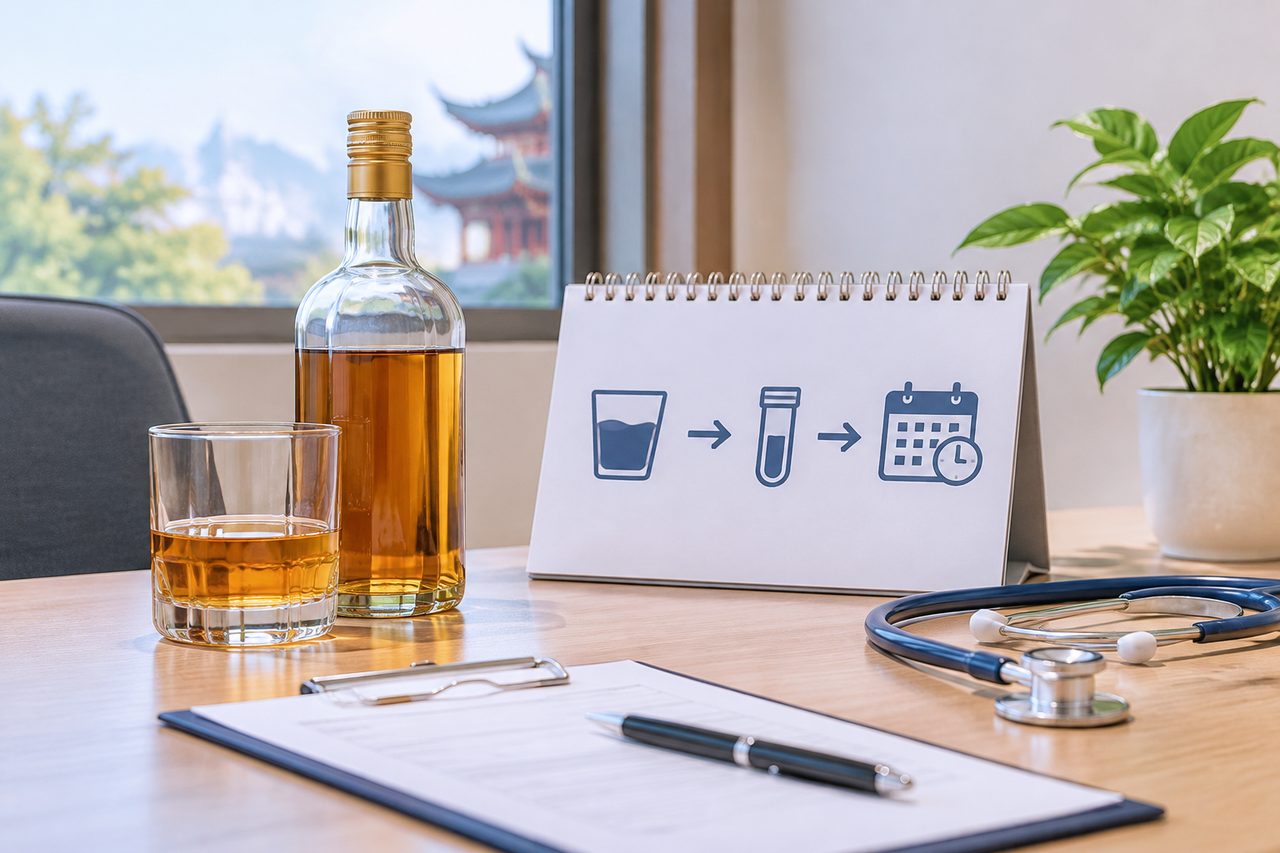
There is no single procedure in China that “treats” alcohol-related infertility. What exists is a staged process: establish how much you drink and over what period, measure the damage through semen analysis, hormone panels, liver markers and ovarian reserve testing, then treat whatever is actually measurable — varicocele, hormonal deficiency, sperm DNA fragmentation, erectile dysfunction, or a partner’s separate fertility factors. Alcohol and fertility treatment cost China searches usually assume a fixed price list; in reality the first meaningful number is a diagnostic workup, and treatment costs only become concrete after that workup is read by a specialist. This article explains how the assessment works, what the options are, what is known about alcohol’s effect on male and female fertility, and what a realistic budget looks like.
Alcohol and Fertility Treatment Cost China: The Short Answer
A diagnostic fertility workup at a Chinese public tertiary hospital typically runs from a few hundred dollars to roughly $1,000 depending on how many tests are ordered, and the first consultation is often far less. Treatment costs diverge sharply after that: medication cycles, varicocele repair, intrauterine insemination and IVF sit in completely different price bands, and none of them is priced as a package until a clinician has reviewed your results. Anyone quoting you a total before seeing your semen analysis, hormone panel and history is guessing.
The caveat that matters: the most effective intervention for alcohol-related fertility impairment is reducing or stopping drinking, and no clinic in China or anywhere else can sell you a substitute for that. Medical treatment addresses the damage that persists after drinking changes, or the separate causes that alcohol may be masking.
Who This Is Right For — and Who It Isn’t
Seeking a Chinese fertility assessment makes sense when you want faster access to a full panel of tests, a second read on results you already have, or a cost structure that makes comprehensive workup affordable. It makes less sense if the underlying issue is untreated heavy drinking that you are not yet ready to address.
Typically a reasonable fit:
- Couples who have tried to conceive for 12 months (6 months if the woman is over 35) without success and want a complete, structured workup.
- Men with abnormal semen parameters on an existing report who want a specialist review and a plan.
- People with a documented history of regular or heavy drinking who want their fertility status measured rather than assumed.
- Patients who already have records from home and want a written second opinion before committing to treatment.
Probably not the right first step:
- Anyone with active alcohol dependence. Withdrawal can be medically dangerous and should be managed by an addiction medicine service locally, before fertility planning.
- Anyone with significant liver disease — this needs hepatology input, not a fertility clinic.
- Couples where neither partner has had basic testing. A local semen analysis and hormone panel is cheaper than an international trip.
- People expecting a guaranteed pregnancy outcome. No clinic can offer that, and any that does should be avoided.
The Options, Compared
Below is how the realistic paths differ. Figures are indicative ranges for public tertiary hospitals and private international clinics in China; they vary by hospital, city and case complexity, and they exclude travel and accommodation.
| Path | What it involves | Typical cost band (USD) | Time to a plan | Best suited to |
|---|---|---|---|---|
| Local testing at home | Semen analysis, hormone panel, basic review | Low, varies by country | Days to weeks | Anyone who has not yet had basic tests |
| Written second opinion from a Chinese specialty team | You send existing reports; a specialist reviews and replies in writing | From $300–500 | Days after records arrive | People with results already in hand |
| Video consultation with a Chinese hospital team | Records plus a live discussion of symptoms, goals and options | From $100–800 depending on tier | Usually within days of booking | Those wanting to hear recommendations before traveling |
| In-person workup in China | Full panel, imaging if indicated, face-to-face specialist review | Several hundred to about $1,000 for diagnostics | Days to a couple of weeks | People ready to proceed if treatment is indicated |
| Treatment (medication, surgery, IUI, IVF) | Determined entirely by diagnosis | Wide range; quoted only after workup | Weeks to months | Patients with a confirmed, treatable diagnosis |
For most readers, the honest recommendation is to start at the top of that table and work down. The written second opinion row is where international patients get the most value for the least commitment, because it converts a vague worry into a specific question a specialist can answer.
Does Drinking Alcohol Affect Fertility in Men — and What the Evidence Shows
The question “does drinking alcohol affect fertility in men” has a more nuanced answer than most online summaries suggest. Heavy chronic drinking is clearly associated with reduced testosterone, testicular atrophy, impaired sperm production and lower libido. Moderate drinking is where the evidence becomes inconsistent: some studies find measurable effects on semen volume, morphology and DNA integrity, others find none at levels below roughly one to two drinks per day. What is fairly consistent is that effects are dose- and duration-dependent, and that they are at least partly reversible after sustained abstinence — though the timeline for recovery varies and is not predictable in an individual case.
In women, regular heavy drinking is associated with ovulatory disruption, altered hormone levels and reduced conception probability, and drinking during pregnancy carries well-established risks to the fetus. For women, the clinical advice is simpler and firmer: stop or sharply reduce before attempting conception.
What the Assessment Actually Looks Like in China
This is the part readers of this exact question still need after the comparison table, and it is where expectations most often go wrong. Chinese public tertiary hospitals generally do not allow a foreign patient to book a routine outpatient slot in advance from overseas. Registration typically happens on the day, in person, and any procedure follows an in-person consultation. That is the standard rule, not a special obstacle for foreigners.
What can be arranged ahead of time is access through a hospital’s international or VIP channel, which provides senior specialists and English-language support at roughly 1.5 to 2 times the standard-channel price. For patients who want a specific appointment locked in before flying, that is the realistic route.
A typical workup for alcohol-related fertility concerns includes:
- For men: semen analysis (sometimes repeated, since results fluctuate), sperm DNA fragmentation testing where available, testosterone and related hormone panel, and liver function markers if drinking history warrants.
- For women: ovarian reserve testing (AMH, antral follicle count), cycle hormone panel, thyroid function, and pelvic ultrasound.
- For both: a structured drinking history — quantity, frequency, duration — which is a clinical tool, not a moral judgment, and which you should answer honestly.
Results are usually available within days for bloodwork and semen analysis; some specialized tests take longer. Only after these are read does a treatment conversation become meaningful.
What Treatment Costs After the Workup
Treatment pricing in China is genuinely lower than in the United States for comparable procedures, but the gap varies enormously by procedure and by whether you use a standard or international channel. Rather than publish figures we cannot verify for your case, here is what drives the number:
- Diagnosis. Medication for hormonal deficiency is inexpensive; varicocele repair is a surgical cost; IVF is in a different category entirely.
- Channel. International/VIP departments cost roughly 1.5–2 times standard channels for the same specialist input.
- Number of cycles. Any assisted reproduction pricing is per cycle, and cycles are not guaranteed to succeed.
- City and hospital tier. A top-ranked hospital in Beijing or Shanghai will price differently from a provincial center.
Public hospitals in China generally require prepayment, with insurance reimbursement handled afterward in your home country — and many international policies exclude or limit fertility treatment, so check before assuming coverage. Private international hospitals more often bill insurers directly. For patients who want to understand which institutions sit at the top of the relevant specialty, our department rankings by specialty list the leading hospitals for reproductive medicine, and the directory of top-ranked Chinese hospitals by city shows how they cluster geographically.
Practical Considerations for International Patients
Records. Bring every prior fertility test, in English where possible. A specialist reading three years of semen analyses can say far more than one reading a single report.
Visa. Medical travel to China uses the S2 visa, annotated for medical treatment; stays beyond 180 days use S1, and accompanying family members apply for S2 as well. Requirements change, so confirm current documentation with the nearest Chinese embassy or consulate and with the treating hospital, which will need to issue supporting letters. Approval is never guaranteed.
Language. China’s top hospitals see enormous daily patient volumes, and navigation without Mandarin is genuinely difficult — registration queues, payment counters and department locations are not designed for non-Chinese speakers. This is the single most common practical complaint from international patients, and it is solvable with support but not by ignoring it.
Follow-up. Anything started in China — medication, monitoring, a post-operative review — needs a plan for continuation after you return home. Ask explicitly who will manage follow-up and what records you will leave with.
Frequently Asked Questions
Not in the sense of undoing the exposure. Clinics can identify and treat specific, measurable problems — hormone deficiency, varicocele, sperm DNA fragmentation, ovulatory dysfunction — and can offer assisted reproduction where natural conception is unlikely. Sustained reduction or cessation of drinking remains the intervention with the strongest evidence base, and recovery timelines vary by individual.
Budget for diagnostics first, not treatment. A full workup at a Chinese public tertiary hospital typically falls in the range of several hundred to about $1,000, excluding travel and accommodation, and a written second opinion on records you already have starts at $300–500. Treatment quotes only become meaningful after those results exist, and any figure given before then should be treated as provisional.
It depends on what you need. Public tertiary hospitals generally offer the deepest specialist expertise and the lowest procedure costs, but routine appointments are typically same-day, in person, and not bookable from overseas. Private international hospitals offer English-speaking staff, insurance direct billing and easier scheduling, at higher prices. Many patients use a private clinic for coordination and a public hospital’s international department for the specialist review itself.
That is a real and reasonably common outcome, and it is not a dead end. Unexplained infertility is a recognized diagnosis with its own management pathway, and it usually means the couple’s combined factors — timing, age, egg and sperm quality — rather than a single correctable defect. A specialist can outline the options honestly, including the possibility that assisted reproduction is the more efficient route.
Your Next Step
The core message is simple: alcohol’s effect on fertility is real but dose-dependent and partly reversible, and the way to know where you stand is a structured workup rather than a guessed diagnosis or a package price. Our team is not a hospital and does not diagnose or treat anyone; we help international patients understand their options, obtain written second opinions from Chinese specialty teams, and coordinate appointments, interpretation and travel logistics when they decide to come. If you already have test results, sending them for a written review is the lowest-commitment way to get a real answer — you can start with a free consultation with our patient coordination team and decide from there.
This article is for general information only and is not medical advice. Fertility concerns, alcohol use and any treatment decisions should be discussed with a qualified clinician who can review your individual history.
For more medical information and treatment options in China, visit chinamedservices.com (China Medical Services).
