Amputee Rehabilitation and Prosthetic Training China: Your Path to Walking Again
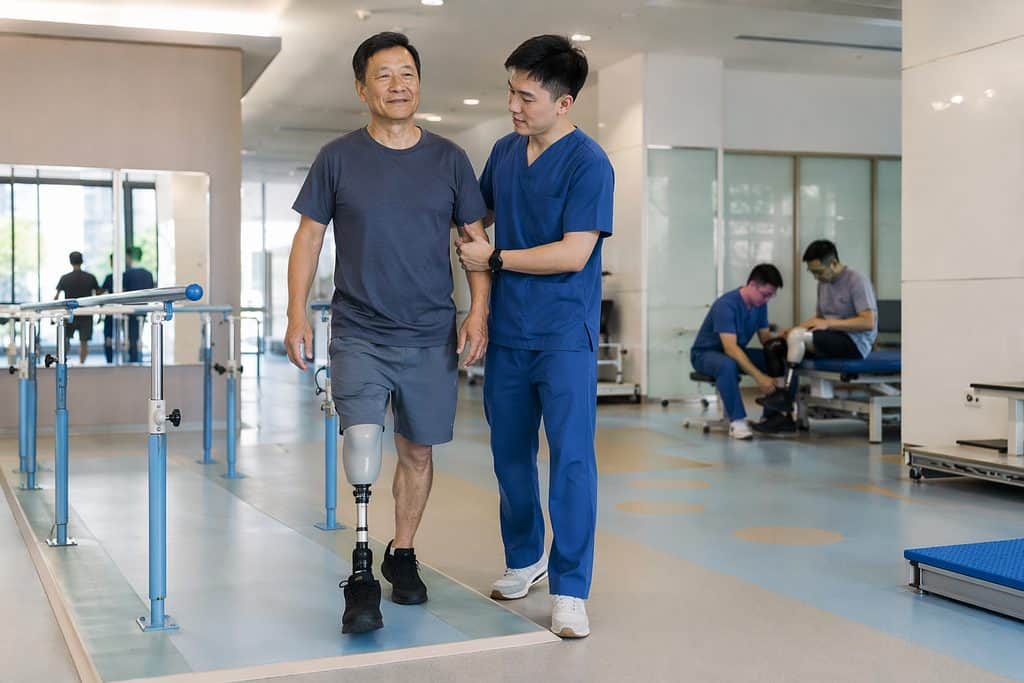
Key Takeaways
- Amputee rehabilitation cost in China typically ranges from 30% to 70% less than comparable programs in the United States or Western Europe, with prosthetic component costs following a similar pattern.
- China’s top rehabilitation hospitals manage prosthetic training caseloads that dwarf most Western centers — a single major department may fit and train over 1,000 new amputees annually, building a depth of clinical experience that directly shapes outcomes.
- Language barriers, visa logistics, and the sheer scale of Chinese public hospitals create genuine friction for international patients — navigating this system without local support is not a minor inconvenience, it is a structural obstacle.
- Prosthetic training is not a quick process. Even with intensive daily therapy, a leg amputee should expect a minimum of 2 to 6 weeks of dedicated gait training before achieving functional independence — and that timeline depends heavily on age, amputation level, and overall health.
The Problem: Rehabilitation That Costs More Than the Prosthesis Itself
Losing a limb reshapes every assumption about your body and your future. The surgery is one event. What follows — learning to stand, balance, walk, climb stairs, navigate uneven ground — that is a months-long negotiation between your brain, your residual limb, and a mechanical device that was not born with you. And for many patients in North America and Europe, the financial burden of this rehabilitation becomes its own kind of trauma.
In the United States, a below-knee prosthetic leg costs between $10,000 and $70,000 depending on componentry. Above-knee systems can exceed $100,000. But the device is only part of the equation. Intensive inpatient prosthetic training at a specialized rehabilitation hospital often runs $1,500 to $3,000 per day. A three-week program can easily reach $40,000 to $60,000 — and that is before factoring in the prosthesis itself. Insurance may cover portions. It may not. Many patients face deductibles and out-of-pocket maximums that leave them choosing between their limb and their savings.
The wait times compound the injury. In Canada and the UK, publicly funded systems may schedule initial prosthetic fitting 3 to 6 months after amputation surgery. Muscles atrophy. Joints stiffen. The window for optimal gait training narrows. Every week of delay makes the eventual rehabilitation harder and the long-term outcome less certain. This is not a system failure — it is a capacity problem. There simply are not enough specialized prosthetic training beds to meet demand.
Who We Are
China Medical Services is not a hospital. We do not provide medical treatment, clinical diagnoses, or prosthetic devices. Our team functions as your logistical architects — we bridge the gap between you and China’s top-tier rehabilitation hospitals. We match your specific amputation level, functional goals, and timeline to the right clinical department, coordinate appointments, arrange bilingual medical companions, and handle the visa and travel logistics that would otherwise consume weeks of your energy. Think of us as the people who make sure you spend your time healing instead of fighting bureaucracy.
Why China’s Prosthetic Training Model Delivers Results
Clinical Volume Builds Pattern Recognition
There is a principle in rehabilitation medicine that is uncomfortable to state plainly but impossible to ignore: the clinician who sees 500 amputees a year sees things the clinician who sees 50 does not. Gait deviations that a less experienced therapist might miss — a subtle hip hike, a trunk lean that compensates for a poorly aligned socket — become obvious when you have seen them hundreds of times. China’s top rehabilitation centers operate at a scale that makes this depth of experience almost inevitable.
The Rehabilitation Hospital affiliated with China Rehabilitation Research Center in Beijing, for instance, manages one of the largest amputee caseloads in Asia. Departments in Shanghai and Guangzhou similarly process prosthetic fittings and training programs at volumes that would be extraordinary by Western standards. This is not a claim about superior skill — it is a structural reality. When your daily patient roster includes multiple new amputees at various stages of recovery, your clinical instincts sharpen in ways that textbooks cannot replicate.
Integrated Prosthetic Fabrication and Training Under One Roof
In many Western rehabilitation models, the prosthetist who fabricates your socket works in a separate facility from the physical therapist who teaches you to walk. Communication happens through notes and phone calls. Adjustments require separate appointments, sometimes days apart. The Chinese model at major rehabilitation hospitals tends to collapse these functions into a single clinical team. The prosthetist and the physical therapist work on the same floor, often seeing the patient together during gait training sessions.
This matters because socket fit is not a one-time event. As your residual limb changes volume throughout the day — and as your gait pattern evolves over weeks of training — the socket needs iterative adjustment. When the prosthetist can observe you walking and make modifications on the same day, the feedback loop tightens dramatically. Patients spend less time in poorly fitted sockets and more time building functional strength. This operational integration is not unique to China, but it is more consistently implemented at the major rehabilitation centers here than in many fragmented Western systems.
Cost Structure Without the Overhead Burden
Let us address the obvious question directly: how can amputee rehabilitation cost in China be substantially lower without compromising quality? The answer lies in structural economics, not shortcuts. Chinese hospital systems operate with lower labor costs across the board — not because clinicians are paid poorly by local standards, but because the overall wage structure in China’s healthcare sector differs from that of the US or Western Europe. A senior physical therapist’s salary, a hospital bed’s nightly rate, the administrative overhead of running a rehabilitation ward — these line items simply cost less in China’s economy.
Prosthetic components themselves — the microprocessor knees, the carbon fiber feet, the silicone liners — are often manufactured in the same global supply chains that feed Western markets. Ottobock, Össur, and other major manufacturers have significant presence in China. The components are the same. The fitting expertise is comparable. But the clinical labor surrounding the fitting costs less. For a patient paying out of pocket, a comprehensive prosthetic training program including device fitting, daily physical therapy, and inpatient accommodation may run $15,000 to $35,000 in China — against $50,000 to $100,000 or more for an equivalent program in the United States. These numbers vary by hospital, amputation level, and component choice. But the directional difference is real and substantial.
What You Need to Know Before Going Alone
The clinical advantages are real. So are the barriers. Walking into a Chinese rehabilitation hospital without preparation is not brave — it is a recipe for frustration. Here is what stands between you and effective treatment if you try to arrange everything independently:
- Visa Requirements Are Specific and Unforgiving: Medical treatment in China requires an S2 visa with a notation specifying the treatment purpose. This is not a tourist visa. It is not a business visa. Applying for the wrong category will get you turned away at the consulate or, worse, at the border. The application requires a formal invitation letter from the treating hospital — and obtaining that letter without a local contact inside the hospital’s international department can take weeks of phone calls and emails that go unanswered.
- Public Hospital Registration Is a Gauntlet: China’s top rehabilitation hospitals are public institutions. Their outpatient departments process thousands of patients daily. Registration counters operate in Mandarin. Payment systems — WeChat, Alipay, hospital-issued cards — assume you have a Chinese bank account and phone number. You cannot simply walk in, present a passport, and expect to see a specialist. The system was not designed for foreign patients, and it shows.
- Prosthetic Component Selection Requires Local Knowledge: Not every international prosthetic brand has equal distribution in China. Some components that are standard in the US may have limited availability or require special ordering with extended lead times. Conversely, some high-quality components manufactured in China or elsewhere in Asia may offer excellent performance at lower cost — but you would never know about them without a clinician familiar with the local supply landscape. Making an informed choice requires navigating a different product ecosystem.
How We Help You Navigate This
These barriers exist for structural reasons, not because anyone is trying to exclude foreign patients. The Chinese healthcare system was built to serve a domestic population of 1.4 billion people. Adapting it to international patients requires a layer of coordination that most hospitals do not staff internally. That is the layer we provide.
Before you travel, we translate your medical records — surgical notes, amputation level details, any comorbidities that affect rehabilitation — into clinical Chinese that a rehabilitation specialist can act on immediately. We identify the hospital department best matched to your specific needs, whether that is a dedicated amputee program in Beijing, a sports rehabilitation center in Shanghai with extensive lower-limb experience, or a facility in Guangzhou with particular expertise in upper-limb prosthetics. We coordinate the S2 visa invitation letter directly with the hospital’s international office. We book your initial consultation so you arrive to a scheduled appointment, not a registration queue.
During your treatment, a bilingual medical companion accompanies you to every session. This person is not a translator on a phone — they are physically present, interpreting between you and your physical therapist in real time as you work on weight shifting, balance exercises, and gait drills. They handle the hospital’s internal payment systems, prescription pickups, and scheduling adjustments. You focus on the hardest work you will ever do: learning to trust a new limb.
After you return home, we coordinate follow-up video consultations with your Chinese rehabilitation team and can help connect you with local prosthetists for socket adjustments — with your Chinese clinical records translated back into English for continuity of care. The goal is not to replace your home-country providers. It is to make sure the progress you made in China does not erode because of information gaps.
How Long Does Prosthetic Training Take for a Leg Amputee?
This is the question every patient asks, and the honest answer is that it depends on variables no one can predict with precision. A young, otherwise healthy below-knee amputee may achieve functional indoor walking with a basic prosthesis in 2 to 3 weeks of daily training. An older above-knee amputee with diabetes or vascular disease may need 6 to 8 weeks — or longer — to develop the core strength, balance, and cardiovascular endurance required for community ambulation.
What the Chinese rehabilitation model offers is intensity. Inpatient programs typically schedule 2 to 3 hours of direct physical therapy daily, supplemented by independent exercise sessions. This concentrated schedule compresses the learning curve. The same total therapy hours that might be spread over 3 months of outpatient visits in a Western system can be delivered in 3 to 4 weeks of inpatient training. The compression does not guarantee faster results — but it eliminates the gaps between sessions where skills degrade and motivation wanes.
Can You Walk Again After Amputation with a Chinese Prosthesis?
The short answer is yes — for the vast majority of lower-limb amputees, walking again is a realistic goal. The longer answer is that “walking again” covers a wide spectrum. Walking on level indoor surfaces with a cane is one outcome. Walking outdoors on uneven terrain, climbing stairs reciprocally, navigating crowds without conscious thought about each step — these represent progressively higher functional benchmarks. Most patients achieve the first. Many achieve the second. The third requires time, excellent prosthetic fit, and a rehabilitation team that pushes you past your comfort zone.
What matters for the “Chinese prosthesis” part of the question is component selection. If you are fitted with an Ottobock C-Leg or an Össur Rheo Knee in a Chinese rehabilitation hospital, you are walking on the same microprocessor-controlled knee joint you would receive in Munich or Minneapolis. The technology is identical. The fitting expertise — provided you are at a top-ranked rehabilitation center — is comparable. The difference is the cost of the clinical labor surrounding the device and the intensity of the training program that teaches you to use it.
Affordable Prosthetic Leg Rehabilitation in Shanghai: What to Expect
Shanghai has emerged as a major destination for international patients seeking prosthetic rehabilitation, partly because of the concentration of top-tier hospitals and partly because the city’s international infrastructure — English-speaking services, direct flights, familiar accommodation options — reduces the friction of medical travel. Hospitals like Huashan Hospital affiliated with Fudan University and Shanghai Sixth People’s Hospital maintain rehabilitation departments with specific amputee programs. The cost for a comprehensive prosthetic leg rehabilitation program in Shanghai, including inpatient accommodation, daily physical therapy, and prosthetic fitting services, typically ranges from $12,000 to $30,000 depending on amputation level and component selection. This compares to $40,000 to $80,000 for equivalent programs in major US cities.
One factor that surprises patients is the pace. Shanghai rehabilitation wards operate on a schedule that assumes you are there to work. Therapy sessions start early. Rest periods are built in, but the overall tempo is brisk. This intensity is not for everyone — patients with significant comorbidities or very recent surgery may need a slower ramp-up. But for those who can tolerate it, the concentrated approach often yields faster functional gains than the twice-weekly outpatient model common in Western systems.
How to Book a Prosthetic Training Program in China for International Patients
Booking a prosthetic training program in China as an international patient follows a sequence that is worth understanding before you make any commitments. The process starts with medical record review — the rehabilitation team needs to see your surgical history, amputation level, current residual limb condition, and any relevant imaging or vascular studies. Without this information, no reputable hospital will schedule you. Once the clinical team confirms you are an appropriate candidate, the hospital’s international department issues the formal invitation letter required for your S2 visa application.
Timing matters. You cannot schedule prosthetic training immediately after amputation surgery — the residual limb needs 6 to 12 weeks of healing and shrinkage before a definitive socket can be fitted. Some patients use this waiting period to complete pre-prosthetic exercises at home: core strengthening, hip extension, balance work on the sound limb. Arriving in China with good baseline strength and a well-healed residual limb puts you in the best position to maximize the intensive training period.
Once you arrive, expect an initial evaluation that may last a full day: physical exam, gait analysis if you have a temporary prosthesis, discussion of functional goals. Socket casting or scanning happens early in the first week. The fabrication turnaround at major Chinese centers is often faster than Western patients are used to — 3 to 5 days for a diagnostic socket is common — because the prosthetist works on-site rather than sending impressions to an external lab. This compressed fabrication timeline is one of the underappreciated advantages of the integrated Chinese model.
Frequently Asked Questions
For a comprehensive inpatient prosthetic training program including device fitting, daily physical therapy, and accommodation, patients should expect to pay between $15,000 and $35,000 in China, depending on amputation level and component selection. Comparable programs in the United States typically range from $50,000 to over $100,000. The cost difference reflects structural economics — lower clinical labor costs and hospital overhead — not compromises in device quality or therapeutic expertise. Prosthetic components from major international manufacturers are priced similarly worldwide, but the services surrounding them cost less in China’s healthcare economy.
There is no single “best” answer — the right hospital depends on your amputation level, functional goals, and any complicating medical conditions. The China Rehabilitation Research Center in Beijing manages one of the largest amputee caseloads in Asia and has specific expertise in complex cases. In Shanghai, Huashan Hospital and Shanghai Sixth People’s Hospital both maintain strong rehabilitation departments with experience treating international patients. Our team matches you to a specific department based on your clinical profile rather than recommending a one-size-fits-all institution. You can explore our database of top-ranked hospitals organized by city and specialty.
Yes — if you are treated at a top-tier Chinese rehabilitation hospital. Major international brands including Ottobock, Össur, and Fillauer maintain significant distribution networks in China. The microprocessor knees, carbon fiber feet, and silicone liners are identical to those fitted in Western hospitals. The key variable is not component availability but fitting expertise. This is why hospital selection matters. A prosthetist who fits dozens of above-knee amputees monthly will achieve better socket outcomes than one who fits a handful annually, regardless of which country they practice in. We connect you with departments where this volume-driven expertise is the norm.
Socket fit changes over time as your residual limb matures and your activity level increases. This is a normal part of prosthetic rehabilitation, not a failure of the initial fitting. Before you leave China, your clinical team will provide detailed socket specifications and fitting notes translated into English. We coordinate follow-up video consultations so your Chinese prosthetist can assess fit issues remotely and advise local adjustments. In many cases, a local prosthetist can make modifications based on these instructions. If a socket replacement is needed, the specifications from your Chinese fitting provide a starting point that reduces trial and error.
Do I need to speak Chinese to participate in a prosthetic training program in China?
At the major rehabilitation hospitals that treat international patients, some senior clinicians speak functional English. But the day-to-day reality of a Chinese rehabilitation ward — the physical therapists, the nursing staff, the administrative desks — operates in Mandarin. You cannot rely on English being spoken consistently. This is exactly why our bilingual medical companion service exists. Your companion is physically present during every therapy session, every prosthetist appointment, every administrative interaction. You focus entirely on the physical work of rehabilitation while we handle the communication layer.
For more medical information and treatment options in China, visit chinamedservices.com (China Medical Services).
