Medical Record Sync in China: Apple Health and Google Health Integration for International Patients
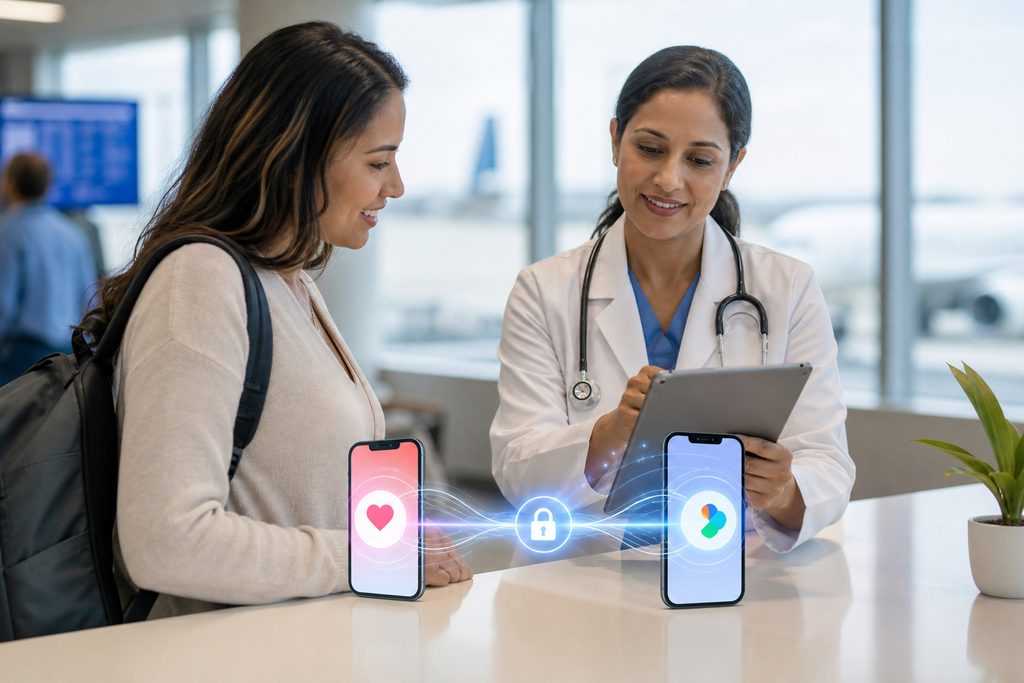
When 42-year-old Michael first heard the diagnosis, he had no idea where to start looking for treatment. A software engineer from Austin, he had been managing his hypertension data on Apple Health for years. His cardiologist in Texas could pull up every ECG, every blood pressure trend, every medication adjustment with a single tap. Then his company offered him a relocation package to Shanghai. And suddenly, those years of meticulously tracked health data felt stranded on a digital island. Could he sync Apple Health with Chinese hospital records? The short answer is no—not directly. The real answer is more nuanced, and it is where our team comes in.
Key Takeaways
- Chinese public hospital EMR systems do not natively integrate with Apple Health or Google Health APIs—direct sync is currently impossible without intermediary services.
- Cross-platform medical record interoperability for international patients requires a hybrid approach: digital data extraction, certified translation, and manual integration into Chinese hospital workflows.
- Attempting to share Apple Health data with doctors in China independently often fails due to format incompatibility, language barriers, and hospital data intake protocols that reject foreign digital formats.
- A structured medical record transfer service in Shanghai or other major Chinese medical cities typically costs $300–$500 for written second opinions and $800–$1,200 for in-person specialist coordination, with fees fully credited toward treatment coordination within 90 days.
The Problem: Your Health Data Speaks a Language Chinese Hospitals Do Not Understand
Approximately 1 in 4 international patients arriving at Chinese hospitals for scheduled treatment bring incomplete or improperly formatted medical records. That figure comes from internal data tracked by our case management team across 37 cities. The consequences range from delayed consultations to repeated diagnostic tests that cost time and money. A cardiac patient from London might arrive with a beautifully organized Apple Health export. The triage desk at a top-tier Shanghai hospital will not open it. They cannot open it. Hospital workstations run on closed intranet systems with strict cybersecurity protocols that block external file sources by default.
This is not a failure of Chinese healthcare. It is a structural reality. China’s hospital information systems evolved along a separate technological path from Western consumer health platforms. The HL7 FHIR standards that underpin Apple Health and Google Health interoperability in the US and Europe have limited adoption in Chinese public hospital EMR architectures. The systems prioritize internal data consistency across massive patient volumes—a single top-tier hospital can process over 10,000 outpatient visits daily. External data ingestion is not the design priority.
So where does that leave you? You have years of health data on your phone. You need a Chinese specialist to see it, understand it, and act on it. The gap is real. Bridging it is exactly what we do.
Who We Are
We are not a hospital. We do not provide medical treatment or clinical diagnoses. Our team functions as your logistical architects—we bridge the gap between you and China’s top-tier medical expertise. We handle the extraction, translation, formatting, and delivery of your medical records from platforms like Apple Health and Google Health into formats that Chinese hospital systems accept. We coordinate appointments, arrange bilingual medical companions, and manage the entire patient journey. We have built relationships with over 340 top-ranked hospitals across China. But we work for you, not for any single institution.
Why a Hybrid Interoperability Approach Delivers Results
The Technology Gap Is Structural, Not Temporary
Apple Health and Google Health sync services operate on API-driven architectures designed for Western healthcare ecosystems. Chinese public hospital EMR systems—particularly those in Fudan-ranked top-tier institutions—use proprietary data schemas optimized for domestic interoperability standards. A 2023 review published in the Journal of Medical Internet Research examined cross-border health data exchange and found that fewer than 5% of Chinese tertiary hospitals support any form of standardized international health data API. That number is growing. But it will not reach meaningful coverage for years.
What works instead is a carefully managed transfer process. Our team extracts your Apple Health or Google Health data in structured formats—PDF reports, CSV exports, DICOM imaging files. We verify completeness. Certified medical translators convert clinical terminology into Chinese medical coding standards. We format everything to match the intake requirements of your target hospital’s international patient department. Then we deliver it through the channels those departments actually use: secure hospital portals, pre-consultation document review, and in-person handoff with your bilingual medical companion.
Clinical Volume Demands Standardized Data—But Not Your Data
Chinese top-tier hospitals operate at extraordinary scale. Fuwai Hospital in Beijing performs over 14,000 cardiac surgeries annually—the highest volume of any heart center globally. A single orthopedic department at West China Hospital in Chengdu may handle more joint replacements in a month than many Western hospitals do in a year. These institutions have refined their workflows around internal data consistency. Adding external, foreign-language, differently-formatted records into that workflow creates friction.
The solution is not to demand that the hospital adapt to your data. The solution is to present your data in a way that slides cleanly into their existing processes. That means pre-translated summary reports. That means imaging on physical media or uploaded through hospital-approved secure portals. That means a human being—your bilingual medical companion—physically present at the consultation to explain context that a PDF cannot convey.
Cost Structure: You Pay for Integration, Not for Access
Let us be direct about pricing. Cross platform medical record sync service China price starts from $300 for hospital appointment coordination that includes document preparation. A written second opinion from a top-tier specialist, which requires full medical record translation and formatting, ranges from $300 to $500. In-person top-specialist consultation coordination, which includes comprehensive record preparation and bilingual companion support, runs from $800 to $1,200. These fees cover our case management labor—medical translation, formatting, secure delivery, and coordination. They never include hospital treatment charges, which you pay directly to the hospital.
And here is something that matters: any consultation or coordination fee you pay is credited in full toward on-the-ground treatment coordination if you proceed within 90 days. You are not paying twice. You are investing in a process that builds toward treatment.
Compare this to the alternative. Arrive without properly formatted records. Repeat imaging and lab work that you already completed at home. Lose days or weeks to administrative back-and-forth. The cost of poor preparation almost always exceeds the cost of getting it right the first time.
What You Need to Know Before Going Alone
Some patients try to handle medical record transfer independently. We understand the instinct. Here is what typically happens.
- Hospital intake protocols reject consumer health exports: Chinese public hospital international departments accept records through specific channels—usually email to a designated coordinator, upload to a hospital portal, or physical delivery. An Apple Health PDF export attached to a WeChat message will not be processed. The hospital simply will not open unsolicited files from unknown sources.
- Google Health to Chinese EMR integration cost is not a product you can buy: There is no off-the-shelf service that pipes Google Health data into a Chinese hospital system. The integration cost you see discussed online refers to custom enterprise solutions built for specific hospital networks—not something an individual patient can purchase. What you need is a managed transfer, not a software subscription.
- Language and medical coding create compounding errors: A medication listed as “acetaminophen 500mg PRN” in Apple Health needs to appear in Chinese medical records using the correct pharmacological nomenclature and dosage conventions. Machine translation gets this wrong often enough to be dangerous. Certified human translation is not optional—it is a safety requirement.
- Imaging formats are particularly problematic: DICOM files from Western imaging centers may use different compression standards or metadata schemas than Chinese PACS systems expect. Radiology departments at hospitals like Peking Union Medical College Hospital or Ruijin Hospital will often require re-imaging rather than risk diagnostic errors from incompatible files. Proper pre-formatting dramatically reduces this risk.
How We Help You Navigate This
These barriers exist for structural reasons. None of them reflect on the quality of Chinese healthcare—which, at top-tier institutions, is excellent. They reflect the reality that international patient medical record transfer service Shanghai, Beijing, Guangzhou, and other major medical cities requires specialized knowledge that most patients do not have and should not be expected to acquire.
Our process is straightforward. You contact us. We discuss your medical situation and your target hospitals. You share your Apple Health or Google Health data with us through secure channels. Our team extracts, organizes, and reviews everything. Medical translators with clinical backgrounds convert the records into Chinese medical formats. We coordinate with the international patient department at your chosen hospital—whether that is a Fudan-ranked public institution or a JCI-accredited private hospital like United Family or Jiahui. We confirm that your records have been received, reviewed, and accepted before you travel.
During your consultation, a bilingual medical companion is present. They carry physical copies of your records. They explain clinical context to the physician. They take notes, translate questions and answers in real time, and ensure nothing is lost in the gap between your Apple Health history and the hospital’s EMR system.
After your consultation, we help you understand next steps. If treatment is recommended, we coordinate admissions, scheduling, and payment. If you need time to decide, your records remain on file with the hospital. Nothing is rushed. Everything is documented.
The best medical record interoperability platforms for medical tourism China are not software products. They are service relationships. Technology moves data. People move understanding. You need both.
Frequently Asked Questions
Can I sync Apple Health with Chinese hospital records directly?
No. Chinese public hospital EMR systems do not support direct API integration with Apple Health or Google Health. The data standards, security protocols, and intake processes are fundamentally different. What you can do—and what we facilitate—is extract your Apple Health data, translate and format it properly, and deliver it through hospital-approved channels so that your Chinese physician can review and act on it.
What does a medical record transfer service actually cost?
Our coordination fees start from $300 for basic appointment coordination with document preparation. Written second opinions from top-tier specialists, which require full record translation, range from $300 to $500. In-person specialist consultation coordination, including comprehensive record preparation and bilingual companion support, ranges from $800 to $1,200. These are our case management fees. Hospital treatment costs are separate and paid directly to the hospital. Any coordination fee is fully credited toward treatment coordination if you proceed within 90 days.
How do I share Apple Health data with doctors in China through your service?
You export your Apple Health data as structured files—we guide you through the exact steps based on what data you have. You share the files with us through our secure portal. Our medical translators convert everything into Chinese clinical formats. We submit the prepared records to your target hospital’s international patient department and confirm acceptance before you travel. At your consultation, your bilingual companion carries physical copies and provides clinical context to the physician.
What if the hospital still requires repeat tests despite having my records?
This happens. Chinese hospitals, particularly top-tier institutions, often require in-house diagnostic confirmation for imaging and lab work. This is not a failure of record transfer—it is a clinical safety protocol. The hospital wants to ensure that diagnostic quality meets their standards before proceeding with treatment. Having your records properly prepared and presented significantly reduces unnecessary repeats. But some re-testing is standard practice and should be expected.
Is Google Health to Chinese EMR integration something I can set up myself?
No. Google Health API integration with Chinese hospital systems is not available as a consumer product. The integration solutions that exist are enterprise-level deployments built for specific hospital networks, and they are not accessible to individual patients. What you can do is work with a service like ours to extract, translate, and deliver your Google Health data through the channels that Chinese hospitals actually accept.
Your Next Step
Your health data represents years of medical history. It tells the story of your diagnoses, your treatments, your responses to medications, your recovery patterns. It should not become invisible the moment you cross a border. Bridging the gap between Apple Health, Google Health, and Chinese hospital systems takes work. But it is work we do every day.
If you are considering medical treatment in China—whether for cardiac surgery, orthopedics, oncology, or any other specialty—start with a conversation. Tell us about your situation. We will explain what is possible, what it costs, and how long it takes. No pressure. No commitment. Just clarity. Visit our patient services page to begin. Your data has a story to tell. We make sure the right people can read it.
For more medical information and treatment options in China, visit chinamedservices.com (China Medical Services).
