How to Arrange Wheelchair Support in China: A Patient Guide
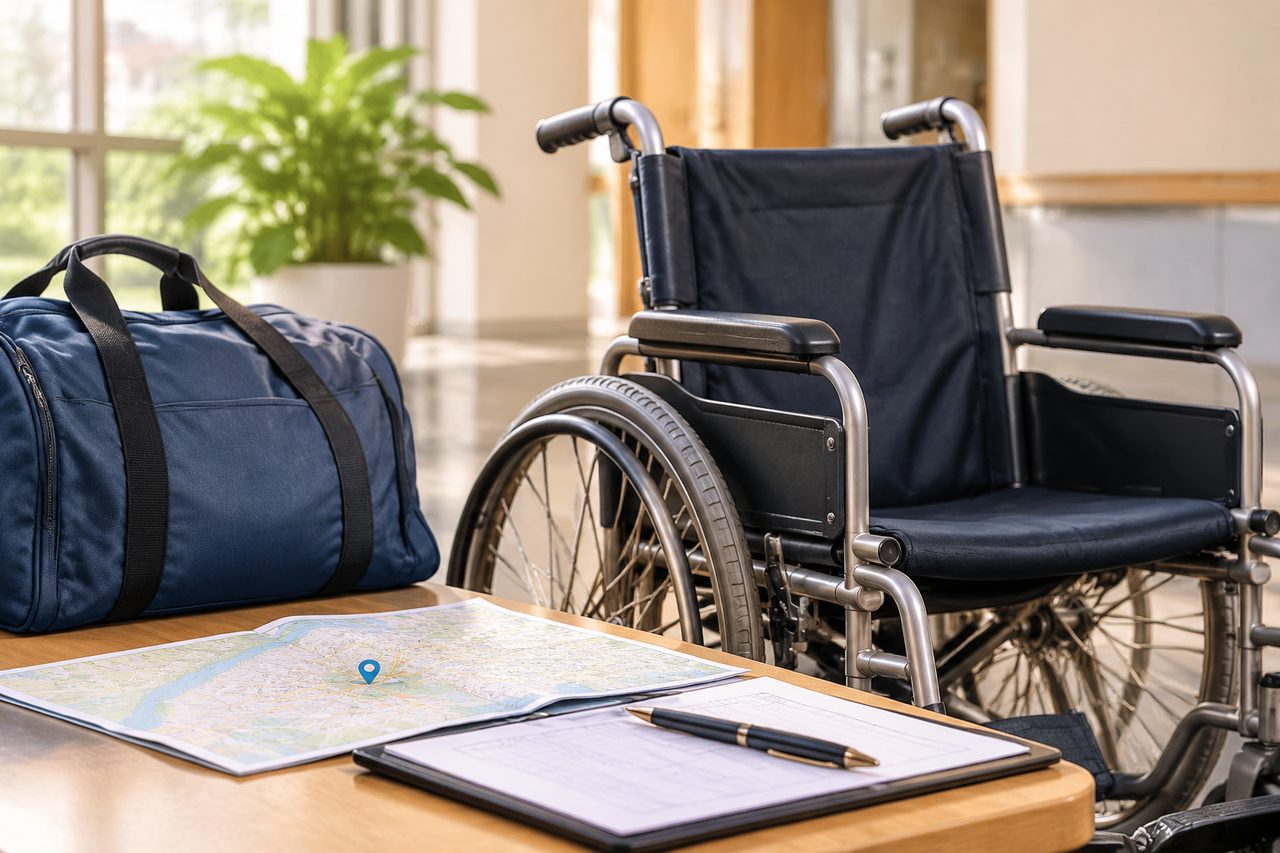
How to Arrange Wheelchair Support in China
What happens if you can walk only a few steps, yet your treatment is at a hospital that sees more than ten thousand outpatients a day? Arranging wheelchair support in China is possible, but it depends less on finding a single “wheelchair service” and more on coordinating three things at once: an accessible hospital, a mobility plan for every step of the visit, and a bilingual person who can push, translate, and navigate. This guide explains how international patients actually organize that, and what it costs.
We are China Medical Services, a patient coordination service, not a medical provider. Everything below reflects how Chinese hospitals work in practice and where the real friction points sit.
How This Actually Works, Step by Step
There is no national wheelchair booking hotline for foreign patients. Support is assembled from separate pieces, and the sequence matters.
Step 1 — Define the mobility need precisely. “Needs a wheelchair” covers very different situations: a patient who can transfer independently but cannot walk long corridors; a patient who needs a pusher at all times; a patient traveling with a folding wheelchair; a patient who may need a hospital-provided chair on arrival. Write down weight, whether the patient can stand briefly, whether an escort will travel with them, and whether a commode or reclining chair is needed. Hospitals and service providers will ask.
Step 2 — Confirm the hospital can accommodate you. Not every department entrance is step-free, and older buildings can have uneven ramps or crowded elevator banks. Before committing, ask the hospital’s international department whether wheelchairs are available at the entrance, whether the relevant outpatient and imaging areas are reachable without stairs, and whether an escort is permitted to accompany the patient through registration and payment. Our team routinely checks these details with the hospital before a visit is confirmed.
Step 3 — Decide who provides the pushing and navigation. Options include a family member, a hospital volunteer (availability varies and English is rarely spoken), or a paid bilingual companion. For a patient who cannot walk and does not speak Mandarin, a paid companion is usually the realistic choice, because the same person handles queueing, payment counters, and directions.
Step 4 — Build the door-to-door plan. That means airport assistance booked with the airline, a vehicle large enough for a folding wheelchair, a hotel with step-free access and an accessible bathroom, and a schedule that leaves buffer time. Chinese tertiary hospitals are vast; moving between the registration hall, the specialist’s room, and the imaging center can take a substantial part of a morning.
Step 5 — Confirm payment and paperwork in advance. Public hospitals generally require prepayment, with insurance reimbursement handled afterward; private international hospitals more often bill insurers directly. Either way, someone must physically go to the payment window, which is exactly the kind of errand a companion absorbs.
Wheelchair Accessible Hospitals in China: What to Check Before You Choose
Wheelchair accessible hospitals in China fall into two broad groups, and the trade-offs are real.
Public tertiary hospitals (Grade 3A) hold most of the country’s deepest specialist expertise. Many are listed in the Fudan rankings, whose Top 100 spans 23 cities, with Beijing (21 hospitals), Shanghai (18), and Guangzhou (10) leading. These institutions are enormous, and accessibility varies by building rather than by reputation. A newly built outpatient tower may be excellent; a older wing across the street may not be. Their international or VIP departments usually offer English-speaking staff and smoother logistics, at roughly 1.5 to 2 times the standard-channel price.
Private international hospitals — examples include United Family, Jiahui, Parkway, and Raffles — typically offer English-speaking staff, JCI accreditation, direct insurance billing, and Western-style facilities. Step-free design and assistance are usually easier to arrange. The trade-off is cost and, for complex specialist care, depth of subspecialty experience compared with the largest public centers.
For patients weighing both routes, our overview of top-ranked hospitals by city and the private international hospital directory show which institutions sit where. City pages such as Shanghai and Beijing help narrow the shortlist geographically, which matters when a wheelchair user will be making repeated trips.
Ask these questions of any hospital before booking:
- Is there a step-free entrance near the department I need, or only at the main gate?
- Are wheelchairs available on site, and is there a deposit or ID requirement?
- Can one companion stay with me through registration, consultation, and payment?
- Are the imaging and laboratory areas in the same building or a separate one?
- Is there an accessible restroom on the floor where I will wait?
A Realistic Timeline
Service fees vary by hours and days rather than by a fixed wheelchair rate. Bilingual companion support starts from $300 per day, and hospital charges are quoted separately by the treating institution. Because needs differ, ask for a written breakdown of hours, tasks, and refund conditions before committing.
In most cases yes, particularly in international or VIP departments, but policies differ by hospital and by area. Some imaging or procedural rooms restrict entry. Confirm the specific rules with the hospital in advance rather than assuming.
No. Medical travel uses the S2 visa, annotated for treatment, with S1 for stays beyond 180 days; accompanying family members also apply under S2. The M visa is for commercial and trade activity and is not applicable to medical treatment.
Your Next Step
Arranging wheelchair support in China is fundamentally a coordination problem, not a purchase. The workable approach is to define the mobility need, confirm the hospital’s physical layout, secure the right visa category, and place one reliable bilingual person beside the patient for the whole visit. We are China Medical Services, and we handle hospital matching, appointment coordination, written second opinions, video consultations, and bilingual accompaniment; we do not provide medical care and do not promise admission, a named specialist, or any clinical outcome. If you would like to talk through your situation, you can start with a free consultation and we will tell you honestly what can and cannot be arranged.
This article is for general information only and is not medical advice. Treatment decisions should be made with a qualified physician who has reviewed your individual case.
For more medical information and treatment options in China, visit chinamedservices.com (China Medical Services).
