Audiometry in China: Cost and Booking for International Patients
Audiometry in China: Cost and Booking for International Patients
You have probably been told that arranging any medical test in China as a foreigner is a bureaucratic nightmare. The reality is more specific than that. A pure-tone audiometry test — the standard hearing assessment where you press a button each time you hear a tone — is one of the simplest, fastest, and cheapest diagnostics you can obtain in China. The audiometry test cost in China typically lands between $15 and $120 depending on the hospital tier, and the test itself takes 20 to 40 minutes. The hard part is not the test. The hard part is booking it without a Chinese ID, a local phone number, or the ability to navigate a hospital registration system built for millions of domestic patients per day.
That gap is exactly what this guide addresses. Below you will find what audiometry actually costs across hospital types, how the booking sequence works in practice, how long each stage takes, and where things realistically go wrong.
How This Actually Works, Step by Step
Here is the real sequence, from the moment you decide you need a hearing assessment to the moment you hold a printed audiogram in your hand.
Step one: clarify what you actually need. “A hearing test” can mean several different things. Pure-tone audiometry measures your threshold of hearing across frequencies. Speech audiometry checks how well you understand words, not just detect them. Tympanometry assesses middle-ear function. Otoacoustic emissions and auditory brainstem response are used in specific situations — newborn screening, sudden hearing loss workups, or cases where a patient cannot respond voluntarily. If you have tinnitus, sudden one-sided hearing loss, or a history of noise exposure, the department you need may differ. Getting this wrong means paying twice.
Step two: send your existing records. If you already have an audiogram from home, an ENT report, an MRI of the internal auditory canal, or a history of ear surgery, those documents shape which hospital and which subspecialist makes sense. A general ENT clinic handles routine audiometry. A neurotology or otology subspecialist handles complex cases. Sending records first prevents a wasted appointment.
Step three: hospital matching and registration. Here is the part most foreign patients do not know. At Chinese public hospitals, outpatient appointments generally cannot be reserved from overseas in the ordinary queue — registration happens on the day, in person, often starting early morning. What can be arranged in advance is the international department or VIP channel, which offers English-speaking staff and a reserved slot. The trade-off is price: international-department pricing typically runs 1.5 to 2 times the standard channel. For a test as inexpensive as audiometry, that premium is small in absolute terms.
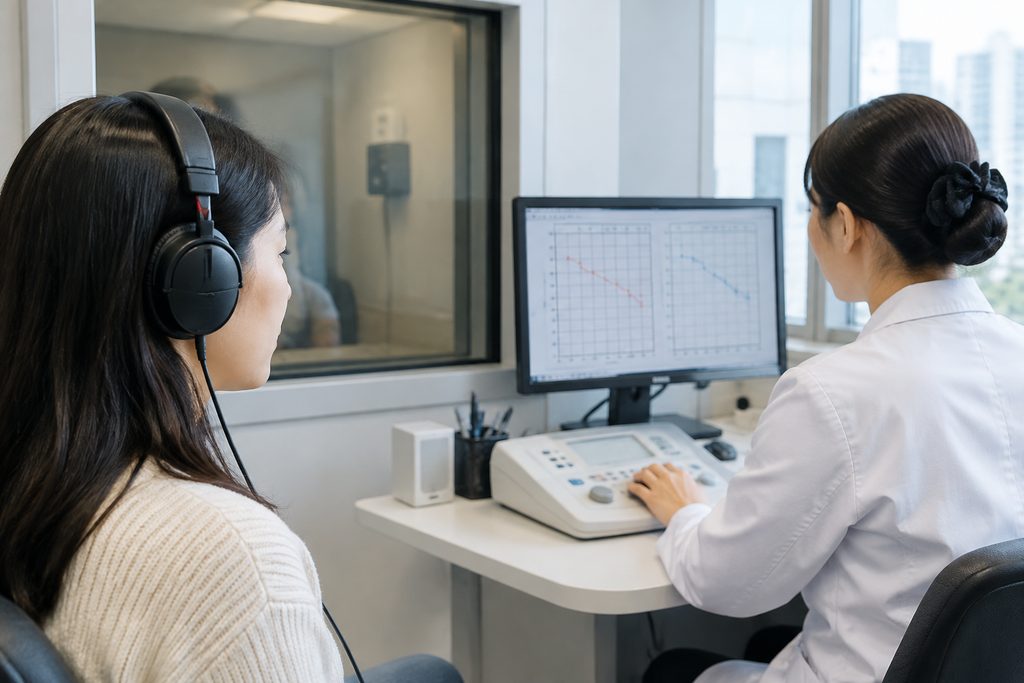
Step four: the visit itself. You register, pay, and are directed to the audiology booth. A technician places headphones on you, delivers tones at varying frequencies and volumes, and records your responses. You also receive bone-conduction testing, where a small vibrator sits behind your ear. The whole session runs 20 to 40 minutes for standard pure-tone plus speech testing.
Step five: results and interpretation. The audiogram is usually printed or available the same day. Interpretation by an ENT physician may happen immediately or at a separate follow-up appointment, depending on the hospital’s workflow.
What an Audiometry Test Costs in China, by Hospital Type
Prices vary by hospital, city, and whether additional tests are bundled. The figures below are realistic ranges, not fixed quotes. Final pricing depends on the specific hospital and the scope of testing ordered.
| Hospital Type | Typical Pure-Tone Audiometry | Full Hearing Assessment Package | Notes |
|---|---|---|---|
| Standard public tertiary hospital (general ENT clinic) | $15–$40 | $50–$120 | Queue-based registration; limited English support |
| Public hospital international / VIP department | $40–$90 | $120–$300 | Advance booking possible; English-speaking staff |
| Private international hospital (JCI-accredited) | $60–$120 | $200–$500 | Direct insurance billing often available; appointment-based |
For comparison, a standalone audiometry test in the United States commonly runs $50 to $200 before any physician interpretation, and a full audiological evaluation with speech testing can exceed $300. The gap is real, but it is not the main reason patients come to China for hearing assessments. The main reason is access — being seen quickly, by a high-volume department, without a six-week wait.
One more number worth knowing: China’s top-ranked hospitals see patient volumes that dwarf most Western institutions. A single tertiary hospital may handle more than 10,000 outpatient visits per day. That scale is why the system is efficient at routine diagnostics and why it is genuinely difficult to navigate alone.
A Realistic Timeline
Below is a realistic schedule for an international patient arranging audiometry in China, assuming no urgent medical need.
| Stage | Typical Duration | What Happens |
|---|---|---|
| Records gathering and translation | 2–7 days | Collect prior audiograms, ENT notes, imaging; translate to Chinese if needed |
| Hospital and department matching | 1–3 days | Identify appropriate hospital tier and ENT subspecialty |
| Appointment coordination | 3–14 days | International department slots book faster; standard-channel registration happens on arrival |
| Visa (S2 category, if traveling) | 1–4 weeks | Requires hospital supporting documents; processing times vary by consulate |
| Travel and arrival | 1–2 days | Flights, accommodation, airport transfer |
| Hospital visit and testing | Half day | Registration, payment, audiometry session, preliminary results |
| Physician interpretation | Same day to 1 week | Depends on whether interpretation is bundled or a separate appointment |
The step people forget is document translation. If your prior records are in English, German, or Arabic, some hospitals accept them as-is, particularly in international departments. Others require a Chinese translation. Budget three to five working days for that if it is needed.
Visa timing is the other commonly underestimated stage. Foreign patients traveling to China for medical treatment use the S2 visa category, which covers short-stay medical treatment and private affairs, and requires supporting documentation from the receiving hospital. Family members accompanying a patient apply under the same category. Processing times fluctuate by consulate and season, so a four-week buffer is sensible. Note that the M visa is a commercial and trade category and has nothing to do with medical treatment.
What Can Go Wrong — and What Happens Then
Honest failure modes matter more than optimistic marketing. Here are the ones that actually occur.
You arrive and cannot register. This happens when a patient shows up at a standard public hospital outpatient hall without preparation, on a busy morning, with no Chinese language ability. The registration queue is long, the system expects a Chinese ID or passport registration at a specific window, and the department may already be full for the day. The recourse is the international department, which handles registration differently — or a bilingual companion who manages the queue, payment, and wayfinding on your behalf.
The test ordered is not the test you needed. A patient with sudden one-sided hearing loss may need urgent workup including MRI, not just audiometry. A patient with tinnitus may need a different battery. If the initial consultation is rushed or the language barrier prevents you from fully describing symptoms, the wrong tests get ordered. The recourse is a written second opinion before travel, where a specialist reviews your history and tells you what to book.
Results arrive but nobody explains them. In high-volume public hospitals, physician time is compressed. You may receive a printed audiogram with no interpretation. The recourse is to request a follow-up consultation slot in advance, or to have results reviewed remotely after you return home.
The appointment you wanted is unavailable. Specific specialists have limited slots, and no coordination service can guarantee a particular physician on a particular date. What a coordination service can do is attempt the booking and refund the coordination fee if the appointment cannot be secured. That is the honest version of the promise.
Is Audiometry Safe in China, and How Do You Choose a Provider?
Audiometry is a non-invasive, passive test. You listen to tones and respond. There is no radiation, no injection, no sedation for standard pure-tone testing, and no recovery period. The question “is audiometry safe in China” has a straightforward answer: the procedure itself carries essentially no risk anywhere it is performed correctly, and the equipment in Chinese tertiary hospitals is standard calibrated audiological equipment.
What varies is not safety but quality of interpretation and the surrounding clinical pathway. When evaluating where to have a hearing assessment done, consider four things.
- Whether the hospital has a dedicated audiology unit rather than a shared room in a general clinic
- Whether an ENT physician, ideally with otology or neurotology subspecialty training, will interpret the results
- Whether English-language support exists for the consultation, not just the test
- Whether the hospital can access your prior records and compare results over time
China’s top-ranked hospitals are concentrated in a handful of cities. Beijing hosts the largest number of top-tier institutions, Shanghai follows closely, and Guangzhou ranks third. For hearing-related work, the relevant department is Otolaryngology (ENT), and the strongest programs sit within large academic medical centers. Our hospital database covers 340+ top-ranked hospitals across 37 cities, and you can browse specialty rankings by department to see which institutions lead in otolaryngology.
For patients who want a faster, English-first experience, private international hospitals offer a different trade-off: higher prices, direct insurance billing, appointment-based scheduling, and Western-style service. You can compare options on our private international hospital page.
Practical Considerations: Records, Payment, and Follow-Up
Records. Bring every prior audiogram you have. Hearing is tracked over time, and a single data point is far less useful than a series. If you have had audiograms at home, request the actual graphs, not just the summary letter.
Payment. Public hospitals in China generally require prepayment, with insurance reimbursement handled afterward in your home country. Private international hospitals more often bill insurers directly. Check your policy’s coverage for overseas diagnostics before you travel — many policies cover testing but require pre-authorization.
Language. This is the practical bottleneck. A hearing test involves instructions (“raise your hand when you hear the tone, even if it is very faint”), and a consultation involves describing symptoms precisely. Bilingual medical companionship exists for exactly this reason: managing registration, queueing, payment, wayfinding, and translation throughout the visit. Rates start from $300 per day for a bilingual medical companion.
Follow-up at home. Ask for a printed audiogram and a written summary you can hand to your physician at home. Digital copies are preferable. If a hearing aid fitting is the eventual goal, the audiogram format matters — confirm it includes the frequency-specific thresholds your home provider needs.
Visa timing. If you are traveling specifically for assessment, the S2 category applies, and you will need hospital documentation to support the application. Requirements change, so confirm current rules with the relevant Chinese embassy or consulate before applying. Nothing here guarantees approval.
Frequently Asked Questions
Standard pure-tone audiometry takes roughly 20 to 30 minutes. If speech audiometry, tympanometry, or otoacoustic emissions are added, the session can extend to 45 or 60 minutes. The hospital visit overall — registration, payment, waiting, testing — typically consumes half a day at a public hospital and considerably less at a private international facility with scheduled appointments.
At public hospitals, ordinary outpatient registration generally happens in person on the day, so a fully pre-booked slot is not the norm. International and VIP departments, plus private international hospitals, do allow advance scheduling. This is the practical reason many international patients choose the international-department route even though it costs more. If you want to arrange a slot in advance, our team can coordinate through the hospital’s official international channel.
If you are traveling to China specifically for medical assessment, the S2 visa category is the applicable short-stay route for medical treatment and private affairs, and it requires supporting documents from the receiving hospital. Accompanying family members apply under the same category. Whether a visa is required at all depends on your nationality and any existing visa-free arrangements — check with your local Chinese embassy or consulate, as rules change.
It depends on what you are comparing. For price alone, a Chinese public hospital audiogram can cost a fraction of a US equivalent. For speed, Chinese tertiary hospitals often see patients faster than Western systems with long audiology waitlists. For convenience and English-language service, private international hospitals narrow the gap. The honest answer is that hearing assessment packages in China make most sense when combined with a broader diagnostic workup or when wait times at home are unacceptable.
Audiometry identifies hearing thresholds; it does not diagnose the cause. If results suggest sudden sensorineural hearing loss, asymmetric hearing loss, or another finding requiring urgent attention, the next step is physician evaluation and possibly imaging. Treatment decisions belong with a qualified ENT physician who has examined you and reviewed your full history. Nothing in this article constitutes individual medical advice.
Your Next Step
Audiometry in China is inexpensive, quick, and technically solid — the friction sits entirely in the logistics of booking, language, and hospital navigation. If you already have records and know what you need, the path is straightforward. If you are uncertain which test or which department fits your situation, a written second opinion from a Chinese ENT specialist can clarify that before you commit to travel.
China Medical Services connects international patients with top-ranked Chinese hospitals through case management: medical record translation, appointment coordination through official hospital international departments, and bilingual companionship during your visit. We do not sell access, and we do not promise specific physicians or guaranteed outcomes. We coordinate, and we are transparent when something cannot be arranged.
If you would like to understand your options, start with a free consultation — describe your situation, and our team will tell you honestly what is feasible.
This article is for general informational purposes only and does not constitute medical advice, diagnosis, or treatment recommendations. Always consult a qualified healthcare professional regarding your individual condition. Prices are estimates and vary by hospital and case complexity.
For more medical information and treatment options in China, visit chinamedservices.com (China Medical Services).
