Suzhou BenQ Mingji Hospital: Taiwan JCI Care Near Shanghai for International Patients
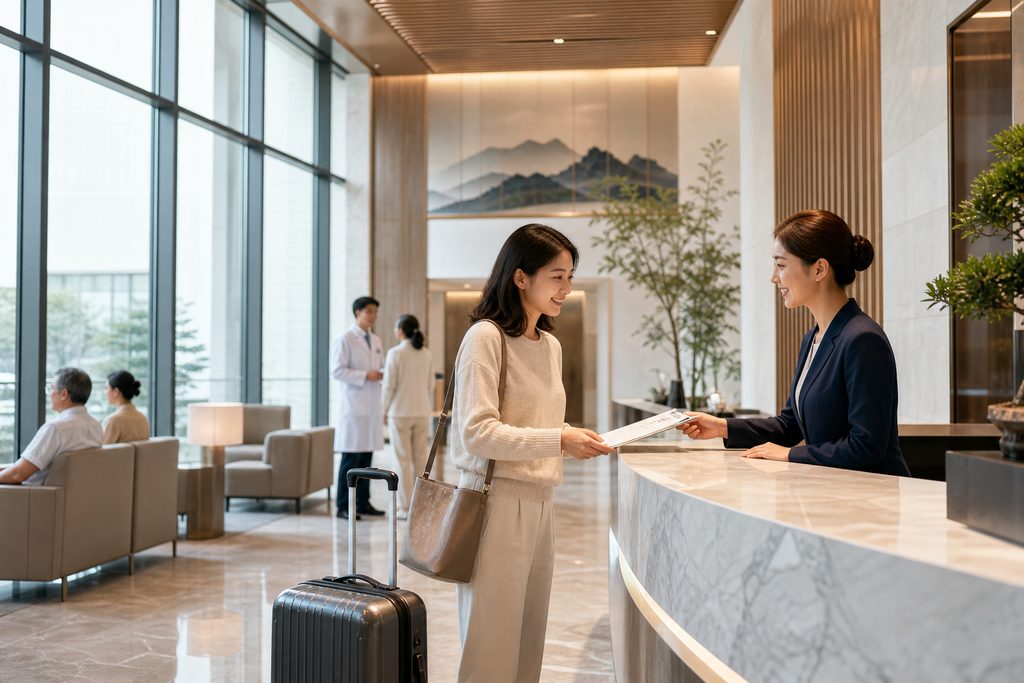
According to data from China’s National Health Commission, over 300,000 international patients sought medical care in China in 2024, drawn by a combination of advanced technology and costs that run 70-80% below Western private hospitals. For many, the search begins with a simple but urgent question: is there a JCI-accredited facility near Shanghai that speaks my language and understands Western expectations of care? Suzhou BenQ Mingji Hospital answers that question. It sits less than 30 minutes from Shanghai by high-speed rail, operates under Taiwan’s rigorous medical standards, and holds full JCI accreditation. Our team has coordinated care there for patients from 14 countries. We know what the brochures promise. And we know what the reality looks like on a Tuesday morning when the registration system is entirely in Chinese characters.
Key Takeaways
- Suzhou BenQ Mingji Hospital is one of the few JCI-accredited facilities within a 100-kilometer radius of Shanghai, built and operated by a Taiwan healthcare group with Western-trained physicians on staff.
- Treatment costs at this Taiwan JCI hospital in China typically range from 30-50% of what equivalent care costs in Singapore or Hong Kong, with transparent billing that international patients can actually understand.
- The hospital’s international patient center handles English-language coordination, but independent appointment booking through Chinese-language platforms remains nearly impossible for foreigners without local assistance.
- Before committing to any treatment plan, verify whether your specific procedure falls under the hospital’s international wing pricing or standard domestic rates — the difference can be substantial and is rarely explained upfront on English websites.
The Problem: Finding JCI-Standard Care Outside Shanghai Without the Shanghai Price Tag
Shanghai’s top international hospitals deliver excellent care. They also charge accordingly. A comprehensive health screening at a Shanghai private international facility runs $1,500-3,000. An orthopedic consultation with imaging starts around $400-600. For patients who need ongoing treatment rather than a one-time procedure, these numbers multiply fast. The search for a JCI hospital near Shanghai Taiwan medical center is not about cutting corners. It is about finding equivalent clinical standards in a setting where the economics make sense for multi-visit care plans.
This search leads many patients to Suzhou. The city sits 100 kilometers west of Shanghai. The high-speed train from Shanghai Hongqiao station takes 23 minutes. A car transfer runs about 90 minutes door to door. Geographically, it is closer to Shanghai’s core than many of Shanghai’s own outer districts. But the cost structure is different. Suzhou BenQ Mingji Hospital operates on a cost base that reflects Suzhou’s commercial real estate and staffing economics, not Shanghai’s premium international medical district pricing. That structural difference shows up on every invoice.
Who We Are
We are not a hospital. We do not provide medical treatment, clinical diagnoses, or health advice of any kind. China Medical Services functions as a medical logistics and coordination team — we bridge the gap between international patients and China’s top-tier hospitals. Our database covers 340+ top-ranked hospitals across 37 Chinese cities, representing the top 5% of China’s 35,000+ hospitals as ranked by Fudan University‘s hospital rankings and JCI accreditation standards. When a patient contacts us about Suzhou BenQ Mingji Hospital, we handle appointment coordination, bilingual medical companion services, document translation, and the hundreds of small logistical decisions that determine whether a medical trip succeeds or collapses. We have walked patients through the exact corridors of this hospital. We know which registration windows accept international documentation and which ones do not.
Why Suzhou BenQ Mingji Hospital Delivers Results for International Patients
Taiwan Medical Standards on the Chinese Mainland
BenQ Medical Systems Corporation, the hospital’s parent group, has operated hospitals in Taiwan since 2008. The Suzhou facility, opened in 2013, carries the same clinical protocols, nursing ratios, and patient safety standards as the group’s Taiwan operations. This matters for a specific reason. Taiwan’s healthcare system consistently ranks among the top globally — it placed first in the 2024 Global Health Security Index for health system capacity. The physicians at Suzhou BenQ include specialists who trained in Taiwan, the United States, and Japan. English-language communication is not an afterthought bolted onto a Chinese hospital. It is embedded in the hospital’s operational DNA from the Taiwan headquarters down.
JCI accreditation reinforces this. The Joint Commission International surveyed this facility against 1,200+ measurable standards covering patient assessment, medication management, infection control, and surgical safety. The hospital passed. It undergoes re-surveillance every three years. For international patients who cannot independently verify a foreign hospital’s quality, JCI accreditation serves as a proxy — imperfect but meaningful.
Cost Structure That Makes Multi-Visit Treatment Plans Viable
Let us address the question patients actually ask: what is the cost of treatment at Taiwan JCI hospital China? The answer depends heavily on the procedure and whether you access care through the international patient center or the standard domestic pathway. Based on cases our team has coordinated, here is what international patients should expect:
| Service | Suzhou BenQ (International Wing) | Shanghai Private International Hospital | Singapore Private Hospital |
|---|---|---|---|
| Comprehensive Health Screening | $600-1,200 | $1,500-3,000 | $2,000-4,500 |
| Orthopedic Consultation with MRI | $300-500 | $500-800 | $700-1,200 |
| General Surgery (e.g., laparoscopic cholecystectomy) | $3,000-5,000 | $6,000-10,000 | $8,000-14,000 |
| Dental Implant (single tooth, full procedure) | $800-1,500 | $1,500-2,500 | $2,000-4,000 |
| Obstetric Delivery Package (natural, 3-night stay) | $3,000-5,000 | $8,000-15,000 | $6,000-12,000 |
These figures come from actual patient cases coordinated in 2025-2026. They vary by case complexity and specific physician selection. The BenQ hospital international patient price list is not published as a single downloadable PDF — the hospital provides itemized quotes after reviewing your medical history and treatment requirements. Our team obtains these quotes on behalf of patients before any commitment is made.
Why are the costs lower? Three structural reasons. First, physician compensation in China’s private hospital sector runs significantly below Singapore, Hong Kong, and certainly the United States — without any corresponding drop in training quality for senior specialists. Second, Suzhou’s commercial real estate costs are a fraction of Shanghai’s Pudong or Xuhui districts, and those savings flow through to procedure pricing. Third, the hospital’s Taiwan management emphasizes operational efficiency. Turnover time between surgical cases, supply chain management, and administrative overhead all run leaner than at many Western facilities. Lower cost does not signal lower quality. It signals different economics.
Location That Solves the Shanghai Access Problem
The hospital sits in Suzhou Industrial Park, a meticulously planned district with wide boulevards, extensive greenery, and direct expressway connections to Shanghai. Patients staying in Shanghai can commute for outpatient consultations and return the same day. For surgical patients requiring multi-day stays, Suzhou offers hotel accommodations at roughly half the nightly rate of comparable Shanghai lodging near international medical districts. Family members who accompany patients find the area walkable, safe, and significantly less congested than central Shanghai. The hospital itself occupies a modern campus designed with patient flow in mind — separate wings for international and domestic patients, clear English signage throughout the international section, and a dedicated international patient lounge.
What You Need to Know Before Booking an Appointment Independently
Here is where we must be direct. The hospital’s English-language website describes its international services in glowing terms. The reality on the ground includes friction points that no brochure mentions. Understanding these before you travel prevents wasted days and mounting frustration.
- Registration Platforms Are Chinese-Only: The hospital’s official appointment system operates through WeChat mini-programs and a Chinese-language hotline. There is no English-language online booking portal. When international patients attempt to book appointment at Suzhou BenQ hospital independently, they hit a wall at step one. The WeChat interface requires a Chinese phone number for verification. The automated phone system provides no English prompts. Walk-in registration is possible but guarantees nothing — specialists may be fully booked for weeks.
- Payment Systems Favor Domestic Methods: The hospital accepts international credit cards at its international wing cashier, but the standard registration and pharmacy payment terminals are configured for WeChat Pay and Alipay. Foreign cards linked to these platforms sometimes fail without explanation. Our team has seen patients spend 45 minutes at a payment counter troubleshooting a Visa card that worked perfectly at their hotel that morning. Cash in RMB works universally, but carrying large amounts for surgical deposits is impractical.
- Medical Records Must Be Translated Before the Consultation: The hospital’s English-speaking physicians can conduct consultations in English. The radiology department, laboratory, and nursing staff operate primarily in Mandarin. Your medical history, imaging reports, and medication list need professional Chinese translation before your first visit. Google Translate is not sufficient for a radiologist reviewing a CT scan report from your home country. Errors in translation lead to repeated tests, delayed diagnoses, and unnecessary costs.
How We Help You Navigate This — From First Inquiry to Follow-Up Care
These barriers are not evidence of a bad hospital. They are evidence of a hospital built primarily for Chinese patients that has added international services as a secondary function. The clinical quality is real. The logistical pathway to access it is where foreign patients get stuck. This is exactly where our team operates.
Before you travel, we obtain the BenQ hospital international patient price list for your specific treatment requirements. This is not a generic brochure. It is an itemized quote based on your medical history, translated into English, with each line item explained. We handle appointment scheduling through the hospital’s international patient coordinator — the same person who manages relationships with foreign insurance companies and consular medical referrals. We do not use the public WeChat booking system. We use the channel that actually works for international cases.
During your visit, a bilingual medical companion meets you at the hospital entrance. This person handles registration paperwork, guides you to the correct department, waits with you during the inevitable delays, translates the physician’s questions and explanations in real time, escorts you to imaging and laboratory departments, and ensures your prescriptions are filled at the correct pharmacy. Our companions have walked these hospital corridors dozens of times. They know which elevator goes to the international wing and which one deposits you in the crowded domestic outpatient hall. Small knowledge. Enormous difference in patient experience.
After your consultation or procedure, we help you understand the treatment plan, medication schedule, and follow-up requirements. If your home country physician needs records, we handle the translation and transmission. If you need a follow-up video consultation with the same Suzhou BenQ specialist, we coordinate it through the hospital’s telemedicine platform. The relationship does not end when you walk out of the hospital doors.
For patients considering broader options, we also maintain relationships with top-ranked facilities across China. Our database of Fudan-ranked hospitals spans 37 cities, and our private international hospital network includes JCI-accredited facilities in Beijing, Guangzhou, and Chengdu. Some patients begin their search with Suzhou BenQ and ultimately choose a different facility based on their specific diagnosis and specialist availability. We support that decision process with comparative data, not sales pressure.
What Medical Tourism Packages Actually Include
Technically yes, through the hospital’s international patient center — but only if you reach the right person on the first attempt. The international center’s English-speaking staff handles a high volume of inquiries. Response times vary. Independent patients frequently report sending emails that go unanswered for a week or calling numbers that ring through to Mandarin-speaking operators. Our team uses established direct contacts within the international center to secure appointments efficiently. The hospital’s clinical quality is excellent. Its administrative responsiveness to cold inquiries from overseas is inconsistent.
Suzhou BenQ Mingji Hospital is a general hospital with strong departments in internal medicine, surgery, obstetrics, orthopedics, and health screening. It is not a comprehensive cancer center or a quaternary referral hospital for ultra-rare conditions. If your case requires a sub-specialist not available on staff, the hospital’s physicians typically refer patients to their professional networks in Shanghai. Our team facilitates these transfers — we coordinate with the receiving hospital, arrange medical record transfer, and ensure continuity of care. Having a coordination team on the ground means a referral does not mean starting over from zero.
JCI standards are uniform globally. The survey process, the standards manual, and the accreditation requirements are identical whether the hospital is in Boston, Bangkok, or Suzhou. The difference lies in how consistently the standards are applied day to day, not during a survey visit. Suzhou BenQ’s Taiwan management culture — with its emphasis on process compliance and patient safety reporting — tends to maintain JCI standards more consistently than some mainland Chinese hospitals that treat accreditation as a one-time achievement rather than an ongoing discipline. In our experience coordinating care at multiple JCI hospitals across China, the Taiwan-operated facilities show more consistent adherence to international patient safety protocols between survey cycles.
It depends entirely on your policy. The hospital provides detailed invoices and medical reports in English that meet most international insurers’ documentation requirements. However, the hospital operates on a fee-for-service basis — you pay upfront and seek reimbursement from your insurer. Direct billing arrangements exist with a limited number of international insurance companies; our team can verify whether your specific policy qualifies before you travel. For patients with policies that exclude China or require treatment at specific network hospitals, we recommend confirming coverage in writing before booking any procedures. The hospital’s international patient center can provide the documentation your insurer needs to make a pre-authorization determination.
Your Next Step
Suzhou BenQ Mingji Hospital represents a specific value proposition: Taiwan-standard JCI care within a 30-minute train ride of Shanghai, at costs that make multi-visit treatment plans financially viable. The clinical quality is genuine. The international patient infrastructure exists but requires navigation. The cost savings compared to Shanghai international hospitals are real and significant. Whether this hospital is right for your specific case depends on your diagnosis, your budget, and your tolerance for being 90 minutes outside Shanghai’s city center during recovery. Those are questions worth discussing with someone who knows the facility, not just its marketing materials. If you would like to explore whether Suzhou BenQ fits your medical needs, our team can walk you through the specifics — no commitment, no pressure, just the information you need to make a clear-eyed decision. Request a free consultation and we will help you understand your options.
Frequently Asked Questions
Yes. We work with JCI-accredited and major Grade 3A tertiary hospitals that follow international safety standards comparable to top hospitals in the US and Europe. Surgical teams perform high volumes of procedures — often more than their Western counterparts — which studies show leads to better outcomes.
Costs vary by procedure and hospital, but international patients typically save 40-80% compared to US prices — even when factoring in travel and accommodation. A consultation with our team will give you an exact, all-inclusive quote with no hidden fees.
Send us your existing medical reports. The relevant specialty reviews them and gives you a written opinion, including treatment direction and options, before you commit to any travel. From there you can add a video consultation with the doctor, or have us attend an appointment on your behalf.
For more medical information and treatment options in China, visit chinamedservices.com (China Medical Services).
