Blood Tests in China Without a Referral: Costs, Walk-In Options & What to Expect
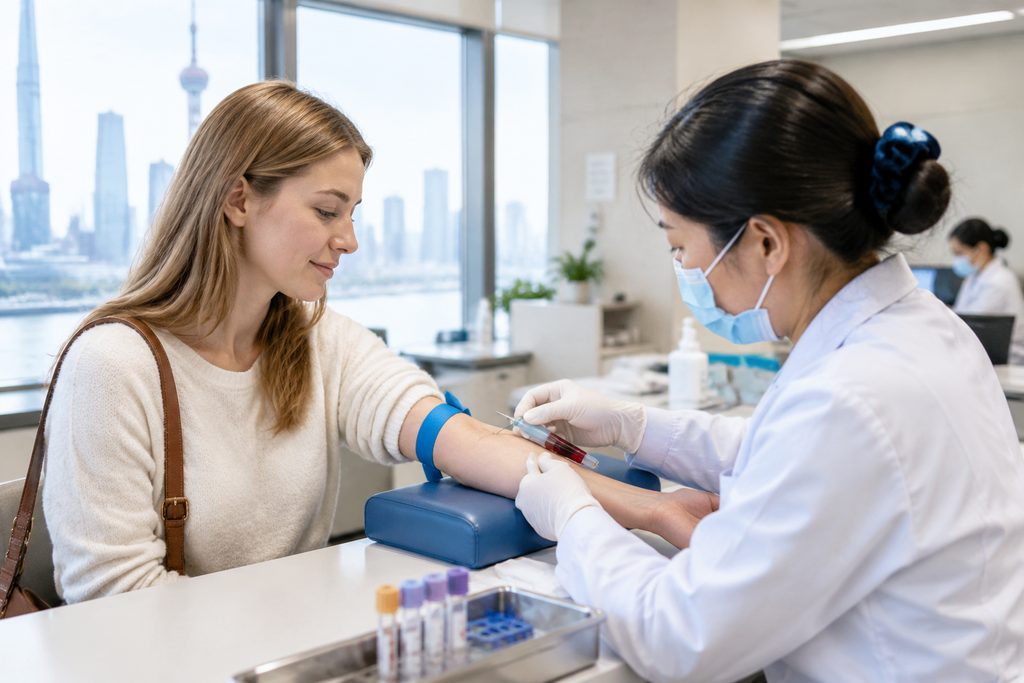
Blood Tests in China Without a Referral: The Short Answer
When 44-year-old Sarah from Portland landed in Shanghai for a business trip, a persistent fatigue she’d been ignoring for weeks finally caught up with her. She wanted a simple CBC and thyroid panel. Back home, that meant a doctor’s visit, a referral, and a bill. In China, she walked into a private clinic near Jing’an, paid about $85, and had results in her inbox the next morning. No referral needed.
That’s the honest headline: you can get blood tests in China without a referral, and the blood test cost China without referral ranges from roughly $15 for a basic panel at a public hospital to $300+ for a comprehensive package at a private international clinic. The catch is that “walk-in” means different things depending on where you go — and the cheapest option is also the one where almost no one speaks English.
This guide breaks down what each route actually costs, how to book, and where the friction really lives.
Who This Is Right For — and Who It Isn’t
Not every visitor should be chasing a walk-in blood draw. Here’s the honest split.
You’re likely a good fit if:
- You need routine screening — CBC, lipid panel, liver and kidney function, thyroid, HbA1c, vitamin D
- You’re monitoring a known, stable condition and just need numbers
- You’re already in China for work, study, or travel and want to avoid a home-country wait
- You’re price-sensitive and comfortable navigating a Chinese-language environment
- You want a baseline before a longer medical stay
You should probably not do this if:
- You need a test interpreted in context — an abnormal result without a clinician who knows your history is worse than no result
- You’re seeking a diagnosis, not a data point. Blood work confirms; it rarely diagnoses on its own
- You have a bleeding disorder, are on anticoagulants, or have difficult venous access — clinic standards for phlebotomy vary
- You need results that will be accepted by a doctor back home without re-testing. Many Western physicians will re-run anyway
Being blunt about that last point saves people money. A $40 panel in Beijing is not a substitute for a $400 workup your own doctor ordered.
The Options, Compared
Three real routes exist. Here’s how they stack up on the numbers that matter.
| Route | Typical Cost (Basic Panel) | Wait Time | English Support | Referral Needed? | Results Turnaround |
|---|---|---|---|---|---|
| Public hospital (三甲, outpatient lab) | $15–$40 | 30–90 min queue | Rare | No | Same day to 48 hrs |
| Public hospital international/VIP department | $80–$180 | 15–30 min | Yes | No | 24–48 hrs |
| Private international clinic (Shanghai/Beijing) | $150–$300+ | Appointment-based | Yes | No | 24–72 hrs |
| Health check-up package (comprehensive) | $200–$600 | Scheduled | Varies | No | 3–7 days |
Which column suits you? If you’re paying out of pocket and just need numbers, the public hospital route wins on price by a wide margin. If your time is worth more than the $150 difference, or you need to discuss results with someone who speaks your language, the private clinic is the sane choice. The international department of a major public hospital sits in the middle — real specialists, English service, prices closer to the public side.
Can I Get Blood Tests in China Without a Doctor Referral? Yes — Here’s How It Actually Works
China’s outpatient system doesn’t gatekeep lab work behind referrals the way many Western systems do. You register, pay, and get tested. That’s the whole flow at a basic level.
At a public hospital, the sequence is: arrive early (before 8 a.m. if you want a short queue), find the registration desk, present your passport, pay the registration fee (typically $2–$5), then go to the lab department. Some hospitals now have self-service kiosks, but they’re Chinese-language. You’ll pay for the test itself at a separate window, then queue for the draw. Results come as a printed slip or via a hospital app — again, in Chinese.
Private clinics flip this. You book online or by phone, walk in at your appointment time, and a nurse or phlebotomist handles everything. Results arrive in English by email, often with a physician’s note.
The phrase “book blood test China walk in” is a bit of a misnomer at private clinics — they prefer appointments, and walk-in slots can mean a wait. Public hospitals genuinely accept walk-ins, but “walk-in” there means joining a crowd.
What It Costs — and What Drives the Variance
Prices swing widely for four reasons: the test itself, the facility tier, whether a physician reviews the result, and whether you need it translated.
A standalone CBC at a Beijing public hospital might run $15. The same test at a private Shanghai clinic: $60–$90. Add a lipid panel, liver function, and thyroid, and you’re at $40 versus $250.
For a broader screening — the kind sold as a “medical tourism blood test package China” — expect $200–$600 at private facilities, sometimes bundled with imaging and a physician consultation. These packages vary enormously in what’s included, so ask for an itemized list before paying.
What’s usually not included: follow-up consultation, translation of results into another language, and any treatment. Those are separate line items.
Practical Considerations: Records, Payment, and Follow-Up
Bring your passport. It’s your ID at every facility, public or private. Some clinics also want a local phone number for result notifications.
Payment is straightforward — cash, international credit cards at private clinics, and increasingly WeChat Pay or Alipay (which require a linked foreign card, and this can be finicky). Public hospitals sometimes only accept local payment methods at certain windows, so carry cash as backup.
Insurance is the tricky part. Most international policies won’t reimburse a walk-in lab visit without a physician’s order and diagnosis code. If you plan to claim, get a receipt with the test names in English and a brief note from the ordering physician. Private clinics do this as standard; public hospitals usually won’t.
For follow-up after you return home, request your results in a format your own doctor can read. PDFs with reference ranges are ideal. If your results are abnormal and you’re still in China, that’s when the calculus changes — you want a specialist, not just a lab slip. Our team can help connect you with the right department at one of China’s top-ranked hospitals, and for anything beyond routine screening, a specialty-matched consultation is worth arranging before you fly home.
One more thing: if your trip involves anything more than a routine draw — a procedure, a specialist workup, a second opinion — the visa question surfaces. Medical travel to China uses the S2 visa (or S1 for stays over 180 days), not the M visa, which is strictly for commercial and trade activity. Family accompanying you apply under the same category. Requirements shift, so confirm current rules with your nearest Chinese embassy or consulate.
Frequently Asked Questions
Correct — for routine lab work, no referral is required. You register as an outpatient, pay, and get tested. That said, without a physician’s order you’re responsible for knowing which tests you need and interpreting the results yourself. For simple screening that’s fine. For anything diagnostic, it isn’t.
A basic panel at a Beijing public hospital typically runs $15–$40. The same panel at a private international clinic in Beijing or Shanghai runs $150–$300. The gap buys you English service, shorter waits, and physician-reviewed results — not better lab accuracy, since major facilities use comparable equipment.
Don’t panic, and don’t self-diagnose from a printout. An abnormal value needs context — your history, medications, recent illness. Private clinics will usually offer a follow-up consultation. At a public hospital, you’d need to register again for a physician visit. If the finding is serious, this is the moment to involve a specialist rather than a lab.
Sometimes, but not always. Many Western physicians re-test to establish their own baseline, especially for anything they’ll act on. Ask for results in English with reference ranges and the lab’s accreditation details. It improves the odds, though it’s no guarantee.
Some private clinics and concierge services offer home or hotel visits in major cities, usually at a premium. Airport lab services are rare and not reliable for planned testing. If convenience is the priority, book a private clinic and ask about mobile phlebotomy when you call.
Your Next Step
Getting blood work in China without a referral is genuinely easy — the hard part is knowing what to do with the results, and that’s where most visitors underestimate the gap. A cheap panel you can’t interpret isn’t a bargain.
We’re China Medical Services, a coordination service that connects international patients with Chinese hospitals. We’re not a hospital and we don’t diagnose or treat. If your needs go beyond a routine draw — a specialist review, a second opinion on results from home, or a full workup during your stay — our team can help you find the right department and arrange a consultation. A free initial consultation is the low-pressure way to start.
This article is for general information only and is not medical advice. Always consult a qualified physician about your individual health situation before making decisions about testing or treatment.
For more medical information and treatment options in China, visit chinamedservices.com (China Medical Services).
