Bone Density Scan in China: Cost, Booking and Top Hospitals
Key Takeaways
- A DEXA bone density scan at a top-tier Chinese public hospital typically runs $80–$250, versus $250–$600 in the United States without insurance.
- Results are usually ready the same day or within 24 hours, and many hospitals offer English-language reports on request.
- The real friction is not the scan itself — it is registration. Most public hospital outpatient slots cannot be reserved from overseas in advance.
- Bring your prior imaging and medication list, and confirm whether you need a plain screening scan or a full metabolic bone workup before you travel.
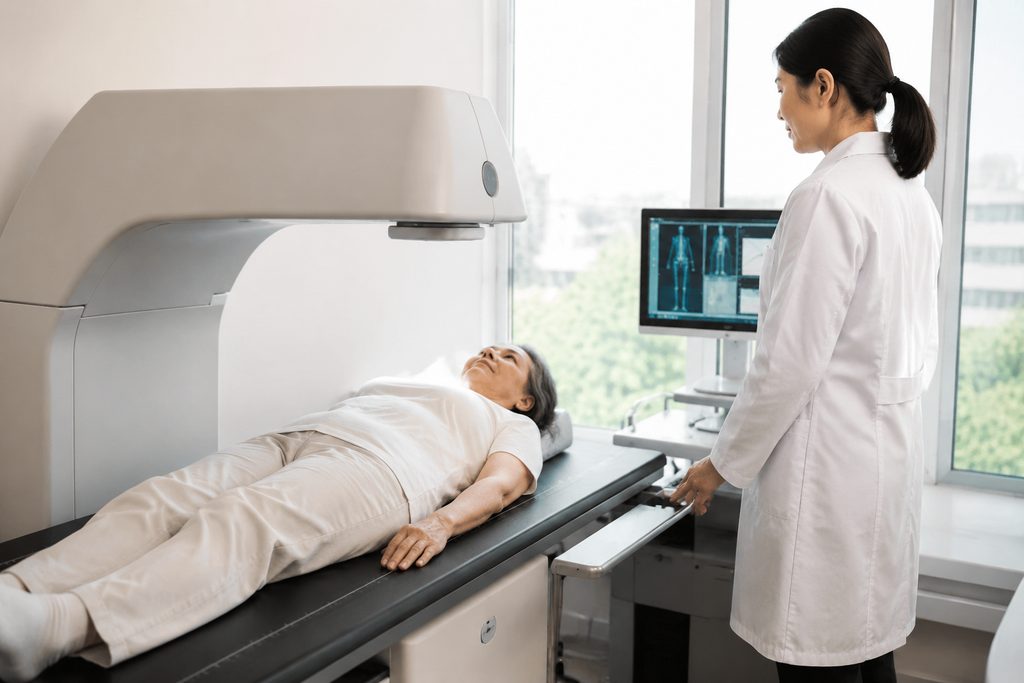
A bone density scan — often called a DEXA scan or DXA scan — is a low-dose X-ray test that measures how much calcium and other minerals are packed into your bones. In plain terms, it tells you whether your skeleton is strong, thinning, or already fragile. The test takes about 10 to 15 minutes, you stay fully clothed, and the radiation dose is a small fraction of a standard chest X-ray.
If you are searching for the bone density scan cost in China, the short answer is this: you will usually pay somewhere between $80 and $250 at a major public hospital, and somewhat more at a private international clinic. That range covers the scan and a basic written report. It does not cover a specialist consultation if you want one.
What follows is a practical breakdown — real price bands, where to book, how the process actually works on the ground, and the questions international patients ask us most often.
The Problem: Screening Gaps and Runaway Pricing Abroad
China’s top hospitals run imaging departments at a scale Western hospitals rarely match. A single large tertiary hospital may perform hundreds of DEXA scans per week. That volume keeps machines calibrated and staff highly practiced at positioning — which matters, because a poorly positioned scan produces numbers your doctor cannot trust.
The hospitals we work with sit in the top 5% of China’s 35,000+ institutions, ranked by the Fudan University Hospital Rankings and JCI accreditation. You can browse them by city on our ranked hospital directory.
Turnaround is measured in hours, not weeks
Most tertiary hospitals in Beijing, Shanghai, and Guangzhou release DEXA reports the same day. Some issue them within two hours. Compare that to the multi-week gap between scan and result that many patients describe in public systems elsewhere.
For a traveler, that compression is the whole point. You can fly in, scan, see a specialist, and fly home with a treatment plan inside a week.
Cost reflects labor economics, not corner-cutting
Here is the objection we hear constantly: if it costs a fifth of the US price, is something being skipped?
No. A DEXA scanner is a DEXA scanner. The same Hologic or GE Lunar equipment used in Boston or Munich is installed in Shanghai and Chengdu. What differs is the cost of the technologist’s time, the radiologist’s read, and the building the machine sits in. Physician salaries in China are a fraction of US levels, and hospital overhead is lower. Those savings pass to the patient.
| Location | Typical DEXA scan price (USD) | Report turnaround |
|---|---|---|
| Top-tier public hospital, Beijing or Shanghai | $80–$180 | Same day to 24 hours |
| Public hospital, second-tier city | $60–$120 | Same day to 48 hours |
| Private international hospital (JCI-accredited) | $180–$350 | Same day, English report standard |
| United States, uninsured | $250–$600 | 1–7 days |
| United Kingdom, private | $190–$380 | 3–7 days |
Prices vary by hospital and case complexity, and a scan bundled with a specialist consultation or a full metabolic panel will cost more. Treat the table as a planning range, not a quote.
Booking a Bone Density Scan in Beijing or Shanghai: The Real Process
This is where expectations need adjusting, and where most guides get vague.
Chinese public hospitals generally do not allow overseas patients to reserve a standard outpatient appointment weeks in advance. Registration for the general outpatient stream happens on the day, in person, often starting before 7 a.m. For a routine DEXA scan, that is workable — you queue, register, pay, and get scanned.
But if you want a fixed date, an English-speaking radiologist, and a specialist review attached, the realistic path is the hospital’s International Department or VIP clinic. These channels accept advance booking, provide English-language service, and cost roughly 1.5 to 2 times the standard fee. For a scan in that price band, the premium is modest.
Here is how a typical arranged visit runs:
- Day 1 (remote): You send your prior DEXA reports, fracture history, medication list, and any relevant bloodwork. A coordinator confirms which department you need — endocrinology, orthopedics, or a dedicated osteoporosis clinic.
- Day 2–5: The hospital is contacted through its official international office. A date is proposed. Note the wording: proposed, not guaranteed.
- Arrival day: You register with your passport, pay at the cashier or via card, and proceed to imaging. The scan itself is 10–15 minutes.
- Same day or next morning: The report is issued. If you have arranged a specialist consultation, it happens now.
For patients weighing Shanghai specifically, the question of the best hospital for a DEXA scan in Shanghai usually comes down to two or three institutions with strong endocrinology and orthopedics departments. Our specialty rankings by department list the top hospitals in each field, and the Shanghai city page groups them with contact and service details.
Reading Your Results: What the Numbers Actually Mean
A DEXA report gives you two scores, and confusing them is the most common mistake patients make.
The T-score compares your bone density to that of a healthy young adult. It is the number used to diagnose osteoporosis. The World Health Organization defines a T-score of -1.0 or above as normal, between -1.0 and -2.5 as osteopenia, and -2.5 or below as osteoporosis.
The Z-score compares you to people your own age and size. It matters most for children, premenopausal women, and men under 50 — groups where a low T-score alone can be misleading.
Two things to watch for. First, DEXA measures are not interchangeable across machines. If you had a scan in Toronto on a GE Lunar and now scan in Beijing on a Hologic, the absolute numbers may shift slightly even if your bones have not changed. Bring your old report so the radiologist can note the equipment. Second, a scan is a snapshot. Bone density changes slowly — typically 1–3% per year with treatment — so repeat scanning sooner than two years rarely adds information unless something clinical has changed.
And a scan alone is not a diagnosis. A qualified physician needs your fracture history, calcium and vitamin D levels, thyroid and parathyroid function, and medication exposure to interpret it properly. We are not a hospital and we do not read scans or give medical advice. What we do is get your records in front of the right specialist.
Practical Considerations for International Patients
Visa. Medical treatment in China falls under the S2 visa category for short stays, with S1 for stays exceeding 180 days. Accompanying family members apply under the same category. Requirements are set by the Chinese embassy or consulate handling your application and can change, so verify current documentation with them directly. The M visa is for commercial and trade activity and is not the correct category for medical travel.
Payment. Public hospitals require payment upfront — cash, Alipay, WeChat Pay, or an international card at larger facilities. Foreign credit cards work at international departments and private hospitals but are less reliable at smaller public cashiers. Bring a backup method. Insurance is typically reimbursed after the fact at public hospitals; many private international hospitals bill insurers directly.
Records. Carry printed copies of your previous DEXA reports, any spine or hip imaging, and a current medication list with generic drug names. Digital files on a USB drive are also accepted at most hospitals.
Language. A large tertiary hospital in Beijing may see 10,000+ outpatient visits in a day. Signage is in Chinese, and registration queues move fast. If you do not speak Mandarin, plan for interpretation — either through the hospital’s international department or an independent companion service.
Follow-up at home. Ask for the report in English, or request a bilingual version. Your physician abroad will want the raw T-scores, Z-scores, scanned regions, and the equipment make and model.
Frequently Asked Questions
Is a bone density scan safe in China?
Yes. DEXA uses a very low radiation dose — roughly 1 to 10 microsieverts, comparable to a few hours of natural background radiation. The equipment in major Chinese hospitals is the same Hologic and GE Lunar systems used in Europe and North America, and tertiary hospitals follow standard calibration and quality-control protocols. The safety profile is equivalent to any accredited facility worldwide.
How much does a bone density test cost abroad compared to China?
Expect $250–$600 uninsured in the US, £150–£300 privately in the UK, and CAD $150–$350 privately in Canada. In China, a top public hospital runs $80–$180, and a private international hospital $180–$350. The gap is largest for uninsured or self-paying patients, and smallest when comparing private-to-private.
Can I book a bone density scan in China before I arrive?
At public hospitals, generally no for the standard outpatient stream — registration happens on the day. Advance booking is possible through International Departments and VIP clinics, which also provide English service at roughly 1.5 to 2 times the standard fee. Coordination services can contact the hospital on your behalf, but no one can guarantee a specific date or a specific physician.
Do I need a doctor’s referral for a DEXA scan in China?
Not always. Many hospitals accept self-referred patients for a screening scan, particularly through international departments. If you want the result interpreted and a treatment plan issued, you will need a consultation with an endocrinologist or orthopedic specialist, which requires a separate registration and fee.
What should I bring to my appointment?
Your passport, prior DEXA reports and any recent imaging, a medication list with generic names, and payment. Wear clothing without metal zippers, buttons, or underwire — though most facilities provide a gown if needed. Avoid calcium supplements on the morning of the scan, as some protocols request it.
Your Next Step
A bone density scan in China is fast, inexpensive, and technically equivalent to what you would receive anywhere — the complexity lies in navigating registration, language, and hospital selection. If you already have a diagnosis and simply need a repeat scan, the process is straightforward. If you are starting from scratch, getting your records reviewed first will save you a wasted trip.
China Medical Services is a coordination service, not a hospital. We do not diagnose, treat, or interpret scans. We connect international patients with the right department at accredited Chinese hospitals, arrange appointments through official channels, and provide bilingual support on the ground. If you would like to understand your options, you can start with a free consultation — no obligation, and no pressure.
This article is for general information only and does not constitute medical advice. Always consult a qualified physician about your individual health, and confirm current visa and hospital requirements before traveling.
For more medical information and treatment options in China, visit chinamedservices.com (China Medical Services).
