Breast Checkup in China: What to Book, Where, and What It Costs
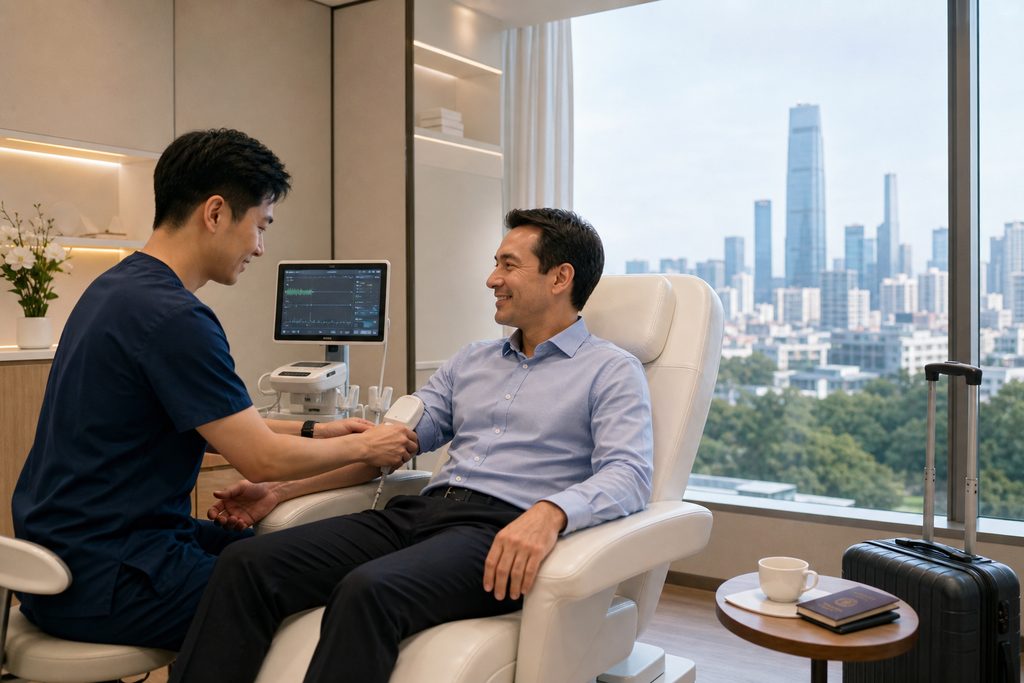
Breast Checkup in China: The Short Answer
You’ve probably heard that getting medical care in China as a foreigner means chaos, language barriers, and mystery pricing. For breast screening, the reality is almost the opposite — if you know which door to walk through. A standard breast checkup in China typically runs $150 to $600 at a top-tier public hospital’s international department, and $400 to $1,200 at a private international clinic. The catch? Public hospitals don’t let you book from overseas through the normal queue. You book through the international wing, or you don’t book at all.
That single distinction — ordinary gate versus international gate — determines your price, your wait time, and whether anyone speaks English to you. Get it right and a breast checkup in China is fast, thorough, and a fraction of what you’d pay in the US. Get it wrong and you’ll spend a morning in a queue of 10,000 people holding a piece of paper you can’t read.
Who This Is Right For — and Who It Isn’t
China’s top hospitals now see a meaningful number of international patients for preventive screening, and breast imaging is one of the more common requests. The equipment is current, the radiologists at major centers read high volumes, and the price gap versus Western markets is real.
Good candidates:
- Women due for routine screening (mammogram, ultrasound, or both) who are already traveling to China, or willing to combine a checkup with a trip
- Patients whose home country has long imaging waitlists — several European systems run 6 to 12 weeks for a non-urgent mammogram
- Women with dense breast tissue who want both mammography and ultrasound in a single visit, which some systems won’t schedule together
- Anyone who wants a written report in English and a follow-up plan before flying home
- Patients combining screening with a broader executive health package at the same hospital
Who should think twice:
- Anyone with a suspicious lump, skin changes, or nipple discharge. That is diagnostic workup, not screening. It moves faster and costs more, and you should not route it through a “package.”
- Women with a known BRCA mutation or a strong family history who are mid-surveillance protocol at home. Interrupting an established imaging schedule to save money is a bad trade.
- Patients who need insurance pre-authorization. Most Chinese public hospitals require payment upfront and give you documentation for later reimbursement. If you can’t float the cost, private clinics with direct billing are the better fit.
- Anyone expecting a same-week appointment with a named professor. International departments coordinate access, but they do not guarantee a specific physician or date.
The Options, Compared
Three routes exist, and they are genuinely different products. Here is how they stack up.
| Route | Typical Cost | Booking Lead Time | English Support | Payment |
|---|---|---|---|---|
| Public hospital, international/VIP department | $150–$600 | 1–3 weeks | Yes, staff interpreter or English coordinator | Pay upfront, receipt for insurance |
| Private international hospital | $400–$1,200 | 3–10 days | Yes, English-speaking throughout | Often direct insurance billing |
| Ordinary public outpatient queue | $60–$200 | Same day, walk-in | Rarely | Cash or local payment app |
Which column suits you? If you’re paying out of pocket and want the best imaging equipment per dollar, the international department of a major public hospital is the sweet spot. If your insurer is involved, or you want a Western-style experience with a private room and a scheduler who answers email in English, go private. The ordinary queue is cheapest and works fine for locals — for a visitor who doesn’t read Chinese, it’s a false economy.
For a broader look at how these hospital tiers differ, our guide to China’s top-ranked hospitals by city breaks down the Fudan Top 100 list, which covers 23 cities and skews heavily toward Beijing (21 hospitals) and Shanghai (18).
What to Actually Book: The Three Standard Packages
This is the part most articles skip. “A breast checkup” is not one thing. Chinese hospitals sell it in tiers, and knowing the tiers is how you avoid overpaying for imaging you don’t need — or underbooking and missing it.
Tier 1 — Basic screening. Bilateral mammogram, usually 2D digital, plus a physician read. Appropriate for average-risk women over 40 with no symptoms. Fast, cheap, done in under two hours.
Tier 2 — Combined screening. Mammogram plus breast ultrasound. This is the standard recommendation for women with dense breast tissue, and it’s the most commonly booked package by international patients. Adds roughly $80 to $200 depending on the hospital.
Tier 3 — Comprehensive breast package. Mammogram, ultrasound, and often a breast MRI or additional tumor-marker bloodwork, bundled with a general physical. Some hospitals fold this into an executive health program that includes cardiac and metabolic screening. Runs $800 to $2,500 at top-tier centers.
If you’re searching for the best breast clinic Shanghai has to offer, the private international hospitals in the city — several of them JCI-accredited with direct insurance billing — are the most foreigner-friendly entry point. Shanghai also hosts a cluster of Fudan-ranked public hospitals whose international departments handle breast imaging routinely. The trade-off is straightforward: private clinics cost more and feel familiar; public international departments cost less and feel busier.
Breast Checkup Cost in China: What Drives the Number
Published package prices are starting points, not final bills. Four variables move the total.
Hospital tier. A Fudan Top 100 hospital’s international department sits at roughly 1.5 to 2 times the ordinary outpatient price for the same scan. You’re paying for the English coordinator, the shorter queue, and often a more senior reader.
Imaging modality. Ultrasound is the cheapest add-on. MRI is the expensive one — it can double or triple a package price on its own, and it’s usually only indicated for specific clinical reasons.
Whether it’s screening or diagnostic. Screening assumes no symptoms. The moment you mention a lump, the hospital reclassifies the visit, adds a consultation, and may order a biopsy. Biopsy pathology adds several hundred dollars and a few days of waiting.
City. Beijing and Shanghai run highest. Chengdu, Wuhan, and Hangzhou can be 20 to 30 percent cheaper for identical protocols at comparably ranked hospitals.
For context on how much a mammogram costs in Beijing specifically: expect $100 to $250 for the scan alone at a public hospital’s international department, or $250 to $500 at a private clinic. Add ultrasound and you’re typically looking at $200 to $450 total. That compares to $250 to $1,000 in the US for a diagnostic mammogram before insurance, and considerably more if you’re uninsured.
Is Breast Screening Safe in China?
Yes, with the same caveats that apply anywhere. Mammography uses low-dose radiation, and the machines at major Chinese hospitals are current-generation units from the same global manufacturers used in Europe and North America. Accreditation matters more than geography — JCI-accredited private hospitals and Fudan-ranked public hospitals operate to international imaging standards.
The real safety question for a foreign patient isn’t radiation. It’s continuity. If your scan finds something, who reads it, who biopsies it, and who follows up after you fly home? That’s why the written English report and a clear recommendation for next steps matter more than the brand on the machine.
Practical Considerations: Records, Visas, and Payment
Bring your prior imaging. If you’ve had mammograms elsewhere, request the discs and reports and carry them with you. Chinese radiologists compare against prior studies when they can, and the comparison meaningfully improves the read. Without priors, a new finding is harder to characterize.
On visas: medical travel to China uses the S2 visa, which covers short-stay private affairs including medical treatment. Stays beyond 180 days fall under S1. Accompanying family members apply for S2 as well. Note that the M visa is for commercial and trade activity and has nothing to do with medical treatment — if a service tells you otherwise, that’s a red flag. Requirements shift, so confirm current documentation with the nearest Chinese embassy or consulate and bring the hospital’s supporting letter.
Payment is the friction point. Most public hospitals want payment before the service and provide receipts you submit to your insurer afterward. Private international hospitals more often bill your insurer directly, which is worth a lot if you’d rather not front the money. Cards are widely accepted at international departments; the ordinary queue often isn’t card-friendly for foreign cards.
Language is the last piece. At a top Chinese hospital, daily outpatient volume can exceed 10,000 people. Signage, forms, and queue systems are in Chinese. An international department solves most of this. If you’re booking a package that includes multiple departments on the same day, a bilingual companion who handles registration, payment, and wayfinding turns a stressful morning into a two-hour errand.
Frequently Asked Questions
Through an international department or private hospital, usually yes — one to three weeks ahead is typical. Through the ordinary public outpatient system, no. Registration happens on the day, in person. This is the single biggest reason foreign patients route through international departments.
Expect $100 to $250 at a public hospital’s international department, or $250 to $500 at a private clinic. Whether insurance covers it depends entirely on your policy and whether the hospital is in-network. Public hospitals generally require upfront payment with receipts for later reimbursement; some private hospitals bill insurers directly.
The hospital will recommend a diagnostic workup, which may include additional imaging, a consultation, or a biopsy. This is a separate process with separate costs and timing, and it can extend your stay. It’s worth asking upfront what the hospital’s diagnostic pathway looks like and roughly what it costs, so a finding doesn’t catch you unprepared.
Medical treatment falls under the S2 visa category for short stays, with S1 for stays over 180 days. Accompanying family members apply under S2 as well. Confirm current requirements with your nearest Chinese embassy or consulate, and bring the hospital’s supporting documentation to your appointment.
Your Next Step
A breast checkup in China is genuinely straightforward once you know that the international department is the door, that combined mammogram-plus-ultrasound is the standard package, and that the written English report is the deliverable that matters most. The savings are real, the equipment is current, and the main variable is how well the logistics are handled.
We are China Medical Services — a coordination team, not a hospital and not a diagnostic service. We don’t read your scans or tell you what they mean. What we do is match you to the right hospital tier for your situation, coordinate the appointment through official international channels, and provide a bilingual companion on the day so registration, payment, and translation aren’t your problem. If a checkup turns into something more, we help with the next step too.
If you’d like to talk through your options before committing to anything, start with a free consultation. No pressure, no obligation — just a clear picture of what’s available and what it costs.
This article is for general information only and is not medical advice. Screening recommendations depend on your age, risk factors, and history. Please consult a qualified physician about your individual situation.
For more medical information and treatment options in China, visit chinamedservices.com (China Medical Services).
