Cardiac Screening in China for Foreigners: Your Complete Heart CT, Calcium Score & Stress Test Booking Guide
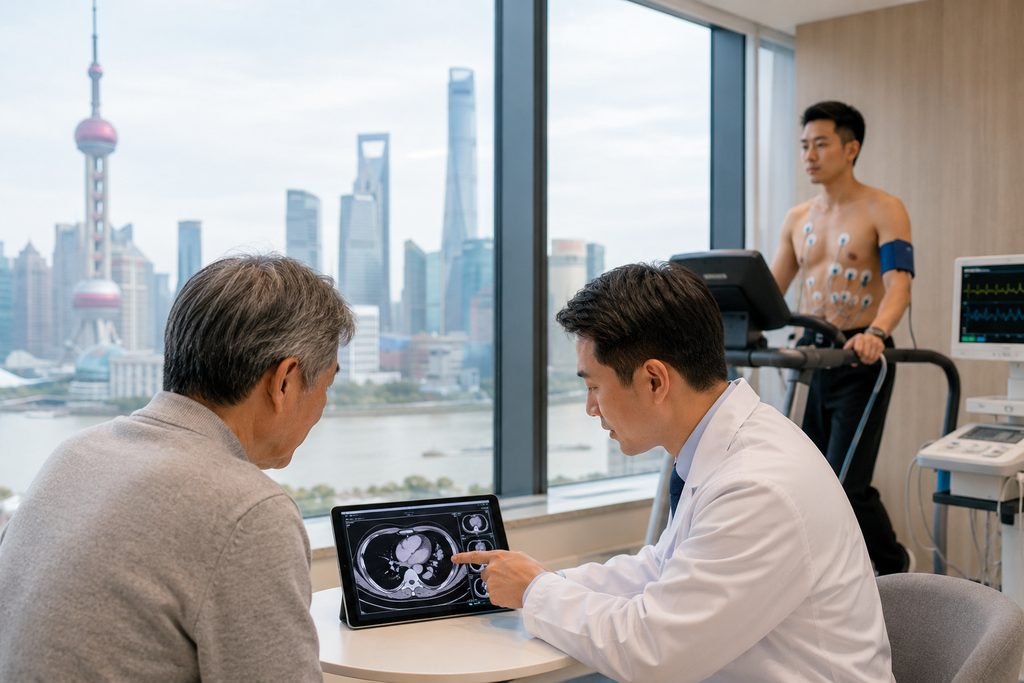
Have you been told the wait for a cardiac stress test is six months? That timeline is not just inconvenient. It can be dangerous.
Key Takeaways
- A coronary calcium score CT scan in China costs between $150 and $400 — roughly 70-85% less than the $1,000-$2,500 charged in the United States, with results often available within 48 hours.
- China’s top cardiac hospitals perform staggering volumes. Fuwai Hospital in Beijing completes over 14,000 cardiac surgeries annually, building a depth of clinical experience few Western centers can match.
- Language barriers and hospital registration systems are real obstacles. Without a bilingual companion, navigating a Chinese public hospital independently is extremely difficult.
- You cannot book a public hospital specialist appointment from overseas through standard channels. Securing a confirmed slot requires coordination through a hospital’s international VIP department.
The Problem: When “Wait and See” Is Not an Option
Cardiovascular disease remains the leading cause of death globally. In the UK, the British Heart Foundation reports that over 7.6 million people live with heart or circulatory diseases. In Canada, patients in some provinces wait an average of 16 weeks just for a consultation with a cardiologist after a referral. That is four months of uncertainty. Four months of anxiety. And for someone with atypical chest pain or a strong family history of early heart attacks, that wait is not a minor inconvenience. It is a gap in care that can have consequences.
The standard cardiac screening pathway in many Western systems looks like this: GP visit, referral letter, wait for a specialist, wait for an imaging slot, wait for results. Each step can take weeks. A heart CT calcium score — a simple, non-invasive scan that measures calcified plaque in coronary arteries — takes fifteen minutes to perform. But getting it scheduled can take months. For international patients who are willing to travel and pay out of pocket, there is another path. China’s top-tier cardiac centers offer rapid-access screening packages at a fraction of the cost. The challenge is knowing how to access them safely.
Who We Are
We are not a hospital. We do not provide medical treatment, interpret your scan results, or offer clinical diagnoses. Our team at China Medical Services functions as your logistical architects — we bridge the gap between you and China’s top-ranked cardiac centers. We handle hospital matching, appointment coordination through official international departments, bilingual medical companions, and visa guidance. Think of us as the people who make sure you walk into the right hospital, see the right specialist, and understand every word spoken along the way. Nothing more, nothing less.
Why Cardiac Screening in China Delivers Results
Clinical Volume That Builds Unmatched Expertise
There is a straightforward relationship between how often a medical team performs a procedure and how good they are at it. China’s top cardiac hospitals operate at a scale that is difficult to visualize. Fuwai Hospital in Beijing, the National Center for Cardiovascular Diseases, performs more than 14,000 cardiac surgeries each year. The cardiology department at Zhongshan Hospital, affiliated with Fudan University in Shanghai, handles an outpatient volume that exceeds 5,000 patient visits daily. This is not a typo. Five thousand. Every single day.
What does that mean for a foreign patient coming for a heart CT calcium score or a stress echocardiogram? It means the technician running your scan has likely performed it thousands of times. The cardiologist reading your results sees more coronary calcium scans in a week than a general radiologist in a small Western hospital might see in a year. Volume drives pattern recognition. Pattern recognition drives diagnostic accuracy. When you are looking for early signs of coronary artery disease, that accuracy matters.
Technology Deployed at Scale
China’s leading hospitals have invested heavily in diagnostic imaging infrastructure over the past decade. A cardiac CT for calcium scoring requires a multi-slice CT scanner — ideally 64-slice or higher for clear, motion-free images of the coronary arteries. The top-ranked hospitals on the Fudan Hospital Ranking list are equipped with 256-slice, dual-source, and even photon-counting CT systems. These are the same Siemens, GE, and Philips machines found in Mayo Clinic or Charité Berlin.
The difference is throughput. A single CT suite in a major Chinese public hospital may scan 80 to 120 patients per day. This operational tempo means appointment slots open up frequently. When we coordinate a booking for an international patient through a hospital’s VIP international department, the turnaround from request to confirmed appointment is often 3 to 7 business days. For someone who has been waiting months at home, that speed is transformative.
Cost Advantage Without Cutting Corners
Let us address the elephant in the room directly. The heart CT calcium score cost China foreigner patients pay is dramatically lower than what they would pay at home. A coronary calcium scan in the United States typically costs between $1,000 and $2,500 without insurance. In Germany, the price ranges from €400 to €800. In China, through a top-tier hospital’s international department, the same scan costs between $150 and $400.
Does lower cost mean lower quality? No. The structural reasons for the price difference are economic, not clinical. Physician salaries, administrative overhead, and facility costs are lower in China. Hospital systems are built for high volume, which spreads fixed equipment costs across more patients. The radiologists reading your scan trained at the same caliber of institutions and publish in the same international journals. The machines are from the same manufacturers. The lower price reflects economics, not compromise.
| Screening Test | China (International Dept) | United States (Self-Pay) | United Kingdom (Private) |
|---|---|---|---|
| Coronary Calcium Score CT | $150 – $400 | $1,000 – $2,500 | £400 – £800 |
| Exercise Stress Test (ECG) | $200 – $450 | $1,500 – $3,000 | £500 – £1,200 |
| Stress Echocardiogram | $350 – $700 | $2,000 – $4,000 | £800 – £1,800 |
| Comprehensive Cardiac Screening Package | $800 – $2,000 | $4,000 – $8,000 | £2,000 – £5,000 |
Prices vary by hospital and case complexity. These are reference ranges, not fixed quotes.
What a Cardiac Screening Package Actually Includes
When international patients search for how to book cardiac screening package China, they often have a vague idea of what they need. Let us clarify what a comprehensive screening typically covers at a top Chinese hospital’s international department.
A standard executive cardiac screening package usually includes: a resting 12-lead ECG, a treadmill exercise stress test or pharmacological stress test if you cannot exercise, a transthoracic echocardiogram to assess heart structure and valve function, and a coronary artery calcium score CT. Some packages add a carotid intima-media thickness ultrasound and comprehensive blood work including lipid panel, high-sensitivity C-reactive protein, and HbA1c. The whole process takes one to two days. Results are reviewed with a cardiologist, often on the same day or within 48 hours.
This is not a replacement for a full cardiac catheterization if you have known significant disease. It is a screening protocol designed for asymptomatic or mildly symptomatic individuals with risk factors — family history, hypertension, elevated cholesterol, smoking history, or simply being over 45 and wanting a baseline.
Is Heart Screening in China Safe for Foreigners?
The question comes up in almost every initial consultation we have. Is heart screening in China safe for foreigners? The short answer is yes, provided you choose the right hospital and do not try to navigate the system alone.
Safety in medical screening has two dimensions. The first is clinical safety: the accuracy of the equipment, the competence of the interpreting physician, the sterility of the environment. At hospitals ranked in the Fudan Top 100 — particularly cardiac powerhouses like Fuwai Hospital, Zhongshan Hospital, and Ruijin Hospital — clinical standards are on par with leading Western centers. These hospitals are JCI-accredited or have passed China’s rigorous Grade 3A hospital evaluation. Their cardiology departments publish in The Lancet, JAMA Cardiology, and the European Heart Journal.
The second dimension is process safety for a foreigner who does not speak Chinese. This is where risk concentrates. A public Chinese hospital is a high-volume, fast-moving environment. Signage is primarily in Chinese. Registration kiosks require a Chinese ID number or a passport scan that staff may not know how to process for a foreigner. Payment counters may not accept international credit cards. If you have a question about your preparation instructions — “Should I take my beta-blocker before the stress test?” — finding someone who can answer you in English at 8:00 AM in a crowded outpatient hall is not guaranteed.
This is not a critique of Chinese hospitals. It is a description of reality. The system was built for a domestic patient population. The international departments at major hospitals exist specifically to bridge this gap, with English-speaking coordinators, streamlined registration, and private waiting areas. Using them is not a luxury. It is the difference between a smooth, safe screening experience and a deeply stressful one.
Best Hospitals for Heart CT Scan China Medical Tourism
When patients ask us about the best hospitals for heart CT scan China medical tourism, we point them to institutions with proven cardiac imaging volume and established international patient pathways. Here are the centers we work with most frequently.
Fuwai Hospital, Beijing. The National Center for Cardiovascular Diseases. This is the highest-volume cardiac center in the world by surgical caseload. Their imaging department runs multiple high-end CT scanners and their cardiologists are sub-specialized in cardiac imaging. If you want your calcium score read by someone who has interpreted tens of thousands of them, this is the place. Their international department handles foreign patients routinely.
Zhongshan Hospital, Fudan University, Shanghai. Ranked consistently in the top tier of the Fudan Hospital Ranking for cardiology and cardiac surgery. Located in central Shanghai, which is often more convenient for international travelers than Beijing. Their cardiac imaging protocols are aligned with American College of Cardiology and European Society of Cardiology guidelines.
Ruijin Hospital, Shanghai Jiao Tong University School of Medicine. Another Shanghai heavyweight with a strong cardiology department and an efficient international medical center. Good option if Zhongshan’s international slots are fully booked.
For patients who prefer a Western-style hospital environment with guaranteed English-speaking staff throughout, private international hospitals like Shanghai United Family Hospital and Jiahui International Hospital offer cardiac screening packages. The cost is higher — typically 1.5 to 2 times the public hospital international department rate — but the experience is closer to what a Western patient expects: carpeted hallways, no crowds, and every staff member speaking English. The CT machines are the same quality. The trade-off is that the interpreting cardiologist may not have the same sub-specialized cardiac imaging volume as a Fuwai or Zhongshan radiologist. For a screening calcium score, this difference is usually negligible. For a complex finding that requires nuanced interpretation, we recommend the top public cardiac centers.
Cardiac Stress Test Price Shanghai International Patient: What to Expect
Shanghai is the most common entry point for international patients. The cardiac stress test price Shanghai international patient visitors encounter breaks down into a few components. At Zhongshan Hospital’s international department, an exercise treadmill stress test with ECG monitoring costs approximately $250 to $400. A stress echocardiogram — where ultrasound imaging is performed before and immediately after exercise to assess wall motion abnormalities — runs $400 to $700. A dobutamine stress echo for patients who cannot exercise costs slightly more due to the medication and monitoring required.
These prices include the procedure itself, the cardiologist’s interpretation, and a written report in English. They do not include the initial consultation fee, which is typically $100 to $200 for an international department cardiologist. If you book a comprehensive screening package, the consultation is usually bundled in.
Compared to the heart ct calcium score cost China foreigner patients pay versus what they would pay at home, the math is straightforward. A flight to Shanghai, three nights in a hotel, and a full cardiac screening package costs less than the screening package alone in the US. That is not an exaggeration. It is arithmetic.
What You Need to Know Before Going Alone
We want to be completely honest about what you will face if you try to arrange cardiac screening in China independently. These barriers are structural, not personal. Understanding them upfront prevents frustration.
- Visa Requirements: Medical treatment in China requires an S2 visa with a notation specifying the medical purpose. This is not a tourist visa. You need an invitation letter from the Chinese hospital confirming your appointment. Obtaining this letter independently — by emailing a hospital’s general inquiries address — is extremely difficult. Most public hospital administrative offices do not respond to English-language emails from individual patients. The international department can issue the letter, but reaching them without a local contact is a challenge. Family members accompanying you also need S2 visas. Do not apply for an M visa. That is for commercial business and will be rejected for medical travel.
- Registration and Payment: Chinese public hospitals use a real-name registration system. You need your passport to register. Payment for international department services is typically required upfront via cash, Chinese UnionPay card, or sometimes WeChat Pay or Alipay. International Visa and Mastercard acceptance is improving but inconsistent. Be prepared with multiple payment methods. Hospital billing codes are in Chinese, which makes insurance reimbursement paperwork a headache if you are handling it alone.
- Language and Navigation: A top public hospital in China can see 10,000 to 20,000 outpatient visits per day. The cardiology department waiting area may have 200 people in it at 9:00 AM. Signs directing you to the CT suite, the ECG lab, and the blood draw station are primarily in Chinese characters. The technician performing your stress test likely does not speak English. If you need to communicate that you are experiencing chest pain during the test, you need someone next to you who can translate instantly and accurately. This is not a nice-to-have. It is a safety requirement.
How We Help You Navigate This
These barriers exist for structural reasons. They are not a reflection of hostility toward foreigners. The Chinese healthcare system simply evolved to serve a domestic population of 1.4 billion people. Our role is to build a bridge across that gap.
Before you travel, we handle hospital matching based on your specific screening needs, medical history, and budget. We coordinate with the hospital’s official international department to secure a confirmed appointment — not a tentative slot, but a real booking with a date and time. We obtain the official invitation letter required for your S2 visa application. We arrange your heart checkup China fast track appointment through the VIP channel, which means a dedicated coordinator meets you at the hospital entrance, walks you through registration, and escorts you to each testing station in the correct sequence. This cuts what could be a two-day maze of queueing and confusion into a half-day or one-day streamlined process.
During your screening, a bilingual medical companion stays with you. They translate every instruction from the stress test technician. They relay your questions to the cardiologist during the results review. They handle payment at each counter so you are not fumbling with an unfamiliar payment app while other patients queue behind you. They make sure your report is printed in English and your images are provided on a CD or USB drive for your home physician.
After you return home, we remain available. If your local cardiologist has questions about the imaging protocol used, we can connect them with the Chinese hospital’s radiology department for clarification. We are not doctors. We do not interpret results. But we make sure the information flows where it needs to go.
Frequently Asked Questions
Yes. At most international departments and private hospitals, you can self-refer for a cardiac screening package. You will still see a cardiologist for a pre-screening consultation as part of the package, but you do not need a referral letter from your home physician. If you have existing cardiac symptoms or a known diagnosis, we strongly recommend bringing your medical records and a referral summary so the Chinese cardiologist has full context.
Through a hospital’s international VIP department, we can typically confirm an appointment within 3 to 7 business days. This assumes you are flexible on the specific hospital and date. If you require a particular cardiologist at a specific hospital, the wait may be longer — up to 2 or 3 weeks. This is still dramatically faster than the multi-month waits common in many Western public systems.
This is the question we encourage every patient to think through before booking. If your calcium score is high or your stress test is abnormal, the Chinese cardiologist will explain the findings and recommend next steps. That could mean additional imaging, a CT coronary angiogram, or a referral for invasive angiography. You have options at that point. You can pursue further workup in China — the same hospital can typically schedule advanced imaging within days. Or you can take your results home and follow up with your local cardiologist. There is no obligation to continue care in China. The screening report and images are yours to take with you. The key is to have a plan for both scenarios before you travel.
The CT equipment used at Fuwai, Zhongshan, Ruijin, and other top-ranked hospitals is manufactured by the same companies that supply leading Western hospitals — Siemens, GE, Philips, Canon. These are modern multi-slice scanners with dose-reduction technology. A coronary calcium score CT is a low-dose scan, typically delivering 1 to 3 millisieverts of radiation. For context, annual background radiation from natural sources is about 3 mSv. The Chinese hospitals follow international protocols for dose optimization. If you are concerned, ask the cardiologist to confirm the estimated dose before the scan.
Absolutely. Most international departments offer comprehensive executive health screening packages that can include cardiac screening plus abdominal ultrasound, chest X-ray, full blood panels, cancer markers, and specialty consultations. Bundling these into a single 1-2 day visit is common and cost-effective. Let us know during the initial consultation what additional screenings interest you, and we will coordinate a package that covers everything in one streamlined visit.
Your Next Step
A coronary calcium score takes fifteen minutes. A stress test takes under an hour. The information they provide — about your real cardiac risk, not a statistical estimate based on population averages — can shape decisions that affect the next twenty years of your life. Waiting months for that information is not mandatory. It is a function of the system you are in.
If you want to explore cardiac screening in China, start with a conversation. No commitment, no pressure. Tell us what you are looking for, your preferred dates, and any specific concerns. We will come back with hospital options, confirmed pricing, and a clear timeline. If it works for you, we move forward. If not, you have lost nothing but the time it took to send an email. Get a free consultation here and we will help you figure out the right path.
Medical Disclaimer: This article is for informational purposes only and does not constitute medical advice. Cardiac screening should be discussed with a qualified physician who understands your personal health history. China Medical Services does not provide medical treatment or clinical diagnoses. We facilitate access to licensed medical professionals and accredited hospitals.
For more medical information and treatment options in China, visit chinamedservices.com (China Medical Services).
