Cataract Surgery China vs UK: Skip Months of NHS Wait
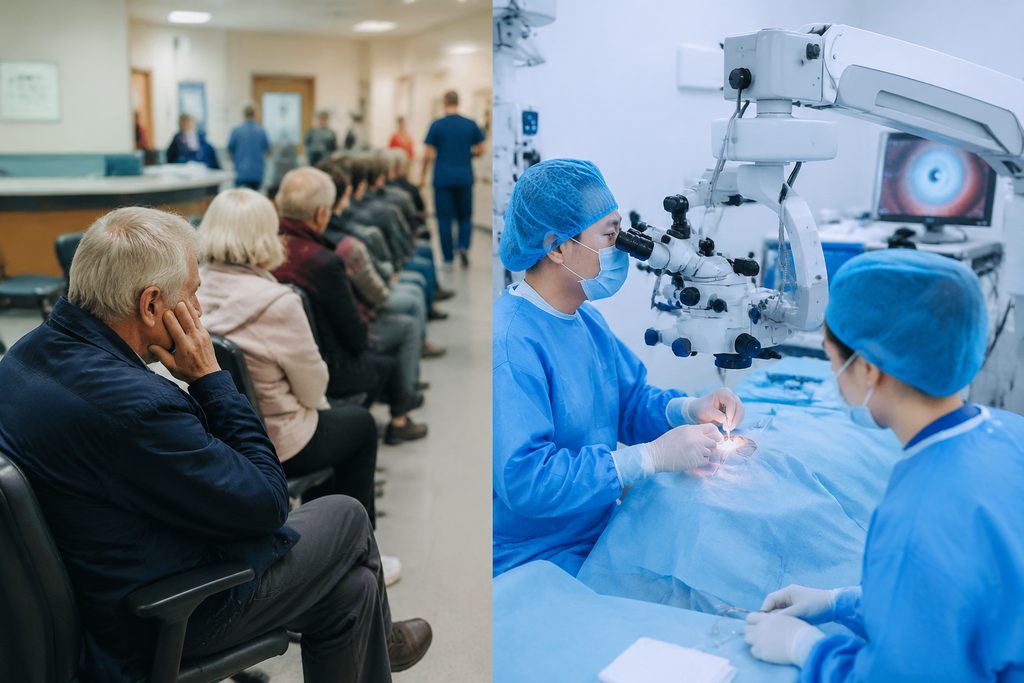
A cataract is simply a cloudy lens inside your eye. Left alone, your world slowly dims, colors wash out, and driving at night becomes a gamble. The fix is straightforward: a surgeon removes the cloudy lens and replaces it with a clear artificial one. In the UK, roughly 330,000 of these procedures happen each year through the NHS. The problem isn’t the surgery. The problem is the queue.
We hear the same story from patients across England: “I was told 9 months.” Then 12. Then “we’ll call you.” When your vision is fading, months feel like years. Some patients start researching alternatives. A growing number look east. The cataract surgery cost China vs UK comparison reveals an option that many hadn’t considered — one where the wait is measured in days, not seasons.
Our team at China Medical Services connects international patients with top-tier Chinese hospitals. We don’t perform surgery. We handle the logistics — hospital matching, appointment coordination, visa guidance, and bilingual support on the ground. Here’s what you need to know if you’re sitting on an NHS waiting list and wondering whether China is a realistic path.
How This Actually Works, Step by Step
The process is less complicated than most people imagine. But it does require a specific sequence. Here’s the real flow, from your current position to post-operative recovery.
Step 1: You send us your records. This means your latest eye examination report, visual acuity measurements, any OCT scans or biometry readings you have, and a brief medical history. If you’ve already been diagnosed with cataracts and told you need surgery, you have most of what’s needed. We arrange certified translation into Chinese.
Step 2: A Chinese ophthalmology team reviews your case. We forward your materials to the international department of a hospital matched to your needs. Their specialists assess whether surgery is appropriate, what lens options suit your eye anatomy, and whether any complicating factors exist — things like high myopia, previous eye surgery, or glaucoma. You receive a written assessment and a treatment recommendation. This is the written second opinion stage.
Step 3: You decide. No pressure. No deposit beyond the consultation fee. You review the proposed surgical plan, the lens options with their costs, and the timeline. If it makes sense, we move to scheduling.
Step 4: We lock in dates and you handle the visa. Once you confirm, our team coordinates with the hospital to secure your surgery slot and pre-operative assessment appointment. You apply for an S2 visa — the short-stay category used for private medical treatment in China. We provide the supporting documentation: hospital invitation letter, treatment confirmation, and itinerary. Processing at the visa centre typically takes 4 to 7 working days. We guide you through it but cannot guarantee approval — that’s the embassy’s decision.
Step 5: You arrive, we meet you. A bilingual medical companion greets you at the airport or your hotel. They accompany you to every appointment: the pre-op assessment, the surgery itself, and the follow-up checks. They translate in real time, handle registration paperwork, and make sure you understand every instruction. You focus on your eyes. We handle the rest.
Step 6: Surgery and recovery. Cataract surgery takes about 15 to 30 minutes per eye. You’re awake — local anaesthetic eye drops, no general anaesthesia. Most patients return to their hotel within a couple of hours. A follow-up exam happens the next day, then again a few days later. Many international patients fly home within a week of the procedure.
Cataract Surgery Cost China vs UK: The Numbers That Matter
Let’s talk money. The NHS provides cataract surgery at no direct cost to the patient — but only if you’re willing to wait. Private cataract surgery in the UK, done at a hospital like the Nuffield Health or Spire network, typically ranges from £2,500 to £4,500 per eye. That’s roughly $3,200 to $5,800 USD. Premium lens options — toric lenses for astigmatism, multifocal lenses for near and distance vision — push the price higher. You’re looking at £3,500 to £5,500 per eye with advanced lens technology.
In China’s top-tier ophthalmology centres, the pricing tells a different story.
| Procedure | UK Private (per eye) | China Top Hospital (per eye) |
|---|---|---|
| Standard monofocal lens cataract surgery | £2,500 – £3,500 ($3,200 – $4,500) | $1,200 – $2,000 |
| Premium multifocal/toric lens surgery | £3,500 – £5,500 ($4,500 – $7,000) | $2,500 – $4,000 |
| Femtosecond laser-assisted cataract surgery | £3,500 – £5,000 ($4,500 – $6,400) | $2,800 – $4,500 |
These are real ranges. They vary by hospital tier, lens manufacturer, and case complexity. The point stands: you can access surgery with premium lens technology in China for roughly what standard surgery costs privately in the UK. Add flights and accommodation — figure another $1,500 to $2,500 depending on your travel style — and the total package still lands well below UK private rates for many patients.
The lens itself drives much of the cost difference. Chinese hospitals source lenses from the same global manufacturers — Alcon, Johnson & Johnson Vision, Bausch + Lomb, Zeiss. The hardware is identical. The pricing reflects different healthcare economics, not different quality.
A Realistic Timeline
Timelines matter more than cost for many patients we speak with. Here’s what a real schedule looks like, including the steps people forget about.
| Stage | What Happens | Duration |
|---|---|---|
| Week 1 | You send records; we arrange translation and forward to hospital | 3–5 working days |
| Week 2 | Ophthalmology team reviews case; written opinion issued | 5–7 working days |
| Week 3 | You confirm decision; we coordinate surgery dates with hospital | 2–5 working days |
| Week 3–4 | Hospital issues invitation letter; you apply for S2 visa | 4–7 working days for visa processing |
| Week 5 | Travel to China; pre-operative assessment at hospital | 1–2 days in-country before surgery |
| Week 5 (day 3–4) | Cataract surgery performed | 15–30 minutes per eye |
| Week 5 (day 4–7) | Post-operative checks; clearance to fly home | 2–3 follow-up visits |
So from first contact to flying home, you’re looking at roughly 5 to 6 weeks. Compare that to the NHS waiting list. The Royal College of Ophthalmologists reported in 2023 that 65% of eye units in England were unable to meet the 18-week referral-to-treatment target for cataract surgery. Some patients wait over a year. The gap is not subtle.
And here’s something many patients ask: how long is the waiting list for cataract surgery in China? For international patients using the hospital international department or VIP channel, the answer is effectively zero. Once your case is reviewed and approved, we schedule around your travel dates. The bottleneck isn’t the hospital’s capacity — China’s top eye centres handle enormous surgical volumes. The bottleneck is your own calendar and visa processing time.
What Can Go Wrong — and What Happens Then
Let’s be direct. Surgery abroad carries risks beyond the procedure itself. Here are the real failure modes for this specific path, and how they’re handled.
Your case isn’t suitable for immediate surgery. The remote review might flag something unexpected — uncontrolled diabetes affecting healing, corneal issues that need management first, retinal problems that change the surgical plan. If the Chinese team says “not yet” or “not this way,” you haven’t lost anything except the consultation fee. You’ve gained a second opinion from a high-volume surgical centre. Some patients discover issues their local assessment missed.
Visa delays or rejection. This is rare with proper documentation but possible. We can’t control embassy decisions. What we do: provide complete, accurate supporting letters and guide you through the application. If the visa is rejected, any coordination fees we’ve charged are refunded. Hospital deposits follow the hospital’s own refund policy, which we clarify before you pay anything.
Complications during or after surgery. Cataract surgery has a very high safety profile — serious complications occur in fewer than 1 in 1,000 cases in experienced hands. But they happen. Posterior capsule rupture, infection, retinal detachment, persistent inflammation. The hospitals we work with manage these complications routinely. The question is follow-up care when you’re back in the UK. We discuss this upfront: you need a UK optometrist or ophthalmologist willing to see you for post-operative checks after your return. This should be arranged before you travel. Most NHS optometrists will see post-surgical patients, but confirm this. Don’t assume.
Language barriers in an emergency. Our bilingual companion is with you during all scheduled appointments. But what about the 3 a.m. worry at your hotel? We provide 24-hour phone support. For any medical concern, the companion coordinates directly with the hospital. You’re never alone trying to explain eye pain through a translation app.
Is Cataract Surgery in China Safe for UK Patients? Evaluating the Evidence
The question behind the question is simple: “Will I be blinded by bargain surgery?” It’s a fair concern. Medical tourism horror stories exist. So let’s look at what’s actually in place.
China’s top ophthalmology centres are not back-alley clinics. They are massive, high-throughput surgical departments embedded in university teaching hospitals. A centre like the Eye & ENT Hospital of Fudan University in Shanghai performs tens of thousands of cataract procedures annually. Their surgeons do more cases in a month than many UK consultants do in a year. Volume correlates with outcomes — multiple studies, including a 2018 analysis in Ophthalmology, have shown that higher surgeon volume predicts lower complication rates in cataract surgery.
Infection control protocols at Joint Commission International (JCI)-accredited hospitals in China follow the same standards you’d find in London or Singapore. The instruments are sterilised to international specifications. The intraocular lenses are the same FDA-approved or CE-marked products used in UK private hospitals. The phacoemulsification machines — the devices that break up and remove the cataract — are the same Alcon Centurion or Johnson & Johnson Signature models.
So the question is cataract surgery in China safe for UK patients has an answer that depends entirely on which hospital you choose. A top-10 ophthalmology department at a Fudan-ranked hospital? Yes, the safety profile is comparable to good private centres internationally. A random clinic with no international accreditation? We wouldn’t send you there, and you shouldn’t go.
Our hospital database covers 340+ top-ranked institutions across 37 cities. For ophthalmology, we match patients to departments ranked among China’s best, with English-speaking international departments accustomed to treating overseas patients. You can browse eye hospitals and ophthalmology rankings on our specialty departments page.
Practical Considerations: Records, Visas, Payment, and Follow-Up
Beyond the surgery itself, several practical layers determine whether this path works smoothly.
Medical records. You need a recent (within 3 months) eye examination. At minimum: visual acuity, slit-lamp examination, intraocular pressure, and dilated fundus exam. Ideally, you also have corneal topography if astigmatism is present, and optical biometry (IOL Master or Lenstar) for lens power calculation. If you don’t have biometry, the Chinese hospital will perform it during your pre-op assessment — but having it beforehand helps the remote review team give you a more precise recommendation.
Visa category. The correct visa is S2, with the purpose noted as private medical treatment. This is not an M visa — M is for commercial and trade activities, and using it for medical travel risks refusal or complications at the border. We provide the hospital’s official invitation letter specifying your treatment dates and purpose. Processing typically takes 4 to 7 working days at the visa centre. Apply at least 3 weeks before your intended travel.
Payment. Chinese public hospitals require prepayment. You deposit funds at the hospital cashier upon registration, and costs are deducted as services are provided. Any remaining balance is refunded at discharge. Credit cards are accepted at international departments. Private international hospitals like United Family may offer direct insurance billing — check your policy. Most UK private medical insurance does not cover elective surgery abroad, but some international policies do. Verify before you commit.
Follow-up at home. The standard post-operative regimen: antibiotic and anti-inflammatory eye drops for 3 to 4 weeks, with tapering. You’ll need a UK optometrist or ophthalmologist to check your eye pressure and healing at roughly 1 week and 1 month after surgery. Arrange this before you travel. The Chinese hospital provides a detailed discharge summary in English for your UK provider. This continuity plan is non-negotiable — don’t skip it.
Language. Our bilingual companion eliminates the daily friction. But you should know: outside the hospital’s international department, English is not widely spoken in Chinese public hospitals. The corridors are crowded, the signage is in Chinese characters, and the queuing system assumes local knowledge. This is exactly why the companion service exists. For a half-day or full-day rate, you have someone who navigates all of it. You sit in the waiting area. They handle the chaos.
Frequently Asked Questions
Not quite immediate — but close. After your records are reviewed and approved (roughly 1 to 2 weeks), we can typically schedule your surgery within 2 to 3 weeks of your preferred travel date. The limiting factor is usually your visa processing time and flight availability, not the hospital’s surgical calendar. Some patients searching for book cataract surgery package China immediate appointment expect next-day surgery upon arrival. That’s not how it works. You need a pre-operative assessment first — measurements, consent, lens selection confirmation. Figure 2 to 3 days in-country before the actual procedure.
Several centres stand out for their ophthalmology departments and international patient services. The Eye & ENT Hospital of Fudan University in Shanghai is consistently ranked among China’s top ophthalmology institutions. Beijing Tongren Hospital‘s ophthalmology department is another heavyweight, with enormous surgical volume. For a more Western-style experience with English-speaking staff throughout, JCI-accredited private hospitals like United Family Healthcare offer cataract surgery with direct insurance billing and hotel-like facilities. The best eye hospitals China for international patients cataract depend on your priorities: pure clinical volume, international accreditation, or a blend of both. We match based on your specific needs and lens preferences.
The NHS has an obligation to treat you if you present with a medical problem, regardless of where the original surgery was performed. If you develop post-operative complications — raised eye pressure, cystoid macular oedema, suspected infection — your GP can refer you to an NHS ophthalmology service, or you can present to an eye casualty department. The key is having your Chinese medical records translated and summarised in English, which we ensure you receive before departure. That said, the NHS will not provide routine follow-up for surgery done privately abroad. You need to arrange that privately with a UK optometrist or ophthalmologist. Budget £150 to £300 for post-operative checks.
How do I know the lens they implant is genuine?
Every intraocular lens comes with a unique serial number and a manufacturer sticker that is placed in your medical record. At top Chinese hospitals, you can ask to see the lens packaging before implantation. The lens is opened in front of you in the operating theatre. This is standard practice
For more medical information and treatment options in China, visit chinamedservices.com (China Medical Services).
