Child Allergy Testing in China: The Basics for International Parents
Child Allergy Testing in China: The Basics for International Parents
What does child allergy testing cost China parents who travel from abroad? At top public hospitals, a full pediatric allergy panel typically runs $150 to $450 — a fraction of the $1,000 to $3,000 billed in the United States. That single number is why so many families start searching. The fuller answer involves which hospital, which panel, and how quickly you need results.
Watching a child sneeze through every spring, break out in hives after a new food, or struggle to breathe during a cold is exhausting. You want answers, not another six-week wait for a referral. China’s largest hospitals now see thousands of pediatric allergy cases each year, and the testing itself is fast, standardized, and internationally comparable. What follows is how the process actually works — including the parts that are genuinely inconvenient.
Child Allergy Testing in China: The Short Answer
Testing is available, reliable, and inexpensive by Western standards. A skin prick test for 10 to 20 allergens takes about 20 minutes in the clinic. Blood-based specific IgE panels take longer to process — usually same-day to 48 hours at large hospitals, sometimes three to five days at smaller ones. Results come with a written report you can carry home.
The complication is access, not quality. Most public hospital outpatient departments in China do not accept advance online bookings from overseas. You register on the day, in person, in Chinese. Pediatric allergy clinics at the biggest children’s hospitals fill up early. That structural reality shapes everything else in this guide.
Who This Is Right For — and Who It Isn’t
China is a reasonable choice for a specific set of families. It is not the right answer for everyone, and pretending otherwise wastes your money and your child’s patience.
Good candidates typically include:
- Families already traveling to China for work, family, or another medical appointment
- Children with a clear history of allergic rhinitis, asthma, eczema, or suspected food allergy who need a comprehensive panel
- Parents facing long waits or high out-of-pocket costs at home for the same tests
- Families who want a second read on an existing diagnosis, with records reviewed by a Chinese pediatric allergist before travel
Who should probably stay home:
- Any child in an active severe reaction, or with a history of anaphylaxis requiring recent emergency care — stabilize locally first
- Infants under six months, where testing has limited interpretive value and results are hard to act on
- Families seeking a specific brand-name treatment unavailable in China — verify availability before booking anything
- Anyone hoping to skip the in-person visit. Testing requires the child present. No exceptions.
One more honest point. If your child’s symptoms are mild and seasonal, and your local clinic can test within a month, the trip rarely makes financial sense once flights and hotels are counted. China’s advantage is depth and speed for families already motivated to travel.
The Options, Compared
Where you test changes the price, the wait, and the language you’ll hear in the room. Here is how the three realistic paths stack up.
| Option | Typical Cost (Panel) | Booking | English Support | Results Turnaround |
|---|---|---|---|---|
| Public tertiary children’s hospital, standard clinic | $150–$350 | Same-day queue, in person | Limited; interpreter usually needed | Same day to 48 hours |
| Public hospital international / VIP department | $300–$600 | Can often be arranged in advance | Yes, English-speaking staff | Same day to 48 hours |
| Private international hospital | $500–$1,200 | Online booking, appointment times | Yes, full English service | 24 hours to 5 days |
Which column fits you? If budget is the priority and you have a Chinese-speaking companion, the standard public clinic delivers the same laboratory quality for a third of the price. If your child is anxious, or you cannot manage a four-hour registration queue with a toddler, the international department is worth the premium. The private route buys convenience and direct insurance billing, not better science.
What a Pediatric Allergy Workup Actually Involves
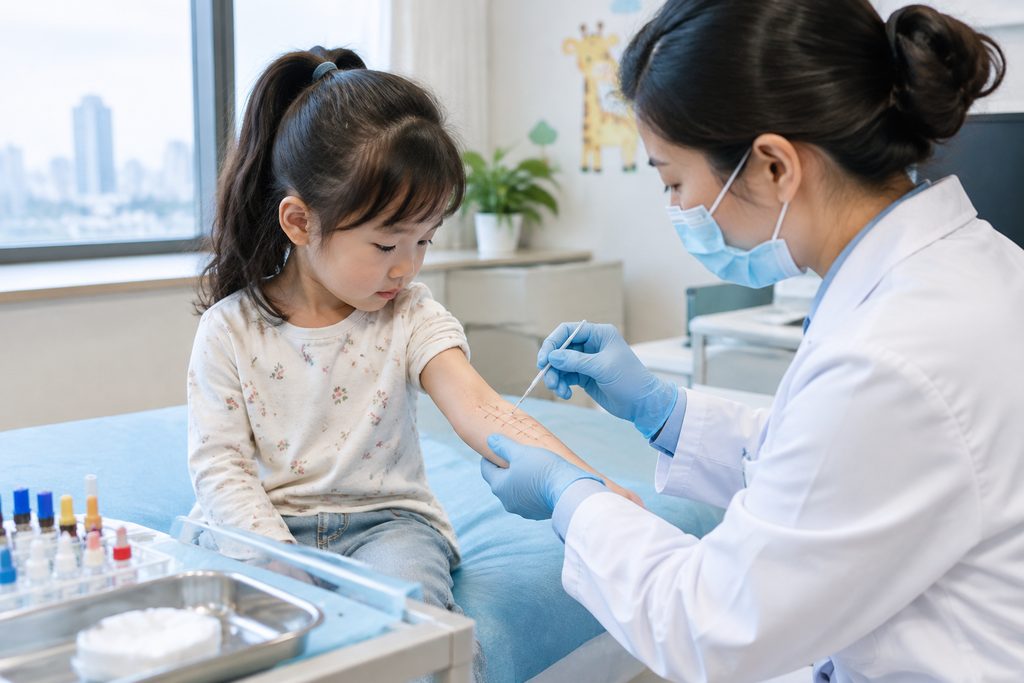
Two test types dominate. Skin prick testing places tiny drops of allergen extract on the forearm or back, then lightly scratches the surface. Results appear in 15 to 20 minutes as a wheal — a small raised bump. It stings briefly. Most children tolerate it better than a blood draw.
Specific IgE blood tests measure antibody levels against individual allergens. They are preferred when a child has widespread eczema, is on antihistamines that would blunt a skin test, or has a history of severe reactions. A typical children’s allergy panel covers common foods (egg, milk, peanut, soy, wheat, shellfish), inhaled allergens (dust mite, cat, dog, cockroach, mold spores), and seasonal pollens.
Expect the visit to include a structured history: when symptoms start, what triggers them, what happens at night, family history of atopy. Chinese pediatric allergists are thorough here, and this history often matters more than the numbers. A positive result without matching symptoms is common and does not automatically mean your child must avoid that food. Ask explicitly what the result means for daily life.
What It Costs and How Long It Takes
Testing charges at public hospitals are set by provincial pricing schedules, which keeps them predictable. A skin prick panel for 10 to 20 allergens generally lands between $80 and $200. A blood IgE panel covering 10 to 20 items runs $150 to $450. Adding a consultation fee, registration, and any follow-up pushes a typical public-hospital visit to roughly $200 to $550 total.
Private international hospitals charge more for the same tests, commonly $500 to $1,200 including the physician consult. The gap pays for scheduling, English service, shorter waits, and insurance paperwork.
Timing breaks down like this. Registration and queueing: one to three hours at a busy public hospital. Consultation: 15 to 30 minutes. Skin test: 20 minutes plus a 15-minute observation. Blood draw: five minutes, with results in one to five days depending on the hospital’s laboratory. A realistic single-day visit runs half a day. If you need results before flying home, confirm the laboratory’s turnaround in writing beforehand.
Practical Considerations: Records, Visas, and Language
Documentation matters more than most parents expect. Bring your child’s immunization record, any prior allergy test reports, a medication list with generic names, and growth charts if available. Chinese specialists read English lab reports without difficulty, but a translated summary of past diagnoses speeds things up.
On visas: the correct category for a short medical visit is the S2 visa, which covers medical treatment and private affairs, with accompanying family members applying under the same category. The M visa is for commercial and trade activity and has nothing to do with medical care — do not let anyone tell you otherwise. Requirements shift, so confirm current documentation with the nearest Chinese embassy or consulate and allow several weeks. If a stay beyond 180 days is anticipated, S1 applies instead.
Payment is another practical wrinkle. Public hospitals generally require prepayment, with insurance reimbursed afterward. Private international hospitals frequently bill insurers directly. Check your policy’s overseas coverage before you book, and ask whether itemized English receipts are provided — they usually are, and you will need them for reimbursement.
Language is the real friction point. Top Chinese hospitals see enormous daily volumes, and signage, registration systems, and pharmacy instructions are in Chinese. A parent managing a tired child cannot also manage a registration queue in a second language. This is precisely where a bilingual medical companion earns their fee: handling registration, queueing, payment, wayfinding, and translation while you focus on your child.
For families comparing destinations, our overview of top-ranked Chinese hospitals by city shows where pediatric services concentrate. Beijing and Shanghai carry the deepest pediatric allergy expertise; Guangzhou and Chengdu are strong alternatives with shorter queues.
Frequently Asked Questions
Yes. Skin prick and blood IgE testing are standard, low-risk procedures performed daily at major Chinese hospitals. The main risks are the same everywhere: brief discomfort, occasional itching at the test site, and — rarely — a systemic reaction that clinic staff are trained to manage. Testing should always be done where resuscitation equipment and trained personnel are immediately available, which is the case at tertiary hospitals.
Skin prick results are read within 20 minutes. Blood IgE panels typically return in 24 to 48 hours at large hospitals, though smaller facilities may take three to five working days. If you are flying home soon, confirm the laboratory’s specific turnaround before your appointment rather than assuming.
At standard public hospital clinics, generally no — registration happens in person on the day, and surgical or procedural bookings require an in-person consultation first. International and VIP departments, along with private international hospitals, can often be arranged in advance. This is the single biggest reason families choose the international route.
Usually, yes. Chinese tertiary hospitals issue structured reports with numerical values and reference ranges that Western allergists can interpret directly. Ask for the report in English, and request the raw values rather than a summary alone. Some clinicians prefer to repeat testing on their own platforms, which is their prerogative — but the Chinese results give you a solid, immediate baseline.
Testing is the starting point, not the endpoint. If immunotherapy, medication adjustment, or dietary management is recommended, discuss the follow-up plan before you leave China, and ask for a written summary you can hand to your physician at home. Any decision about starting treatment belongs with a qualified clinician who has examined your child.
Your Next Step
Child allergy testing in China is fast, well standardized, and dramatically cheaper than equivalent testing in the US or Western Europe — but the logistics of registration, language, and hospital navigation are real obstacles that trip up unprepared families. Knowing which hospital tier fits your budget and how the S2 visa and appointment system actually work removes most of the friction before you book a flight.
China Medical Services is a coordination service, not a hospital and not a provider of medical advice. We help international families understand their options, arrange written second opinions, and connect them with appropriate departments at JCI-accredited international hospitals and public tertiary centers. If you would like a clear picture of what testing would involve for your child, start with a free consultation — no pressure, and no obligation to travel.
This article is for general information only and does not constitute medical advice. Allergy testing and any treatment decisions should be made with a qualified physician who has evaluated your child in person.
For more medical information and treatment options in China, visit chinamedservices.com (China Medical Services).
