Child Vision Checkup in China: A Parent’s Guide to Costs and Clinics
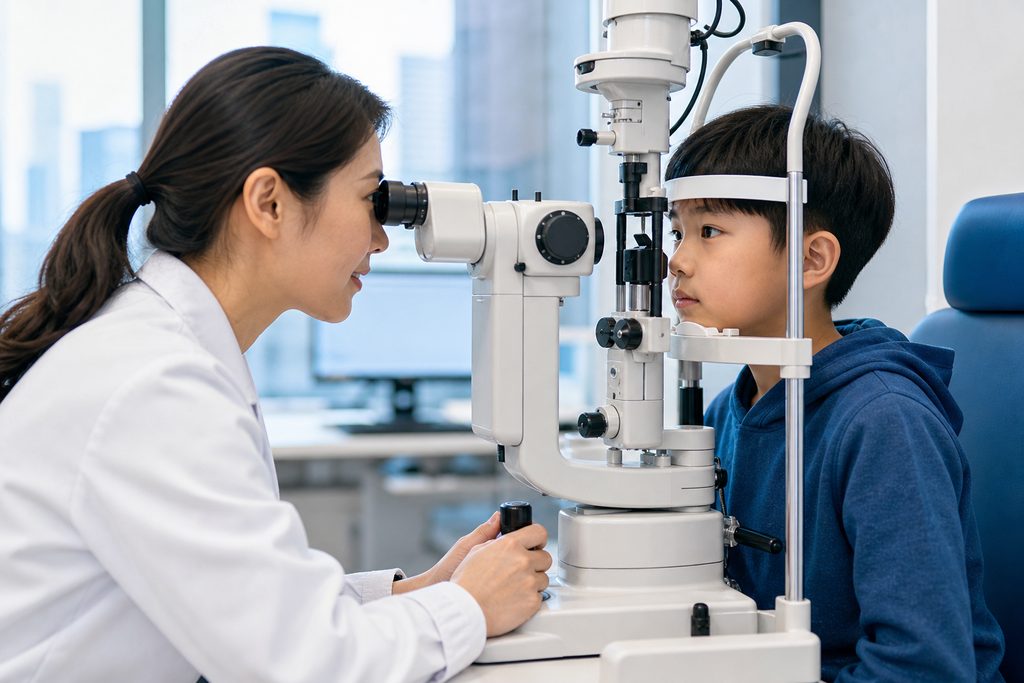
When Sarah’s seven-year-old son started squinting at the whiteboard, her optometrist in Portland handed her a referral and a three-month wait. She began researching a child vision checkup cost China option almost by accident — and discovered that a full pediatric ophthalmology workup at a top-tier Chinese hospital could be arranged in days, not months, for a fraction of what her insurance deductible would swallow.
Sarah’s situation is not unusual. Families who contact us often arrive with the same three questions: what does it cost, where should we go, and is it safe? This guide answers all three. We are not doctors, and nothing here replaces an examination by a qualified ophthalmologist. What we can do is explain how the system actually works, so you can decide whether it fits your family.
Child Vision Checkup Cost China: The Short Answer
A comprehensive pediatric eye exam at a top-ranked Chinese public hospital typically runs $50 to $150 out of pocket, including refraction, slit-lamp examination, and dilated fundus check. At a private international clinic, expect $150 to $400. Compare that to $200–$500 in the United States before insurance, and the arithmetic becomes obvious.
But cost is the easy part. The harder question is access. Chinese public hospitals generally do not allow overseas patients to book a standard outpatient slot in advance. You register on the day, in person, in a queue that can start before dawn. That single rule reshapes everything about how you plan a trip.
Key takeaway: The examination itself is inexpensive. The real cost driver is how you access it — standard queue versus international department — and whether you need a bilingual companion to navigate a hospital that may see 10,000 outpatients a day.
Who This Is Right For — and Who It Isn’t
Medical travel for a child’s eyes is not for everyone. Being honest about that up front saves families a lot of wasted effort.
Typically a good fit:
- Families already traveling to China for work, family, or another medical reason
- Children needing a second opinion on a diagnosis such as amblyopia, strabismus, or a suspected retinal condition
- Expats and long-stay visitors who want a thorough workup without a months-long wait
- Parents seeking a baseline exam plus spectacles at a fraction of Western retail prices
Probably not the right choice:
- Any child with an acute eye injury, sudden vision loss, or suspected infection — go to the nearest emergency department, wherever you are
- Families whose child cannot tolerate a long, crowded, unfamiliar environment
- Anyone expecting a Western-style appointment experience at a public hospital price
- Cases requiring complex surgery where continuity of post-operative care at home matters more than the initial procedure
If your child falls into the second list, staying home is genuinely the better call. We would rather tell you that than sell you a trip.
The Options, Compared
Three realistic pathways exist for a foreign family. Each has a different price, pace, and level of hand-holding.
| Pathway | Typical Exam Cost | Booking | English Support | Best For |
|---|---|---|---|---|
| Public hospital, standard queue | $50–$150 | Same-day, in person only | Limited | Chinese-speaking families, flexible schedules |
| Public hospital international / VIP department | $150–$350 | Advance coordination possible | Yes | Overseas families wanting a named specialist |
| Private international clinic | $150–$400 | Online booking, often same week | Yes, fully | Short visits, insurance direct billing |
Which column suits you depends on two things: how much time you have in China, and whether anyone in your party speaks Mandarin. The international department route — roughly 1.5 to 2 times the standard price — is the middle ground most of our families choose. It buys you a pre-arranged slot and a doctor who can explain findings in English.
For a broader look at how hospital tiers differ, our directory of top-ranked Chinese hospitals by city groups facilities by ranking tier so you can see what exists in each city before you commit.
Finding the Best Pediatric Eye Clinic Shanghai and Beyond
Shanghai is the most common entry point for families, and for good reason. The city hosts several of China’s strongest ophthalmology departments, and the international infrastructure is mature. If you are searching for the best pediatric eye clinic Shanghai can offer, look at hospitals that appear on the Fudan specialty reputation ranking for ophthalmology — a list that names the top ten hospitals per specialty nationwide.
Beijing, Guangzhou, and Chengdu also have serious pediatric eye capacity. The Fudan Top 100 general ranking is concentrated in 23 cities, with Beijing holding 21 hospitals and Shanghai 18. That concentration matters: outside these hubs, English-language pediatric eye care gets thin fast.
Two practical notes. First, pediatric ophthalmology is a subspecialty — a general ophthalmologist may not be the right fit for a squinting six-year-old. Second, hospital websites are rarely updated in English. Our specialty directory listing the top ten hospitals per department is a faster starting point than guessing at search results.
Tip: If your child needs spectacles, ask about the prescription process during the same visit. Optical dispensing inside a Chinese hospital is usually fast and inexpensive, but the queue is separate from the exam queue.
How Much Does a Child Eye Exam Cost in China — and What Drives the Variance
The ranges above hold for routine exams. Several factors push the number up or down.
- Dilation and imaging. A basic refraction is cheap. Optical coherence tomography, visual field testing, or cycloplegic refraction for a young child adds cost.
- Department tier. Standard, international, and private departments price differently for the same test.
- City. Beijing and Shanghai run higher than Chengdu or Xi’an.
- Companion services. If you need a bilingual medical companion, that is a separate line item — from $300 per day for a half or full day of registration, queueing, payment, wayfinding, and interpretation.
- Follow-up visits. Amblyopia management is not one appointment. It is a series.
All figures here are indicative. Final pricing always varies by hospital and case complexity, and only the hospital can quote you precisely after seeing your child.
Practical Considerations: Records, Visas, and Payment
Bring every prior record you have. Refraction prescriptions, school vision screening results, prior imaging, and any diagnosis letters — translated into Chinese where possible. A Chinese specialist working from a complete file reaches a conclusion faster, and you may avoid repeating tests you already paid for at home.
On visas: foreign nationals traveling to China for medical treatment typically use the S2 visa, which covers short-stay medical treatment and private affairs, subject to the latest embassy or consulate requirements and supporting hospital documents. Accompanying family members apply under the same category. Note that the M visa is for commercial and trade activity and has nothing to do with medical care — if a service tells you otherwise, walk away. Stays beyond 180 days fall under S1 instead. No visa outcome is guaranteed in any case.
Payment is another friction point. Chinese public hospitals require prepayment; insurance reimbursement happens afterward, in your home country. Private international clinics more often offer direct billing with international insurers. Check your policy before you travel, not after.
Language remains the biggest practical hurdle. A top Chinese hospital can process tens of thousands of outpatient visits in a single day. Signage, registration kiosks, and pharmacy counters assume Mandarin. This is exactly the gap a bilingual medical companion fills — not medical advice, just navigation.
One more consideration: follow-up after you return home. Ask the treating ophthalmologist to write findings in a format your home optometrist or pediatrician can act on. A clear discharge summary prevents your child’s care from restarting from zero.
Frequently Asked Questions
For routine examinations at a ranked public hospital or a JCI-accredited international clinic, the clinical standards are comparable to Western centers, and equipment is current. The realistic risks are logistical, not medical: crowding, language barriers, and difficulty following up if something unusual is found. If your child has an acute or complex condition, weigh continuity of care carefully before traveling.
You generally cannot book a standard public hospital outpatient slot from abroad — those are same-day, in person. Advance coordination is possible through a hospital’s international or VIP department, or through a private international clinic’s online booking. A coordination service can handle registration and card creation on your behalf, though any eventual admission remains subject to hospital rules.
Rarely for routine vision screening, which most travel policies exclude. Some international health plans reimburse diagnostic exams if medically indicated. Public hospitals require you to pay upfront and claim later; some private clinics bill insurers directly. Verify coverage in writing before departure.
The examination itself is usually 30 to 60 minutes. Budget two to four hours for the whole hospital visit once registration, payment, dilation waiting time, and pharmacy are included. Dilation can blur your child’s near vision for several hours, so plan a quiet afternoon afterward.
Yes, and many families do. Schedule the hospital visit early in your stay so any follow-up can happen before you fly home, and keep the day after the exam light in case of dilation or fatigue.
Your Next Step
The core message is simple: a thorough child vision checkup in China is affordable and clinically sound, but the logistics — booking, language, payment, follow-up — are where families get stuck. Knowing that in advance is most of the battle.
We are China Medical Services, a coordination service, not a hospital. We do not diagnose, treat, or promise clinical outcomes. We help families match with appropriate hospitals, arrange appointments through official international departments, and provide bilingual companions on the ground. If you would like to talk through your child’s situation with no obligation, start with a free consultation and we will tell you honestly whether a trip makes sense.
For more medical information and treatment options in China, visit chinamedservices.com (China Medical Services).
