Family Airport Meet and Greet Service China: Coordinating Multiple Arrival Times Without Chaos
Key Takeaways
- A dedicated family airport meet and greet service in China coordinates staggered arrivals, sparing you the stress of navigating multiple terminal pickups while managing a patient.
- The family airport meet and greet china price typically starts from $200 round-trip, though multi-vehicle or overnight coordination adds complexity and cost.
- China’s major airports — Beijing Capital, Shanghai Pudong, Guangzhou Baiyun — are among the world’s busiest. Without pre-arranged ground support, reuniting a family spread across different flights can consume hours.
- Medical travel adds urgency. A missed connection between arrivals means a patient waiting alone. Understanding how the logistics work before you book flights changes everything.
The Problem: Your Family Lands in Three Different Terminals. Now What?
Beijing Capital International Airport handled over 100 million passengers in 2019. Shanghai Pudong processed roughly 76 million that same year. These are not regional airstrips. They are sprawling complexes where Terminal 1 and Terminal 3 at Capital Airport sit nearly 3 kilometers apart — a 10-minute drive without traffic, and far longer during peak hours.
Now picture this. Your father lands at Terminal 3 from San Francisco at 4:30 PM. Your sister’s flight from London arrives at Terminal 2 forty minutes later. You are already inside the terminal with your mother, who is scheduled for a cardiac evaluation at Fuwai Hospital the following morning. Three people. Two terminals. One patient who cannot be left unattended.
This is not a hypothetical scenario. We see it every month. Families flying in from different continents for a loved one’s medical treatment in China. The flights never align perfectly. And the person who needs the most support — the patient — is often the first to land, waiting in a foreign airport with limited mobility and no Mandarin.
The stress compounds fast. Chinese airports require passport checks at multiple points. SIM cards need purchasing. Luggage carousels span entire halls. A wheelchair request made through the airline does not automatically transfer to the arrivals hall greeter. Someone has to coordinate all of this, in real time, across terminals, often in a language the family does not speak.
Most families try to self-organize. One person runs between terminals. Another stays with the patient. Phones die. WiFi requires a Chinese phone number for SMS verification. The carefully planned reunion unravels before it even begins.
Who We Are
We are not a hospital. We do not provide medical treatment or clinical diagnoses. Our team acts as logistical architects for international families navigating China’s healthcare system. We handle the ground-level coordination — airport meet and greet, hospital appointment scheduling, bilingual medical companionship — so that you focus on what matters: your family member’s health. We connect patients with over 340 top-ranked hospitals across 37 cities. But before any consultation happens, someone needs to get your family from the arrivals gate to the hotel, together, without incident. That is where we start.
What a Family Airport Meet and Greet Service Actually Coordinates
The term “meet and greet” sounds simple. A driver holds a sign. You get in a car. Done.
That works for a solo business traveler. It collapses when applied to a family medical journey involving multiple flights, terminals, and a patient who may be fatigued, in pain, or anxious about the days ahead.
A properly structured family arrival service in China handles several moving parts simultaneously. Understanding these layers is what separates a smooth first day from a nightmare.
Flight Tracking Across Multiple Arrivals
Real-time flight monitoring is the foundation. Your father’s flight from San Francisco may land 40 minutes early. Your sister’s connection through Doha might delay by an hour. The ground team needs to track all inbound flights simultaneously and adjust pickup sequences on the fly.
Chinese airports do not allow non-ticketed individuals past immigration. The greeter waits in the arrivals hall, behind the customs exit. If two family members land at different terminals within 30 minutes of each other, a single greeter cannot be in two places at once. The service must deploy two greeters — or stage one arrival in a lounge while the other is retrieved.
This is where the family airport meet and greet china price reflects operational reality. A basic single-arrival pickup costs less because it requires one greeter, one vehicle, one time window. Coordinating multiple arrivals means parallel staffing. The cost rises accordingly, typically starting from $200 round-trip for straightforward cases and scaling with complexity.
Terminal Logistics and Inter-Terminal Transfers
Beijing Capital Airport has three terminals. Terminal 3 handles most international flights, including Air China, United, and Lufthansa. Terminal 2 serves China Southern, KLM, and several others. They are not connected by a walkway. You need a vehicle or the airport shuttle bus, which runs every 10-15 minutes but requires navigating ticket machines in Chinese.
Shanghai Pudong has two main terminals — T1 and T2 — plus a satellite concourse accessible by underground train. A family arriving on two different airlines can easily end up 20 minutes apart, even within the same airport.
A coordinated vip family arrival service beijing airport cost factors in these transfers. The price includes not just the vehicle, but the greeter who escorts each arriving family member from the customs exit to the vehicle, and in some cases, between terminals to reunite the group before departing for the hotel.
The Patient’s Immediate Needs
Medical travel changes the airport equation. A patient arriving for orthopedic surgery may need wheelchair assistance from the gate. A cardiac patient should not be hauling luggage. Someone traveling for oncology treatment may be immunocompromised and need to avoid crowded shuttle buses.
The meet and greet team coordinates with the airline beforehand to confirm wheelchair requests. They position the vehicle as close to the arrivals exit as possible. They bring bottled water, portable phone chargers, and — critically — a Mandarin-speaking team member who can communicate with airport staff if something goes wrong.
One detail families consistently overlook: Chinese airports have medical stations, but staff rarely speak English. If a patient feels unwell upon landing, the greeter becomes the communication bridge between your family and airport medical personnel. This alone justifies the service for many of our clients.
How to Coordinate Family Airport Pickup with Different Flights in China
The operational sequence matters. Here is how a well-designed service manages the logistics.
Step One: Pre-Arrival Briefing
At least 72 hours before the first flight lands, the ground team collects every arrival’s flight number, scheduled landing time, terminal, and any special assistance requests. This is not a formality. It allows the team to map terminal assignments and identify conflicts — two arrivals within 20 minutes at opposite ends of the airport, for instance — and propose solutions before anyone boards a plane.
The team also confirms the hotel or hospital destination. If the patient is heading directly to a hospital international ward, the vehicle routing changes. Some hospitals in Beijing’s Haidian district are an hour from Capital Airport in traffic. Shanghai’s Huashan Hospital sits in the former French Concession — narrow streets, unpredictable drive times. The greeter plans accordingly.
Step Two: Staggered Deployment
On arrival day, the ground team positions greeters at each terminal before the first flight lands. If two flights arrive at the same terminal within an hour, one greeter may handle both, escorting the first arrival to a VIP lounge while waiting for the second. If flights arrive at different terminals simultaneously, two greeters work in parallel.
The vehicles stage in short-term parking. For a family of four with luggage, a minivan or SUV is standard. For larger groups, two vehicles may be necessary. This is another factor in the book airport meet and greet for family shanghai pricing — vehicle size and quantity directly affect the quote.
Step Three: The Reunion
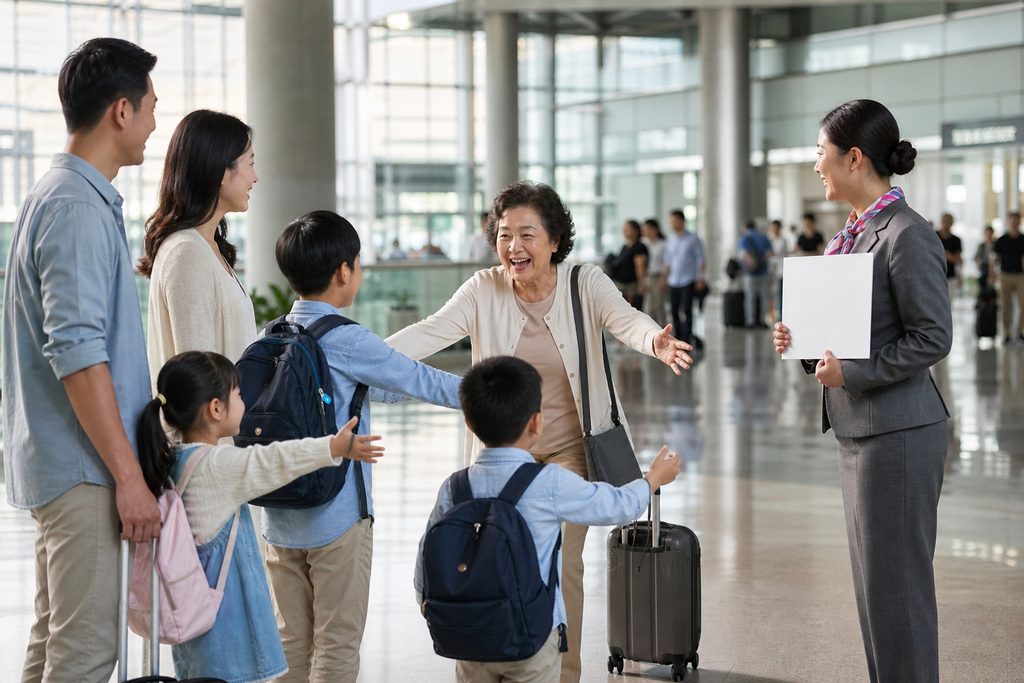
The goal is to reunite the family as quickly as possible. If the patient lands first, the greeter escorts them to a quiet seating area, helps with luggage, and waits. When the second family member clears customs, the greeter brings them to the patient. Only then does the group move to the vehicle together.
This sounds minor. It is not. For a patient who has just completed a 12-hour flight, waiting alone in a chaotic arrivals hall is disorienting. Having a familiar face — even a professional greeter — reduces anxiety measurably. And when family members finally see each other, the emotional relief is immediate.
What the Family Airport Meet and Greet China Price Covers
Let us address the question directly. The family airport meet and greet china price varies based on several factors: number of arriving flights, terminal spread, vehicle requirements, and whether overnight or early-morning coordination is needed.
For a single round-trip airport transfer — one pickup, one drop-off — prices start from $200. This covers one vehicle, one greeter, and a standard time window. For families with multiple arrivals across different terminals, the price increases because the staffing model changes. Two greeters working simultaneously, two vehicles, and lounge access for waiting family members can push the cost to $400–600 or higher for complex multi-flight coordination.
These are reference ranges, not fixed quotes. Final pricing depends on the specific arrival schedule, airport, and any special patient needs. We provide a detailed breakdown before any commitment is made.
Why Medical Tourism Family Concierge Services Exist in China
China’s healthcare system draws international patients for specific reasons. Cardiac surgery volumes at Fuwai Hospital exceed 14,000 procedures annually — the highest in the world. Orthopedic surgeons at top-tier hospitals perform 200–500 joint replacements per year, compared to roughly 65 for the average US surgeon. The cost differential is structural: a heart bypass that runs $120,000 or more in the United States may cost $12,000–20,000 at a top Chinese public hospital.
But the system is not built for foreign patients. Public hospital registration desks operate in Mandarin. Payment requires a Chinese bank card or cash — international credit cards are often rejected. Navigating from the airport to the hospital to the hotel without language support is exhausting for a healthy person. For a patient, it borders on impossible.
This is why medical tourism family concierge china multiple arrivals coordination has grown into a necessary service category. Families are not coming for vacation. They are coming because a loved one needs treatment, and the logistics cannot be left to chance. The concierge layer — airport meet and greet, hospital escort, translation — is the scaffolding that makes the medical journey viable.
Comparing Airports: Beijing, Shanghai, and Guangzhou
Each major entry point presents different challenges.
| Airport | Terminals | Key Challenge for Families | Best Family Airport Transfer Service Approach |
|---|---|---|---|
| Beijing Capital (PEK) | T1, T2, T3 (T3 is massive) | Inter-terminal distance requires vehicle transfer; T3 arrivals hall is crowded and loud | Deploy greeters per terminal; stage patient in quieter T3 lounge area |
| Shanghai Pudong (PVG) | T1, T2 + satellite concourse | Satellite terminal adds 15–20 min transit time; confusing for first-time visitors | Pre-confirm terminal assignments; allow extra buffer between pickups |
| Guangzhou Baiyun (CAN) | T1, T2 | Fewer international flights than Beijing/Shanghai; fewer English-speaking staff | Mandarin-speaking greeter is non-negotiable; plan for longer immigration queues |
The best family airport transfer service for medical travel china adapts to the specific airport rather than applying a one-size-fits-all template. A procedure that works smoothly at Shanghai Pudong may fail at Guangzhou Baiyun if the team does not account for longer immigration processing times and fewer English-language resources.
Real Coordination: A Case of Three Flights, Two Terminals, One Patient
Last spring, we coordinated an arrival for a family of five. The patient — a 67-year-old man scheduled for a knee replacement at Peking University Third Hospital — landed at Beijing Capital Terminal 3 at 2:10 PM on a flight from Vancouver. His wife was with him. Their adult son landed at Terminal 2 at 2:45 PM from London. Their daughter and son-in-law landed at Terminal 3 at 3:20 PM from Sydney.
Three flights. Two terminals. One patient who could not walk long distances.
We deployed two greeters. Greeter One met the patient and his wife at Terminal 3, secured a wheelchair, and escorted them to a quiet seating area near the arrivals coffee shop. Greeter Two met the son at Terminal 2 and drove him to Terminal 3 — a 10-minute trip — where he reunited with his parents. Both greeters then waited for the daughter’s flight. When she and her husband cleared customs at 3:50 PM, the entire family walked to the parking area together and departed in a single minivan.
Total time from first landing to group departure: just under two hours. Without coordination, the family estimated they would have spent four to five hours navigating the airport independently — and the patient would have been left alone at multiple points.
This is not exceptional. It is what a properly structured service delivers as standard.
Common Mistakes Families Make When Self-Coordinating
We see the same errors repeated. They are all avoidable.
- Assuming terminals are connected. They are not, at any major Chinese airport. Walking between terminals is not an option. You need a vehicle or shuttle, and the shuttle requires tickets purchased in Chinese.
- Underestimating immigration times. Foreign passport holders can spend 30–60 minutes in the immigration queue at peak times. If two flights land 30 minutes apart at the same terminal, the first arrival may still be in line when the second lands.
- Booking flights that land too close together. A 20-minute gap between arrivals at different terminals guarantees someone waits alone for an extended period. We recommend at least a 90-minute buffer for multi-terminal arrivals.
- Not arranging a Chinese SIM card in advance. Airport WiFi requires a Chinese phone number for SMS verification. Without a local SIM, family members cannot communicate with each other unless they have an international roaming plan that works reliably in China.
- Assuming the patient can manage luggage. After a long flight, even a healthy traveler is tired. A patient with limited mobility or post-surgical restrictions should never be expected to handle bags. The meet and greet team handles all luggage from carousel to vehicle.
Frequently Asked Questions
The family airport meet and greet china price starts from $200 for a standard round-trip transfer with one vehicle and one greeter. For families with multiple arrivals across different terminals, the price typically ranges from $400 to $600 or higher, depending on the number of greeters, vehicles, and coordination complexity required. We provide a detailed quote based on your specific flight schedule before any commitment.
Sometimes. If two flights land at the same terminal within 60–90 minutes of each other, one greeter can often manage both, escorting the first arrival to a waiting area while the second clears customs. If flights arrive at different terminals simultaneously, two greeters are necessary. We assess this during the pre-arrival briefing and recommend the appropriate staffing level.
The ground team monitors all inbound flights in real time. If a delay occurs, the greeter adjusts the pickup schedule accordingly. If a flight is canceled, we coordinate with the family to rebook and reschedule the meet and greet service for the new arrival time. There is no additional charge for rescheduling due to airline delays or cancellations.
We coordinate wheelchair requests with the airline before departure. However, the airline controls whether a wheelchair is available at the gate. Our greeter can request a wheelchair at the arrivals level if one was not provided at the gate, and will assist the patient until the wheelchair is secured. For patients with significant mobility limitations, we recommend confirming wheelchair availability with the airline at least 48 hours before departure.
Is the airport meet and greet service available in cities beyond Beijing and Shanghai?
Yes. We coordinate arrivals at all major Chinese airports, including Guangzhou, Shenzhen, Chengdu, Hangzhou, and others. The service model is the same — flight tracking, greeter deployment,
For more medical information and treatment options in China, visit chinamedservices.com (China Medical Services).
