Transport: Your First Hour in China — Airport to Hospital Without the Chaos
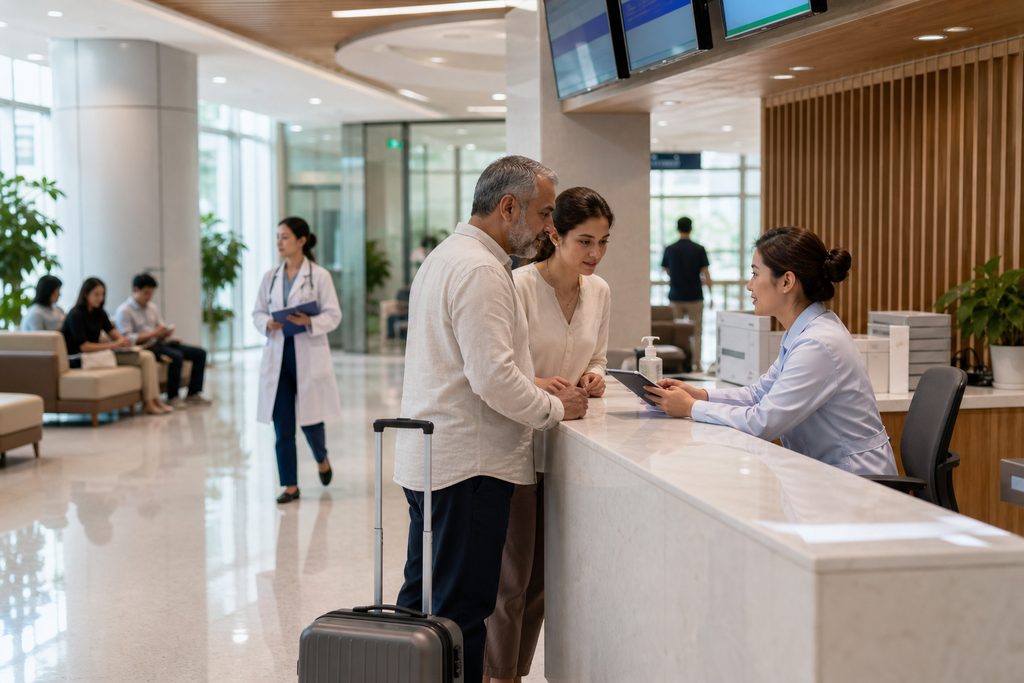
Transport: The Short Answer
You land at Pudong or Hongqiao, clear immigration, and step into a wall of noise, signs, and people. Your phone has no data. You’re tired. And you still need to reach the best hospital for medical tourists Shanghai has on its list — likely 40 to 60 minutes away by car. The honest answer: pre-book a vetted private transfer. It costs $200 round-trip through our coordination service, removes the single biggest source of first-hour stress, and gets you to the right entrance the first time. The caveat? Not every transfer service is legitimate, and hailing a random taxi after a long flight is where most first-timer mistakes happen.
Who This Is Right For — and Who It Isn’t
A pre-arranged airport pickup makes sense for most medical travelers. But let’s be specific about who benefits most.
Good candidates for a managed transfer:
- First-time visitors to China who don’t read Chinese characters
- Patients with reduced mobility, post-operative needs, or heavy medical documentation
- Anyone arriving after an overnight flight with a same-day consultation scheduled
- Families traveling with children or elderly relatives
- Patients heading to a specific department at a large public hospital with multiple gates
Who can reasonably skip it:
- Frequent China travelers comfortable with ride-hailing apps and local SIM setup
- Those staying at a hotel with a confirmed, reliable airport shuttle
- Budget travelers willing to navigate the Maglev and metro with luggage — it’s doable, just slower
Being honest about who shouldn’t pay for this is part of what we do. If you’re a confident solo traveler with data sorted in advance, the metro from Pudong is efficient and cheap. But if your first appointment is at 9 a.m. and you land at 6 a.m., a fixed-price car removes variables you don’t need.
The Options, Compared
Here’s what your first hour actually looks like across the realistic transport choices. We compared them on cost, time, and failure points.
| Option | Cost (USD) | Time to Hospital | Main Risk |
|---|---|---|---|
| Pre-booked private driver | $100 one-way / $200 round-trip | 40–60 min | Low — driver waits with name sign |
| Official airport taxi | $30–50 | 45–70 min | Medium — communication issues, wrong entrance |
| Ride-hailing (DiDi) | $25–40 | 45–70 min | Medium — app setup, pickup point confusion |
| Maglev + metro | $10–15 | 70–100 min | High — transfers, luggage, walking |
| Hotel shuttle (if offered) | Free–$30 | 60–90 min | Variable — schedule, multiple stops |
Which column fits you? If your priority is showing up calm and oriented, the private driver wins. If you’re on a tight budget and have no mobility issues, the Maglev is genuinely fast to central Shanghai — but it doesn’t solve the last-mile problem at the hospital gate. The taxi is the default for many, and it works, but expect to show your destination in Chinese characters and know which gate to ask for.
Your First Hour: A Minute-by-Minute Reality Check
Let’s walk through what actually happens after you exit the baggage hall at Pudong — because the gap between expectation and reality is where stress compounds.
Minutes 0–15: Immigration and baggage. Lines move faster than they used to. Fingerprints, a photo, a stamp. Your S2 visa should already be in your passport, so no surprises here. Baggage claim is efficient. You’re out.
Minutes 15–25: The SIM card decision. This is where many travelers lose 40 minutes. Yes, you can buy a SIM at the airport. The counters near arrivals sell tourist SIMs, but the staff may not speak English, the plans vary, and activation sometimes takes 20 minutes. If you booked a driver, skip this entirely — do it later at the hospital or your hotel. If you need data immediately, buy before you fly or use an eSIM. The question of SIM card for tourists at Beijing airport gets asked a lot, and the same logic applies in Shanghai: it’s available, but it’s not a two-minute stop.
Minutes 25–35: Finding your ride. A pre-booked driver stands in arrivals with a sign showing your name and the hospital logo. No negotiation, no app, no explaining. A taxi requires you to queue, show a screenshot, and hope the driver knows the hospital’s international department entrance — not the main public gate, which can be a 15-minute walk from where you need to be.
Minutes 35–70: The drive. Traffic in Shanghai is predictable at mid-morning but rough during rush hour. The driver takes the elevated highway toward Puxi or the tunnel toward Pudong-side hospitals. You sit. You breathe. You’re done.
What It Costs — and What Drives the Price
The cost of private driver medical tourism China services varies by city, distance, and whether you book one-way or round-trip. Our coordination team arranges airport transfers from $200 round-trip in Shanghai, Beijing, and Guangzhou. That covers the driver, fuel, tolls, waiting time (up to 90 minutes after landing), and a meet-and-greet inside the terminal.
What it does not cover: tips (not expected in China), parking if you ask the driver to wait at the hospital for hours, and any detours. If you need the driver to stay with you through registration and translation, that’s a separate bilingual companion service — from $300 per day.
Why the range? Distance is the main factor. Pudong Airport to Huashan Hospital‘s international department is roughly 50 km. Hongqiao Airport to the same area is under 20 km. Time of day matters too — a 7 a.m. pickup costs less in driver time than a 5 p.m. pickup in rush hour. And vehicle class changes the quote: a standard sedan versus a van for wheelchair access or multiple family members.
Practical Considerations: Documents, Payment, and the S2 Visa
Your transport is only as smooth as the paperwork that gets you into the car in the first place. Here’s what to have ready.
Visa category. For medical treatment in China, you apply for an S2 visa with the purpose noted as medical treatment. Your accompanying family members also apply for S2. Stays over 180 days require S1. The M visa is for commercial and trade activities — it is not a medical visa and using it for treatment creates problems. We help patients prepare the supporting documents from the receiving hospital, but the visa decision always rests with the Chinese embassy or consulate.
Payment methods. Your driver is pre-paid through our coordination service, so no cash changes hands at the airport. For everything else in your first hour — a bottle of water, a SIM card — have some RMB cash or set up Alipay or WeChat Pay before you fly. International credit cards are accepted at major hotels and international hospital departments, but the airport convenience store may not take them.
Insurance and records. Carry printed copies of your medical records, referral letters, and imaging reports. Don’t check them. If your luggage is delayed, your medical documents are not in it.
Language. Assume no English at the airport taxi queue. Assume some English at the international medical department. The gap between those two points is where a companion earns their fee.
Is It Safe to Take a Taxi from Shanghai Pudong Airport?
Short answer: yes, with caveats. Official taxis at Pudong operate from a managed queue, use meters, and are generally safe. The vehicles are regulated, and drivers are licensed. The risk isn’t safety in the criminal sense — it’s miscommunication and wrong entrances.
Here’s the specific problem. Large Chinese public hospitals have multiple gates. The main gate serves thousands of outpatients daily. The international department or VIP clinic often has a separate entrance, sometimes on a different street entirely. A taxi driver who doesn’t know this will take you to the main gate. You’ll then walk 10–20 minutes through crowds with your luggage, find the right building, and check in late. That’s the failure mode. Not danger — friction.
So yes, is it safe to take taxi from Shanghai Pudong airport? Safe, yes. Efficient for a medical arrival? Not always. If you take a taxi, have the exact building name and entrance in Chinese, and call the hospital’s international department before you leave the airport.
Medical Tourism Airport Pickup Service China: What Actually Gets Coordinated
When patients ask us about medical tourism airport pickup service China, they’re usually asking one of two things: “Can someone meet me at the gate?” and “Will this person get me to the right doctor?” The answer to the first is yes. The second requires more than a driver.
A proper medical arrival service coordinates three layers. The driver handles the car. A bilingual companion — often the same person on the ground — handles the terminal meeting, the hospital check-in, the registration queue, and the first conversation with the nursing desk. And our coordination team handles the scheduling so that your consultation time accounts for realistic traffic and immigration delays.
That’s the difference between a transport booking and a medical arrival service. One gets you to the building. The other gets you to the right desk, with the right documents, at the right time. For patients traveling alone, the companion layer matters more than the car.
For context on where you’re heading, our database covers 340+ top-ranked hospitals across 37 cities, including the major international departments in Shanghai. If you’re still deciding between public and private options, we’ve compared private international hospitals with JCI accreditation against top-tier public institutions — the transport logic is the same, but the entrance and check-in process differ.
Frequently Asked Questions
The same logic applies in Beijing as Shanghai. Pre-book a driver who knows the hospital’s international department entrance, or take an official taxi with your destination written in Chinese. Beijing Capital Airport is roughly 30–40 km from the central hospital district, and traffic can double that time during peak hours. The how to get from Beijing airport to hospital question has no single answer — it depends on your arrival time, mobility, and which hospital you’re visiting.
This is why we book through a coordination service rather than a standalone app. The driver tracks your flight number and adjusts the pickup time automatically. If a delay pushes you past the waiting window, the coordination team reassigns or reschedules. You’re not stranded, and you’re not paying twice. With a taxi or ride-hail, a delay just means you start the process again when you land.
Before you fly, if possible. The SIM card for tourists at Beijing airport and Shanghai airport counters work, but they add 20–40 minutes to your first hour, and the staff may not speak English. An eSIM activated before departure solves the problem entirely. If you must buy locally, do it at the hospital or your hotel, not in the arrivals hall when you’re tired and carrying medical documents.
For a medical trip, usually yes. The difference isn’t the car — it’s the elimination of variables. A pre-booked driver meets you inside, knows the correct hospital entrance, and is pre-paid. A taxi requires queueing, communication, and the real possibility of being dropped at the wrong gate. If you’re arriving for a consultation that took weeks to schedule, $160 in saved friction is cheap insurance.
Your Next Step
Landing in China for medical care doesn’t need to be the hardest part of the trip. The right transport plan removes the first-hour chaos and gets you to your consultation on time and oriented. We’re not a hospital, and we don’t diagnose or treat — what we do is coordinate the logistics that make your medical visit possible: hospital matching, appointment scheduling, bilingual companions, and airport transfers. If you’re planning treatment at one of China’s top hospitals, start with a conversation. Tell us where you’re flying into and what you need, and we’ll map the first hour with you.
Your first hour in China sets the tone for everything that follows. Make it boring. Make it predictable. Then focus on why you came.
For more medical information and treatment options in China, visit chinamedservices.com (China Medical Services).
