Understanding Your Checkup Bill in China: A Foreigner’s Line-by-Line Guide
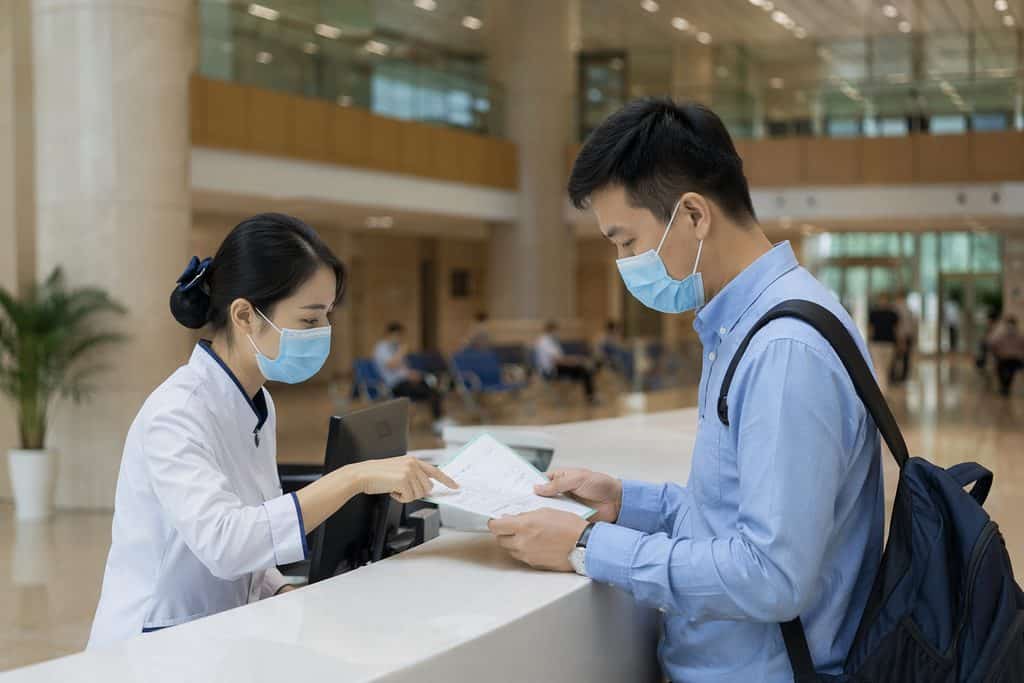
Understanding Your Checkup Bill in China: A Foreigner’s Line-by-Line Guide
A hospital bill in China for foreigners looks intimidating at first glance. Rows of itemized charges, unfamiliar department codes, and a payment window with no English signage. But strip away the formatting, and it is a straightforward document. Every line represents a service, a material, or a bed-day. The confusion comes from the language and the system, not from hidden fees. Once you know how the categories work, you can read a Chinese hospital bill in about ten minutes.
We help international patients through this exact process every week. Our team at China Medical Services coordinates hospital visits, translates documents, and sits beside patients at the cashier window. What follows is what we have learned about how these bills are built, what drives the total up or down, and where mistakes tend to hide.
Key takeaway: Chinese hospital bills are itemized by design. The total is rarely a mystery once you know that registration, diagnostics, lab work, pharmacy, and physician fees are billed as separate line items — not bundled into one price.
How This Actually Works, Step by Step
Here is the real sequence, from walking in the door to walking out with a receipt.
Step 1 — Registration and the medical card. You present your passport at the registration desk. Staff create a hospital medical card tied to your passport number. This card becomes your billing identity for the entire visit. Registration fees at top-tier public hospitals typically run 50 to 300 RMB depending on whether you see a standard or senior specialist. International departments charge more.
Step 2 — The consultation. The physician examines you, writes orders for tests, and hands you a printed list. Nothing is charged yet at most hospitals. The orders accumulate on your card.
Step 3 — Pre-payment at the cashier. This is the step that surprises Western patients. Chinese public hospitals generally require payment before services are rendered. You take your order list to a cashier window, pay an estimated amount, and receive a stamped receipt. Only then can you proceed to the lab, imaging suite, or pharmacy.
Step 4 — Services performed. Blood draws, ultrasounds, CT scans, ECG. Each department scans your card and deducts from your pre-paid balance.
Step 5 — Final settlement. After all results return and the physician issues prescriptions or a treatment plan, you return to the cashier. Staff reconcile what you pre-paid against what was actually consumed. You receive either a refund or a supplemental charge, plus the final itemized bill.
That final document — the 费用清单 (itemized charge list) — is what you need for insurance reimbursement back home. Ask for it explicitly. It is not always handed over automatically.
What Each Line on the Bill Actually Means
Chinese hospital bills group charges into a handful of standard categories. Knowing these categories is the whole game.
- Registration fee (挂号费): The cost of booking the physician’s time. Ranges from roughly 20 RMB at a community clinic to 600 RMB or more for a senior specialist at a top hospital’s international wing.
- Consultation/treatment fee (诊疗费): The physician’s professional fee. Often separate from registration at larger hospitals.
- Laboratory tests (化验费): Blood work, urinalysis, cultures. A standard complete blood count might run 30 to 80 RMB. A full metabolic panel 200 to 500 RMB.
- Imaging (检查费): X-ray, ultrasound, CT, MRI. An MRI of a single region at a top public hospital commonly falls between 600 and 1,200 RMB. CT scans run 300 to 800 RMB.
- Pharmacy (药费): Prescription and over-the-counter medications. Chinese hospitals dispense most drugs in-house.
- Materials and consumables (材料费): Syringes, IV tubing, gauze, contrast dye. Small individually, but they add up across a long visit.
- Bed and nursing fees (床位费/护理费): Only applies to inpatient stays. A standard public ward bed runs 50 to 200 RMB per day. VIP or international wards cost substantially more.
If you are trying to read a Chinese medical bill and one line does not map to any of these, ask the cashier or your companion to explain it. Nine times out of ten it is a sub-category of one of the above.
A Realistic Timeline
How long the whole process takes depends heavily on what you are having done. Here is a realistic picture for a comprehensive health checkup at a major hospital.
| Stage | Typical Duration | Notes |
|---|---|---|
| Appointment coordination | 3–10 business days | Public general clinics often cannot be pre-booked from abroad; international departments can |
| Medical card creation on arrival | 20–40 minutes | Bring passport; some hospitals require a local phone number |
| Consultation and order writing | 15–45 minutes | Longer at international departments with English-speaking staff |
| Pre-payment at cashier | 10–30 minutes | Peak morning hours can mean long queues |
| Diagnostics (labs, imaging) | 2–6 hours | Some imaging requires a separate appointment days later |
| Results review with physician | Same day or next day | Complex panels may take 48–72 hours |
| Final settlement and itemized bill | 15–30 minutes | Request the official stamped version for insurance |
Add buffer time. A full checkup at a large hospital — from arrival to final receipt — realistically consumes a full day, sometimes two if imaging is scheduled separately. Budget for it.
What Can Go Wrong — and What Happens Then
Mistakes happen. Here are the ones we see most, and what to do about each.
Duplicate charges. Occasionally a test gets billed twice because two departments scanned the same card. When you review the itemized list, compare it against your order slips. If you find a duplicate, take both the bill and the order slip to the cashier. Corrections are routine and usually processed the same day.
Wrong patient name or passport number. This matters enormously for insurance. If the medical card was created with a typo, the reimbursement claim will bounce. Flag it immediately at the registration desk — fixing it later requires a formal correction request.
Pre-payment overestimation. Hospitals often pre-charge a generous estimate. If your actual services cost less, you are entitled to a refund at final settlement. Do not leave without it. Ask specifically: “Is there a balance to refund?”
Missing itemized bill. Some cashiers hand over only a summary receipt. Insurance companies need the detailed line-item version with the hospital’s official stamp. Ask for the 费用明细清单 explicitly, and confirm it carries the red official seal.
Never pay a cashier who cannot produce an official hospital receipt. All legitimate payments at Chinese public hospitals generate a stamped receipt with a unique number. Keep every receipt until your insurance claim is fully settled.
Language breakdown at the window. This is the most common failure point. Cashiers at public hospitals rarely speak English. If you cannot explain a discrepancy, you cannot resolve it. This is precisely where a bilingual companion earns their fee.
China Hospital Checkup Cost for International Patients: What to Expect
Prices vary by hospital tier, city, and the depth of the checkup package. But here are realistic ranges for a standard comprehensive checkup at a top-tier public hospital.
| Checkup Package | Typical Cost (Public Top-Tier) | Typical Cost (Private International) |
|---|---|---|
| Basic (blood, urine, ECG, chest X-ray) | 500–1,200 RMB | 2,000–4,000 RMB |
| Standard (adds ultrasound, more lab panels) | 1,500–3,000 RMB | 4,000–8,000 RMB |
| Comprehensive (adds CT, cardiac workup, tumor markers) | 3,000–6,000 RMB | 8,000–15,000 RMB |
| Executive/VIP (adds MRI, endoscopy, specialist consults) | 6,000–15,000 RMB | 15,000–30,000 RMB |
For context, an equivalent executive checkup in the United States frequently runs $3,000 to $8,000. The gap is real, but it reflects different cost structures — not different quality of diagnostics.
If your bill comes in higher than expected, the usual culprits are imaging add-ons, specialist consultations beyond the original package, and pharmacy. Ask for a breakdown before you pay the final amount.
Practical Considerations: Payment, Insurance, and Records
How to pay hospital bill China with insurance. Public hospitals require upfront payment. You pay out of pocket, collect the itemized bill and official receipts, then submit a reimbursement claim to your home insurer. Private international hospitals — the ones with JCI accreditation and English-speaking staff — often bill your insurer directly. If direct billing matters to you, choose a private international facility. Our private hospital directory lists facilities with direct insurance settlement.
Records you need for reimbursement. Collect these before you leave the hospital: the itemized charge list with official stamp, the physician’s diagnosis certificate, all lab and imaging reports, and the prescription receipts. Missing any one of these can stall a claim for weeks.
Medical bill translation service China. Your home insurer will almost certainly require English translations of the Chinese documents. Hospital international departments sometimes provide bilingual summaries, but not always. Professional medical translation services exist, and we coordinate this for patients as part of our document handling. The translation must be accurate — insurers reject claims with sloppy translations.
Visa category. If you are traveling to China specifically for medical treatment, the applicable short-stay visa is the S2, with a notation for medical purposes. The M visa is for commercial and trade activities and does not cover medical treatment. Family members accompanying you apply for S2 as well. Requirements change, so confirm current rules with the nearest Chinese embassy or consulate before applying. Our patient consultation page walks through the documentation hospitals typically provide to support a visa application.
Follow-up after you return home. Bring copies of all imaging on disc or USB, plus the translated reports. Your physician at home will want the original images, not just the written interpretation. Request these at the hospital’s imaging department before departure — it is far harder to obtain them remotely.
Frequently Asked Questions
Most often it is imaging and pharmacy. A checkup package quote rarely includes every scan or medication ordered during the visit. Also, if you were seen at an international department rather than the standard outpatient clinic, fees run roughly 1.5 to 2 times higher. Ask for the itemized list and compare it against your original package quote — the difference is usually explainable line by line.
At most public hospitals, no. You pay upfront and seek reimbursement afterward. Some private international hospitals with JCI accreditation do offer direct billing with certain international insurers. Check with your insurer before choosing a facility, and confirm which hospitals are in their network.
Take the itemized bill and your original order slips to the cashier window. Point out the specific line. Duplicate charges and clerical errors are corrected routinely, usually the same day. If the cashier cannot help due to a language barrier, ask for the international department or bring a bilingual companion. Do not pay a disputed amount before the error is resolved.
For insurance reimbursement, professional translation is strongly recommended. Insurers often reject self-translated documents, and medical terminology errors can delay or void a claim. If you only need the bill for your own understanding, a bilingual companion or hospital international desk can explain it verbally.
It depends on your priorities. Private international hospitals offer English-speaking staff, shorter waits, direct insurance billing, and a Western-style experience. Public top-tier hospitals offer the same diagnostic quality at a fraction of the price, but require navigation. Many patients choose public for diagnostics and private for convenience on follow-up visits.
Your Next Step
Reading a Chinese hospital bill comes down to knowing the categories, requesting the itemized version, and checking for errors before you pay. The system is transparent once you understand its structure. What it is not is self-explanatory in English — and that gap is where most problems start.
China Medical Services connects international patients with more than 340 top-ranked hospitals across 37 cities. We coordinate appointments, provide bilingual medical companions, handle document translation, and guide you through the billing process from registration to final receipt. We are not a medical provider and we do not offer clinical advice — we handle the logistics so you can focus on your health.
If you would like help understanding what a checkup in China would cost for your situation, start with a free consultation. No pressure, no obligation — just a clear conversation about what is possible.
This article is for informational purposes only and does not constitute medical advice. Costs vary by hospital, city, and case complexity. Always consult a qualified healthcare provider regarding your individual medical needs.
For more medical information and treatment options in China, visit chinamedservices.com (China Medical Services).
