Stay Connected Online During Hospital Stay in China: A Practical Internet Guide
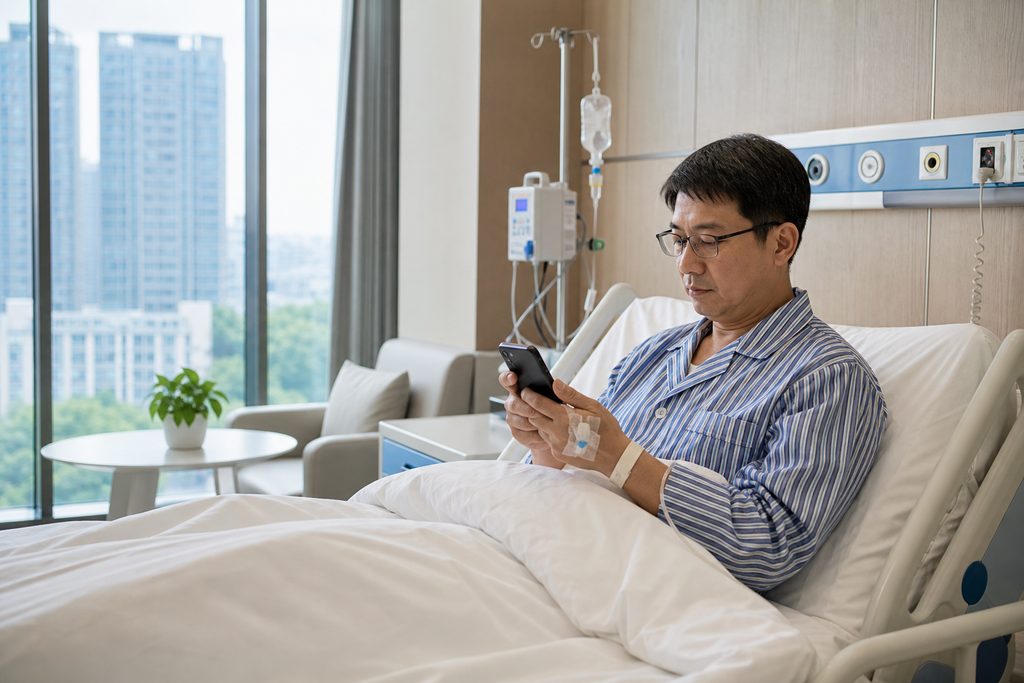
You have probably heard that staying connected online inside China is a nightmare of blocked apps and impenetrable firewalls. The reality is more nuanced. Yes, WhatsApp, Google, Instagram, and Gmail all stop working the moment you connect to standard hospital WiFi. But hundreds of international patients manage this every month without losing touch with family back home. They do it by arriving with the right tools already installed and knowing which connection method to use in which building.
The short version: a VPN installed before you board your flight is the single most reliable way to stay connected during a hospital stay in China. Without it, you will be cut off from most Western platforms. With the right one, you will barely notice the difference.
Stay Connected Online During Hospital Stay in China: The Short Answer
Bring a pre-installed VPN. That is the answer. China’s internet infrastructure blocks Google services, all Meta platforms (WhatsApp, Instagram, Facebook), X (Twitter), Gmail, Google Maps, and most Western news sites by default. Hospital WiFi networks apply these same national-level restrictions. No workaround exists without a VPN. A local SIM card gives you mobile data but does not bypass the firewall. The hospital’s guest WiFi will load Chinese websites perfectly and block almost everything else.
One caveat: not all VPNs work inside China. The Great Firewall actively identifies and blocks VPN traffic. Many popular services that function perfectly in Europe or North America will not connect at all from a Shanghai or Beijing hospital room. Installing the wrong one is almost the same as installing nothing.
Who Needs This Setup — and Who Can Skip It
Most international patients need a connectivity plan. But not everyone.
Good candidates for a full VPN-plus-local-SIM setup include anyone who needs daily contact with family through WhatsApp or FaceTime, anyone who relies on Gmail for medical records or insurance communication, and anyone planning a stay longer than three days. Also, patients who want to stream Netflix or YouTube during recovery downtime. And anyone whose employer or insurance provider requires regular email updates through Google Workspace.
Patients who can manage without a VPN are rare. If you use only WeChat for messaging, have no need for Google services, and do not mind browsing Chinese-language websites exclusively, you might get by with just a local SIM. But most Western patients find that isolating. Even short stays feel longer when you cannot send a quick WhatsApp photo to your children.
VPN for Hospital WiFi China: What Actually Works
The keyphrase here is not hypothetical. It is what patients type into Google at 2 a.m. from a hospital bed after realizing nothing loads. By then it is too late. VPN websites are blocked. App stores do not display VPN apps when your IP address is Chinese. You cannot download a solution after you arrive.
ExpressVPN and AstrillVPN have the strongest track record among our patients. Both use obfuscated protocols that disguise VPN traffic as regular HTTPS browsing. This matters because Chinese network infrastructure does not just block known VPN servers. It analyzes traffic patterns and blocks anything that looks like encrypted tunneling. The protocol matters more than the brand name.
NordVPN works intermittently. Some patients report it connecting on hospital WiFi in Beijing but failing in Shanghai. Surfshark has improved recently but still drops connections during peak hours. Free VPNs are not worth installing. They are the first ones identified and blocked. They also sell your data, which is a separate problem you do not need during a medical stay.
Install the VPN on every device you will bring: phone, tablet, laptop. Log in and test it before you leave home. Confirm it connects. Then update the app to the latest version. Turn on the kill switch feature if available. This prevents any data from leaking outside the encrypted tunnel if the VPN drops.
Best SIM Card for Foreigners in China Hospital: Your Options
A VPN solves the blocked-site problem. It does not solve the connectivity problem. Hospital WiFi is often slow, congested, or requires a Chinese phone number for SMS verification to log in. A local SIM card with a generous data plan gives you independence from hospital networks.
China Mobile, China Unicom, and China Telecom are the three state-owned carriers. For international patients, China Unicom tends to offer the most English-friendly service at major city branches. You will need your passport to purchase a SIM. Registration is mandatory under Chinese law. The process takes about 20 minutes at an official store.
A typical data-heavy plan costs between $15 and $40 for one month with 20GB to 60GB of data. Speeds are generally good in major cities. Shanghai and Beijing have extensive 5G coverage. Smaller cities may drop to 4G, which is still sufficient for video calls.
The critical detail: a Chinese SIM card gives you a Chinese IP address. It does not unblock anything. You still need the VPN running on top of the mobile data connection to access WhatsApp, Google, or Gmail. The SIM solves the bandwidth problem. The VPN solves the access problem. You need both.
eSIM options exist through providers like Nomad and Airalo, offering China data packages that activate on arrival. These are convenient because you skip the store visit. But they route through Hong Kong or Singapore servers, which sometimes adds latency. And they still do not bypass the firewall without a VPN.
How to Access WhatsApp in China Hospital: The Step-by-Step Reality
WhatsApp is the single most requested app among our patients. It is also one of the most reliably blocked. The moment your phone connects to a Chinese network, WhatsApp messages stop sending. Voice calls fail. Video calls do not connect.
The fix is straightforward but must be done in the right order. Connect to your VPN first. Confirm the VPN is running and showing a server outside China. Then open WhatsApp. It will work exactly as it does at home. Messages send. Calls connect. Media downloads.
If you open WhatsApp before connecting the VPN, the app may cache the blocked connection state. Force-close WhatsApp, connect the VPN, wait 30 seconds, then reopen it. This resolves most issues.
A small number of patients report WhatsApp working intermittently without a VPN on certain hospital WiFi networks. This is unpredictable and not reliable. Do not count on it. The block can resume at any moment.
For video calls with family, WhatsApp works well on VPN. So does FaceTime. Zoom also functions through a VPN, though it sometimes requires switching servers if the connection lags. WeChat is the one messaging app that works perfectly without any VPN at all. Many international patients end up installing it as a backup communication channel.
International Patient Internet Access Shanghai Hospital: What the Facilities Actually Provide
Shanghai’s major international hospitals and VIP wards understand the connectivity problem. Facilities like Huashan Hospital‘s International Medical Center and Jiahui International Hospital offer WiFi networks specifically configured for foreign patients. Some of these networks have built-in VPN-like routing that allows access to Google and WhatsApp without a separate VPN subscription.
This is the exception, not the rule. Most public hospital wards, even in Shanghai, use standard Chinese internet with full restrictions. The international department on the 15th floor might have open access while the standard ward on the 6th floor has none. Same building, different networks, different rules.
Beijing’s situation is similar. Peking Union Medical College Hospital‘s international department offers better connectivity than its standard wards. Private hospitals like United Family Healthcare generally provide Western-standard internet with minimal blocking. You pay for this convenience through higher room rates.
The practical takeaway: do not assume any hospital will solve this for you. Even facilities that advertise “international patient services” may not include unrestricted internet in that definition. Bring your own solution. Treat hospital-provided access as a bonus if it works.
China Hospital WiFi for Foreigners Blocked Sites: What Gets Caught and What Slips Through
The blocklist is not random. It is systematic and consistently enforced across all standard Chinese networks, including hospital guest WiFi.
Google services are blocked in their entirety. That includes Google Search, Gmail, Google Drive, Google Maps, Google Play Store, and YouTube. Microsoft services generally work. Outlook, Office 365, and Bing load without a VPN. Apple iMessage sometimes works. Sometimes it does not. iCloud services are inconsistent. Apple Maps functions but lacks detail outside major cities.
All Meta platforms are blocked. WhatsApp, Instagram, Facebook, Messenger. X (Twitter) is blocked. TikTok loads but shows the Chinese version, Douyin, which is a separate platform with different content. Reddit is blocked. Most Western news sites are blocked, including the New York Times, Wall Street Journal, BBC, and CNN. Wikipedia works intermittently. Sometimes the English version loads. Sometimes only the Chinese version.
Banking websites and apps from your home country usually work without a VPN. So do most medical-record portals. The firewall targets media and communication platforms, not financial services.
What this means in practice: you can check your bank balance on hospital WiFi without a VPN. You cannot email your doctor back home through Gmail. You can browse Amazon. You cannot watch YouTube tutorials about your recovery exercises. The internet does not disappear. It just becomes a much smaller place.
Unblock Social Media During Hospital Stay China: The Setup Checklist
Arriving prepared takes about 30 minutes before your flight. Arriving unprepared means hours of frustration and possibly days without family contact.
Before departure, install and test your VPN on all devices. Subscribe to a paid plan. Free services fail. Purchase an eSIM data package if your phone supports it, as a backup to hospital WiFi. Download WeChat and set up an account. Even if you never use it at home, having it ready gives you a fallback channel. Save offline maps of your hospital’s city in Google Maps. The app will not load new map data without a VPN, but saved offline maps work regardless.
Print a card with your hospital’s address in Chinese characters. If your phone dies or your VPN fails, you can show this card to a taxi driver. This is a connectivity backup of a different kind, but just as important.
After arrival, buy a local SIM at the airport or a carrier store near your hospital. Test the VPN on both WiFi and mobile data immediately. Do not wait until you need it. Confirm WhatsApp, Gmail, and any other critical services load. Identify the nearest coffee shop with reliable WiFi as a tertiary backup. Starbucks and Costa Coffee in China generally offer stable connections, though the same firewall restrictions apply.
What This Costs: Connectivity Budget for a Two-Week Stay
Connectivity is not free, but it is not expensive relative to the overall cost of international medical travel.
A one-month VPN subscription costs $10 to $15. Some providers offer annual plans that drop the monthly rate below $5. A Chinese SIM card with 30GB of data runs $20 to $30 for a month. An eSIM data package for two weeks costs $15 to $40 depending on data allowance. The total connectivity budget for a two-week hospital stay ranges from $35 to $70.
Compare that to international roaming charges from a home carrier. Using a U.S. or European SIM in China without a local plan can cost $10 per day or more. A two-week stay at $10 daily hits $140 before adding any data usage. The local SIM plus VPN approach is both more functional and significantly cheaper.
What is not included: device purchases. If your phone does not support eSIM or is locked to a home carrier, you may need an unlocked handset. Budget phones that work fine as hotspots cost $150 to $250. This is worth considering if your primary phone is carrier-locked.
Practical Considerations: Power, Privacy, and Hospital Policies
Chinese hospital rooms use Type A and Type I electrical outlets. Type A is the two-flat-prong plug common in North America. Type I is the three-flat-prong plug used in Australia and New Zealand. Bring a universal adapter. Hospital bedside outlets are sometimes positioned awkwardly. A 2-meter charging cable solves most reach problems.
Some hospitals restrict WiFi usage in certain wards. ICU and post-operative monitoring units may prohibit personal devices entirely. This is rare but worth asking about during admission. The restriction is usually about electrical interference with monitoring equipment, not internet policy.
Privacy is a separate concern. Hospital WiFi networks, like all public networks, are not secure. Anyone on the same network can potentially intercept unencrypted traffic. A VPN encrypts your data end-to-end, which protects against this. Using hospital WiFi without a VPN exposes your browsing activity not just to the Chinese firewall but to anyone technically inclined on the same network. The VPN serves double duty: unblocking and security.
Power banks are useful. Hospital rooms do not always have enough outlets for multiple devices. A 20,000mAh power bank keeps a phone running for two full days and costs around $30. Bring one. Long hospital days drain batteries faster than you expect.
Frequently Asked Questions
Can I just use international roaming instead of a VPN?
International roaming on a foreign SIM routes your data through your home carrier’s network, which bypasses the Chinese firewall entirely. WhatsApp, Google, and Gmail all work without a VPN. This sounds perfect. The problem is cost. Most carriers charge $10 to $15 per day for international roaming in China, with data caps as low as 500MB. A two-week stay can cost $200 or more. Video calls consume data quickly and trigger overage charges. Roaming works technically but is financially impractical for anything beyond a two-day trip.
What happens if my VPN stops working mid-stay?
VPN connections drop. Servers get blocked. This is normal and expected. Switch to a different server location within your VPN app. Most providers offer dozens of countries. Japan, Singapore, and U.S. West Coast servers tend to work best from China. If your entire VPN stops connecting, try switching protocols. OpenVPN with obfuscation or WireGuard usually restores service. If nothing works, find a coffee shop with WiFi and try there. Different networks sometimes allow different VPN handshakes. As a last resort, contact your VPN provider’s support team through their website. They routinely help users inside China troubleshoot connection issues.
Is using a VPN in China legal?
Using a VPN for personal internet access occupies a gray area. Chinese law prohibits using VPNs to bypass the Great Firewall, but the law is enforced against VPN providers and commercial operations, not individual users checking Gmail in a hospital bed. We are not aware of any international patient facing legal consequences for personal VPN use during a medical stay. That said, the legal environment can change. Use a reputable VPN. Do not use it for anything beyond personal communication and browsing. This is practical advice, not legal advice. Consult your own judgment.
Can I video call my family every day from the hospital?
Yes, with a working VPN. WhatsApp video calls, FaceTime, and Zoom all function reliably through a VPN on a stable connection. Hospital WiFi bandwidth varies. Evening hours, when many patients are online, can slow connections. Mobile data on a Chinese SIM with VPN often provides more consistent speeds than congested hospital WiFi. Schedule important calls during daytime hours when networks are less crowded. Keep calls under 30 minutes if bandwidth is tight. The connection works. It just requires more management than at home.
Do private international hospitals in China provide unrestricted internet?
Some do. United Family Healthcare, Jiahui International Hospital, and ParkwayHealth generally offer internet access that allows Google, WhatsApp, and Western social media without a personal VPN. These are private facilities with international patient populations. They invest in connectivity infrastructure specifically to meet foreign patient expectations. Public hospital international wards sometimes offer similar access. Standard public hospital wards almost never do. If unrestricted internet is critical to your stay, ask the specific facility about their network policy before booking. Do not assume. Verify.
Your Next Step
Staying connected during a hospital stay in China is a solvable problem. It requires preparation, not technical expertise. Install a VPN. Buy a local SIM or eSIM data package. Test everything before you need it. The patients who struggle are the ones who assume it will work itself out. The ones who sail through are the ones who spent 30 minutes setting up before they left home.
Our team helps international patients coordinate treatment at more than 340 top-ranked hospitals across 37 Chinese cities. We are not a hospital. We do not provide medical advice or diagnoses. What we do is handle the logistics — hospital matching, appointment coordination, bilingual companion support, and the practical details that make a medical stay abroad feel manageable instead of overwhelming. If you are considering treatment in China and want someone who can walk you through the connectivity plan, the visa process, and which hospital makes sense for your condition, we are here.
Get a free consultation about your medical travel to China. No commitment. Just a conversation about what you need and whether we can help.
For more medical information and treatment options in China, visit chinamedservices.com (China Medical Services).
