China Hospital Outpatient Department: Help for Foreign Patients
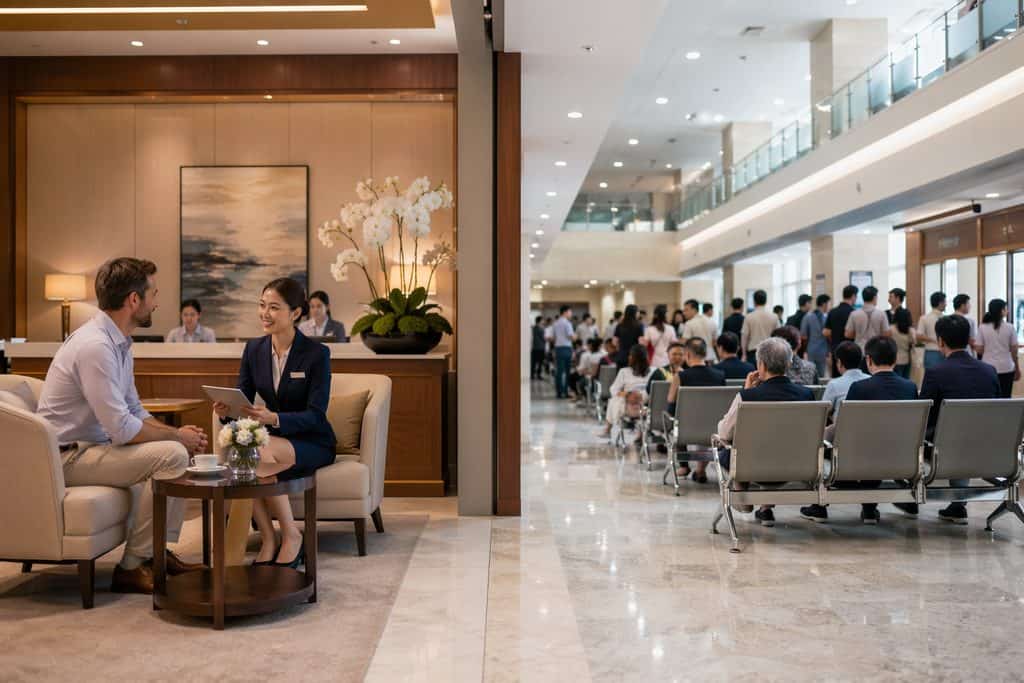
While patients in Canada wait a median 28.6 weeks for orthopedic surgery, surgeons at Beijing Jishuitan Hospital routinely perform over 300 joint replacements per month. That gap — months of waiting versus hundreds of procedures monthly — is why international patients increasingly look toward China. But the first obstacle they hit is rarely the surgery itself. It is the outpatient department.
Key Takeaways
- China’s top 340+ hospitals see thousands of outpatients daily, and the outpatient visit is the mandatory gateway to any surgery or inpatient admission.
- Public hospital outpatient fees are low — often $10–$50 for registration — but you generally cannot pre-book a standard public slot from overseas.
- Hospital international departments and VIP channels are the realistic route for foreigners who need a confirmed appointment before flying.
- Language, queuing, and payment logistics are the real barriers, not the medicine.
The Problem: You Cannot Book a Chinese Public Outpatient Slot From Abroad
Here is the uncomfortable truth most medical tourism websites skip. A standard public hospital outpatient appointment in China is not like booking a slot on a US or UK portal. You typically register on the day, in person, at the hospital. The queue starts before dawn.
This is not a policy aimed at foreigners. It is simply how a system serving enormous volume operates. China has 35,000+ hospitals. The top 5%, ranked by Fudan and JCI standards, handle outpatient volumes that would overwhelm most Western facilities. One major hospital can process more than 10,000 outpatient visits in a single day.
So when a patient in Ohio or Dubai searches for help booking a Chinese outpatient department, the honest answer is: the public channel is not designed for you to book remotely. That does not mean you are locked out. It means you need to understand the two doors — the public queue and the international/VIP channel — and which one fits your situation.
How Does Outpatient Care Work in China Hospitals?
The outpatient department is the front door to everything. No surgeon in a Chinese public hospital schedules an operation without seeing you in an outpatient consultation first. That single rule shapes the entire journey.
The Public Channel: Cheap, Fast for Locals, Hard for Foreigners
Registration fees at a top public hospital are remarkably low by Western standards. Expect roughly $10–$50 depending on the hospital tier and whether you see a standard or senior physician. You take a number, wait, see the doctor — often for a short consultation — receive orders for tests or imaging, pay, and complete them, sometimes across different floors or buildings.
For a Mandarin-speaking local, this is routine. For a foreigner with no Chinese, it is close to unmanageable. Signage, payment kiosks, and staff communication are overwhelmingly in Chinese.
The International / VIP Channel: Built for You
Most top-tier hospitals operate a separate international department or VIP clinic. Here you get English-speaking staff, appointment coordination, and a calmer environment. The trade-off is price: roughly 1.5 to 2 times the public channel. You are paying for access, language, and time saved — not for better medicine. The same specialists often work both channels.
What Does the Outpatient Department Cost in China?
Cost is where China’s system genuinely surprises Western patients. The outpatient department cost in China is a fraction of equivalent care in the US or Europe — and it stays low across the whole visit.
| Service | China (top public hospital) | US comparison |
|---|---|---|
| Standard registration | $10–$50 | $150–$300 (specialist visit) |
| Senior specialist consultation | $30–$100 | $250–$500 |
| MRI scan | $80–$250 | $1,000–$3,000 |
| Blood panel | $20–$80 | $200–$600 |
| International/VIP channel premium | 1.5–2× public fee | — |
These are reference ranges. Actual figures vary by hospital and case complexity, and top private international hospitals in Beijing or Shanghai charge considerably more than public VIP clinics while offering direct insurance billing.
Is It Safe to Use Public Hospitals in China as a Foreigner?
Clinically, yes — with a caveat about logistics. China’s top public hospitals are accredited, heavily regulated, and perform enormous surgical volumes. Fuwai Hospital, for example, performs over 14,000 cardiac surgeries a year, the highest volume in the world. Volume like that builds real expertise.
The safety question foreigners actually face is not about the medicine. It is about communication. If you cannot read your consent form, understand your medication instructions, or explain your symptoms directly, you are exposed to avoidable risk. That risk is manageable — with interpretation, a bilingual companion, or an international department — but it should never be ignored.
Private international hospitals such as United Family, Jiahui, Parkway, and Raffles offer English-speaking staff, JCI accreditation, and Western-style care, often with direct insurance billing. They cost more. For many patients, that premium buys peace of mind.
How to Book an Outpatient Appointment in China as a Foreigner
There are three realistic paths, and they suit different patients.
- Direct via the hospital’s international department. Some top hospitals accept overseas inquiries by email or online form. Response times vary, and you may still need records translated into Chinese.
- Through a coordination service. A service handles registration, medical card creation, and communication with the hospital’s official international or VIP channel on your behalf. This is case management — not a fee for jumping a queue.
- In person on arrival. Possible at the public channel, but risky if you have flown a long distance expecting a specific specialist.
Whichever route you choose, prepare your records first. Bring recent imaging on disc, pathology reports, and a clear summary of your history. Chinese specialists move fast; a well-organized file gets you further than a long story.
Medical Tourism China Outpatient Fast Track: What It Really Means
The phrase “fast track” gets used loosely. In practice, a genuine fast-track outpatient experience means three things: a confirmed appointment before you travel, an English-speaking point of contact, and a same-day or next-day pathway through registration, consultation, and initial tests.
What it does not mean — and what no honest provider should promise — is skipping clinical assessment or guaranteeing a specific surgeon on a specific date. Any coordination service that guarantees a named specialist before reviewing your file is overpromising.
For patients comparing options, the practical test is simple. Ask three questions: Can you confirm an appointment before I book flights? Who will be with me in the hospital on the day? And what happens if the appointment cannot be secured? A serious service answers all three plainly.
Best International Hospitals in Beijing for Outpatient Care
For a public hospital, budget $50–$150 for registration, consultation, and basic tests, plus more for imaging. The international channel runs roughly 1.5–2 times higher. Final costs vary by hospital and case complexity.
Yes. Medical travel uses the S2 visa, with S1 for stays over 180 days. The M visa is for business and does not cover treatment. Always confirm current requirements with your nearest Chinese embassy or consulate.
Reputable coordination services state clearly that if a requested appointment cannot be secured, the coordination fee is refunded in full. No service can guarantee a specific specialist or date in advance.
Your Next Step
Understanding the outpatient department is the key that unlocks everything else in Chinese healthcare — the consultation, the tests, the surgery, the recovery. Get that first step right and the rest follows.
Our team at China Medical Services connects international patients with 340+ top-ranked hospitals across 37 cities. We are not a hospital and we do not diagnose or treat anyone. We handle records, appointment coordination through official international channels, and bilingual accompaniment on the day. If you would like to talk through your situation, you can start with a free consultation — no pressure, just a clear picture of your options.
Frequently Asked Questions
Yes. The hospitals used for international patients are JCI-accredited and follow the same international safety standards as top hospitals in the US and Europe. Surgical teams perform high volumes of procedures — often more than their Western counterparts — which studies show leads to better outcomes.
Costs vary by procedure and hospital, but international patients typically save 40-80% compared to US prices — even when factoring in travel and accommodation. A consultation with our team will give you an exact, all-inclusive quote with no hidden fees.
Send us your existing medical reports to get started. We handle everything from hospital selection and appointment scheduling to visa assistance and post-operative recovery planning. Your medical records are reviewed by the specialist before you even book a flight.
For more medical information and treatment options in China, visit chinamedservices.com (China Medical Services).
