Hospital Security Checks in China: A Guide for International Patients
Key Takeaways
- Most large Chinese public hospitals now run a routine entry security check: bag screening, a walk-through metal detector, and sometimes an ID or appointment check at the gate.
- The process is usually quick — typically a few minutes — but it adds a step to your arrival, especially at peak morning hours when outpatient volumes at major hospitals can exceed 10,000 visits a day.
- The check is a public-safety measure applied to everyone, not a screening of foreigners or a medical assessment; it does not affect your appointment or treatment.
- Understanding what is screened and what to leave at home lets you move through the entrance calmly and reach registration on time.
A hospital security check in China for international patients is a routine entry procedure at most large public hospitals: your bag passes through an X-ray scanner or is opened for a visual check, you walk through a metal detector, and staff may ask to see an appointment slip or identification. It takes a few minutes, applies to everyone entering, and is separate from anything to do with your medical care. If you are planning treatment in China and wondering what happens at the door, this guide explains the process step by step, why it exists, and how to prepare so it does not disrupt your visit.
The Problem: Uncertainty at the Hospital Entrance
For a patient who has traveled thousands of miles for care, the first obstacle is rarely the consultation itself — it is the entrance. Large Chinese tertiary hospitals are enormous, busy facilities. At peak times, a single major outpatient building can receive more than ten thousand patient visits in a day, and entrances are shared by patients, family members, delivery staff, and visitors. To manage that flow safely, hospitals have introduced controlled entry points with screening equipment.
Nothing about this is aimed at foreign patients. But if you do not know it is coming, the experience can feel confusing: a queue forming before dawn, bags being scanned, staff speaking quickly in Mandarin, and signage that may not be in English. The uncertainty is the real problem — not the check itself. Once you understand the sequence, the entrance becomes an ordinary part of the day rather than a source of anxiety.
What Is the Security Check at Hospitals in China?
In practice, the check is a short, standardized procedure. Understanding what is the security check at hospitals in China helps you move through it without stress. The typical components are:
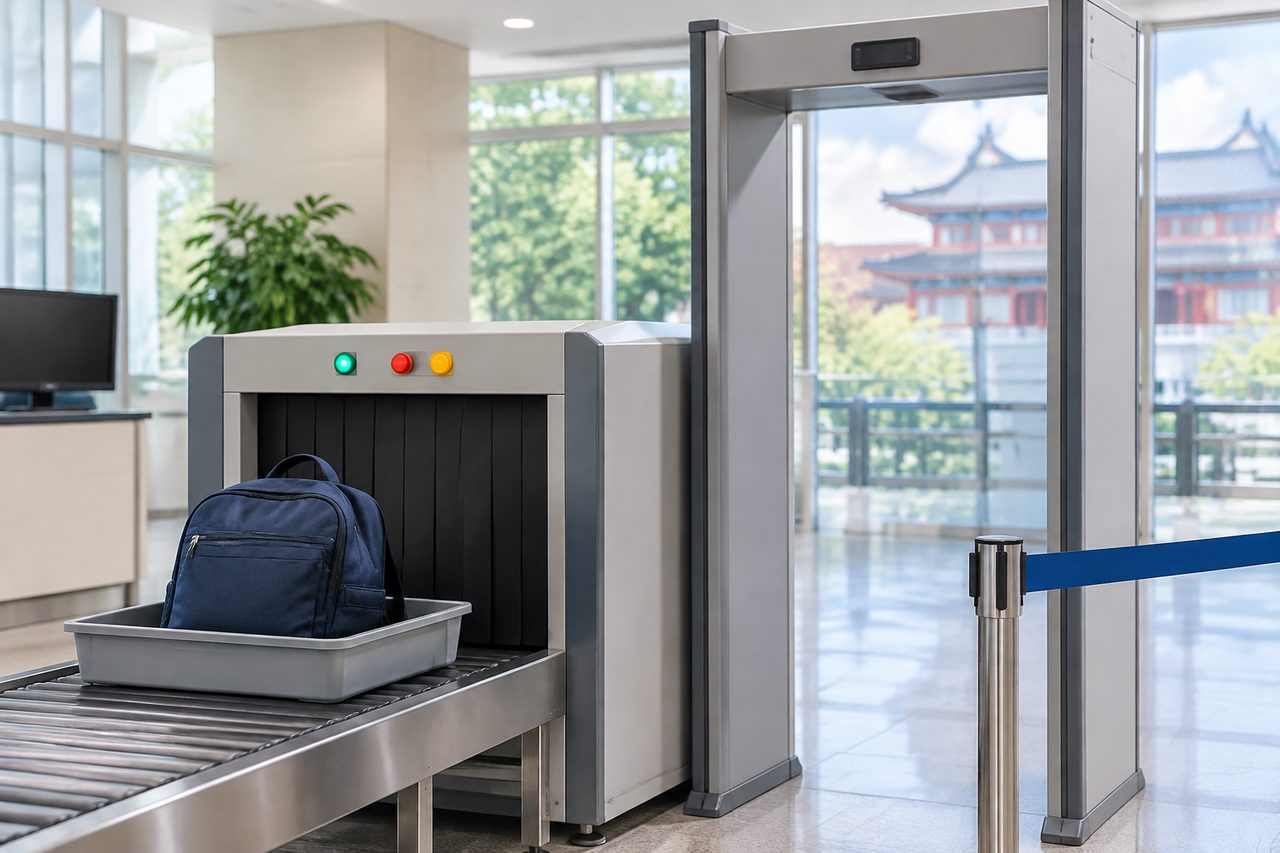
- Bag screening. Carry-on bags and backpacks pass through an X-ray machine, or a staff member asks you to open them for a quick visual inspection.
- Walk-through metal detection. You pass through a detector frame; if it alerts, a staff member may use a handheld wand.
- Appointment or ID verification. At some hospitals, especially those with dedicated international departments, staff at the entrance may ask for an appointment confirmation or passport before directing you to the right building.
- Restricted items. Sharp objects, flammable materials, and large luggage are commonly restricted inside clinical areas. Hospitals typically provide storage or ask you to leave such items with a companion.
The screening is conducted by hospital security staff, sometimes supported by contracted security personnel. It is a safety measure, similar in spirit to entry screening at airports, government buildings, or large public venues. It is not a medical triage step, and it does not determine whether you will be seen.
Do Chinese Hospitals Have Security Screening for Foreigners?
Yes — but the key point is that the screening is not separate for foreigners. Do Chinese hospitals have security screening for foreigners? They do, in the sense that foreign patients pass through the same entrance checks as everyone else. There is no special lane, no additional interrogation, and no medical screening at the door.
What can differ is the support around you. Hospitals with international departments or VIP channels — the routes most commonly used by patients who do not speak Chinese — often have English-speaking staff at reception who can confirm your appointment and guide you past the security point to the correct floor. In standard outpatient areas, signage and staff communication may be in Mandarin only, which is where the practical difficulty usually lies.
Why the Check Exists: Safety at Scale
China’s top hospitals operate at a scale that is hard to picture from abroad. The country has more than 35,000 hospitals, and the busiest tertiary centers concentrate enormous daily footfall into a few buildings. Controlled entrances help hospitals manage crowd flow, reduce the risk of weapons or hazardous items entering clinical areas, and protect both patients and staff.
This is part of a broader pattern of visible public security in China. Many public buildings, transport hubs, and large venues use entry screening as a matter of routine. For patients, the practical consequence is simple: budget a few extra minutes on arrival, particularly for a first visit, and expect the process to be repeated each time you enter the main clinical buildings.
What the Check Looks Like, Step by Step
Here is how a typical arrival at a major public hospital unfolds, so you know what to expect on the day:
- Approach the designated entrance. Large hospitals often have several entrances, with the main outpatient entrance handling the heaviest flow. Follow signs or ask a companion to confirm which entrance serves your department.
- Join the security queue. Queues are longest in the early morning, when outpatient registration opens. Arriving slightly later in the morning can mean a shorter line.
- Place bags on the scanner belt. Remove any large bags and place them on the belt. If there is no scanner, open your bag for inspection.
- Walk through the detector. Remove nothing unless asked; if the alarm sounds, cooperate with a handheld check.
- Show documents if requested. Present your appointment confirmation or passport if staff ask.
- Proceed to registration. Once through, follow signs or staff directions to the registration desk or international department.
The whole sequence usually takes a few minutes. At peak times, allow 15 to 30 minutes from arrival at the entrance to reaching your registration desk, including queueing and wayfinding.
Common Mistakes and How to Avoid Them
Most difficulties at the entrance are avoidable with a little preparation. The most frequent issues we see are:
- Bringing restricted items. Sharp objects, large suitcases, and flammable items are commonly restricted. Leave them at your hotel or with a companion.
- Arriving at the wrong entrance. Some entrances serve specific buildings or departments. Confirm the correct entrance in advance, especially for international departments.
- Not carrying identification. Keep your passport with you; some hospitals request it at entry or registration.
- Misreading the check as a medical step. The security check does not assess your condition or affect your appointment. Do not worry that it reflects anything about your case.
- Underestimating the queue. Build in buffer time on the day of a first consultation, when you also need to complete registration and payment.
Practical Considerations for International Patients
Beyond the entrance itself, a few logistics are worth planning around:
- Language. Security staff may not speak English. Having your appointment details written down, or a bilingual companion with you, makes communication straightforward.
- Visa. Foreign patients traveling to China for medical treatment typically use the S2 visa for short stays, with supporting hospital documents; stays exceeding 180 days generally use the S1 category. Requirements are set by the latest embassy and consulate guidance, and approval is never guaranteed.
- Payment. Public hospitals generally require prepayment, with insurance reimbursement handled afterward; many private international hospitals offer direct billing. Confirm the payment process for your chosen hospital before you travel.
- Appointment reality. Standard outpatient registration at public hospitals generally cannot be reserved from abroad in advance; surgery is arranged only after an in-person consultation. International or VIP departments are the usual route for securing appointments ahead of time.
- Records. Bring copies of your medical reports in English where possible. These are useful for registration and for any consultation that follows.
If you are still choosing where to go, our overview of top-ranked hospitals by city and the specialty rankings can help you shortlist centers before you plan the journey.
Frequently Asked Questions
At hospitals that operate controlled entrances, yes — screening applies to all visitors, patients, and staff. It is a standard safety procedure rather than a policy aimed at any particular group. If you are unsure which entrance to use, ask at reception or check your appointment confirmation.
Usually not. The check itself takes only a few minutes, though queues are longer at peak morning hours. Allow extra time on your first visit, when you also need to complete registration and payment. If you have a fixed appointment time, arrive early rather than cutting it close.
Carry your passport with you. Some hospitals request identification at entry or registration, and it is also needed for creating a hospital medical card. Keep it accessible rather than packed away in a suitcase.
Restrictions vary by hospital, but sharp objects, flammable materials, and large luggage are commonly restricted in clinical areas. If in doubt, leave such items at your hotel or with a companion. Staff at the entrance can advise if an item needs to be stored.
Private international hospitals generally have lighter entry screening and more English-speaking staff at reception, but the overall principle is the same: a brief safety check before you enter clinical areas. The experience is usually calmer because patient volumes are lower.
Your Next Step
The security check is a small, predictable part of a much larger journey — one that becomes manageable once you know the sequence. If you are planning treatment in China and want help understanding the practical steps, our team at China Medical Services can assist with hospital matching, appointment coordination, and bilingual support on the day. We are not a hospital and do not provide diagnoses; we help you navigate the system with clearer information. A good next step is simply to start a conversation about your needs — no commitment required. Understanding the entrance is the first step; the rest of the path can be planned with the same clarity.
For more medical information and treatment options in China, visit chinamedservices.com (China Medical Services).
