Personal Driver and Vehicle Service China: Dedicated Transport for Medical Tourists
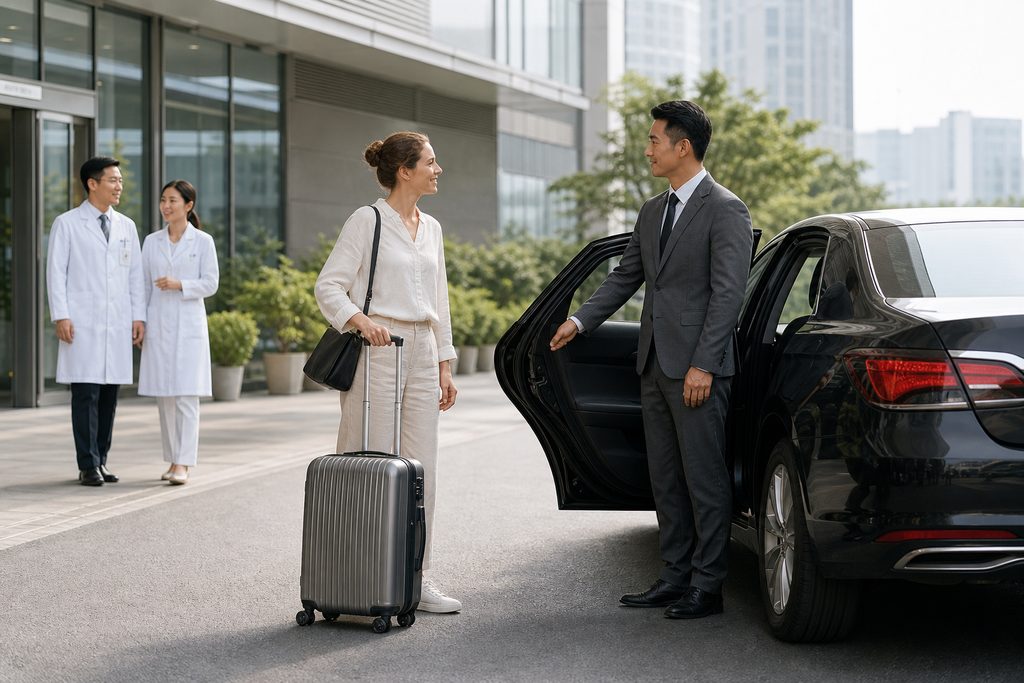
Key Takeaways
- A dedicated personal driver service in China transforms a disorienting hospital journey into a seamless recovery, with city transfers starting from roughly $100 per trip.
- Unlike ride-hailing apps, a private chauffeur solves the critical language barrier, navigates complex hospital campus layouts, and ensures a sanitized vehicle for post-surgery transport.
- Booking a driver independently online often leads to unvetted vehicles, no medical awareness, and canceled bookings — a significant risk for patients on fixed surgical schedules.
- Structured services that combine a medical escort with a vehicle are often safer and more cost-effective than hiring a standalone driver who cannot assist inside the hospital.
The Problem: Navigating a Megacity While Medically Vulnerable
Landing in Shanghai Pudong International Airport after a 14-hour flight is disorienting enough. Now imagine doing it 72 hours after a spinal fusion. You do not speak Mandarin. You cannot bend to lift luggage. The taxi queue is 200 people deep, and the ride-hailing app is entirely in Chinese characters. This is not a hypothetical anxiety — it is the daily reality for thousands of medical tourists who underestimate the physical toll of ground transport in China’s megacities.
Beijing has a population of over 21 million. Shanghai exceeds 24 million. Hospital districts like Xicheng in Beijing or Xuhui in Shanghai are labyrinths of one-way streets, pedestrian-only zones, and multi-building medical campuses. A patient fresh out of a knee replacement at Peking University Third Hospital cannot walk half a mile from a drop-off point to the orthopedics building. They need a curb-to-entrance solution. And they need it without explaining their pain level to a driver who only speaks Shanghainese.
The private driver for medical tourists China cost is not just a line item on a travel budget. It is the price of safety, dignity, and clinical compliance during recovery. Yet most international patients either overpay for hotel concierge black cars or gamble on unregulated drivers found in expat forums. Neither option accounts for the specific needs of a post-operative body.
Who We Are
Our team is the operational backbone for international patients seeking treatment at China’s 340+ top-ranked hospitals across 37 cities. We are not a hospital. We do not provide medical treatment or clinical diagnoses. We are your logistical architects — we bridge the gap between you and China’s top-tier medical expertise. We handle hospital matching, bilingual medical companionship, visa guidance, and the dedicated transport logistics that make a treatment plan physically possible. When a patient asks how to hire a car and driver after surgery in China, we do not just send a car. We send a recovery-ready environment on wheels.
Why a Dedicated Medical Vehicle Changes the Recovery Equation
Clinical Safety Starts at the Curb
Post-surgical transport is a clinical event. A patient discharged after a laminectomy must maintain a neutral spine position. Slouching into a low-slung sedan seat can undo weeks of surgical precision. A standard Didi driver will not know this. A private driver briefed by a medical coordination team will. They arrive with the rear seats adjusted to a 30-degree recline, a firm cushion to reduce vibration transfer, and the air suspension set to comfort mode. These are not luxuries. They are non-negotiable for spinal fusion, hip arthroplasty, and abdominal surgery recoveries.
In 2019, a study published in the *Journal of Patient Safety* noted that non-clinical transport immediately after discharge contributed to elevated pain scores and preventable readmission anxiety in elderly surgical patients. The vehicle is an extension of the recovery ward. If it is not configured correctly, the patient suffers.
Solving the Language Barrier at 60 Kilometers Per Hour
Medical transport in China is not just about moving a body from point A to point B. It is about real-time communication. A patient needs to say: “I feel nauseous. Can we pull over safely?” Or: “The discharge papers say I must keep my leg elevated — is there space?” In a standard taxi, that sentence is lost. Our drivers are paired with bilingual medical companions who sit in the rear with the patient. They translate clinical instructions, monitor comfort, and coordinate directly with the hospital’s international department if a discharge delay occurs. The vehicle becomes a mobile care unit, not just a ride.
Cost Efficiency When You Bundle Transport with Coordination
When patients research the private driver for medical tourists China cost in isolation, they often see rates of $80 to $150 per half-day on freelance platforms. That looks cheap. But it rarely includes fuel surcharges, highway tolls, waiting time penalties, or the cost of a second staff member to assist with hospital check-in. A standalone driver drops you at the entrance and leaves. You are then alone in a 2,000-bed hospital with signage in Chinese.
A bundled service that integrates a medical companion and a vehicle typically starts from $200 per day. That single rate covers the driver, the vehicle, the companion, and the logistics of navigating the hospital’s internal departments. When you unbundle these services, you end up paying more for less coverage. That is the hidden math most first-time visitors discover too late.
| Service Component | Freelance Driver (Standalone) | Integrated Medical Transport |
|---|---|---|
| Vehicle & Driver | $80–150/half-day | Included |
| Bilingual Hospital Companion | Not available | Included |
| Hospital Internal Navigation | Drop-off only | Full escort |
| Post-Surgery Vehicle Configuration | Not guaranteed | Standard protocol |
| Total Estimated Daily Cost | $150–250+ (if companion hired separately) | from $200 |
What You Need to Know Before Booking a Driver Independently
Many patients attempt to self-source a driver through expat social media groups or local hotel concierges. The impulse is understandable. It feels more direct. But the risks compound quickly for someone on a medical timeline.
- Visa Compliance and Insurance Gaps: A private driver operating outside a registered transport service may not carry commercial passenger insurance. If an accident occurs, the patient’s travel medical insurance may deny the claim because the vehicle was not a licensed medical transport provider. This is a gray zone that becomes pitch black when a claim is filed.
- Hospital Campus Access Restrictions: Many top-tier hospitals, including Fuwai Hospital and Peking Union Medical College Hospital, have restricted vehicle access zones. Unregistered private cars are barred from the inner campus roads. Patients are dropped at the outer gate, often 500 meters from the actual department entrance. A medically coordinated vehicle has pre-registered access or a companion who knows the accessible entry points.
- No-Show Risk on Surgery Days: A freelance driver who cancels 20 minutes before pickup on a surgery morning leaves a patient stranded. There is no backup fleet. A professional coordination team maintains a pool of vetted drivers and can deploy a replacement in under 30 minutes. For a patient facing a non-negotiable surgical check-in time, that redundancy is the difference between a successful admission and a rescheduled procedure.
How to Book a Dedicated Vehicle for Medical Travel in China
The process of securing reliable transport should begin at least two weeks before your flight. Last-minute bookings are possible, but vehicle configuration requests — such as a flat-lay seat for a patient who cannot sit upright — require advance notice.
First, confirm your hospital schedule. The vehicle booking must align precisely with your consultation, admission, and discharge dates. If your surgery date shifts, the transport schedule must shift with it. A rigid booking with a non-medical driver will not accommodate this. A medically aware service builds in buffer days.
Second, specify your clinical needs. A patient recovering from cardiac surgery at Zhongshan Hospital Fudan University has different transport requirements than a patient undergoing IVF at Jiahui International Hospital. The former needs a vehicle with minimal vibration and a climate-controlled cabin to avoid cardiac stress. The latter needs discretion, privacy, and a calm environment. Generic “airport transfer” services do not make these distinctions. A service that handles medical transport routinely will ask these questions before you do.
Third, verify the vehicle’s sanitation protocol. Immunocompromised patients — those on chemotherapy or post-transplant immunosuppressants — cannot ride in a vehicle that was used for general tourism the previous day. A proper medical vehicle is deep-cleaned with hospital-grade disinfectants, and the driver wears a fresh N95 mask. This is standard in China’s private medical transport sector. It is absent in the standard ride-hail economy.
Medical Transport Service Shanghai Prices and Regional Variations
You can. But we strongly advise against it. A post-surgical patient needs someone who can communicate with hospital staff during discharge, read the aftercare instructions in Chinese, and physically assist with doors and seat adjustments. A driver alone cannot leave the vehicle in a no-parking zone. A companion can. The combined cost of a standalone driver plus a separate translator is almost always higher than an integrated service. And the clinical risk of missing a discharge instruction due to a language gap is impossible to price.
Yes, but vehicle options narrow considerably. A last-minute booking may limit you to a standard sedan when you needed a wheelchair-accessible van. For planned surgeries, book at least 14 days in advance. For emergency medical evacuations or sudden consultation needs, we can often deploy a vehicle within 4 hours in Beijing, Shanghai, and Guangzhou. The vehicle may not have the full post-surgical configuration on short notice, but it will be clean, safe, and driven by a medically briefed professional.
This is common. Surgical schedules shift. A professional medical transport service builds in contingency days and does not penalize patients for hospital-driven delays. You inform the coordination team of the new discharge date, and the schedule adjusts. If the delay extends beyond the original booking window, the service continues at the agreed daily or weekly rate. No surge pricing. No cancellation fees for the hospital’s timeline change.
All vehicles in our network carry commercial passenger insurance. Drivers are licensed, background-checked, and trained in basic patient transfer safety. This includes proper lifting techniques for patients with limited mobility and awareness of common post-surgical restrictions. This is not a guarantee of clinical outcomes — no transport service can offer that — but it is a guarantee that the vehicle and driver meet the legal and safety standards that a standard ride-hail driver may not.
Your Next Step
Ground transport is the most underestimated variable in medical travel. Patients spend months researching surgeons and hospitals, then leave the 48-hour post-discharge window to chance. That window is when complications are most likely to surface and when physical vulnerability is at its peak. A dedicated, medically briefed vehicle is not a luxury line item. It is the final mile of a treatment plan that began the moment you decided to seek care in China.
If you are planning treatment at one of China’s 340+ top-ranked hospitals, we can align your transport logistics with your clinical schedule. Start with a free consultation — we will review your hospital itinerary, recommend the appropriate vehicle class, and provide a transparent cost breakdown. There is no pressure and no commitment. Just a clear plan for getting you safely from the operating room to your recovery bed. Speak with our coordination team today.
Frequently Asked Questions
Yes. We work with JCI-accredited and major Grade 3A tertiary hospitals that follow international safety standards comparable to top hospitals in the US and Europe. Surgical teams perform high volumes of procedures — often more than their Western counterparts — which studies show leads to better outcomes.
Costs vary by procedure and hospital, but international patients typically save 40-80% compared to US prices — even when factoring in travel and accommodation. A consultation with our team will give you an exact, all-inclusive quote with no hidden fees.
Send us your existing medical reports. The relevant specialty reviews them and gives you a written opinion, including treatment direction and options, before you commit to any travel. From there you can add a video consultation with the doctor, or have us attend an appointment on your behalf.
For more medical information and treatment options in China, visit chinamedservices.com (China Medical Services).
