China Orthopedic Surgical Robot: Joint Replacement with Sub-Millimeter Precision for Foreigners
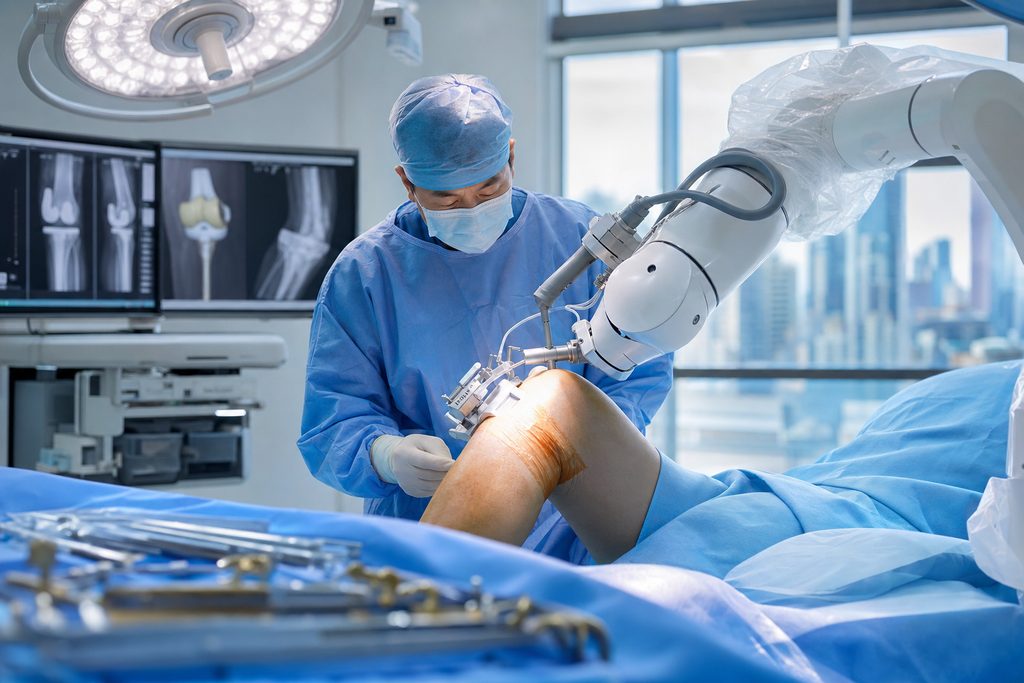
You have probably seen the headlines. Medical tourists flying to Asia for cheap surgery and coming back with complications. The assumption is that lower cost means higher risk. That is a reasonable fear. But it is also outdated. When it comes to robotic joint replacement, China has quietly built an infrastructure that challenges that assumption at the data level. We are talking about sub-millimeter precision, surgical volumes that dwarf Western hospitals, and a robotic knee replacement cost China that runs roughly 70% below US prices. Not because corners are cut. Because the economics and scale are fundamentally different. Our team at China Medical Services has spent years connecting international patients with this system. We do not perform surgery. We make sure you do not get lost in the system before you even reach the operating room.
Key Takeaways
- Chinese orthopedic surgeons using robotic platforms like Mako and TiRobot routinely achieve implant placement accuracy within 0.5mm — a precision level that directly correlates with lower revision rates over the implant’s lifespan.
- The total cost for robotic-assisted total knee replacement at a top-tier Chinese public hospital ranges from $15,000 to $25,000, compared to $45,000 to $70,000 in the United States for the same technology.
- Foreign patients cannot simply book a surgery online. Public hospitals require an in-person consultation first. International departments exist specifically to bridge this gap, but navigating them without local language skills is the single biggest barrier to access.
- China’s top joint replacement centers handle over 1,000 robotic knee procedures annually per hospital. That volume creates a proficiency curve that smaller Western centers simply cannot replicate.
The Problem: Precision Matters More Than Patients Realize
Roughly 20% of patients report dissatisfaction after traditional total knee replacement. That number comes from a 2016 study in the Bone & Joint Journal. The primary culprit is not infection or implant failure. It is subtle malalignment. A prosthesis placed just 2 or 3 degrees off the mechanical axis changes how force distributes through the joint. The patient feels it. The implant wears unevenly. A revision surgery looms years earlier than necessary.
Traditional jig-based techniques rely heavily on the surgeon’s tactile feel and intraoperative estimation. Even an experienced surgeon operates with a margin of error measured in millimeters and degrees that can drift. The patient has no way to verify this. They trust the surgeon’s hands. Most of the time, that trust is warranted. But when it is not, the cost of revision surgery in the US averages $50,000 to $80,000. And the recovery is harder the second time.
Robotic-assisted surgery changes the equation. Preoperative CT scans build a 3D model of the patient’s specific anatomy. The robotic arm defines a virtual boundary. The saw physically cannot cut outside that boundary. The surgeon retains control. The robot enforces the plan. Accuracy drops below 1mm of deviation. Below 1 degree of angular error. This is not marketing language. It is physics.
Who We Are
We are not a hospital. We do not provide medical treatment or clinical diagnoses. We are your logistical architects. China Medical Services bridges the gap between you and China’s 340+ top-ranked hospitals. We handle hospital matching, appointment coordination through official international departments, bilingual medical companionship, and visa guidance. We exist because China’s most advanced orthopedic centers are genuinely world-class — and genuinely difficult to access if you do not speak Chinese or understand how the system works. Our role is to make the clinical expertise reachable.
Why Robotic Joint Replacement in China Delivers Results
Clinical Volume Creates a Proficiency Curve Most Western Surgeons Never Reach
Here is a number that should reframe how you think about surgical skill. A senior orthopedic surgeon at a major Chinese joint replacement center performs between 300 and 600 robotic knee replacements annually. The average US orthopedic surgeon performs approximately 65 knee replacements per year, according to data from the American Joint Replacement Registry. That is a 5-to-1 volume ratio.
Volume is not a vanity metric. Multiple studies, including a 2019 analysis in JAMA Surgery, show a clear correlation between surgeon-specific annual volume and lower complication rates. The learning curve for robotic-assisted total knee arthroplasty plateaus after roughly 50 to 100 cases. After that, every additional hundred cases refines efficiency, intraoperative decision-making, and the ability to handle complex deformities. Chinese surgeons at high-volume centers cross that threshold in their first few months of practice each year.
This is not a statement about individual talent. It is a statement about system design. China’s centralized hospital model funnels complex cases to a relatively small number of top-tier public institutions. A hospital like Peking University Third Hospital or Shanghai Sixth People’s Hospital runs orthopedic departments with dozens of attending surgeons, each operating at volumes that would make them outliers in most Western systems.
Sub-Millimeter Precision Is Now Standard, Not Exceptional
Let us talk about what how precise is robotic joint replacement surgery in China actually means in practice. The accuracy metric that matters is implant positioning relative to the preoperative plan. With robotic platforms — primarily Stryker’s Mako system and China’s domestically developed TiRobot — published studies report mean deviations of 0.5mm to 0.8mm for tibial component alignment and under 1 degree for coronal plane alignment.
Why does 0.5mm matter? Because soft tissue balancing in knee replacement is exquisitely sensitive to component position. A femoral component placed 3mm too anteriorly overstuffs the patellofemoral joint. The patient feels stiffness and anterior knee pain. A tibial component in 3 degrees of varus loads the medial compartment unevenly. Polyethylene wear accelerates. At 0.5mm deviation, these failure modes become dramatically less likely. The robot does not get tired. It does not have a bad day. It executes the plan.
For international patients, the question becomes practical: can foreigners get sub-millimeter robotic hip surgery in Beijing? The answer is yes, but the pathway matters. The clinical capability exists. The barrier is not technology. It is access. Beijing’s top orthopedic hospitals — including Peking Union Medical College Hospital and Jishuitan Hospital — operate robotic systems daily. Their international departments are equipped to receive foreign patients. But you need someone who speaks the language and understands admission protocols to get you through the door.
Cost Advantage Without Quality Compromise
The robotic knee replacement cost China runs between $15,000 and $25,000 for the complete procedure at a top-tier public hospital’s international or VIP ward. That includes the surgeon fee, robotic system usage, implant, hospital stay of 5 to 7 days, and postoperative imaging. In the United States, the same procedure with the same Mako robotic platform typically ranges from $45,000 to $70,000. Some private hospitals in Singapore and Germany quote $35,000 to $50,000.
The price difference is not a quality signal. It reflects structural economics. Chinese hospital systems operate at enormous scale with lower per-procedure overhead. Surgeon compensation is salary-based rather than fee-for-service. Implant costs are negotiated nationally at volumes that individual Western hospitals cannot match. The robotic platform itself is the same Stryker Mako system used at Mayo Clinic or Hospital for Special Surgery. The difference is the cost structure wrapped around it.
| Country | Robotic Knee Replacement (USD) | Robotic Hip Replacement (USD) | Includes |
|---|---|---|---|
| United States | $45,000 – $70,000 | $40,000 – $65,000 | Surgeon, implant, hospital, robot |
| Germany | $30,000 – $45,000 | $28,000 – $40,000 | Surgeon, implant, hospital, robot |
| Singapore | $35,000 – $50,000 | $32,000 – $45,000 | Surgeon, implant, hospital, robot |
| China (Top Public, VIP Ward) | $15,000 – $25,000 | $14,000 – $22,000 | Surgeon, implant, hospital, robot |
| China (Private International) | $25,000 – $35,000 | $22,000 – $32,000 | Surgeon, implant, hospital, robot, English-speaking staff |
These figures vary by hospital tier, implant brand, and case complexity. A straightforward primary knee replacement in a patient without significant deformity sits at the lower end. Revision cases or bilateral procedures push toward the upper end. Our team provides case-specific estimates after reviewing your imaging and medical history.
What You Need to Know Before Going Alone
The clinical capability exists. The cost advantage is real. But the barriers to accessing this care independently are significant. We have seen patients try. Most give up. Here is why.
- Visa Requirements Are Specific and Unforgiving: Medical treatment in China requires an S2 visa with a notation specifying the treatment purpose. This is not a tourist visa. It is not a business visa. The application requires an invitation letter from the Chinese hospital confirming your treatment arrangement. Obtaining that letter without a local contact inside the hospital’s international department is extremely difficult. Consulates reject applications with incomplete documentation. We handle this end-to-end, from hospital invitation letter to consulate submission guidance.
- Public Hospital Registration Does Not Work Like Western Booking Systems: You cannot browse an online calendar and select a surgery date. Top orthopedic surgeons in public hospitals see 80 to 120 outpatients per morning session. Registration opens at specific times, often through WeChat mini-programs entirely in Chinese. Slots for sought-after surgeons fill within minutes. Our bilingual companions handle registration, queue management, and payment processing so you arrive at the consultation, not at a dead end.
- Payment Systems Are Fundamentally Different: Chinese public hospitals operate on a prepaid deposit model. You load funds onto a hospital account card. Every test, medication, and procedure deducts from that balance. The system is cashless but entirely domestic — international credit cards are not accepted at most public hospital counters. We manage deposit logistics and payment processing so you never stand at a cashier window trying to explain why your Visa card will not work.
How We Help You Navigate This
These barriers are not designed to exclude foreigners. They are the natural byproduct of a healthcare system optimized for a domestic population of 1.4 billion people. Our job is to bridge that gap without pretending the gap does not exist.
Before you travel, we collect your medical records, imaging, and surgical history. We translate and format these for review by the orthopedic department at your matched hospital. We coordinate a video consultation with the surgical team where clinically appropriate. Our bilingual medical companion service ensures that when you arrive, someone is physically with you — handling registration, translating during consultations, and navigating the hospital campus. A single top-tier Chinese hospital can see over 15,000 outpatients daily. The physical scale alone is disorienting. Having someone who knows exactly which building, which floor, and which window to approach saves hours and reduces stress measurably.
During your hospital stay, we coordinate communication between you, your family, and the clinical team. After discharge, we arrange follow-up imaging, rehabilitation guidance, and, if needed, remote consultations with your surgeon. We also coordinate the S2 visa extensions if your recovery requires a longer stay than initially planned.
For patients researching the best hospital for robotic joint replacement China for international patients, the answer depends on your specific clinical needs. Peking Union Medical College Hospital in Beijing offers a renowned international medical department with decades of experience treating foreign patients. Shanghai Sixth People’s Hospital runs one of the highest-volume orthopedic surgery departments in the world. West China Hospital in Chengdu is a powerhouse for complex revision cases. We match based on your imaging and history, not a generic ranking list. You can explore our database of top-ranked hospitals to understand the landscape, but the final match should be clinical, not alphabetical.
Many patients ask about orthopedic surgical robot joint replacement price abroad comparisons and whether a book robotic knee surgery China medical tourism package approach works. It does not — not in the way some Southeast Asian medical tourism companies operate. China’s top public hospitals do not sell pre-packaged surgery deals. The pathway is consultation first, surgical plan second, scheduling third. Anyone offering a fixed-price “package” that skips the consultation step is not working through official hospital channels. Our coordination service starts from $300 for appointment booking, with full refund if we cannot secure the requested appointment. Video consultations with top specialists range from $500 to $800. These fees are credited in full toward on-the-ground coordination if you proceed with treatment within 90 days. That is our commitment to aligning our interests with yours — we only succeed if your clinical pathway succeeds.
Frequently Asked Questions
Yes. The primary robotic platforms are Stryker’s Mako system and Zimmer Biomet’s ROSA system — identical hardware and software to what you would find at leading orthopedic centers in the US. China also has a domestically developed system called TiRobot, which has published peer-reviewed accuracy data comparable to Mako. The choice of platform depends on the hospital and your specific anatomy. Your surgeon will determine which system is appropriate based on your CT-based preoperative plan.
This is the single most important question to ask before traveling for surgery anywhere. Chinese top-tier hospitals provide comprehensive operative notes, implant documentation, and postoperative imaging in English upon request. Your home-country orthopedic surgeon can use these records for follow-up care. We also coordinate remote video consultations with your Chinese surgical team if your local doctor needs to discuss the case directly. That said, you should establish a relationship with a local orthopedic surgeon before traveling. No one should travel for surgery without a plan for who will manage their recovery at home.
Plan for a minimum of 14 to 21 days after surgery. The hospital stay itself is typically 5 to 7 days. The remaining time is for early rehabilitation, suture removal, and a final follow-up with your surgeon before clearance to fly. Flying long-haul within the first two weeks after joint replacement increases deep vein thrombosis risk. Your surgeon will clear you for travel only after confirming that your wound is healing well and your mobility is sufficient for the journey. Do not book a return flight with a fixed date before your surgery. We help coordinate flexible bookings and recovery accommodations near the hospital.
Most Western health insurance plans, including Medicare and many US private insurers, do not provide direct coverage for elective surgery in China. Some international health insurance plans — particularly those from providers like Cigna Global, Bupa International, or Allianz — may offer partial reimbursement for treatment at JCI-accredited hospitals in China. Public hospitals in China typically require prepayment and provide detailed invoices for you to submit to your insurer for reimbursement. Private international hospitals like United Family can sometimes bill international insurers directly. We recommend contacting your insurer before making any commitments. We can provide the documentation your insurer requires to evaluate coverage.
The implants used in Chinese top-tier hospitals are the same brands and models used globally — Stryker, Zimmer Biomet, DePuy Synthes, Smith & Nephew. These are multinational orthopedic companies with identical manufacturing standards regardless of which country the implant is sold in. Chinese hospitals do not use generic or locally manufactured implants for robotic joint replacement unless the patient specifically chooses a domestic brand (which does exist and has strong clinical data, but the choice is always disclosed). Your preoperative consultation will specify the exact implant brand and model planned for your procedure.
Your Next Step
Robotic joint replacement in China offers precision that was unavailable to any surgeon a decade ago, at a cost that makes the procedure accessible to patients who would otherwise face years of deterioration while saving for surgery at home. The technology is the same. The implants are the same. The clinical volumes are, in many cases, higher. What is different is the pathway to access. That pathway requires local knowledge, language capability, and institutional relationships. If you are considering robotic knee or hip replacement and want to understand whether China’s top orthopedic centers are a viable option for your specific case, reach out to us. We review your imaging, match you with an appropriate surgical team, and handle the logistics. The consultation is free. The decision is yours.
For more medical information and treatment options in China, visit chinamedservices.com (China Medical Services).
