Why China Pharmacy Is Inside Hospital Not Down the Street: The System Explained
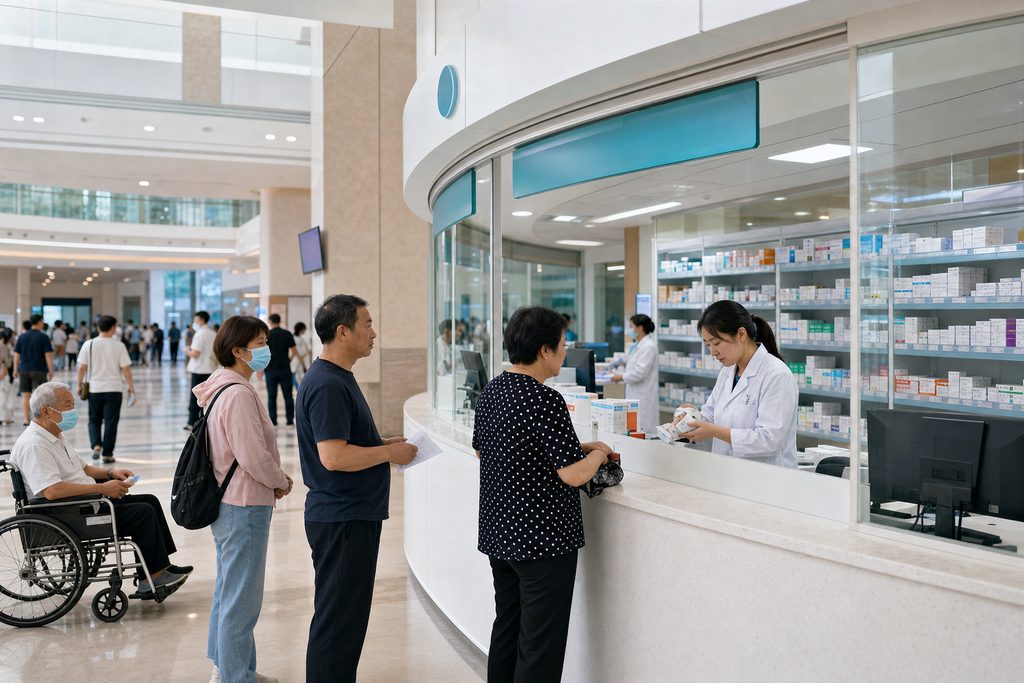
When 42-year-old Michael landed in Shanghai for a business trip, a severe sinus infection hit him harder than the jet lag. Back home in Manchester, he would have walked two blocks to Boots, handed over a prescription, and been home with antibiotics in ten minutes. In Shanghai, he stared at his phone map, confused. The nearest pharmacy was not on the corner. It was buried inside the outpatient tower of a massive public hospital. He walked half a mile into a sprawling campus, navigated a crowd, and eventually found the dispensary window — only to be told he needed a Chinese doctor’s prescription first. What Michael stumbled into was not a random inconvenience. He had collided with one of the most fundamental structural differences in global healthcare delivery: the hospital-centric pharmacy model of China.
The question of why are pharmacies in hospitals in china rather than sprinkled through neighborhoods like Starbucks is not just logistical curiosity. For foreign visitors and medical tourists, it is a make-or-break operational detail. It determines where you go, how long you wait, what you pay, and whether you even get the right medication. Our team has guided hundreds of international patients through this exact maze. The system is logical once you understand the incentives that built it. Let us walk through those incentives, the pricing, and exactly what a foreigner needs to know to get a prescription filled without wasting a day.
Key Takeaways
- Over 75% of China’s pharmaceutical sales flow through hospital pharmacies, compared to roughly 15% in the United States — the hospital is the primary, not the alternative, dispensing channel.
- Hospital pharmacies in China are legally accountable for the entire chain of custody, from manufacturer cold storage to patient handoff, reducing the counterfeit drug risk that plagues fragmented retail markets.
- A foreigner cannot simply walk up to a hospital pharmacy window and buy prescription medicine; you must first see a doctor inside that same hospital to obtain a valid, hospital-specific prescription.
- Retail pharmacy prices in China are unregulated and often 20-40% higher than hospital pharmacy prices for the same drug, but hospital access requires navigating a registration and consultation process that rarely offers English support.
The Problem: A Pharmacy Model Built for Hospital Accountability, Not Retail Convenience
In most Western countries, the pharmacy and the clinic are legally, financially, and physically separate. That separation is a feature, not a bug — it prevents physicians from profiting directly from the drugs they prescribe. China took the opposite path. For decades, public hospitals were underfunded by the government and permitted to retain a 15% markup on drug sales to subsidize operations. The result was an explosive financial incentive to dispense on-site. By 2017, hospital drug sales accounted for 68% of the total pharmaceutical market, according to a report by IQVIA. Even after major reforms eliminated the markup in public hospitals, the infrastructure and patient behavior had already been locked in for a generation.
That is the structural answer. But there is a patient-safety logic that often gets overlooked. A hospital pharmacy in China is not just a pickup window. It is the final checkpoint in a closed-loop system. The prescribing doctor, the hospital’s internal pharmacy and therapeutics committee, and the dispensing pharmacist all operate under the same institutional roof. If a batch of injectable ceftriaxone is recalled at midnight, the hospital can freeze dispensing across all its wards and outpatient windows by 12:15 a.m. A standalone retail chain with 2,000 independently operated franchises cannot do that. For a country that experienced multiple high-profile counterfeit drug scandals in the 2000s, this centralized control is not bureaucratic overreach — it is the regulatory immune system.
For an international patient, this means the pharmacy is not where you start. It is where you finish.
Why China’s Hospital-Centric Pharmacy Delivers Safety and Speed
The model frustrates visitors who want a quick transaction. But once you understand the workflow, it becomes an asset rather than an obstacle. The advantages are real, and they are quantified.
Closed-Loop Accountability Reduces Counterfeit Risk
The World Health Organization estimates that one in ten medical products in low- and middle-income countries is substandard or falsified. China’s response, particularly after the 2007 heparin contamination scandal that killed dozens of patients in the United States after originating from a Chinese supplier, was to tighten the chain of custody until it became a straitjacket. Hospital pharmacies now procure directly from provincial tendering platforms. Every vial, tablet, and IV bag is tracked with a unique drug traceability code managed by the National Medical Products Administration. A retail pharmacy can also comply with this system, but enforcement is far more consistent inside a hospital where the pharmacy director reports to the same hospital president who answers for adverse events. When our team coordinates care for a patient from Dubai or London, we know the injectable medications dispensed at a top-tier public hospital have passed through fewer hands and more checkpoints than they would in a fragmented retail environment.
Pharmacist-Physician Integration in One Building
At a major Chinese teaching hospital like Ruijin Hospital in Shanghai, the clinical pharmacy team rounds with physicians in the ICU every morning. The pharmacist who will later verify and dispense the prescription already knows the patient’s renal function, allergy profile, and culture results before the order hits the system. That integration is nearly impossible when the pharmacy is a CVS three blocks away. For a foreign patient on five different home medications with unfamiliar Chinese generic names, having a pharmacist who can walk down the hall and clarify an interaction with the prescribing cardiologist is not a luxury. It is a safety net.
Cost Control Through Institutional Buying Power
There is a persistent myth that hospital pharmacies in China are more expensive. The opposite is true for prescription drugs. Hospital procurement is conducted through massive provincial pooled purchasing. When Fujian province negotiates a contract for atorvastatin, it is buying for 40 million people. The volume-based procurement (VBP) program, launched nationally in 2018, has driven prices down by an average of over 50% for drugs in the program. A box of generic rosuvastatin that costs a hospital pharmacy 6.24 yuan might retail for 22 yuan at a chain drugstore. The hospital price is controlled by the state tender. The retail price is not. For a medical tourism patient paying out of pocket, the difference matters — especially for chronic disease medications or post-operative antibiotic courses.
Can Foreigners Buy Medicine at a Chinese Hospital Pharmacy? The Step-by-Step Reality
The short answer is yes, but the sequence is non-negotiable. A foreigner cannot walk into a hospital, bypass the clinical process, and purchase prescription medication at the pharmacy window. The pharmacy is the last step, not the first. Here is the actual workflow a patient must follow, based on the cases we coordinate daily.
Step one is hospital registration. You need a physical hospital card or a digital profile in the hospital’s app. This requires a passport. Without it, the system cannot generate a prescription record. Step two is a consultation with a doctor in that same hospital. The doctor enters the diagnosis and the prescription electronically. Step three is payment at the hospital cashier — the consultation fee, any required tests, and the medication cost are paid as one bundled transaction. Step four is the pharmacy pickup. You scan your hospital card or the barcode on your payment receipt at the dispensary window. The pharmacist verifies the electronic prescription, prepares the medication, and hands it over with printed instructions. The instructions will be in Chinese unless you are in an international department that provides translated labels.
This entire process assumes you can navigate it in Chinese or have someone who can. The registration kiosks, the consultation, the payment counters, and the pharmacy window operate almost exclusively in Mandarin. That is not a complaint about the system. It is a fact about it. For a tourist with a sudden infection like Michael, the practical path is to visit the hospital’s emergency department, see a doctor, and fill the prescription on-site, all in one exhausting but functional sequence. There is no workaround that skips the doctor visit.
Hospital Pharmacy vs Retail Pharmacy in China: The Price Gap and the Tradeoffs
Understanding the hospital pharmacy vs retail pharmacy China price dynamic is essential for any foreigner managing a healthcare budget. The general rule: hospital pharmacies are cheaper for prescription drugs, while retail pharmacies offer convenience and, increasingly, access to imported over-the-counter products. But the details matter.
| Factor | Hospital Pharmacy | Retail Chain Pharmacy |
|---|---|---|
| Prescription drug pricing | Controlled by provincial VBP tender; often 30-50% cheaper than retail for generic drugs on the national procurement list | Market-driven; can be 20-40% higher for the same generic, though some chains price-match for insured patients |
| Imported/originator drug availability | Limited to the hospital’s formulary; public hospitals increasingly prioritize VBP generics, so the original brand may not be stocked | Larger chains in major cities often stock imported brands (e.g., Pfizer’s Lipitor rather than generic atorvastatin) but at a significant premium |
| Prescription requirement | Mandatory — must be issued by a doctor in that same hospital during a current visit | Technically required for Rx drugs, but enforcement varies; some chains dispense common medications (antibiotics, antihypertensives) with only a verbal request, though this is illegal |
| Pharmacist consultation | Brief, often limited to dosing on the label; deep clinical questions may require requesting a clinical pharmacist consult | More personalized; chain pharmacists often have time to explain side effects and interactions, especially in chains targeting expat communities |
| Foreigner accessibility | Requires hospital registration and a consultation; no English support outside international departments | Walk-in access; some chains in expat-heavy areas (Shanghai’s Jing’an, Beijing’s Chaoyang) have English-speaking staff |
| Operating hours | Aligned with outpatient clinic hours, typically 8:00 AM to 5:00 PM on weekdays; 24-hour emergency pharmacy available at major hospitals | Many chains operate until 9:00 or 10:00 PM; some 24-hour locations exist in city centers |
The price gap is not uniform. For a common post-operative antibiotic like cefuroxime, the hospital price under VBP might be 8 yuan per course, while the same generic at a retail chain could be 25 yuan. But for a specialized oncology drug not on the VBP list, the hospital and retail prices may be nearly identical — and both will be significantly lower than US cash prices. A month of generic imatinib for chronic myeloid leukemia costs approximately $400-600 in China’s hospital system versus $8,000-10,000 in the United States. The savings are structural, not retail-versus-hospital specific.
For a foreigner who needs a prescription filled as a tourist, the hospital path is often the only legal path. But it is not the only practical path. Some international clinics in Beijing and Shanghai operate their own in-house pharmacies and can dispense directly after a consultation, which combines the clinical visit and the pharmacy stop into one English-friendly experience. The cost will be higher — often 1.5 to 2 times the public hospital price — but the friction is far lower.
How to Get a Prescription Filled in China as a Tourist Without Losing a Day
Most international travel insurance policies reimburse hospital-based treatment, including prescribed medications dispensed by the hospital pharmacy. You will typically need to pay upfront and submit a claim with itemized receipts. Ask the hospital cashier for a detailed invoice with the hospital’s official stamp. Without that stamp, your insurer may reject the claim. Direct billing is rare outside of private international hospitals.
Contact the hospital’s international department before you travel. Provide the generic name, dosage, and manufacturer of your medication. The pharmacy team can check their formulary and, if necessary, order the drug in advance. For very rare or imported medications, the hospital may not be able to procure it on short notice. In that case, you may need to bring a sufficient supply from home, along with a doctor’s letter and the original prescription for customs purposes. China allows personal importation of up to a three-month supply of medication for personal use, but controlled substances require advance approval.
Your Next Step
The Chinese pharmacy system is not broken. It is just organized around a different assumption — that the safest place to dispense a drug is the same institution that prescribed it. For a foreign patient, that means planning your pharmacy access as part of your clinical visit, not as a separate errand. Our team helps international patients map out exactly this kind of logistical sequence before they ever board a plane. We are not a hospital, and we do not provide medical advice or diagnoses. What we do is make sure you know where to go, what to bring, and how to navigate the system so you spend your time on treatment, not on translation. If you are considering medical care in China and want a clear,
Frequently Asked Questions
Yes. The hospitals used for international patients are JCI-accredited and follow the same international safety standards as top hospitals in the US and Europe. Surgical teams perform high volumes of procedures — often more than their Western counterparts — which studies show leads to better outcomes.
Costs vary by procedure and hospital, but international patients typically save 40-80% compared to US prices — even when factoring in travel and accommodation. A consultation with our team will give you an exact, all-inclusive quote with no hidden fees.
Send us your existing medical reports to get started. We handle everything from hospital selection and appointment scheduling to visa assistance and post-operative recovery planning. Your medical records are reviewed by the specialist before you even book a flight.
For more medical information and treatment options in China, visit chinamedservices.com (China Medical Services).
