Public vs Private Hospitals in China: What International Patients Must Know Before Booking
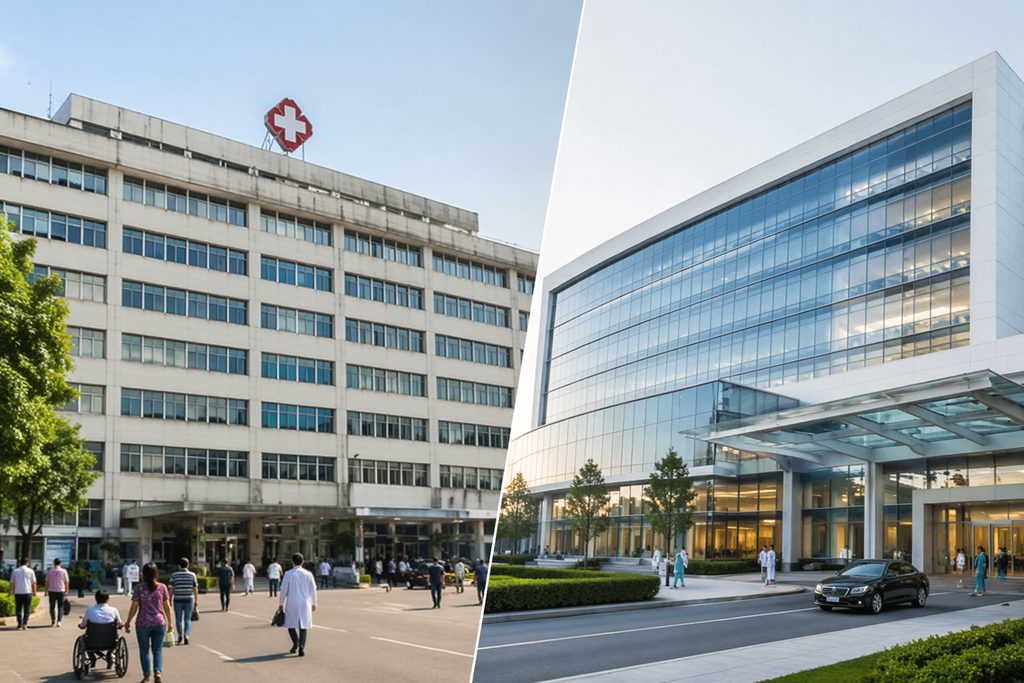
Staring at two hospital lists for China — one full of massive public institutions with walls of Chinese characters, the other showing sleek private clinics with English websites — can feel like trying to read a map in the dark. You are not alone in that confusion. The choice between a public teaching hospital and a private international facility shapes everything: your out-of-pocket cost, how you communicate with your surgeon, and whether your insurance company will even pick up the phone.
The numbers tell a story worth understanding. A cardiac bypass at a top-tier Chinese public hospital runs between $12,000 and $20,000. The same procedure at a private international hospital in Shanghai might reach $35,000 to $50,000. Both numbers sit well below the $120,000-plus you would face in the United States. But the price gap between public and private inside China is real, and it reflects genuine differences in experience, not just branding.
Our team has spent years helping international patients navigate exactly this fork in the road. We are not a hospital. We do not provide medical treatment or clinical diagnoses. We are your logistical architects — we bridge the gap between you and China’s top-tier medical expertise, handling everything from hospital matching to bilingual accompaniment so you can focus entirely on your health.
Key Takeaways
- China’s public top-tier hospitals perform surgical volumes unmatched anywhere — Fuwai Hospital alone completes over 14,000 cardiac surgeries annually, driving clinical expertise through sheer repetition.
- The private vs public hospital cost in China gap is substantial: public VIP wards cost roughly 1.5 to 2 times standard rates, while private international hospitals charge 3 to 5 times standard public pricing.
- Foreigners can absolutely access Chinese public hospitals, but the standard outpatient system requires same-day queuing and Chinese language ability — international departments are the practical bridge.
- Safety in a Chinese public hospital depends almost entirely on choosing a Fudan-ranked or JCI-accredited institution, not on whether the building is publicly or privately owned.
The Problem: Western Healthcare Costs Are Breaking People — And Wait Times Are Not Helping
Approximately 1 in 4 Americans report delaying or skipping necessary medical care because of cost, according to a 2023 Kaiser Family Foundation survey. For surgical procedures, the math gets brutal fast. A hip replacement in the United States averages $40,000 without complications. In the United Kingdom, NHS wait times for non-urgent orthopedic surgery stretched past 18 months in some trusts during 2023. Canada’s median wait time between specialist referral and treatment hit 27.7 weeks in 2023, per the Fraser Institute.
These are not abstract statistics if you are the one living with pain. Every month spent waiting is a month of lost mobility, lost income, and deteriorating quality of life. The structural problem is straightforward: high labor costs in Western healthcare systems meet constrained public budgets, and patients get squeezed in the middle.
China presents a different equation. Labor costs are lower. Hospital throughput is extraordinarily high. A surgeon at a major Shanghai orthopedics center might perform 300 joint replacements in a year — roughly five times the annual volume of an average US orthopedic surgeon. Volume does not guarantee quality, but the research correlation between surgical volume and patient outcomes is well-documented across multiple specialties. That is the core tradeoff international patients are evaluating: can I access this clinical experience safely, and what does the experience actually look like on the ground?
Who We Are
China Medical Services operates as a medical concierge and navigation platform connecting international patients with over 340 top-ranked hospitals across 37 Chinese cities. We are not clinicians. We do not diagnose, treat, or recommend specific procedures. What we do is translate the complexity of Chinese healthcare into a clear, actionable pathway — matching you with the right hospital and department, coordinating appointments through official international channels, handling visa documentation, and providing bilingual medical companions who stay at your side through every consultation, test, and billing interaction. We sit squarely between you and the system, making sure nothing gets lost in translation.
Public Hospitals in China: Where the Clinical Heavyweights Live
When international patients ask “can foreigners go to public hospitals in China,” the short answer is yes. The honest answer is yes, but how you access them changes everything.
China’s public hospital system is tiered. At the top sit the Grade 3, Class A (三级甲等, or “3A”) institutions — roughly 1,600 hospitals that handle the most complex cases. Within that group, the Fudan University Hospital Ranking identifies the top 100 comprehensive hospitals, distributed across 23 cities. Beijing alone holds 21 of them. Shanghai follows with 18. These are not small community facilities. A single outpatient building at Huashan Hospital or Peking Union Medical College Hospital can process 10,000 patient visits in a day.
The standard outpatient experience in these hospitals is intense and entirely Chinese-language. You arrive early. You queue. You pay a registration fee (typically $5 to $50 for a standard specialist visit). You wait again. You see the doctor for perhaps five to ten minutes. If imaging or lab work is needed, you queue at separate windows to pay, then queue again at the testing department. Results come back the same day in many cases — a genuine operational strength — but navigating this without Mandarin is nearly impossible.
For international patients, the practical route runs through the hospital’s international medical department or VIP wing. These units exist at most major teaching hospitals. They offer English-speaking coordinators, longer consultation times, and faster access to specialists. The cost runs roughly 1.5 to 2 times the standard public rate — still dramatically below Western private hospital pricing. A specialist consultation through a public hospital’s international department typically lands between $100 and $300, depending on the seniority of the physician and the hospital’s tier.
Is it safe to have surgery in a Chinese public hospital? The evidence points to yes — at the right institutions. JCI accreditation, held by a growing number of Chinese public hospital international departments, applies the same standards used in Singapore, the UAE, and the United States. Fuwai Hospital’s cardiac surgery program posts outcomes comparable to Cleveland Clinic benchmarks while performing a surgical volume no Western center matches. The key variable is not public versus private ownership. It is whether the specific department you are entering has documented volume, international accreditation, and experience with foreign patients. A Fudan-ranked cardiology department at a public hospital will almost certainly outperform an unaccredited private clinic on clinical measures. But the private clinic will win on comfort, language access, and administrative ease every time.
Private International Hospitals: Built for the Patient Experience
Walk into the best private hospital in Shanghai for international patients — United Family, Jiahui, Parkway, or Raffles — and the contrast with a public 3A facility is immediate. The lobby is quiet. Someone greets you in English. Appointments start on time. Insurance direct billing means you hand over your card, not a stack of cash. These hospitals were purpose-built for a specific patient: someone who expects a Western-standard care environment and is willing to pay for it.
The clinical staffing model differs from public hospitals in one critical way. Private international hospitals employ full-time physicians, many trained overseas or with significant international fellowship experience. Public hospitals, by contrast, house the professors — the physicians who train the next generation, publish in The Lancet, and see the rarest pathology because their departments are referral destinations for the entire country. Some top specialists split time between public and private settings, but the deepest subspecialty expertise generally sits in the public academic centers.
Where private hospitals shine is predictability. You can book a private hospital in Beijing online through their English-language patient portal weeks in advance. You know the consultation will last 30 to 45 minutes. You know your insurance will be billed directly. You know follow-up appointments will be scheduled before you leave. For patients with straightforward needs — a health screening, an uncomplicated surgical procedure, a specialist consultation that does not require ultra-rare expertise — the private international hospital path removes enormous friction.
The tradeoff is cost. A comprehensive health screening package at a Shanghai private international hospital ranges from $800 to $2,500 depending on scope. The same screening at a public hospital international department might run $300 to $800. Neither number is unreasonable by US standards, but the gap matters if you are paying out of pocket.
Private vs Public Hospital Cost in China: A Direct Comparison
| Procedure | Public Hospital (Standard Ward) | Public Hospital (VIP/Int’l Dept) | Private International Hospital | US Average (for reference) |
|---|---|---|---|---|
| Cardiac Bypass Surgery | $12,000 – $18,000 | $18,000 – $25,000 | $35,000 – $50,000 | $120,000+ |
| Total Hip Replacement | $8,000 – $12,000 | $12,000 – $18,000 | $22,000 – $35,000 | $40,000+ |
| Comprehensive Health Screening | $150 – $400 | $300 – $800 | $800 – $2,500 | $2,000 – $5,000 |
| Specialist Consultation | $5 – $50 | $100 – $300 | $150 – $400 | $250 – $500 |
| MRI (single region) | $100 – $200 | $200 – $400 | $400 – $800 | $1,000 – $3,000 |
These figures are ranges drawn from our coordination experience across multiple hospitals and cities. Actual pricing varies by hospital, case complexity, length of stay, and the specific specialist involved. None of these numbers include our coordination fees, which are separate and quoted before any commitment.
One structural point worth understanding: lower cost in China does not reflect lower quality. It reflects lower labor costs across the entire healthcare workforce, higher patient throughput per physician per day, and a hospital financing model that does not carry the administrative overhead burden typical of US institutions. The clinical outcomes at Fudan-ranked public hospitals and JCI-accredited private hospitals are the data points that matter — and those outcomes compare favorably with international benchmarks in multiple specialties.
China Medical Tourism Package Price: What You Are Actually Buying
Searching for “China medical tourism package price” online brings up a mix of real offers and vague marketing. The term “package” itself needs unpacking. Unlike cosmetic surgery tourism in South Korea or dental tourism in Mexico, serious medical travel to China for cardiology, oncology, orthopedics, or neurosurgery is not typically sold as a fixed-price all-inclusive deal.
What exists instead is a coordination service model. You pay separately for the hospital’s clinical charges and for the logistical support that makes treatment possible. Our coordination fees start from $300 for hospital appointment coordination, covering case review, document translation, scheduling through official international department channels, and confirmation before you book a flight. For patients who want a fully managed experience — airport pickup, dedicated bilingual companion throughout every hospital visit, accommodation coordination, and post-discharge follow-up — our VIP end-to-end coordination ranges from $5,000 to $8,000 depending on case duration and complexity.
The hospital’s own charges are paid directly to the hospital, not to us. We provide a clear estimate before you travel, but the final hospital bill always reflects the actual clinical course. Someone who needs an extra three days of inpatient recovery will pay more than someone discharged on schedule. This is not a resort package with a fixed price tag. It is real medical care with real variability.
What makes the overall economics work for most patients is the combination: a coordination fee that ensures nothing goes wrong administratively, plus hospital charges that even at the high end of the private international range sit at a fraction of US or UK private rates. When you add flights and accommodation, the total cost of a major procedure in China — including a week of recovery in a serviced apartment — still lands well below the procedure cost alone in most Western systems.
What You Need to Know Before Going Alone
Plenty of patients consider handling a China medical trip independently. We understand the impulse — coordination fees are real money, and you want to believe you can figure it out. Some people can. Most encounter the following barriers quickly.
- Visa Complexity: Medical treatment in China requires an S2 visa with a specific annotation for medical purposes. The application demands an invitation letter from the receiving hospital, proof of appointment, and documentation of your treatment plan. Family members accompanying you also need S2 visas. The M visa — commonly mentioned online — is for commercial trade and does not cover medical treatment. Getting the wrong visa category can result in entry denial or treatment delays. Hospital international departments can issue invitation letters, but only after you have a confirmed appointment — creating a chicken-and-egg problem for independent travelers.
- Payment Infrastructure: Chinese public hospitals operate on a prepayment model. You deposit funds at admission; the hospital draws down against that deposit as tests, medications, and procedures are performed. Standard international credit cards are not reliably accepted at public hospital cashier windows. WeChat Pay and Alipay dominate the payment ecosystem, and linking a foreign card to these platforms is possible but not always straightforward. Private international hospitals accept major credit cards and direct-bill insurance, but public hospital international departments often require cash deposits or domestic bank transfers. Showing up without a local payment strategy means you could be standing at the admissions desk with a confirmed surgery slot and no way to post the required deposit.
- Language and Navigation Reality: A public 3A hospital campus can span multiple city blocks with separate buildings for outpatient registration, lab testing, imaging, inpatient wards, and pharmacy. Signage in English exists in international departments but is inconsistent elsewhere. Registration forms, consent documents, and discharge instructions are in Chinese. Even finding the correct queue — there are separate queues for registration, payment, lab sample drop-off, and result pickup — requires reading signs or asking staff, none of whom are expected to speak English outside the international wing. This is not a system designed for independent foreign navigation.
How We Help You Navigate This
These barriers exist for structural reasons, not because anyone is trying to make things difficult. The Chinese hospital system was built to serve a domestic population of 1.4 billion people at extraordinary scale. Adapting it for international patients requires a layer of translation, coordination, and physical presence that simply does not exist inside the standard hospital workflow.
That layer is what we provide. Before you travel, we review your medical records, identify the appropriate hospital and department based on your diagnosis and priorities, and coordinate directly with the hospital’s international department to secure an appointment. We handle the invitation letter for your S2 visa application. We provide a clear estimate of hospital costs and a transparent quote for our coordination service.
During your treatment, a bilingual medical companion stays with you. This person handles registration, payment queues, and physical navigation between departments. They sit in on your consultations to ensure you understand every question the doctor asks and every answer you give. They translate discharge instructions and medication schedules. They are not clinical staff — they do not offer medical opinions — but they remove the language barrier entirely from the patient experience.
After discharge, we coordinate follow-up appointments, assist with pharmacy visits, and maintain communication with the hospital if any post-treatment questions arise. For patients who opt for remote video consultations before committing to travel, those consultation fees are fully credited toward our coordination service if you proceed with treatment within 90 days. That means the initial $500 to $800 for a top-specialist video consultation is not an extra cost — it becomes part of your overall coordination investment.
The hospitals we work with include the full range: public academic giants like Fudan-ranked top 100 institutions with world-class subspecialty departments, private international facilities like those found on our private hospitals directory, and specialized centers of excellence in fields from oncology to orthopedics. The right choice depends entirely on your clinical needs, your budget, and your preferences around environment and language support.
Frequently Asked Questions
Technically yes, practically very difficult. Anyone can walk into a public hospital outpatient hall, pay the registration fee, and queue for a specialist. But doing so requires Chinese language ability, familiarity with the hospital’s physical layout and payment systems, and the patience to navigate a process designed for high-volume domestic throughput. The international department or VIP wing is the realistic entry point for foreign patients, and these departments typically require advance coordination — they are not walk-in services.
Safety depends on the specific hospital and department, not on public versus private ownership. A Fudan-ranked cardiac surgery department at a public teaching hospital performs thousands of procedures annually with outcomes data comparable to major international centers. An unranked public hospital in a smaller city may not meet the same standard. The safety question is really a selection question: are you choosing an institution with verifiable volume, international accreditation, and experience with foreign patients? If yes, the safety profile is strong. If you are selecting based on convenience or price alone, the risk increases. We help patients make this selection based on clinical data, not marketing.
What is the best private hospital in Shanghai for international patients?
Several
For more medical information and treatment options in China, visit chinamedservices.com (China Medical Services).
