Public Teaching Hospital vs Private International Hospital in China: Which Is Right for You?
While patients in Canada wait a median 27.4 weeks between specialist consultation and orthopedic surgery, surgeons at Beijing Jishuitan Hospital complete over 300 joint replacements each month. A hip replacement that costs $40,000 in the United States runs $8,000 to $15,000 at a top Chinese public teaching hospital. These numbers create a jarring question for anyone facing a long wait or an impossible bill: is the answer a Chinese hospital? And if so, which kind?
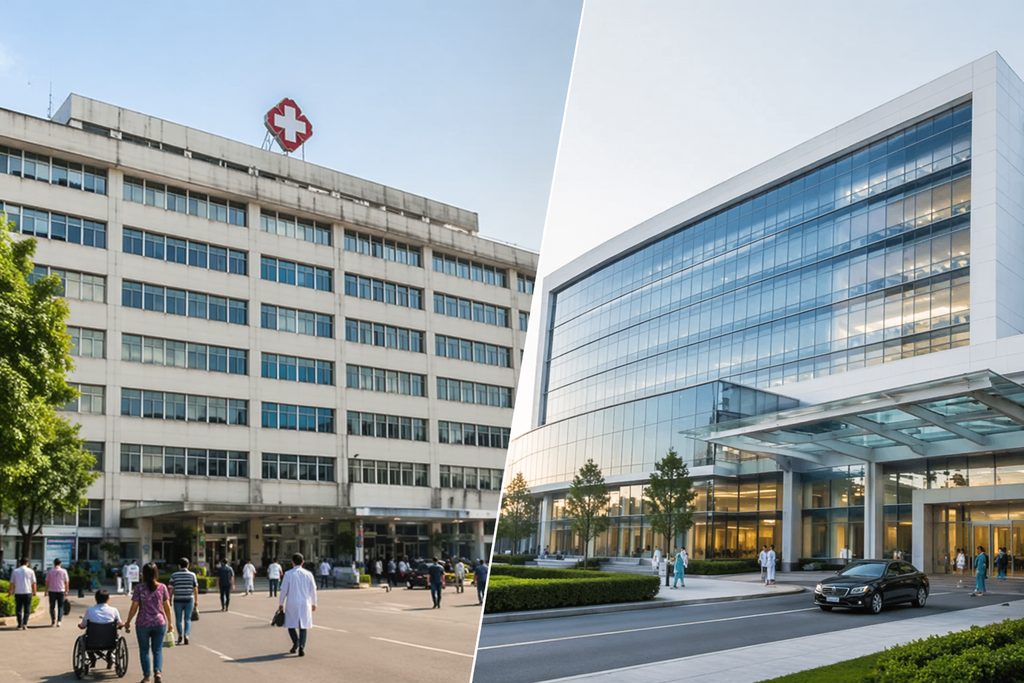
The question splits into two very different realities. China’s healthcare system offers international patients a fork in the road. One path leads to a massive public teaching hospital, a powerhouse of clinical volume and academic prestige. The other leads to a private international hospital, built around familiar Western care models, English-speaking staff, and direct insurance billing. Neither is universally “better.” The right choice depends on what you value most: raw clinical firepower or a seamless, low-friction experience.
Our team has seen patients thrive in both settings. We have also seen mismatches that caused real stress. A cardiac patient who needs the world’s highest-volume surgeon should not end up in a boutique private ward that handles twenty cases a year. A family seeking a calm, English-guided pediatric consultation should not get lost in a 10,000-patient-per-day public hospital without language support. This article lays out the facts, the costs, the safety data, and the trade-offs so you can make a clear-eyed decision.
Key Takeaways
- China’s top public teaching hospitals perform surgical volumes unmatched in the West — Fuwai Hospital alone completes over 14,000 cardiac surgeries annually — with clinical outcomes that meet or exceed international benchmarks.
- Private international hospitals offer JCI accreditation, English-speaking staff, direct insurance billing, and a Western-style care experience, but at 2 to 5 times the cost of public hospital international departments.
- Public hospitals in China are safe for surgery when you choose a top-tier institution, but the patient experience is starkly different: minimal privacy, limited English, and crowded hallways are the norm on the general floor.
- Your choice should hinge on three factors: the complexity of your condition, your budget, and your tolerance for navigating an unfamiliar system.
The Problem: You Are Comparing Two Radically Different Systems
A patient in London researching knee replacement options might pull up websites for Bupa Cromwell and the NHS Royal National Orthopaedic Hospital. The comparison makes sense. Both are in the same city, operate under the same national health regulations, and employ surgeons trained in similar programs. The differences come down to wait times, room quality, and cost.
That mental model breaks in China.
A public teaching hospital like Peking Union Medical College Hospital sees 15,000 outpatient visits daily. Its cardiac surgery department may handle more complex valve repairs in a month than a private international hospital handles in a year. The surgeons publish in The Lancet. The pathology lab runs 24 hours a day. The hospital is also crowded, loud, and operates almost entirely in Mandarin. You will share an elevator with gurneys. You will not get a private room unless you use the international department — and even then, the VIP wing feels more like a efficient clinical floor than a hotel.
A private international hospital like Shanghai United Family Hospital offers something closer to what a Western patient expects: appointments scheduled in advance, English-speaking doctors, private rooms with sofa beds for family members, and direct billing to insurers like Cigna and Aetna. The trade-off is depth. For a straightforward delivery, a wellness checkup, or a laparoscopic cholecystectomy, the private hospital is more than capable. For a rare sarcoma requiring a multidisciplinary tumor board and a surgeon who has done 500 of that exact procedure, the private hospital may simply not have that specialist on staff.
This is not a quality judgment. It is a volume and mission judgment. Teaching hospitals exist to handle the hardest cases and train the next generation of specialists. Private international hospitals exist to deliver a consistent, comfortable experience to a defined patient population. Understanding this distinction is the foundation of a good decision.
Why Public Teaching Hospitals Deliver Results That Rival the West
Clinical Volume Drives Better Outcomes
The relationship between surgical volume and patient outcomes is well-documented. A 2017 study in The Lancet found that for complex cancer surgeries, patients treated at high-volume hospitals had significantly lower 30-day mortality rates. This principle applies directly to China’s top-tier public hospitals. A surgeon at Fuwai Hospital performs roughly 200 coronary artery bypass graft procedures per year. The median for a US cardiac surgeon is around 45. When complications arise during a procedure, the surgeon who has seen that complication fifty times before responds differently than one who has seen it twice.
This volume advantage extends across specialties. The orthopedic team at Shanghai Sixth People’s Hospital reattaches more severed limbs annually than any other hospital in the world — a grim but telling statistic. Oncology departments at Fudan University Shanghai Cancer Center treat patient volumes that allow them to run clinical trials and refine protocols at a pace smaller centers cannot match. For patients with complex or rare conditions, this aggregated experience matters.
Technology and Efficiency at Scale
Walk into the radiology department of a top Chinese public hospital and you will see equipment that matches any Western academic medical center. PET-CT scanners, da Vinci surgical robots, proton therapy centers — the capital investment in China’s flagship hospitals has been enormous over the past decade. West China Hospital in Chengdu operates one of the world’s largest biobanks, supporting precision medicine research that feeds directly into clinical care.
But the efficiency is what shocks most Western visitors. A patient can get a CT scan, have it read by a radiologist, and discuss the results with their specialist — all in the same morning. This is not luxury. This is throughput. The system is designed to move patients through quickly because the demand is relentless. For an international patient who has waited weeks for an MRI back home, the speed feels miraculous. The trade-off is that the process is not gentle. You will be one of thousands moving through the system that day.
Cost Advantage Without Quality Compromise
The public vs private hospital cost China gap is the single biggest factor driving international patient interest. A cardiac bypass surgery at a top public hospital’s international department runs between $12,000 and $20,000. The same procedure at a private international hospital in Shanghai costs $30,000 to $50,000. Both are still dramatically cheaper than the $120,000-plus bill in the United States. But the public hospital option is where the truly life-changing savings appear.
These lower costs do not reflect lower quality. They reflect structural economics: lower physician salaries (Chinese surgeons earn a fraction of what US surgeons earn), higher patient volumes that spread fixed costs, and hospital pricing that is regulated by the government for public institutions. The clinical outcomes are comparable. A 2019 study comparing cardiac surgery outcomes between Fuwai Hospital and top US centers found no statistically significant difference in risk-adjusted mortality rates for CABG procedures.
How to Choose Between a Teaching Hospital and a Private Hospital in China
The decision framework we use with our patients starts with three questions. Answer these honestly and the path forward becomes much clearer.
Question one: How complex is your condition? If you have a rare cancer, a congenital heart defect requiring specialized reconstruction, or a spinal deformity that has stumped previous surgeons, you need a high-volume teaching hospital. The specialist you need likely works at one of the hospitals on the Fudan ranking’s specialty reputation list. Private international hospitals in China generally do not employ these subspecialists full-time. Some have visiting consultant arrangements, but the depth is not the same.
Question two: What is your budget reality? A straightforward total hip replacement at a private international hospital in Beijing will run about $25,000 to $35,000. At a public hospital international department, it costs $12,000 to $18,000. Both are below US prices. But if your insurance does not cover treatment abroad and you are paying out of pocket, that $13,000 difference is real money. On the other hand, if your insurer has a direct billing arrangement with United Family or Jiahui, the private hospital may actually be cheaper for you personally because you pay nothing upfront.
Question three: How much friction can you tolerate? The public hospital experience — even in the international department — requires patience. Appointments shift. Communication happens through translators. You will see other patients in distress. The private hospital experience is designed to feel familiar and controlled. For some patients, the psychological comfort of that environment is worth the premium. For others, the priority is getting the best possible surgeon in front of their problem, and everything else is secondary.
| Factor | Public Teaching Hospital (Int’l Dept) | Private International Hospital |
|---|---|---|
| Surgical volume (complex cases) | Very high — thousands annually per department | Low to moderate — hundreds annually |
| Cost (hip replacement) | $12,000–$18,000 | $25,000–$35,000 |
| English-speaking staff | International department staff speak English; general floors do not | Fully English-speaking environment |
| Insurance | Pay upfront, seek reimbursement | Direct billing with major international insurers |
| Privacy | Private rooms in international wing; shared spaces elsewhere | Private rooms throughout |
| Wait time for surgery | Days to 1–2 weeks after consultation | Days to 2 weeks |
| JCI accreditation | Some have it; most rely on domestic standards | Most are JCI-accredited |
Is a Public Hospital in China Safe for Surgery? What the Data Says
Look for hospitals ranked on the Fudan University hospital list, which evaluates China’s top 100 hospitals across 45 specialties. These institutions report outcomes data, participate in international research, and are subject to government quality monitoring. Also check whether the hospital has an international department — this indicates experience treating foreign patients and a baseline level of English-speaking coordination staff. Avoid unranked hospitals for surgical care.
It depends on your policy. Major international insurers like Cigna, Aetna, and Bupa have direct billing arrangements with private international hospitals in China, including United Family and Jiahui. Public hospital international departments generally do not offer direct billing — you pay upfront and submit for reimbursement. Check with your insurer before committing to a hospital. Get pre-authorization in writing if your policy requires it.
Top Chinese hospitals have complication management protocols comparable to Western standards. Intensive care units at major teaching hospitals are well-equipped. The challenge for international patients is not clinical capability — it is communication and legal recourse. Medical malpractice laws in China differ from those in Western countries. Patients should have a clear understanding of the hospital’s complaint and resolution process. Having a bilingual advocate on-site during your stay significantly reduces the risk of miscommunication during critical moments.
Your Next Step
The choice between a public teaching hospital and a private international hospital in China is deeply personal. It depends on your diagnosis, your finances, and what you need to feel safe. There is
Frequently Asked Questions
Yes. The hospitals used for international patients are JCI-accredited and follow the same international safety standards as top hospitals in the US and Europe. Surgical teams perform high volumes of procedures — often more than their Western counterparts — which studies show leads to better outcomes.
Costs vary by procedure and hospital, but international patients typically save 40-80% compared to US prices — even when factoring in travel and accommodation. A consultation with our team will give you an exact, all-inclusive quote with no hidden fees.
Send us your existing medical reports to get started. We handle everything from hospital selection and appointment scheduling to visa assistance and post-operative recovery planning. Your medical records are reviewed by the specialist before you even book a flight.
For more medical information and treatment options in China, visit chinamedservices.com (China Medical Services).
