Rehabilitation Access for Foreigners in China: Costs, Timelines, Top Centers
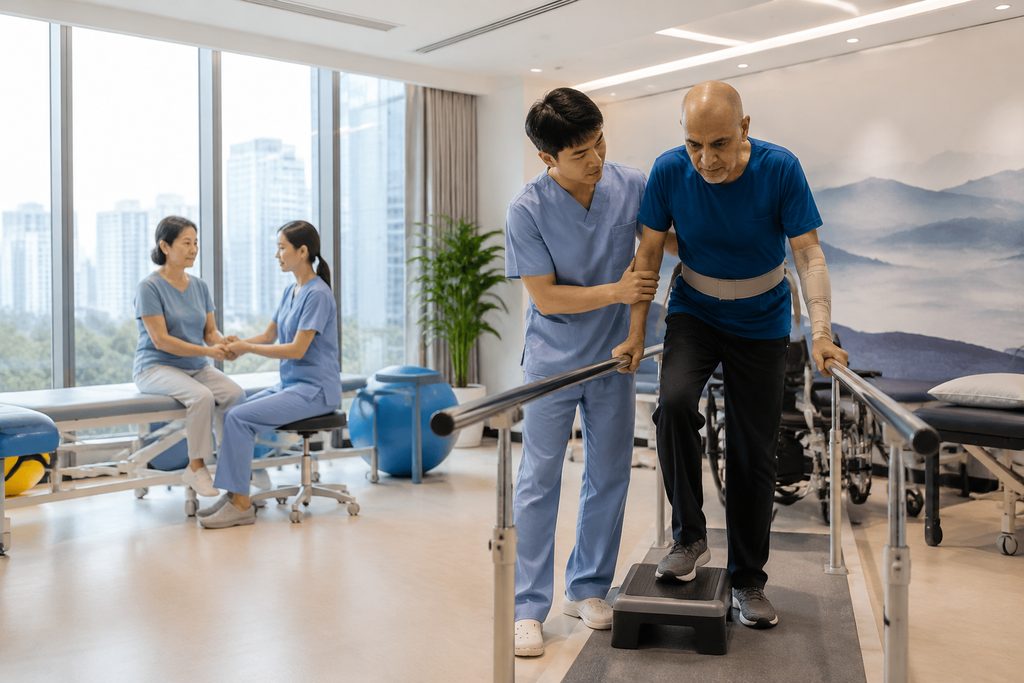
Can Foreigners Actually Get Rehabilitation in China?
What if the rehab you need at home comes with a six-month waitlist and a price tag you cannot justify?
Rehabilitation access for foreigners in China is more straightforward than most people expect — and considerably less expensive. China operates 340+ top-ranked hospitals across 37 cities, and many of them run dedicated rehabilitation medicine departments with international patient offices. Stroke recovery, orthopedic post-surgical rehab, spinal cord injury programs, cardiac rehabilitation, and traditional Chinese medicine (TCM) therapies like acupuncture and tuina are all available to foreign patients who follow the correct entry process.
The catch is not whether you can get in. It is understanding how the system works before you book a flight. Public hospitals in China do not accept overseas pre-booking for standard outpatient slots, and surgery or inpatient admission almost always requires an in-person consultation first. That single rule shapes everything about how you plan a rehabilitation trip.
Key takeaway: Foreign patients can access rehabilitation in China, but the realistic path runs through a hospital’s international department or VIP channel — not the standard public queue. Budget 1.5 to 2 times the standard consultation fee for that access, and plan for a first in-person visit before any program is confirmed.
How This Actually Works, Step by Step
Here is the real sequence, from your living room to your first therapy session in China.
Step one — you send records. You gather your existing examination reports: MRI or CT imaging, discharge summaries, surgical notes, bloodwork, and any current therapy assessments. These get translated into Chinese by a qualified medical translator. Machine translation is not acceptable to hospital review boards.
Step two — a Chinese specialty team reviews them. Depending on your condition, that might be a rehabilitation medicine department, a neurology department, or an orthopedic team. What comes back is a written assessment: whether a rehabilitation program is appropriate for your case, roughly how long it should run, and which hospital or department fits best.
Step three — you speak with the team directly. A video consultation lets you explain your symptoms and goals in your own words and hear the medical team’s recommendations. This step matters more than people expect. Rehabilitation is slow and personal, and you want to know whether the therapists understand your situation before you commit to travel.
Step four — you decide, then we coordinate arrival. Once a plan is feasible and you agree to it, the logistics begin: hospital registration, medical card creation, appointment scheduling, and if needed, a proxy visit where someone attends in person with your materials. Admission itself always remains subject to hospital rules.
Step five — you arrive and start therapy. A bilingual companion handles queueing, registration, payment, wayfinding, and translation so your sessions are not consumed by administrative friction.
What Rehabilitation Therapy Costs in China Compared With Home
Rehabilitation therapy cost China is where the arithmetic gets interesting. In the United States, an intensive inpatient rehabilitation stay can run $1,500 to $2,500 per day. In China’s top public hospitals, comparable inpatient rehabilitation typically lands between $150 and $400 per day, depending on the hospital tier, the city, and how much one-on-one therapist time your program includes.
Outpatient therapy follows the same pattern. A single physical therapy session at a Chinese tertiary hospital commonly costs $20 to $60. The same session in the US averages $100 to $200 before insurance. That gap is not a discount gimmick — it reflects lower labor costs and a different pricing structure across the entire health system.
| Service | China (top public hospital) | United States | Western Europe |
|---|---|---|---|
| Inpatient rehab, per day | $150–$400 | $1,500–$2,500 | $700–$1,400 |
| Outpatient PT session | $20–$60 | $100–$200 | $60–$130 |
| Acupuncture session (TCM) | $15–$50 | $75–$150 | $50–$110 |
| 30-day intensive program (estimate) | $4,000–$12,000 | $45,000+ | $20,000+ |
These figures vary by hospital and case complexity. A program requiring robotic gait training, a dedicated neurologist, and daily one-on-one sessions will sit at the top of the range. A general post-fracture program with group sessions will sit near the bottom. Anyone quoting you a single fixed number before reviewing your records is guessing.
Worth noting for planning: private international hospitals in China — United Family, Jiahui, Parkway, Raffles — offer English-speaking staff, JCI accreditation, and direct insurance billing. They cost more than public hospitals, often two to three times more, but they remove nearly all language friction. For patients with international insurance that reimburses, that trade-off frequently makes sense. You can compare options on our private international hospitals page.
A Realistic Timeline
Nobody plans a rehabilitation trip in a week. Here is what the calendar actually looks like, including the steps people forget.
| Stage | What Happens | Realistic Duration |
|---|---|---|
| Records gathering | Collect imaging, reports, discharge summaries | 3–10 days |
| Medical translation | Certified translation into Chinese | 3–7 days |
| Hospital review | Specialty team evaluates and responds | 5–14 days |
| Video consultation | Direct discussion with the medical team | Scheduled within 1–2 weeks |
| Appointment coordination | Registration, medical card, slot confirmed | 1–3 weeks |
| S2 visa application | Embassy or consulate processing | 4–15 business days |
| Travel and arrival | Flights, airport transfer, accommodation | 2–5 days |
| First in-person consultation | Assessment and program confirmation | Day 1–3 after arrival |
| Program start | Therapy begins | Within 1 week of arrival |
Add it up and a well-organized patient moves from first email to first therapy session in roughly six to ten weeks. Rush cases exist, but they depend on hospital capacity and visa speed, neither of which anyone can promise in advance.
What Can Go Wrong — and What Happens Then
Honest planning means naming the failure modes.
Your records are incomplete. This is the most common delay. Hospital review boards reject files missing imaging or discharge documentation, and the clock restarts when you resubmit. Fix: send everything you have, then ask what is missing before translation begins.
The hospital determines rehab is not appropriate yet. Sometimes a patient needs further diagnostic work or a surgical consult before rehabilitation makes sense. That is not a rejection — it is a redirection. The team will typically outline what should happen first.
You cannot get the exact specialist or date you wanted. Public hospital schedules are tight and senior specialists are in demand. No coordination service can guarantee a specific doctor or a specific admission date. What can be promised is a genuine effort and a full refund of the coordination fee if the appointment cannot be secured.
Your visa application hits a snag. Consular officers decide visa outcomes, not hospitals and not us. If additional documentation is requested, processing extends. Build buffer time into your plans.
Progress is slower than you hoped. This is rehabilitation, not a repair shop. Plateaus happen. The medical team will adjust the program, but nobody should promise a recovery timeline in advance.
Is Rehabilitation in China Safe for International Patients?
Is rehabilitation in China safe for international patients? For the most part, yes — with the right hospital selection. China’s top tertiary hospitals are accredited, heavily regulated, and handle enormous patient volumes. Fuwai Hospital alone performs more than 14,000 cardiac surgeries a year, the highest volume in the world. That kind of throughput builds institutional experience that smaller centers cannot match.
The safety variables that actually matter for a foreign patient are narrower than people assume:
- Hospital tier. Stick to tertiary (Grade 3A) public hospitals or JCI-accredited private international hospitals. Lower-tier facilities may lack the rehabilitation technology and infection control standards you expect.
- Language. A therapy session where you cannot describe your pain level is a compromised session. This is the single strongest argument for bilingual accompaniment.
- Continuity. Ask who will see you on day one and who will see you on day thirty. Rotating therapists without a lead physician is a warning sign anywhere in the world.
- Discharge planning. You need a written home program before you leave, in English, with exercises you can actually perform.
For a city-by-city look at facilities, our ranked hospital directory groups top centers by city and tier.
Choosing a Rehabilitation Program: What the Numbers Mean
Two programs can both say “intensive rehabilitation” and deliver completely different things. Ask four questions before committing.
How many therapy hours per day? Three hours of one-on-one therapy is a fundamentally different product from six hours of mixed group and self-directed work. Get the daily schedule in writing.
Who leads the team? Rehabilitation works best with a physician-led multidisciplinary team — physiatrist, physical therapist, occupational therapist, speech therapist where relevant. Ask for the team composition.
What outcome measures do they use? A serious program tracks you with standardized scales — the Fugl-Meyer Assessment for stroke motor recovery, the Barthel Index for daily living function, the Berg Balance Scale for fall risk. If nobody can name the scales they use, that tells you something.
What happens at discharge? The best programs hand you a documented home plan and offer remote follow-up. The weakest ones hand you a bill.
For patients searching for the best rehab centers in Shanghai for foreigners, the strongest options cluster around the city’s major teaching hospitals and its JCI-accredited international facilities. Beijing offers comparable depth, and booking a rehabilitation program in Beijing for foreigners typically runs through the international departments of its top-tier hospitals. Our specialty rankings list top hospitals by department, including rehabilitation medicine.
Practical Considerations: Visas, Payment, and Follow-Up
You can complete records review, a video consultation, and appointment coordination before you travel. What you cannot do is lock in a confirmed inpatient program remotely — public hospitals in China generally require an in-person assessment first. This is why the staged approach works: remote evaluation narrows the plan, then arrival confirms it.
At private international hospitals, English-speaking staff make independent navigation feasible. At top public hospitals, everyday operations — registration, payment, queueing, wayfinding — run in Chinese, and therapy sessions require precise communication about pain and progress. Bilingual medical accompaniment exists precisely for this gap.
Coordination services can attempt specific hospitals, departments, or specialists on your behalf, but no one can guarantee a particular doctor or admission date. If the requested appointment cannot be secured, the standard practice is a full refund of the coordination fee. Hospital treatment charges are separate and always set by the hospital.
For most Western patients, yes — often by a factor of five to ten on comparable inpatient programs. But “cheaper” only matters if the program is appropriate for your condition. A low-cost program that does not match your needs costs more in the end than the right one.
Your Next Step
Rehabilitation access for foreigners in China comes down to three things: the right hospital, a realistic timeline, and someone handling the language and logistics so your energy goes into recovery. None of it requires guesswork, and none of it requires committing to travel before you understand the plan.
We are China Medical Services. We connect international patients with 340+ top-ranked hospitals across 37 cities, coordinate written second opinions and video consultations, and provide bilingual medical companions on the ground. We do not practice medicine, and we do not promise outcomes — we handle the parts of the journey that should not fall on a patient.
If you are weighing rehabilitation options, start with a conversation. Tell us your situation and we will tell you honestly what is possible.
This article is for general information only and is not medical advice. Treatment decisions should always be made with a qualified physician who has reviewed your individual case.
Frequently Asked Questions
Yes. The hospitals used for international patients are JCI-accredited and follow the same international safety standards as top hospitals in the US and Europe. Surgical teams perform high volumes of procedures — often more than their Western counterparts — which studies show leads to better outcomes.
Costs vary by procedure and hospital, but international patients typically save 40-80% compared to US prices — even when factoring in travel and accommodation. A consultation with our team will give you an exact, all-inclusive quote with no hidden fees.
Send us your existing medical reports to get started. We handle everything from hospital selection and appointment scheduling to visa assistance and post-operative recovery planning. Your medical records are reviewed by the specialist before you even book a flight.
For more medical information and treatment options in China, visit chinamedservices.com (China Medical Services).
