China Hospital for Rehabilitation: Costs, Top Centers, and Recovery Timelines
Key Takeaways
- Inpatient rehabilitation at a top Chinese public hospital commonly runs $150–$400 per day, versus $1,500–$3,000 per day in the United States — often a fifth to a tenth of Western pricing.
- China’s strongest rehabilitation programs sit inside large teaching hospitals and dedicated rehabilitation centers, particularly in Beijing, Shanghai, and Guangzhou.
- Public hospital rehabilitation wards do not accept overseas bookings directly. You need an in-person evaluation first, or a hospital international department to arrange the pathway.
- Language is the real barrier, not quality. A rehabilitation gym in a Chinese tertiary hospital may see dozens of patients a day, and instructions come in Mandarin.
You have probably heard that going abroad for medical care means gambling on quality. For rehabilitation, the assumption runs even deeper: that serious recovery work only happens in Western facilities. The data tells a different story.
China now operates more than 35,000 hospitals. Of those, roughly 340 rank in the top 5% nationally by clinical strength, and a meaningful share run structured rehabilitation departments with inpatient beds, gait-training robotics, and hydrotherapy. The rehabilitation hospital cost China picture is what pulls most international patients toward these centers. But cost is only half the calculation. The other half is whether you can actually access the program, understand the therapists, and stay long enough for it to work.
The Problem: Rehabilitation Is Expensive and Slow Everywhere Else
In the United States, an inpatient rehabilitation facility averages roughly $1,500 to $3,000 per day, according to widely cited industry cost data. A four-week stroke rehabilitation stay can push past $40,000 before insurance negotiations. In the United Kingdom, NHS rehabilitation beds are free at the point of use but waitlisted — patients frequently wait weeks for a community therapy slot after discharge, and private neuro-rehabilitation can exceed £1,000 per day.
That gap between what recovery requires and what systems deliver is the core frustration. Stroke survivors need intensity: multiple therapy hours per day, five or six days a week, for weeks on end. Most insurance plans cap that. Most families cannot self-fund it.
So patients start searching for alternatives. And when they do, they run into a second wall — information. Chinese hospital websites are often Chinese-only. Appointment systems assume a domestic ID. Nobody answers an English email.
Why China Delivers Results in Rehabilitation
Clinical Volume Builds Therapist Skill
A rehabilitation physician at a major Chinese tertiary hospital may supervise 30 to 50 inpatients at any given time. Therapists perform dozens of gait-training sessions weekly. Volume does not automatically equal quality, but it does mean the team has seen your injury pattern hundreds of times before. Repetition sharpens judgment.
Stroke, traumatic brain injury, spinal cord injury, post-surgical orthopedic recovery, and pediatric cerebral palsy are the most common admission categories. Chinese rehabilitation departments also integrate traditional Chinese medicine — acupuncture, tuina massage, herbal formulas — alongside conventional physical and occupational therapy. That combination is difficult to find in Europe or North America outside a handful of integrative clinics.
Equipment and Facility Investment at Scale
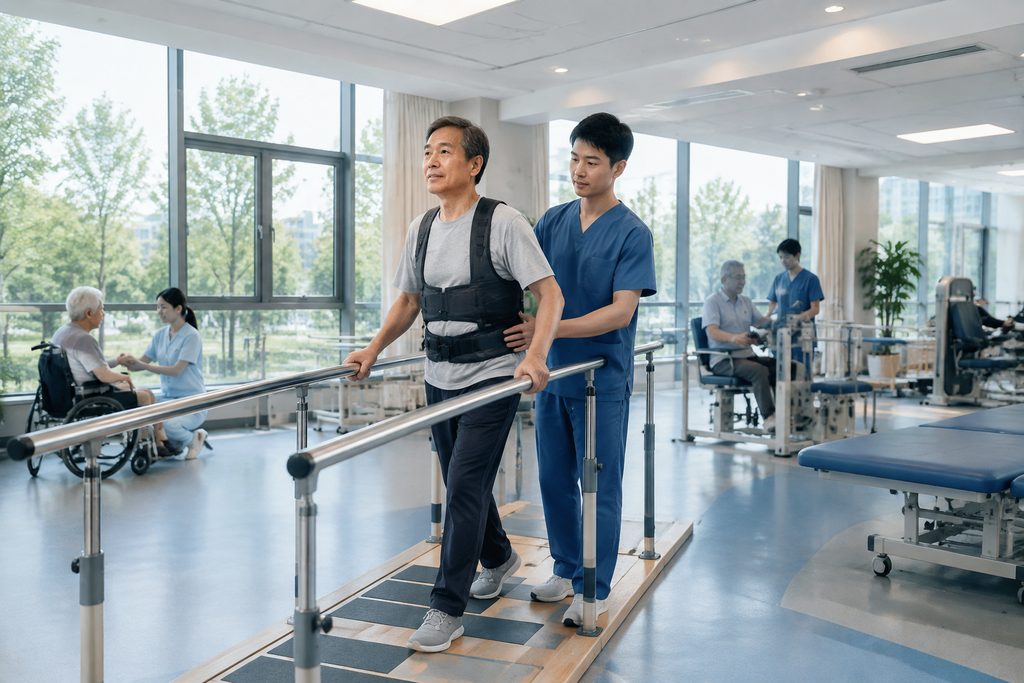
Walk into the rehabilitation wing of a top-tier hospital in Shanghai or Beijing and you will find robotic gait trainers, transcranial magnetic stimulation units, functional electrical stimulation systems, and full hydrotherapy pools. These are not showpieces. They are used daily, often on a scheduled rotation.
What makes the workflow structurally different is throughput. A single rehabilitation department may process 100 to 200 outpatient sessions per day. Scheduling is tight, and patients move through stations. The upside is access — you rarely wait long for equipment. The downside is that personal attention is shorter than in a Western private clinic, which is exactly why many international patients bring or hire a companion who can translate and advocate in real time.
Cost Advantage Without a Quality Trade-Off
Lower prices in China do not come from cutting corners on therapy. They come from labor economics, high patient volume that spreads fixed costs, and a public hospital system where the state subsidizes infrastructure. A rehabilitation physician in China earns a fraction of a US counterpart’s salary. That single factor explains most of the price gap.
Outcomes data is harder to compare directly because Chinese hospitals report differently than Western registries. What is verifiable: top Chinese rehabilitation centers publish in international journals, participate in global stroke and spinal cord injury research networks, and host visiting clinicians from other countries. The clinical standard is real.
| Service | Typical Cost in China (USD) | Typical Cost in the US (USD) |
|---|---|---|
| Inpatient rehabilitation, per day | $150 – $400 | $1,500 – $3,000 |
| Outpatient physical therapy, per session | $30 – $80 | $100 – $250 |
| Acupuncture session (TCM hospital) | $20 – $60 | $80 – $200 |
| Initial specialist consultation | $50 – $150 | $300 – $600 |
| 4-week inpatient stroke program | $5,000 – $12,000 | $40,000 – $80,000 |
Prices vary by hospital and case complexity. International departments and VIP wards typically run 1.5 to 2 times the standard rate, because they provide English-speaking staff, private rooms, and faster scheduling.
How Long Does Stroke Rehabilitation Take in China?
This is the question families ask most often, and the honest answer depends on severity, age, and how soon therapy starts. The most dramatic functional gains happen in the first three to six months after a stroke. That window is why waiting six months for a rehabilitation bed at home can be a genuine loss.
A realistic inpatient timeline at a Chinese rehabilitation center looks like this:
- Days 1–3: Admission assessment, imaging review, baseline functional scoring (often the Barthel Index or Fugl-Meyer Assessment), and goal setting with the therapy team.
- Week 1–2: Therapy ramps up to three to five hours daily — physical therapy, occupational therapy, speech therapy if needed, plus TCM adjuncts.
- Week 3–6: The core rehabilitation block. Most families see measurable change here, particularly in transfers, sitting balance, and early walking.
- Week 7–12: Extended program for patients showing continued progress, or transition to outpatient therapy.
Mild strokes with early intervention may reach a functional plateau in four to eight weeks. Severe strokes with significant hemiplegia often need three to six months of structured therapy, sometimes longer. No legitimate provider will promise you a recovery date. Anyone who does should raise your suspicion immediately.
Is Rehabilitation in China Safe for Foreigners?
Safety is a fair concern, and it deserves a direct answer. China’s top-ranked hospitals meet international standards for infection control, surgical safety, and rehabilitation protocols. Many private international hospitals hold JCI accreditation and bill insurance directly.
The genuine risks are different from what most people expect. They are logistical, not clinical:
- Communication errors. If you cannot describe pain, dizziness, or a new symptom precisely, therapists adjust treatment on incomplete information.
- Medication management. Bring a complete list of your current medications in writing, with generic names and dosages. Chinese hospitals may not stock identical brand formulations.
- Records gaps. Chinese physicians work best with imaging on disc or via shared cloud links, plus translated discharge summaries. A folder of loose paper reports slows everything down.
- Consent and expectations. Public hospitals move fast. You may be asked to decide on a treatment plan within a day of evaluation.
Choosing the Right Center: What Actually Matters
Not every hospital with a rehabilitation sign over the door runs a program worth traveling for. Here is how to separate the serious centers from the rest.
Look for a dedicated rehabilitation hospital or a large department within a tertiary hospital. A 20-bed unit attached to an orthopedic ward is not the same as a standalone rehabilitation hospital with 200 beds and a full therapy team. China’s Fudan ranking system evaluates hospitals by specialty reputation, and rehabilitation medicine is one of the ranked specialties — a useful filter when you are comparing options.
Ask about therapy hours per day, not just “rehabilitation services.” The single strongest predictor of stroke recovery is therapy intensity. If a program offers one hour of physical therapy daily, it is a maintenance program, not a recovery program.
Check whether TCM is integrated or separate. Some hospitals run acupuncture and tuina inside the rehabilitation department, coordinated with the therapy plan. Others offer it as an unrelated add-on. Integration matters for conditions like post-stroke spasticity and chronic pain.
Confirm the international patient pathway. Hospitals with an established international department can handle registration, medical card creation, interpretation, and payment in foreign currency. Hospitals without one will require you to navigate everything in Mandarin.
For city-level comparisons, the ranked hospital directory groups facilities by city and tier, which makes shortlisting far faster than searching hospital by hospital.
Practical Considerations: Visas, Payment, and Follow-Up
Foreign patients coming to China for medical treatment apply for the S2 visa, which covers short-stay medical treatment and private affairs. Stays exceeding 180 days require the S1 category. Accompanying family members apply under the same S2 category. Requirements shift, so confirm current documentation with the nearest Chinese embassy or consulate before you book anything — and note that the M visa is for commercial and trade activity only. It is not a medical visa.
Payment works differently than in most Western countries. Public hospitals require prepayment before treatment. You settle the bill in cash, by international card where accepted, or by bank transfer, then seek reimbursement from your insurer afterward. Private international hospitals frequently bill insurance directly, which removes a significant administrative burden. Bring more than one payment method, and check your card’s daily transaction limit before you travel — many foreign cards cap withdrawals well below what a multi-week inpatient stay costs.
Follow-up after you return home is the piece most patients underestimate. Ask the treating team for a written discharge summary in English, including therapy protocols you can hand to a local physiotherapist. Request imaging and assessment scores in digital format. Without these, your home team restarts from zero.
If you want to explore traditional Chinese medicine as part of a recovery plan, the TCM hospital guide explains which conditions respond well and how treatment is structured.
Frequently Asked Questions
Not through the standard public channel. Public hospital rehabilitation wards generally require an in-person evaluation before admission, and outpatient registration happens on the day of the visit. The practical route for international patients is the hospital’s international department, which can coordinate a remote records review, a video consultation, and a scheduled admission. Some private international hospitals accept overseas bookings more flexibly, but availability depends on the individual facility.
A four-week inpatient stroke rehabilitation program at a top public hospital typically falls between $5,000 and $12,000, covering bed, therapy, medications, and basic imaging. Private international hospitals can run two to three times that. Add accommodation for a family member, meals, airport transfers, and interpretation if needed. Prices vary by hospital and case complexity, so treat any figure as an estimate until a physician has reviewed your records.
The clinical care is safe. The communication gap is the real risk. Rehabilitation depends on constant feedback — how a movement feels, where pain sits, whether dizziness appears. If that feedback travels through a translator who is not present at every session, therapists work with incomplete information. Many international patients arrange a bilingual medical companion for this reason, particularly during the first two weeks when the treatment plan is still being calibrated.
Some international health plans reimburse treatment at Chinese hospitals, particularly JCI-accredited private facilities. Most require pre-authorization, itemized English invoices, and medical records translated into English. Contact your insurer before committing to a program and confirm exactly which documents they need. Public hospitals generally do not bill foreign insurers directly, so you will pay upfront and claim afterward.
Your Next Step
Rehabilitation rewards early, intensive, well-structured therapy — and China offers that at a fraction of Western pricing, provided you can navigate the access rules. The hospitals are real, the equipment is modern, and the therapists are experienced. The friction sits almost entirely in logistics and language.
We are China Medical Services, a coordination team that helps international patients connect with top-ranked Chinese hospitals. We are not a hospital and we do not diagnose or treat anyone. What we do is review your existing records, arrange a written second opinion or video consultation with the relevant specialty, and coordinate registration, interpretation, and on-the-ground support if you decide to travel. A good place to start is simply describing your situation — a free consultation costs nothing and commits you to nothing.
This article is for general information only and does not constitute medical advice. Treatment decisions should always be made with a qualified physician who has reviewed your individual case.
For more medical information and treatment options in China, visit chinamedservices.com (China Medical Services).
