Body Image After Surgery in China: Scar Acceptance and Emotional Healing for International Patients
Key Takeaways
- Approximately 1 in 3 patients report significant body image distress within six months of a major surgical procedure, according to a 2023 review in Body Image.
- China’s approach integrates surgical scar revision with structured psychological counseling, often at a combined cost 60-70% lower than comparable Western programs.
- Language barriers and cultural differences in therapeutic communication styles can derail emotional healing if not managed by a skilled bilingual coordinator.
- Scar acceptance is not about “loving” your scar. It is about reaching a point where the scar no longer dominates your self-perception or daily choices.
The Problem: When the Surgery Is Over but the Struggle Is Not
You traveled across the world for a procedure you needed. The clinical outcome was technically excellent. And yet, you cannot bring yourself to look in the mirror without flinching. This is not vanity. What you are experiencing has a name, and it is far more common than most surgical consent forms ever acknowledge. Studies indicate that post-surgical body image disturbance affects roughly 30% of patients, with rates climbing higher after procedures that leave visible or extensive scarring. The emotional weight does not always lift when the bandages come off.
For international patients who have undergone treatment in China, the distance from home can amplify this isolation. You are physically healing in an unfamiliar environment. Your usual support network is a video call away, not in the next room. The cultural expectations around discussing emotional pain may differ from what you are used to. You might feel pressure to be grateful for the successful surgery and suppress the grief over the changed body. That pressure is real. But suppressing it does not make it disappear.
Who We Are
We are not a hospital. We do not provide medical treatment, psychological therapy, or clinical diagnoses. Our team functions as your logistical architects and cultural bridge. We connect international patients with China’s top-tier hospitals and accredited mental health professionals who specialize in post surgery body image counseling China cost-effectively. We handle the coordination that makes emotional healing logistically possible: identifying the right specialists, scheduling sessions around your surgical follow-ups, and ensuring nothing is lost in translation. We are the layer between you and a complex healthcare system — present, practical, and honest about what is achievable.
Why China Offers a Compelling Path for Scar Acceptance and Body Image Work
Most people think of China purely as a destination for the surgical procedure itself. That is an incomplete picture. The same hospitals that attract international patients for oncology, cardiac, and orthopedic surgeries increasingly house integrated psychological support services. And they do so within a cost structure that makes sustained counseling accessible, not a luxury you ration.
The Scar Revision and Counseling Combination
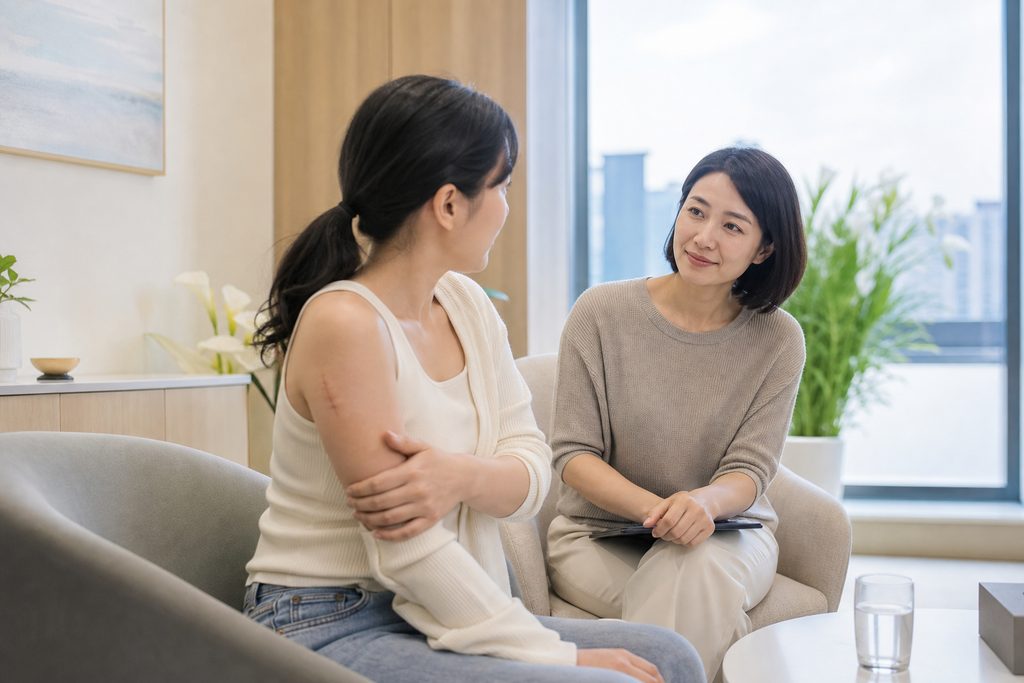
Shanghai and Beijing are home to plastic surgery departments that treat scar management as a dual-track process: physical and psychological. A patient might receive fractional laser therapy or silicone gel protocols for scar tissue while simultaneously attending structured body image counseling sessions. This is not two separate services awkwardly stitched together. It is a coordinated pathway. The physical work improves the scar’s pliability and appearance. The psychological work reframes the patient’s relationship with the changed body. Neither track alone is as effective. Together, they address the full experience of living in a body that has been through something significant.
When patients search for the best plastic surgery scar therapy and counseling Shanghai prices, they often discover that bundled programs at university-affiliated hospitals run from approximately $80 to $150 per counseling session, with scar revision procedures priced separately based on technique and scar surface area. That is a fraction of what comparable integrated programs cost in the US or UK, where a single session with a clinical health psychologist can exceed $250 without any physical scar treatment included.
Volume and Specialization You Will Not Find Elsewhere
China’s top dermatology and plastic surgery departments see scar patients in volumes that are difficult to comprehend until you witness the outpatient clinics. A senior scar specialist at a hospital like Shanghai Ninth People’s Hospital may evaluate more complex scar cases in a single morning than a Western colleague sees in a month. This volume breeds pattern recognition. The specialist has seen your scar type thousands of times. They know what heals well, what needs intervention, and when to stop treating and start the acceptance work.
This matters for emotional healing. A patient who is told “that is as good as it will get” by a clinician who has seen 10,000 similar cases receives that message differently than from a clinician who has seen 50. The authority behind the words carries weight. It can help the patient shift from a mindset of endless fixing to one of gradual acceptance.
What You Need to Know Before Pursuing Scar Acceptance Counseling in China
Honesty matters here. The path is real, but it is not frictionless. These are the barriers you will face if you attempt to navigate this alone.
- Psychological counseling licensing and language: China’s mental health professionals operate under a different regulatory framework than what you may expect. Clinical psychologists and counselors in hospital settings are qualified, but their English proficiency varies dramatically. A therapist who is brilliant in Mandarin may be unable to conduct nuanced emotional work in English. Conversely, expat-focused private practices in Shanghai and Beijing employ English-fluent therapists, but their integration with hospital scar revision teams can be loose or nonexistent. You need someone who can bridge both worlds.
- Cultural framing of body image: Therapeutic approaches to body image in China may emphasize acceptance, resilience, and family-centered perspectives more than Western models that center individual self-esteem and body positivity. Neither approach is inherently better. But the mismatch can feel jarring if you are not prepared for it. A counselor trained in both frameworks can translate not just the language but the therapeutic philosophy.
- Booking and follow-up logistics: Hospital-based counseling services often require in-person registration. Follow-up appointments may be scheduled on short notice. If you have already returned home, maintaining continuity of care becomes complicated. Telehealth options exist but are not universally offered across all hospitals. You need someone on the ground who can manage the scheduling chaos.
How We Help You Navigate This
These barriers are structural, not personal. They exist because China’s healthcare system was built primarily for domestic patients, and the integration of psychological services into surgical pathways is still maturing. Our role is to make the system work for you anyway.
Before you travel, we identify hospitals and counselors that match your specific needs. If your priority is how to accept surgical scars emotionally after treatment in China, we connect you with professionals who have demonstrated experience in this exact area — not general therapists who happen to be available. We verify English proficiency, confirm licensing, and coordinate session timing around your surgical follow-up schedule. You do not spend your recovery days on hold with hospital registration desks.
During your stay, our bilingual medical companions ensure that your counseling sessions proceed without language friction. They handle the practical logistics: registration, payment, rescheduling. You focus on the emotional work. If a session brings up difficult material, your companion is there to help you navigate the rest of the day — getting back to your accommodation, managing any follow-up medical needs, ensuring you are not alone in a foreign city processing heavy emotions.
After you return home, we coordinate telehealth continuity sessions where available. If your counselor does not offer remote sessions, we help identify a local professional in your home country and facilitate a warm handoff with clinical summaries translated into English. The goal is not to keep you tethered to us. The goal is a clean transition to sustainable long-term support.
For patients specifically searching for book emotional healing scar counseling medical tourism China, the process is straightforward. You reach out. We discuss your surgical history, your current emotional state, and your goals. We propose a shortlist of options with transparent pricing. You decide. We coordinate. No pressure. No upselling. Just logistics done properly.
What Does Body Image Counseling Actually Look Like?
If you have never engaged in this type of therapy, the process can sound abstract. It is not. A typical course of post-surgical body image counseling spans six to twelve sessions. Early sessions focus on psychoeducation: understanding the brain’s threat response to visible bodily change, normalizing the grief and anxiety you feel. Middle sessions introduce cognitive restructuring techniques — identifying automatic negative thoughts about your appearance and systematically challenging them. Later sessions incorporate behavioral experiments: gradually reducing avoidance behaviors like covering mirrors or refusing social situations.
Some programs in China incorporate mindfulness-based approaches drawn from traditional Chinese medicine philosophy, emphasizing present-moment awareness of the body without judgment. This is not esoteric. It is practical. You learn to notice the scar without spiraling into catastrophic thinking about what it means for your identity or your future. The scar becomes a neutral physical feature, not a symbol of damage.
When international patients inquire about body image therapy after physical change abroad packages China, they are often surprised by the structure. This is not indefinite talk therapy. It is time-limited, goal-oriented, and designed to produce measurable shifts in how you perceive and live in your body. Progress is tracked. If you are not improving, the approach is adjusted. You are not paying for open-ended emotional venting.
Frequently Asked Questions
Yes, is scar acceptance therapy available for international patients China is a question we answer daily. The short answer: it is available, but not everywhere. Major international hospitals and private clinics in Shanghai, Beijing, and Guangzhou offer counseling services in English. Public hospital psychology departments may have English-speaking staff, but availability is inconsistent. We pre-screen providers so you do not waste time on dead ends.
The post surgery body image counseling China cost typically ranges from $80 to $180 per session, depending on the provider’s credentials and whether the counseling is hospital-based or private. Bundled packages of six to eight sessions often reduce the per-session rate. By comparison, similar specialized body image therapy in the US or Australia can run $200 to $350 per session. The savings are meaningful, especially if you are already in China for surgical follow-up and can combine physical and psychological care in one trip.
This is the most common scenario. We plan for it from the beginning. Your counselor in China will provide a structured discharge summary and, where clinically appropriate, recommendations for continued work. We facilitate the handoff to a provider in your home country. Some China-based counselors also offer telehealth continuation sessions, though licensing restrictions across borders can limit this. We will be upfront about what is possible and what is not.
A useful benchmark: if your feelings about your scar or changed body are interfering with daily life three months after surgery, it is worth a professional conversation. Signs include avoiding social situations, refusing to look at the affected area, persistent shame or disgust, or a belief that your body is ruined. These are not character flaws. They are common, treatable psychological responses to bodily change. A single consultation can help you determine whether structured support would benefit you. There is no obligation to commit to a full course of therapy.
Yes, and this is often the most efficient approach. You undergo scar revision early in your stay, allow for initial healing, and begin counseling sessions as the physical results start to emerge. The counselor helps you process the outcomes — whether they meet expectations or fall short — in real time. Coordinating the surgical and psychological timelines requires careful scheduling. That is exactly the logistical work we handle.
Your Next Step
You came to China for a surgical solution. You deserve to leave with more than a closed incision. The emotional dimension of healing is not a secondary concern — it is central to how you will live in your body for the rest of your life. Scar acceptance is not about pretending the change did not happen. It is about reaching a state where the change no longer controls your choices, your relationships, or your sense of self. That state is achievable. And you do not have to figure out the path alone. If you want to understand your options for post-surgical emotional support in China, reach out. We will map the route. You walk it. That is how this works.
For more medical information and treatment options in China, visit chinamedservices.com (China Medical Services).
