A Taxi App in China Explained: Ride-Hailing for Foreign Visitors
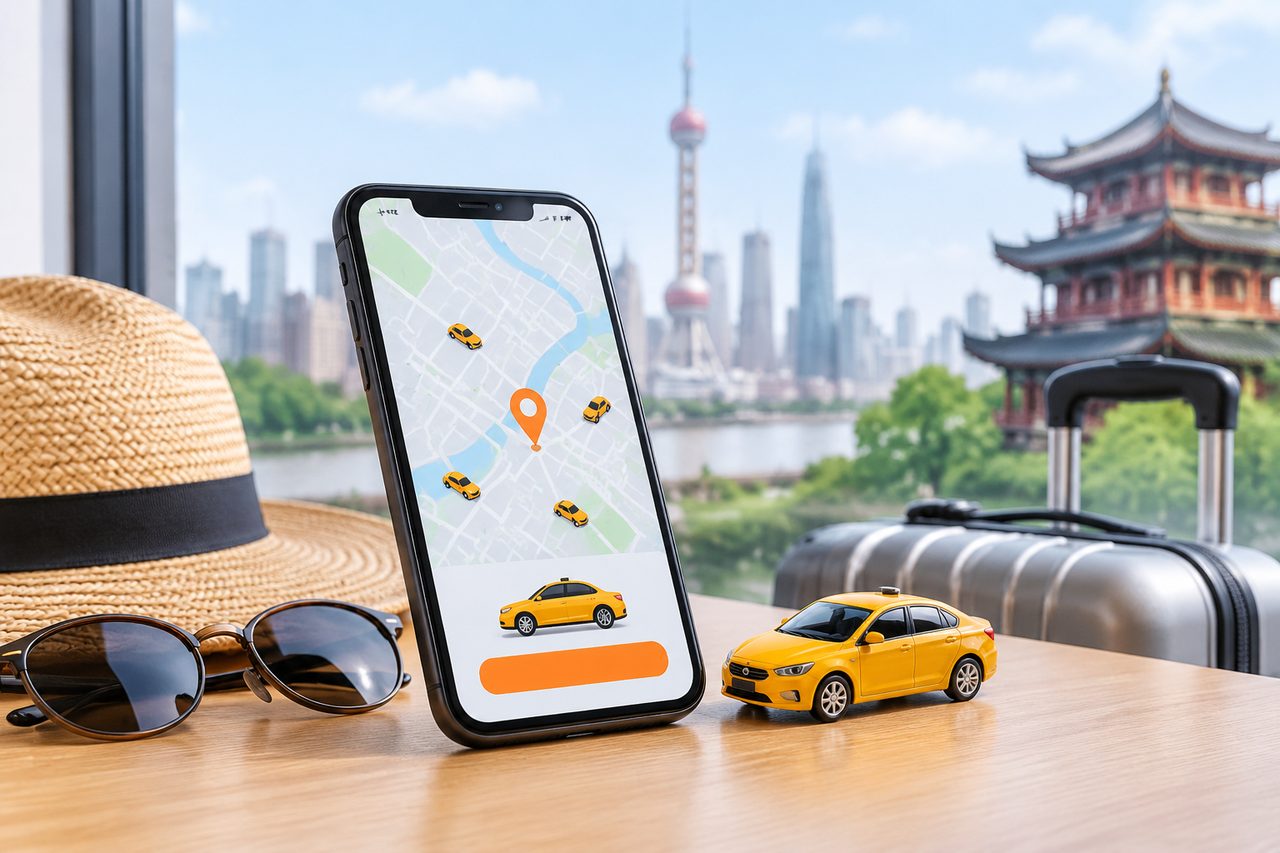
A taxi app in China explained in one sentence: foreign visitors use DiDi, the dominant ride-hailing platform, and its English interface lets you set a pickup point, see a fixed fare before you ride, and pay by linked international card or cash — no Mandarin required. For most travelers, that single app replaces street-hailing entirely. The complication is that “taxi app China for foreigners” is not one task but three: downloading the right app, verifying a payment method that Chinese platforms accept, and communicating a pickup location inside a vast, poorly signposted hospital campus or airport terminal. Get those three right and the rest is routine.
Who This Is Right For — and Who It Isn’t
Ride-hailing in China is genuinely accessible to short-term visitors, but it is not the right tool for every situation.
Good candidates:
- Travelers with a working smartphone, a data connection, and a bank card that supports international transactions.
- Anyone arriving at a major airport or high-speed rail station who wants a fixed, pre-agreed fare rather than a negotiated street taxi.
- Patients and family members moving between hotels, hospitals, and diagnostic centers on a schedule.
- People traveling with luggage, mobility limitations, or young children who need a door-to-door trip.
Poor candidates:
- Visitors without any mobile data plan. The app is useless offline, and airport Wi-Fi rarely reaches the pickup zone.
- Anyone whose only payment method is a card their bank blocks for overseas transactions. Set up a backup before you fly.
- Travelers who need a receipt in a specific format for insurance reimbursement. Ride-hailing receipts are issued in-app and are not always accepted by foreign insurers without translation.
- People expecting to hail a licensed metered taxi by app in the way they would in London or New York. The vehicle you summon is usually a private car operating under platform rules, not a traditional cab.
The Options, Compared
Before committing to one method, it helps to see how the realistic alternatives stack up for a foreign visitor.
| Method | English support | Fare certainty | Payment | Best for |
|---|---|---|---|---|
| DiDi (international interface) | Yes, full app in English | Fixed price shown before booking | Linked international card, some wallets, cash on select tiers | Most visitors, airport transfers, daily hospital trips |
| Street taxi (metered) | Rarely; drivers seldom speak English | Meter, subject to route and traffic | Cash; mobile payment if you have a local wallet | Short hops where you can show a written address |
| Hotel-arranged car | Usually yes, via concierge | Fixed but often higher | Billed to room or paid at desk | Arrivals after midnight, families with heavy luggage |
| Airport official taxi rank | Limited | Meter plus possible surcharges | Cash | Travelers without a data plan |
| Metro and airport rail | Signage is bilingual in major cities | Flat ticket price | Ticket machines accept cash and cards | Light packers, daytime arrivals, budget travel |
If you have data and a card that works abroad, the app column wins on nearly every measure. If you arrive without either, the airport taxi rank or the metro is the honest fallback — slower and less predictable, but it will get you there.
How to Use DiDi in China: Setup, Booking, and the Pickup Problem
The mechanics of how to use DiDi in China are simpler than most first-time visitors expect, and the friction almost always appears at one specific point: the pickup pin.
Download the app before you depart, not at the airport. Registration requires a phone number, and while foreign numbers are generally supported, doing this on arrival Wi-Fi with a queue behind you is avoidable stress. Add your payment card in advance and confirm with your bank that overseas charges are enabled; a declined card at the moment of booking is the most common reason a first ride fails.
When you book, the app asks for a destination and a pickup point. The destination is easy — type the English name of your hotel or hospital and select from the suggestions. The pickup point is where things go wrong. Large Chinese hospitals and transport hubs have multiple gates, and the app’s map pin may default to a vehicle entrance that is not where you are standing. The reliable fix is to open the map, zoom in, and drag the pin to a named landmark you can physically see, such as a specific gate number or a metro exit letter. If you cannot identify one, ask hotel staff or a hospital information desk to help you set the pin once, then save that location as a favorite for repeat trips.
Once a driver accepts, the app displays the plate number, vehicle model, and estimated arrival time. Match the plate before you get in. In-app chat includes automatic translation between common languages, which handles most short exchanges about where exactly you are standing.
DiDi English App Airport Pickup: What Actually Happens
The DiDi English app airport pickup process deserves its own explanation because airports concentrate every difficulty into fifteen minutes.
Most major Chinese airports designate specific pickup zones for ride-hailing vehicles, separate from the taxi rank and often on a different level of the terminal. The app will route your driver there, and it will route you there too — but only if your pin is accurate. After landing, connect to airport Wi-Fi, open the app, and set your pickup point to the designated ride-hailing zone rather than the terminal entrance. If the airport is unfamiliar, the information desk can point you to it.
Expect a short walk. Drivers generally cannot wait at the curb, so build in five to ten minutes to reach the zone. Luggage assistance is not standard; if you are traveling with mobility limitations or multiple large cases, a hotel-arranged car or a pre-booked transfer is the more realistic choice, and it is worth arranging before departure rather than improvising on arrival.
What It Costs
Fares vary by city, distance, time of day, and vehicle tier. Rather than quote figures that will be outdated or wrong for your route, it is more useful to understand what drives the number.
DiDi shows a fixed price before you confirm, so surge pricing is visible rather than a surprise at the end. Base fares in Chinese cities are generally low by Western European or North American standards, and a cross-city airport run typically costs a fraction of an equivalent trip in London, Paris, or New York — but the exact amount depends on your route, and we would rather you check the app’s quoted price than rely on a figure printed in an article.
What is not included: tolls on some expressway routes, which may be added to the fare; waiting time if you keep a driver parked; and cancellation fees if you cancel after a driver has been dispatched. Payment is settled in-app at trip end, so there is no cash negotiation and no need to calculate a tip — tipping is not customary for ride-hailing in China.
Practical Considerations: Payments, Language, and Getting Help
Payment. International cards linked to the app generally work, but Chinese platforms sometimes decline foreign cards for fraud-control reasons. Carry a small amount of cash as backup and confirm before you travel whether cash payment is available on the vehicle tier you intend to use. Do not assume your usual travel card will be accepted without testing it.
Language. The English interface covers booking and payment. It does not guarantee an English-speaking driver. Written communication is handled by in-app translation; spoken conversation usually is not. Keep your destination written down.
Data. A local data plan or an international roaming package is effectively mandatory. Without connectivity you cannot book, track, or pay.
Receipts. Request the in-app receipt immediately after each trip and store it. If you need documentation for insurance or an employer, ask in advance whether your insurer accepts platform-issued receipts in Chinese.
Getting around hospitals. This is where transport logistics intersect with medical travel. A large Chinese hospital campus can span multiple buildings, and the drop-off point for one department may be a ten-minute walk from another. Patients planning appointments across several sites often find that coordinating transport alongside appointments is the part that consumes the most energy. Our team handles bilingual accompaniment that includes navigating between departments, registration counters, and payment windows — you can read more about how our patient support service works if that kind of ground-level help would be useful. For readers still choosing where to be treated, our directory of top-ranked hospitals by city groups facilities geographically so you can judge how much moving around a trip will involve.
Frequently Asked Questions
Not necessarily. Foreign mobile numbers are generally supported for registration, and many visitors register before departure using their home number. However, some account features and verification steps work more smoothly with a local number, so if registration fails, obtaining a short-term local SIM at the airport is a practical solution. Set this up before you need a ride, not during one.
International cards are widely accepted in the app, but foreign-card declines do happen, usually because the issuing bank has flagged the transaction. Notify your bank before you travel and keep a cash reserve. You do not strictly need a Chinese wallet, but having a backup payment route is sensible rather than paranoid.
Use the in-app chat, which translates automatically, and send your location pin plus a nearby landmark. If the driver cancels, the platform reassigns your request, though repeated cancellations can add delay. In dense areas — hospital complexes especially — walking to a clearly named gate before booking reduces this problem far more than any in-app feature.
Trips are recorded on the platform with driver identity and route data, which is a meaningful safety advantage over an unmarked street car. Share your trip status with a family member, match the plate number before entering, and sit in the back. If you have a medical condition that could require assistance mid-journey, traveling with a companion is the more prudent arrangement.
Your Next Step
Transport is the least clinical part of a medical trip to China, and usually the easiest to solve once you know which app to install, which payment method to verify, and how precisely to set a pickup pin. We are a patient navigation service, not a hospital and not a medical provider — we do not diagnose or advise on treatment, but we do coordinate the practical layer around appointments, including hospital matching, scheduling support, and bilingual accompaniment on the ground. If you are planning a visit and want to understand what the logistics will involve before you commit to anything, start with a conversation and we will tell you honestly what we can and cannot arrange.
Getting around China is learnable in an afternoon. Planning the medical side deserves more of your attention — and that is where good preparation pays off.
For more medical information and treatment options in China, visit chinamedservices.com (China Medical Services).
