Cognitive Decline Prevention Service China: Brain Health Assessment and Intervention
Key Takeaways
- A comprehensive brain health checkup in China starts from approximately $800, roughly 70-80% less than comparable assessments in the US.
- China’s top neurology centers use advanced biomarkers, neuroimaging, and AI-driven analysis that often surpasses standard Western screening protocols.
- Navigating the public hospital system independently is nearly impossible without Mandarin fluency — language barriers can compromise diagnostic accuracy.
- Prevention programs here emphasize early intervention, combining Western diagnostics with validated lifestyle and nutritional strategies.
The Problem: Cognitive Decline Is Stealing Years Before You Notice
Dementia affects approximately 55 million people worldwide. That number is projected to reach 78 million by 2030, according to the World Health Organization. The truly unsettling part? The pathological changes in the brain — amyloid plaques, tau tangles, vascular damage — begin 15 to 20 years before the first obvious symptom appears. You feel fine. Your doctor says you are fine. But the disease is already active.
Most Western healthcare systems are not designed for prevention. They are designed for crisis. A standard annual physical rarely includes a detailed cognitive assessment. If you ask for one, you might get a five-minute Mini-Mental State Exam. That test was developed in 1975. It misses early-stage decline in highly educated adults almost entirely. By the time a standard screening catches the problem, significant neurodegeneration has already occurred. This is not a failure of individual doctors. It is a structural gap in how we approach brain aging.
Who We Are
We are not a hospital. We do not provide medical treatment or clinical diagnoses. Our team functions as your logistical architects — bridging the gap between you and China’s top-tier neurology and brain health expertise. We connect international patients with 340+ top-ranked hospitals across 37 cities, coordinate appointments, arrange bilingual medical companions, and handle the operational complexity so you can focus entirely on your health. We exist because accessing China’s best medical resources alone, without language skills and local knowledge, is a near-impossible task.
Why China Delivers a Different Kind of Brain Health Assessment
Clinical Volume Creates Diagnostic Pattern Recognition
A senior neurologist at a major Chinese hospital may review over 100 brain MRI scans in a single week. That volume is staggering by Western standards. Research published in academic radiology journals consistently links diagnostic accuracy to case volume — radiologists who interpret more scans detect subtle abnormalities earlier. This matters enormously for cognitive decline. Early signs on neuroimaging are easy to miss. A slight reduction in hippocampal volume. Microvascular changes in white matter. These are not obvious. They require a trained eye that has seen thousands of normal and abnormal scans side by side. The best neurology hospital Beijing for dementia prevention handles this volume daily.
That repetition builds an intuitive diagnostic sharpness. It is not magic. It is exposure. And it translates into earlier detection for patients who travel here.
Technology That Goes Beyond the Standard Screening
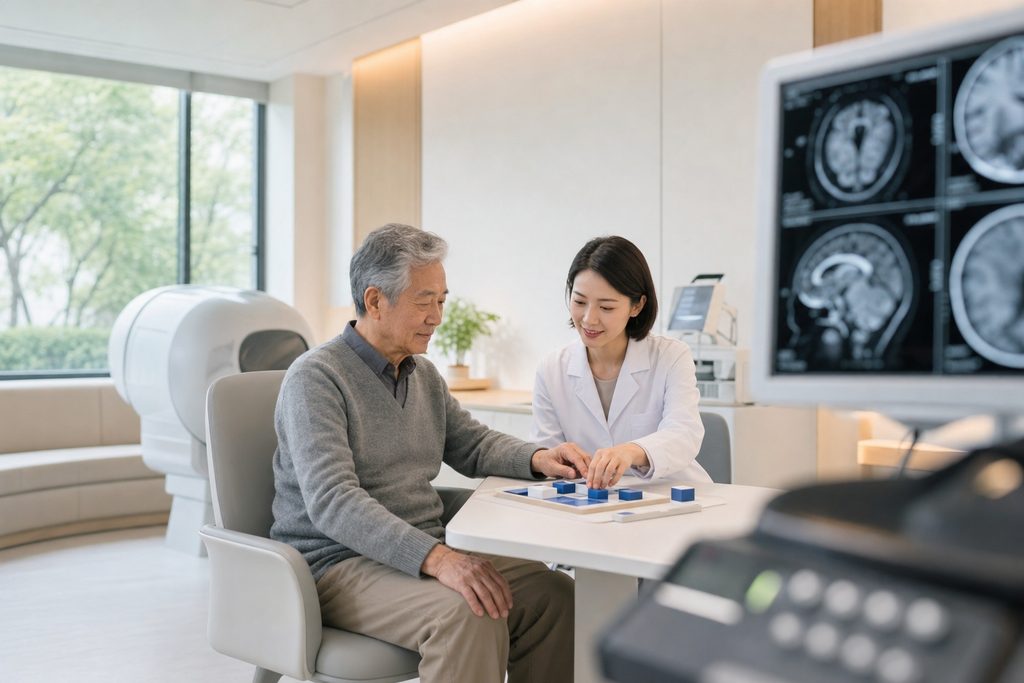
A typical cognitive assessment in a Western clinic involves a questionnaire and perhaps a basic CT scan. The protocols offered at China’s leading neurology centers are fundamentally different. Patients undergo high-resolution 3T or even 7T MRI with volumetric analysis — software that precisely measures the size of specific brain regions and compares them to age-matched norms. PET scans with amyloid or tau tracers are available. Blood biomarkers like p-tau217, which can detect Alzheimer’s pathology years before symptoms, are increasingly integrated into clinical workflows. These are not research tools here. They are part of a standard brain health checkup cost China packages.
Also included in many protocols: comprehensive neuropsychological testing that takes two to three hours, not ten minutes. It assesses memory, executive function, processing speed, language, and visuospatial ability across multiple domains. The result is a detailed cognitive map, not a single score.
Cost Structures That Make Prevention Accessible
Let us address the obvious question. How can a brain health checkup cost China be so much lower than in the US or Europe? The answer is structural, not qualitative. Chinese hospital systems operate at enormous scale. Labor costs are lower. Equipment utilization rates are higher. Administrative overhead is leaner. A comprehensive brain health assessment package — including advanced neuroimaging, blood biomarkers, and multi-hour neuropsychological testing — runs from $800 to $2,500 depending on the hospital tier and protocol depth. A comparable workup in the United States can exceed $10,000, often with longer wait times for imaging.
This is not a discount. It is a different economic model that produces equivalent or superior diagnostic data. The cognitive decline treatment Shanghai price for follow-up interventions follows the same pattern — accessible without compromising clinical rigor.
What You Need to Know Before Going Alone
Honesty matters more than marketing. Coming to China for a brain health assessment is logistically complex. Here is what you will face if you attempt to arrange everything independently:
- Visa Requirements: Medical travel to China requires an S2 visa with a specific medical purpose annotation. The application demands an official invitation letter from the hospital, confirmed appointment documentation, and detailed treatment plans. Embassies reject incomplete applications routinely. This is not a tourist visa scenario.
- Appointment Access: Public hospital outpatient departments do not accept international advance bookings through their standard channels. You cannot simply call or email to schedule a brain health assessment. These slots go through the hospital’s international medical center or VIP department — and those offices operate entirely in Mandarin.
- Diagnostic Precision Depends on Communication: A neuropsychological assessment requires nuanced verbal interaction. Describing the exact nature of a memory lapse, a word-finding difficulty, or a spatial confusion to a Mandarin-speaking clinician through a generic translation app risks losing critical diagnostic information. Precision matters here.
How We Help You Navigate This
These barriers exist for structural reasons — not because anyone wants to exclude international patients. Our job is to solve each one.
Before you travel, we translate your medical history and current concerns into clinical Chinese, ensuring nothing is lost. We match your specific cognitive profile and goals to the right neurology department — whether that is the memory disorders center at a top-tier public hospital or a private international clinic with JCI accreditation. We coordinate the S2 visa invitation documentation directly with the hospital’s international office. When you arrive, a bilingual medical companion meets you. They handle registration, payment, navigation between imaging suites and consultation rooms, and — most critically — real-time interpretation during your cognitive assessments and physician consultations. They ensure your subjective experience of memory changes is communicated accurately. After your assessment, we coordinate follow-up discussions, second opinions if needed, and any intervention planning.
We also connect patients interested in complementary approaches. Many wonder how to prevent memory loss with Chinese medicine. Traditional Chinese Medicine offers adjunctive strategies — acupuncture protocols targeting cerebral blood flow, herbal formulations studied for cognitive support, dietary therapy based on constitutional assessment. These do not replace neurological care. But they can sit alongside it, and we connect you with university-affiliated TCM departments that practice evidence-informed integrative medicine.
Can Brain Training Delay Alzheimer’s Abroad?
This question comes up in nearly every consultation. The short answer: cognitive training alone is not a magic shield. But structured, multi-domain intervention programs — the kind offered at China’s leading brain health centers — show real promise. The landmark FINGER study, published in The Lancet, demonstrated that simultaneous intervention across diet, exercise, cognitive training, and vascular risk management improved or maintained cognitive function in at-risk older adults. Chinese brain health programs have adopted and localized this model aggressively.
What does that look like in practice? After your assessment identifies specific cognitive vulnerabilities, the intervention plan targets them precisely. If processing speed is declining, you get adaptive computerized training with real-time performance tracking. If vascular risk is high, aggressive management of blood pressure and glucose is integrated. Nutritional counseling shifts from generic advice to targeted protocols — specific micronutrient supplementation, anti-inflammatory dietary patterns, and gut-brain axis support. This is not a brain-training app. It is a medically supervised, multi-modal program. Patients who book brain health assessment package China options often continue with structured follow-up remotely after returning home.
What a Brain Health Checkup Actually Includes
A typical comprehensive protocol spans one to two days and includes:
- Neurologist consultation with detailed medical and family history review
- High-resolution brain MRI with volumetric analysis
- Optional amyloid or tau PET imaging based on risk profile
- Blood work including p-tau217, APOE genotyping, inflammatory markers, and metabolic panel
- Comprehensive neuropsychological testing (2-3 hours, multi-domain)
- Sleep quality assessment (sleep apnea is a major reversible cause of cognitive decline)
- Integrated report with diagnosis, risk stratification, and personalized intervention plan
The report you leave with is actionable. It names specific risks, quantifies them where possible, and outlines exactly what to do next — whether that is pharmacological intervention, lifestyle modification, or monitoring with repeat assessment in 12 months.
Frequently Asked Questions
The imaging equipment, biomarker assays, and neuropsychological testing protocols used at China’s top-ranked neurology hospitals are equivalent to those in any major Western academic medical center. Many machines are newer. The radiologists and neurologists interpreting your results are trained in internationally recognized protocols. The diagnostic data you receive is clinically valid and can be shared with your physician at home for continuity of care.
Expect to pay between $800 and $2,500 for the assessment itself, depending on hospital tier and which imaging and biomarker options are clinically appropriate for your risk profile. This does not include travel, accommodation, or our coordination services. A cognitive decline treatment Shanghai price for follow-up care — if intervention is recommended — varies by protocol but generally falls between $1,500 and $5,000 for structured multi-week programs. All prices vary by hospital and case complexity.
Yes. Many patients choose to do exactly this. The neurology assessment gives you a precise, data-driven picture of your brain health. TCM offers adjunctive strategies — acupuncture, herbal medicine, dietary therapy — that some patients find supportive for energy, sleep, and subjective cognitive clarity. We connect you with university-affiliated TCM physicians who understand how to integrate their approach with Western neurology, not compete with it. Learning how to prevent memory loss with Chinese medicine works best when you have clear diagnostic data to guide the approach.
Then you have caught it early — which is the entire point. Early detection of cognitive decline opens a window for intervention that simply does not exist later in the disease course. Your neurologist will outline a specific plan. If pharmacological treatment is indicated, you can begin it here or take the report home to your local physician. We coordinate follow-up remotely. Many patients return annually for repeat assessments to track progression objectively.
Top-tier public hospitals offer the highest clinical volumes and often the most advanced research-level protocols. But they are busy, the environment is less polished, and English-speaking staff are concentrated in the international medical center. Private international hospitals like United Family or Jiahui offer a more Western-style experience — English-speaking throughout, direct insurance billing, calmer atmosphere — but may have slightly less access to the most cutting-edge research biomarkers. The best neurology hospital Beijing for dementia prevention depends on your priorities: maximum diagnostic depth or maximum comfort. We help you weigh this trade-off based on your specific case.
Your Next Step
Cognitive decline is not an inevitable consequence of aging. It is a process — one that can be detected early, slowed, and in some cases significantly modified through targeted intervention. The tools to assess your brain health with precision exist today. They are accessible. They are affordable relative to Western alternatives. The hardest part is navigating the logistics of accessing them from abroad — and that is exactly what we do.
If you want to understand your cognitive baseline, identify your specific risks, and walk away with a clear, personalized plan, we are ready to help. Visit our patient coordination page to start a conversation. No pressure. No obligation. Just clarity.
For more medical information and treatment options in China, visit chinamedservices.com (China Medical Services).
