Crown or Filling: How to Tell Which Dental Restoration Your Tooth Needs
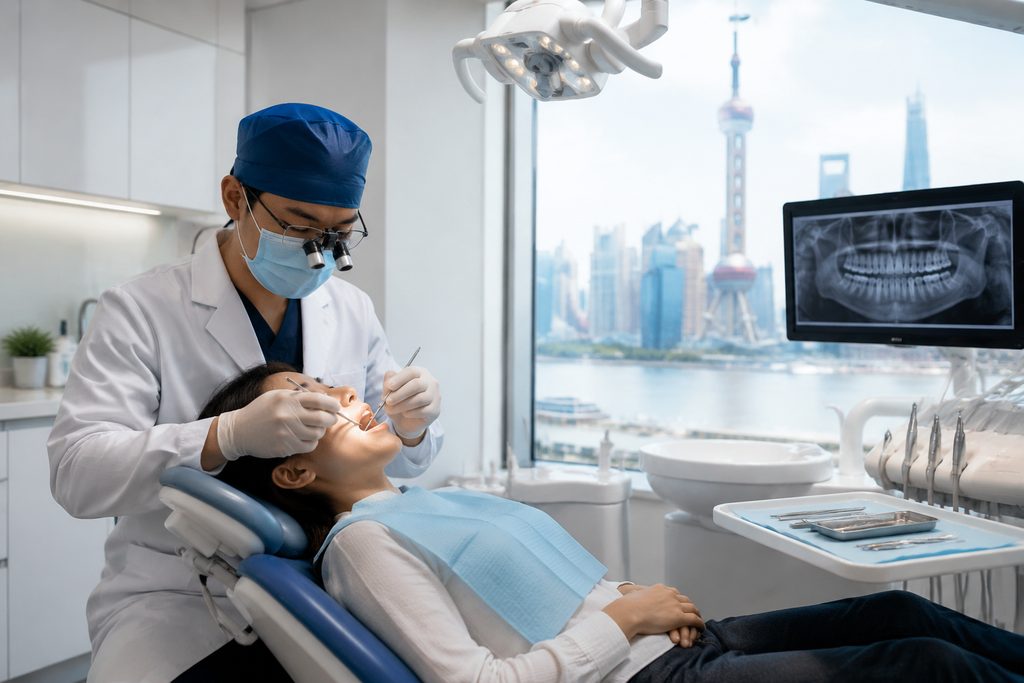
Crown or Filling: Which Does My Tooth Need? A Practical Guide to Dental Crown Cost China vs Filling
A filling patches a hole. A crown replaces the entire visible portion of a tooth above the gum line. That is the fundamental difference. But knowing which one your tooth actually needs depends on how much healthy tooth structure remains — and how much stress that tooth takes when you chew. For international patients comparing dental crown cost China vs filling, the clinical decision should come first. The financial decision follows. This guide walks through both.
Key Takeaways
- A filling works when at least 50% of the natural tooth crown remains intact; a crown becomes necessary when structural integrity drops below that threshold.
- In China, a composite filling typically costs $50–150, while a porcelain-fused-to-metal crown runs $200–600 and a full zirconia crown $400–900 — roughly 60–80% less than US private-practice prices.
- Dental tourism in China is viable for major restorative work, but you need a clear treatment plan from your home dentist first — Chinese clinics rarely diagnose remotely.
- Language barriers in Chinese public dental hospitals are real; private international clinics in Shanghai and Beijing solve this but charge 2–3 times more than public hospital rates.
The Problem: A Cracked Tooth Gets Worse Every Month You Wait
Dental caries remains the most common noncommunicable disease on the planet. The World Health Organization estimates that untreated tooth decay in permanent teeth affects approximately 2 billion people globally. That is nearly one in four humans walking around with an active cavity. Some of those cavities are small enough for fillings. Others have silently progressed to the point where the tooth is a fracture waiting to happen.
Here is the uncomfortable truth: a tooth with a large filling — say, one covering more than half the chewing surface — is structurally compromised. Studies published in the Journal of Prosthetic Dentistry have repeatedly shown that endodontically treated molars without cuspal coverage fracture at significantly higher rates than those protected by full crowns. A meta-analysis in the Journal of Endodontics found that the 10-year survival rate for root-canal-treated molars restored with crowns was approximately 81%, compared to roughly 63% for those restored with direct fillings only. The difference is not cosmetic. It is structural survival.
And the cost of waiting? A tooth that cracks below the gum line cannot be saved with either a filling or a crown. Extraction and replacement — implant, bridge, or partial denture — costs three to ten times more than a crown placed at the right time. The most expensive dental procedure is the one you needed six months ago but did not get.
Why Understanding Dental Crown Cost China vs Filling Matters for International Patients
China has become a serious destination for dental care among expatriates and medical travelers. The reason is straightforward: price transparency and volume. But the decision framework does not change based on geography. You still need to know whether the tooth needs a filling or a crown before comparing prices. Let us break down the clinical and financial logic.
Clinical Volume Drives Procedural Confidence
Chinese dental hospitals process enormous patient volumes. A single public stomatology hospital in Beijing or Shanghai may see several thousand outpatients daily. That scale means the specialists performing crown preparations and cementations do them constantly. The Ninth People’s Hospital in Shanghai, affiliated with Shanghai Jiao Tong University School of Medicine, operates one of the largest oral and maxillofacial departments in Asia. Its dental faculty handles complex restorative cases that would be referred to multiple specialists in smaller markets. Repetition matters in dentistry. A clinician who cements a dozen crowns per week has encountered every possible complication — and knows how to avoid them.
Technology Has Standardized, Not Differentiated
CAD/CAM same-day crown systems are now common in mid-range Chinese dental clinics, not just premium ones. Digital intraoral scanners, 3D-printed models, and zirconia milling units are standard equipment in international dental departments across Shanghai, Beijing, and Shenzhen. That means the quality gap between Chinese private clinics and Western practices has narrowed considerably for routine restorative work. What differentiates providers now is not the milling machine. It is the diagnostic judgment and the quality of the tooth preparation — both of which improve with clinical volume.
Cost Advantage Without Quality Compromise
Why is dental crown cost China vs filling so much lower than in the United States or Western Europe? Labor economics and clinic efficiency, primarily. Chinese dentists earn less than their American counterparts, and Chinese clinics operate with leaner administrative overhead. A crown preparation that takes 60–90 minutes in a US private practice might take 45–60 minutes in a high-volume Chinese clinic — not because of rushing, but because the workflow is streamlined. Materials are globally sourced and identical: 3M, Ivoclar, VITA, and Kuraray products are used in Chinese clinics. The savings are structural, not a compromise on material quality.
How Do I Know If I Need a Crown or Filling? The Clinical Decision Tree
This is the question every patient asks first. The answer comes from a clinical examination and an X-ray. But you can understand the decision framework before you ever sit in a dental chair.
A filling is appropriate when the cavity or fracture affects less than 50% of the tooth’s chewing surface, the remaining walls are thick and intact, and the tooth does not bear extreme biting force. Composite resin fillings bond directly to enamel and dentin. They work beautifully for small to moderate cavities in front teeth and premolars.
A crown is indicated when any of these conditions exist:
- The cavity or fracture involves more than half the tooth’s width or chewing surface
- A cusp (the pointed chewing part of a back tooth) has fractured off
- The tooth has had root canal treatment and now lacks internal moisture, making it brittle
- An existing large filling is failing, with recurrent decay underneath
- The tooth has a vertical crack that threatens to split it entirely
The rule of thumb most dentists use: if the remaining tooth structure is less than what the filling material would replace, the tooth needs a crown. A filling is a patch. A crown is a replacement cap that holds the tooth together from the outside. When in doubt, ask your dentist to show you the X-ray and point to the remaining tooth walls. If they look thin, a filling will fail within a few years.
Common mistake: Patients sometimes insist on a filling because it costs less upfront. But a large filling in a structurally weak tooth typically lasts 3–5 years before the tooth fractures. A crown on the same tooth lasts 10–15 years. The filling is the more expensive choice over a decade.
Is a Crown Better Than a Filling for Cracked Tooth? Comparing Durability and Cost
The short answer: for a cracked tooth, yes. A filling cannot hold a cracked tooth together. It merely fills the space. The crack continues to propagate under chewing forces, and the filling does nothing to stop it. A crown encircles the entire tooth, binding the walls together like a metal ring around a cracked barrel. That compressive force is what prevents catastrophic fracture.
Here is how the options compare in real numbers, based on typical pricing in Chinese public hospital international departments and private clinics as of 2026:
| Restoration Type | Indication | Typical Lifespan | China Price Range (USD) | US Price Range (USD) |
|---|---|---|---|---|
| Composite filling (small) | Minor cavity, intact walls | 5–8 years | $50–120 | $150–350 |
| Composite filling (large) | Moderate cavity, thin walls | 3–5 years | $80–150 | $200–450 |
| Porcelain-fused-to-metal crown | Large cavity, cracked tooth, post-root canal | 10–12 years | $200–600 | $800–1,500 |
| Full zirconia crown | Posterior teeth, bruxism, aesthetics | 12–15 years | $400–900 | $1,200–2,500 |
| E-max (lithium disilicate) crown | Anterior teeth, high aesthetics | 10–15 years | $350–800 | $1,000–2,200 |
These figures vary by hospital tier, city, and case complexity. A crown in a top-tier public hospital international department in Shanghai will cost more than one in a mid-range private clinic in Chengdu. But the pattern holds: Chinese pricing runs 60–80% below typical US private-practice fees for comparable materials and clinical standards.
Affordable Dental Crowns for Foreigners Beijing: What to Expect at International Clinics
Beijing has two distinct dental care ecosystems for foreigners. The first is the international department of major public stomatology hospitals, such as Peking University School of Stomatology and Beijing Stomatological Hospital. These departments offer English-speaking coordination, same-day or next-day appointments, and pricing that sits between public and private rates. A porcelain-fused-to-metal crown here typically runs $250–500. A full zirconia crown runs $450–800.
The second ecosystem is the private international clinic network — United Family, Raffles, Parkway, and similar JCI-accredited facilities. These clinics offer Western-style scheduling, direct insurance billing, and fully English-speaking staff. The convenience comes at a premium: crown prices run 1.5–2 times higher than public hospital international departments. A zirconia crown at a top-tier private clinic in Beijing can cost $800–1,200. Still less than the US, but not the bargain that public hospital dentistry offers.
For patients seeking affordable dental crowns for foreigners Beijing, the public hospital international department route offers the best balance of price and clinical quality — provided you can navigate the registration process. That is where a bilingual coordinator becomes valuable, though the process is manageable independently with preparation.
Best Dental Clinic Shanghai Crown Price: Navigating the Options
Shanghai’s dental market mirrors Beijing’s in structure but differs in one important way: the density of private international clinics is higher, and competition has driven mid-range pricing down. The Ninth People’s Hospital remains the gold standard for complex restorative and prosthodontic work. Its international VIP clinic offers crown procedures with English coordination, though wait times for non-urgent cases can stretch to several weeks.
Private clinics in the former French Concession and Pudong areas — Jiahui, Parkway, and independent practices staffed by Western-trained dentists — offer faster scheduling and a more familiar patient experience. For a single crown, the price difference between these private clinics and the Ninth People’s Hospital international department is often only $100–200. For multiple crowns or full-mouth rehabilitation, the gap widens significantly.
When evaluating best dental clinic Shanghai crown price, the relevant question is not which clinic is cheapest. It is which clinic gives you access to a prosthodontist — not a general dentist — for the crown preparation. Prosthodontists complete three additional years of training in crown, bridge, and implant restoration. In China, top dental hospitals staff prosthodontics departments separately from general dentistry. For a single crown on a healthy tooth, a general dentist is fine. For a crown on a root-canal-treated molar or a tooth with a questionable prognosis, see a prosthodontist.
Practical Considerations: Documentation, Payment, and Follow-Up for Dental Work in China
Before you book a dental crown procedure in China, understand the logistics. These are the facts, not a sales pitch.
Documentation. Bring your home dentist’s records if you have them — recent X-rays, a treatment plan, and any notes on existing restorations. Chinese dentists will take their own X-rays regardless, but your records provide context. If you have had a root canal, bring the endodontic report if available.
Visa. For dental treatment in China, international patients typically enter on an S2 visa, which covers short-term private affairs including medical treatment. The visa application requires supporting documents from the treating hospital or clinic — usually an appointment confirmation or treatment invitation letter. Check the latest requirements with your nearest Chinese embassy or consulate before booking flights. Processing times vary by country.
Payment. Chinese public hospitals operate on a prepayment model. You pay a deposit when registering, and each procedure — examination, X-ray, crown preparation, crown cementation — is billed as you go. International departments accept major credit cards and sometimes international insurance. Private international clinics frequently offer direct insurance billing. Confirm payment methods before your appointment.
Insurance. Most international health insurance plans with dental coverage will reimburse treatment at JCI-accredited clinics, but public hospital international departments may not be in-network. You will likely pay out of pocket and file for reimbursement. Get a detailed invoice and treatment record — in English if the clinic provides it.
Language. Public hospital dental departments operate almost entirely in Chinese. The international departments have English-speaking coordinators, but the dentists themselves may have limited English. If you do not speak Chinese, factor in the cost of a bilingual companion or choose a private international clinic where English is standard.
Follow-up. A crown placed in China should last 10–15 years with proper care. But if a problem arises — a loose crown, sensitivity, or a chipped margin — you need a plan. Most issues can be addressed by a dentist in your home country, though they may not honor any warranty from the Chinese clinic. Ask about the clinic’s warranty policy for crown restorations before you leave. Some private clinics offer 1–3 year warranties on laboratory work.
Frequently Asked Questions
The deciding factor is remaining tooth structure. If more than half the chewing surface is intact and the walls are thick, a filling works. If a cusp has fractured, the tooth has had a root canal, or the cavity extends under the gum line, you need a crown. Only a clinical exam and X-ray can confirm this — but asking your dentist to show you the X-ray and explain the remaining tooth structure is the fastest way to understand the recommendation.
Yes, with the right provider. Top-tier public stomatology hospitals and JCI-accredited private clinics in China meet international standards for infection control and clinical quality. The key is choosing a provider with documented experience treating international patients and verifying that the clinic uses globally sourced materials. Avoid low-cost street-front clinics that advertise heavily but lack verifiable credentials.
A well-made crown rarely fails in the first few years. But if it does — a loose crown, recurrent decay, or a fracture — any competent dentist in your home country can address it. You may need to pay out of pocket for the repair, and the Chinese clinic’s warranty may not apply internationally. Before leaving China, ask for your dental records, the crown’s material certification, and written warranty terms.
You can book the initial consultation and examination in advance, but no reputable clinic will schedule a crown preparation without first examining your tooth. The process is: consult and X-ray on day one, crown preparation on day two or three, and cementation of the final crown about one week later — assuming the clinic has an on-site milling unit. For same-day CAD/CAM crowns, the entire process can be completed in a single visit. Confirm the timeline with the clinic before booking flights.
Your Next Step
Understanding dental crown cost China vs filling is the easy part. The hard part is knowing which restoration your tooth actually needs — and that requires a clinical exam. If you are considering dental treatment in China, our team at China Medical Services can help you identify suitable dental departments at top hospitals in Shanghai, Beijing, and other cities, and coordinate your appointment. We are not a hospital and we do not provide diagnoses. But we do help you navigate the system with clarity. When you are ready to explore your options, start with a free consultation.
For more medical information and treatment options in China, visit chinamedservices.com (China Medical Services).
