Dental Implant Recovery in China: Post-Op Care and Hotel Support
Dental Implant Recovery in China: The Short Answer
Most patients return to desk work within 2 to 3 days after a single dental implant placement. Full osseointegration — the bone fusing to the titanium post — takes 3 to 6 months. The dental implant cost China clinics charge typically includes the surgical phase, but post-op care and accommodation logistics are separate considerations that catch many international patients off guard.
That gap between “back to work” and “fully healed” is where planning matters. You are not bedridden. But you are also not free to ignore your mouth for five months. The real question is not whether you can manage alone — it is whether you want to, and what support actually costs.
Who This Is Right For — and Who It Isn’t
Dental implant surgery in China suits a specific profile. Knowing whether you fit it saves you a wasted trip.
Typically a good candidate:
- You need multiple implants or full-arch restoration and the savings justify the travel. The dental implant cost China hospitals and clinics charge often runs 50–70% below US or UK private rates.
- You are already planning travel to Shanghai, Beijing, or Guangzhou for business or family reasons.
- You have stable blood sugar if diabetic, do not smoke heavily, and have adequate bone volume — or are willing to accept a bone graft as part of the plan.
- You can commit to a two-trip structure: one for surgery, one 3–6 months later for the abutment and crown.
Who should not pursue this:
- Patients with uncontrolled diabetes, active periodontal disease, or a history of bisphosphonate use for osteoporosis. These conditions raise implant failure risk regardless of geography.
- Anyone who cannot return for the restorative phase. A titanium post without a crown is not a finished tooth.
- Smokers unwilling to pause for at least 2 weeks post-surgery. Smoking constricts blood flow to the gum tissue and measurably slows healing.
- Patients who need a single implant and live near a competent local dentist. The savings on one implant may not offset two international flights.
Being honest about who should stay home is what makes the rest of this guide trustworthy.
The Options, Compared
Where you get a dental implant in China changes the recovery experience. Three tiers dominate the market for international patients.
| Option | Typical Cost per Implant (USD) | English Support | Post-Op Follow-Up | Best For |
|---|---|---|---|---|
| Public hospital stomatology department | $600–$1,200 | Limited; bring a companion | Included, but crowded and fast-paced | Budget-focused patients comfortable with a busy environment |
| Private dental clinic chain | $800–$1,800 | Usually available | Scheduled, more personalized | Most international patients; balance of cost and comfort |
| International hospital dental unit (e.g., United Family, Jiahui) | $1,500–$3,000 | Native-level English standard | Western-style, unhurried, detailed aftercare instructions | Patients who prioritize communication and seamless insurance billing |
The public hospital route is the cheapest — but the dental implant cost China public departments quote rarely includes the time you spend navigating registration, payment windows, and follow-up queues without Chinese language skills. The international hospital tier costs more, yet the aftercare instructions abroad patients receive are usually written in clear English, and follow-up appointments are easier to schedule around a flight home. Most of our clients land in the middle tier: private clinics with English-speaking coordinators and prices that still beat Western quotes by a wide margin.
Post-Op Care in a Hotel: What Actually Works
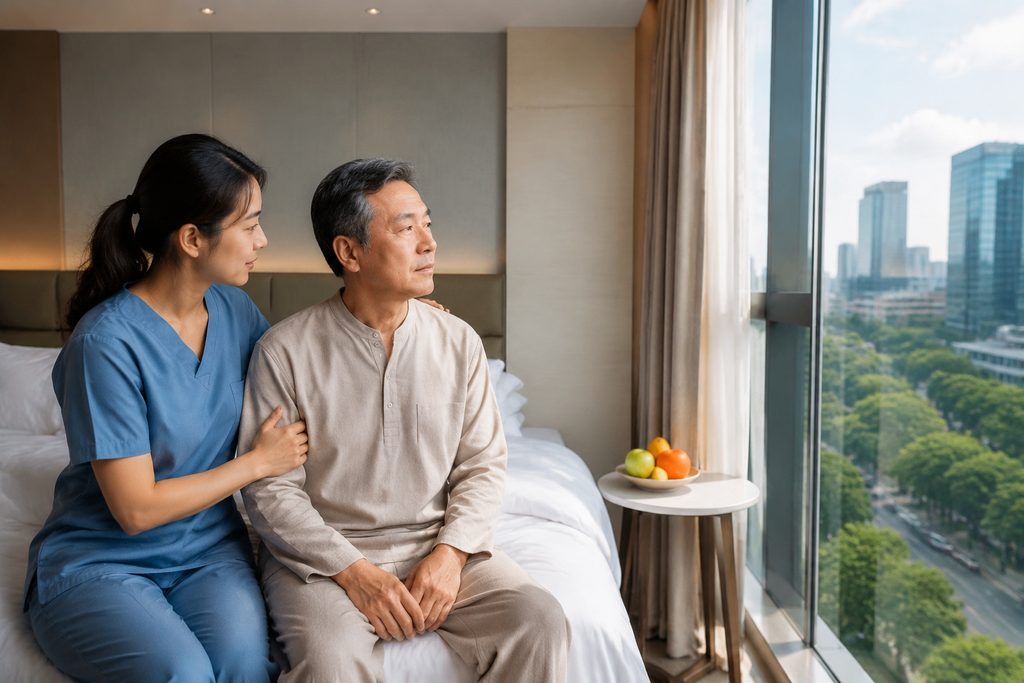
Recovering in a hotel is not the same as recovering at home. You lack a kitchen. You may lack ice. Room service menus are not designed for soft-food diets. Here is what a realistic hotel recovery looks like for the first 72 hours after implant placement.
Day 1: Bleeding should stop within a few hours. Bite on gauze as directed. Swelling begins. Sleep with your head elevated — ask housekeeping for extra pillows before you need them. Do not rinse your mouth. Do not spit forcefully. Blood-tinged saliva is normal; active bleeding is not.
Day 2: Swelling peaks. Apply a cold pack to the outside of your cheek for 15 minutes on, 15 minutes off. A hotel can usually provide ice, but a gel pack from a nearby pharmacy is more reliable. Eat lukewarm congee, yogurt, or scrambled eggs. Nothing hot, nothing crunchy.
Day 3: Swelling starts to subside. Begin gentle saltwater rinses after meals. You can usually fly home this day or the next — but read the flying section below before booking.
Days 4–14: Stick to soft foods. Avoid the side of the implant when chewing. Continue saltwater rinses. If sutures were placed, they typically dissolve or are removed at a 7–10 day follow-up.
The hotel support question is really about three things: proximity to your clinic, access to soft food, and a refrigerator for cold packs. We recommend booking within 15 minutes’ walk or taxi ride of your dental provider. A hotel with a mini-fridge solves the ice problem. A hotel with a breakfast buffet solves the soft-food problem — yogurt, congee, steamed eggs, and fruit are almost always available.
Can I Fly After Dental Implant Surgery?
Yes — with caveats. Most dentists clear patients to fly 24 to 48 hours after a straightforward single implant placement. The concern is not the implant itself. It is cabin pressure changes interacting with sinus involvement, and the risk of a bleeding episode at altitude.
If your implant was placed in the upper jaw near the sinus floor, or if a sinus lift was performed, wait 5 to 7 days before flying. Pressure changes can cause discomfort and, rarely, complications with the surgical site. If you had multiple implants placed or a bone graft, extend that window to a week.
Book a flexible return ticket. Swelling, pain, or an unexpected need for a follow-up visit can delay departure. A non-refundable budget fare is a false economy when you are recovering from oral surgery.
What Dental Implant Recovery Costs — Beyond the Implant
The dental implant cost China clinics advertise is the surgical fee. It is not the total cost of your trip. Here is what a typical single-implant journey looks like for an international patient, in USD.
| Expense | Typical Range | Notes |
|---|---|---|
| Implant surgery (private clinic) | $800–$1,800 | Includes post and surgical placement |
| Abutment + crown (second trip) | $400–$1,000 | 3–6 months later |
| Diagnostics (CBCT scan, X-rays) | $50–$150 | Usually required before surgery |
| Hotel (7 nights, mid-range) | $350–$700 | Shanghai or Beijing city-center pricing |
| Bilingual medical companion | from $300/day | Optional; covers clinic visits, translation, logistics |
| Round-trip flights (varies wildly by origin) | $600–$2,000 | Economy, booked in advance |
What is not included in the implant fee: pain medication, antibiotics if prescribed, any grafting material, and the second trip for the crown. The second trip is shorter — usually 3 to 4 days — but it is not optional. Some clinics offer same-day crowns using immediate-loading protocols, but these are not suitable for every case and carry a slightly higher failure risk in the first year.
How long is dental implant recovery in total? The surgical recovery is days. The biological recovery — osseointegration — is 3 to 6 months. You cannot rush bone. Clinics that promise a fully finished tooth in one week are either doing immediate-loading (with specific candidacy requirements) or cutting corners.
Practical Considerations: Documents, Payments, and Follow-Up
International patients need more than a passport and a credit card. Here is what actually matters for a dental implant trip to China.
Visa: Medical treatment falls under the S2 visa category, not the M visa. M is for commercial and trade activities. For dental implant surgery, you apply for an S2 visa with supporting documents from the hospital or clinic — usually an invitation letter, treatment plan, and appointment confirmation. Requirements shift, so check with the Chinese embassy or consulate in your country before booking flights. We can provide document support but never guarantee visa approval.
Payment: Public hospitals require prepayment at each step. Private clinics and international hospitals accept international credit cards more readily, but check before you arrive. Some clinics require a deposit to secure a surgery slot. Insurance is rarely accepted for dental implants at public hospitals; private international clinics may offer direct billing depending on your policy.
Records: Bring any existing dental X-rays, CBCT scans, and a summary of your dental history. If you have had failed implants before, bring those records too — they change the treatment plan. Digital copies on your phone are acceptable at most clinics, but a USB drive is more reliable.
Follow-up after returning home: Your Chinese dentist should provide a written summary and digital imaging for your home dentist. The crown phase can sometimes be completed by a local dentist if they are willing to work with the implant system your Chinese clinic used — but many Western dentists decline to finish work started elsewhere. Discuss this before you commit. The safest path is returning to the same clinic for the restorative phase.
Language is the quiet variable. A public hospital stomatology department in Shanghai may have excellent surgeons and zero English-speaking front-desk staff. That is where a bilingual medical companion earns their fee — navigating registration, payment, pharmacy pickup, and post-op instructions. It is not a luxury for everyone. But if you do not speak Mandarin, it is the difference between a smooth recovery and a stressful one.
Frequently Asked Questions
Soft foods for the first 7 to 10 days. You can gradually return to a normal diet after that, but avoid chewing directly on the implant site for 6 to 8 weeks. Full chewing strength returns once the crown is placed and the bone has integrated — typically 3 to 6 months after surgery.
Private clinics in Shanghai typically charge $800 to $1,800 per implant for the surgical phase. International hospital dental units run $1,500 to $3,000. Public hospital stomatology departments start around $600 but offer minimal English support. Prices vary by implant brand — Swiss and German systems cost more than Korean or Chinese brands — and by case complexity.
Some private clinics and medical tourism facilitators offer packages that bundle surgery, diagnostics, hotel, and local transport. These are convenient but not standardized. Read the fine print: what happens if surgery is delayed? Is the hotel refundable? Who pays for an extra night if complications arise? We help patients evaluate these packages, but we never push one over another.
Implant failure rates are low — roughly 2–5% over five years for healthy patients — but they are not zero. Early failure usually shows up within the first few months as mobility, pain, or infection. If this happens, contact the placing clinic immediately. Some clinics offer a warranty period and will replace a failed implant at reduced or no cost, but you still need to travel back. Ask about the clinic’s failure policy before surgery, in writing.
For a single implant, most patients manage alone. For multiple implants, a sinus lift, or sedation beyond local anesthetic, having someone with you for the first 48 hours is strongly advisable. A companion helps with medication timing, food, and getting you to a follow-up appointment if something feels wrong.
Your Next Step
Dental implant recovery in China is manageable — if you plan for it. The surgery is the easy part. The logistics of hotels, soft food, follow-up visits, and a second trip for the crown are where international patients stumble. That is what we do. China Medical Services is not a hospital and we do not diagnose or treat anything. We are a team of coordinators who help international patients find the right clinic, prepare documents, and navigate the in-country experience — including dental implant aftercare instructions abroad patients can actually follow. If you are weighing the dental implant cost China clinics quote against your local options, start with a conversation. Request a free consultation and tell us what you need. We will tell you honestly whether this makes sense for your case.
For more medical information and treatment options in China, visit chinamedservices.com (China Medical Services).
