Dental Implants in China: Full Mouth Restoration Cost, Safety, and Personal Assistance
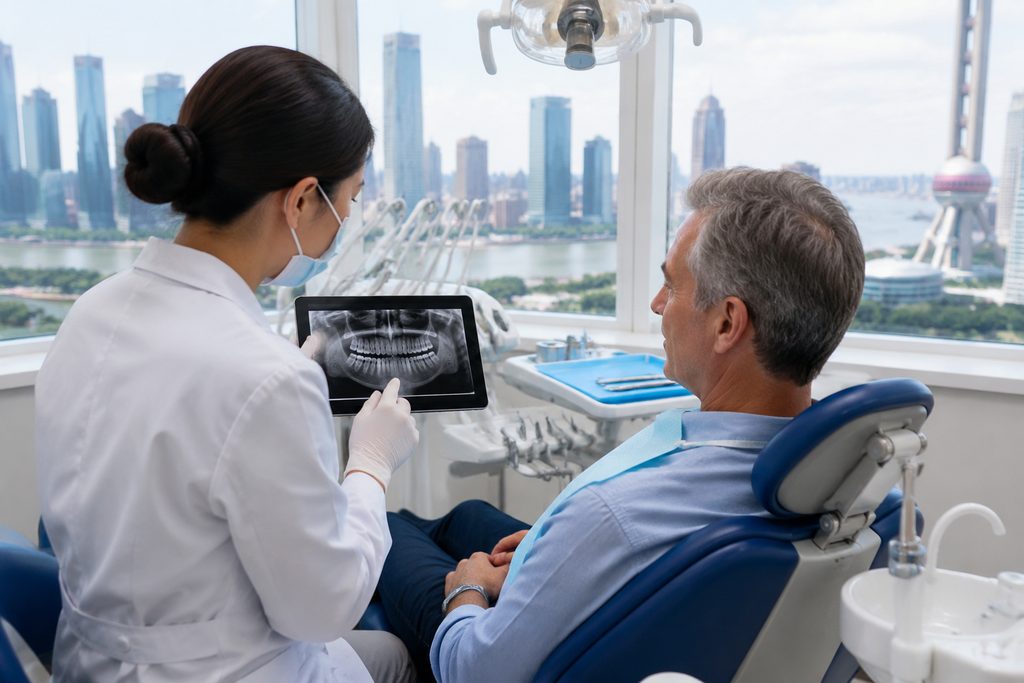
When 54-year-old Robert from Manchester crumbled a molar on a piece of sourdough toast, he already knew the score. Years of gum disease and a childhood accident had left his mouth a patchwork of failing bridges and hopeless teeth. His UK dentist quoted £28,000 for a full-arch restoration — per jaw. Robert did the math. £56,000, months of appointments, and a denture phase he dreaded. He typed “full mouth dental implants cost China” into Google at 2 a.m., desperate for an alternative that wouldn’t bankrupt his retirement.
He is not alone. The American College of Prosthodontists estimates that approximately 178 million Americans are missing at least one tooth, and about 40 million are missing all of their teeth. In Europe, severe tooth loss affects roughly 7% of adults over 65. The standard solution — full mouth dental implants — carries a price tag in Western countries that forces many patients into impossible choices: deplete savings, take on crushing debt, or simply live with the functional and psychological toll of tooth loss.
China has emerged as a destination where those choices get rewritten. Not because the care is cheaper in a way that compromises safety. Because the structural economics of Chinese healthcare — high clinical volume, lower labor costs, and efficient hospital systems — create a price differential that can reach 70-80% below US and UK rates. The question is not just about cost. It is about whether you can access that care safely, with someone ensuring nothing gets lost in translation.
Key Takeaways
- Full mouth dental implants in China cost between $8,000 and $25,000 per arch — a 70-80% reduction compared to US prices, with comparable implant brands and technology.
- China’s top dental hospitals handle implant volumes that dwarf Western clinics — a surgeon at a major Shanghai hospital may place more implants in a month than a UK dentist does in a year.
- Language barriers and hospital navigation are the single greatest obstacle for international patients — without bilingual assistance, even registering for a consultation becomes nearly impossible.
- Quality varies significantly between clinics. Choosing a hospital affiliated with a major university and verified through independent ranking systems is essential for safe outcomes.
The Problem: When Your Mouth Becomes a Financial Emergency
A full mouth restoration is not cosmetic dentistry. It is functional surgery for people who cannot eat, speak, or smile without pain or embarrassment. The standard protocol — often called All-on-4 or All-on-6 — involves placing four to six titanium implants per arch, which support a fixed prosthetic bridge. In the United States, the average cost per arch ranges from $21,000 to $30,000. Both arches together routinely exceed $50,000.
Dental insurance rarely covers more than a fraction. Medicare does not cover dental implants at all. Patients in the UK face NHS waiting lists that stretch beyond a year for complex restorative work — and many are told they do not qualify. Private care is the only option. Private care is unaffordable for most.
So patients start searching. They find clinics in Turkey, Thailand, Mexico, and increasingly, China. The price comparisons are startling. But price is only one variable. The real question patients like Robert ask is: Can I trust the quality? And how do I actually do this without speaking a word of Chinese?
Who We Are
We are not a hospital. We do not employ dentists, nor do we provide clinical treatment or diagnose conditions. Our team functions as your logistical architects for medical travel in China — we connect international patients with verified, top-tier dental hospitals and ensure that every step of the process, from visa paperwork to post-operative pharmacy runs, happens smoothly and in English. We have built a network across 37 Chinese cities, covering more than 340 top-ranked hospitals. We exist because China’s best hospitals are genuinely world-class, but they are not built for foreign patients to navigate alone.
Why Full Mouth Dental Implants in China Deliver Results
Clinical Volume Drives Surgical Precision
A dental implant surgeon at Shanghai Ninth People’s Hospital — one of China’s premier dental institutions — may place 30 to 50 implants in a single week. Over a year, that surgeon gains more hands-on experience with complex full-arch cases than many Western dentists accumulate in a decade. Volume is not just a number. It correlates with lower complication rates, faster surgery times, and better management of the unexpected — like insufficient bone density requiring immediate grafting.
China’s top dental hospitals are affiliated with major universities. The stomatology department at Peking University, West China Hospital of Stomatology in Chengdu, and Shanghai Ninth People’s Hospital all run active research programs and train residents under strict protocols. Implant brands used — Straumann, Nobel Biocare, Osstem, Dentium — are the same globally recognized manufacturers you would find in a US or European clinic. The difference is not the hardware. The difference is how many times the surgeon has used it.
Technology Infrastructure at Scale
Digital workflow is standard at China’s top dental centers. Cone-beam CT (CBCT) scanning for 3D jaw modeling. Intraoral optical scanners that eliminate the goop-and-gag of traditional impressions. CAD/CAM milling systems that fabricate provisional bridges within hours, not weeks. These technologies exist in Western clinics too — but in China, they are deployed at a throughput that dramatically reduces cost per procedure.
For a full mouth restoration, digital planning means the surgeon can place implants virtually before touching a scalpel. The surgical guide is 3D-printed. The provisional prosthesis is pre-fabricated. A patient can arrive on Monday, undergo surgery on Tuesday, and leave with fixed temporary teeth on Wednesday. The final zirconia bridge is delivered months later after osseointegration — but the patient never spends a day without teeth.
Cost Advantage Without Quality Compromise
Here is what full mouth dental implants cost China in real terms. For a single arch using the All-on-4 or All-on-6 technique with a reputable university-affiliated hospital, expect to pay between $8,000 and $15,000. Both arches typically range from $16,000 to $25,000. These figures include the surgery, the implants, the provisional bridge, and often the final zirconia prosthesis. Compare this to $50,000-$60,000 in the US or £30,000-£56,000 in the UK.
The cost gap is not explained by inferior materials or undertrained surgeons. It is structural. A dental surgeon’s salary in China is a fraction of their Western counterpart’s. Hospital overhead is lower. The supply chain for implants — many of which are manufactured in Asia — eliminates import markups. And the sheer patient volume allows hospitals to operate on thinner margins per case while maintaining profitability. Lower price does not signal lower quality here. It signals a different economic model entirely.
| Procedure | China (USD) | United States (USD) | United Kingdom (GBP) |
|---|---|---|---|
| Single Arch All-on-4/6 | $8,000 – $15,000 | $21,000 – $30,000 | £12,000 – £28,000 |
| Both Arches (Full Mouth) | $16,000 – $25,000 | $42,000 – $60,000 | £24,000 – £56,000 |
| Single Tooth Implant | $800 – $2,000 | $3,000 – $6,000 | £1,500 – £3,500 |
| CBCT Scan + Digital Planning | $100 – $250 | $300 – $800 | £150 – £400 |
Prices vary by hospital tier, implant brand, bone grafting needs, and case complexity. University-affiliated public hospitals tend toward the lower end; private international clinics toward the higher end.
What You Need to Know Before Going Alone
If you are asking “how much are full mouth implants in Shanghai” and thinking of booking a flight, pause. The price is real. The quality at top hospitals is real. But the barriers to accessing that care independently are also real — and they are not trivial.
- Visa Requirements: Medical treatment in China requires an S2 visa, specifically annotated for medical purposes. You need an invitation letter from the hospital confirming your treatment plan and dates. Without this letter, the visa application stalls. Getting that letter as an individual foreign patient — without a Chinese speaker, without a local contact, without knowing which department to call — is extraordinarily difficult. Family members accompanying you also require S2 visas. M visas are for business and do not apply here.
- Hospital Registration and Payment: Public hospitals in China do not allow international patients to book surgery online from overseas. You must appear in person for a consultation first. Registration happens at a kiosk with Chinese-language menus. Payment is typically required upfront — cash, Chinese bank card, or WeChat Pay. International credit cards are often not accepted. Hospitals may require a deposit of 50-100% before scheduling surgery. Insurance reimbursement is retrospective; you pay first and claim later.
- Language and Navigation: A top dental hospital in Shanghai might see 10,000 outpatients daily. Signs are in Chinese. Queue numbers are called in Mandarin. Post-operative instructions are written in Chinese characters. If you cannot read the pharmacy slip, you cannot fill your prescription. If you cannot describe sudden swelling or pain to a nurse at midnight, you are alone in a very crowded building. This is not a hypothetical risk. It is the daily reality of China’s public healthcare system.
How We Help You Navigate This
These barriers exist for structural reasons. Chinese public hospitals were built to serve a domestic population of 1.4 billion people. They are efficient, expert, and completely indifferent to the needs of a foreign patient who speaks no Mandarin. That is not malice. That is design. Our role is to layer a service infrastructure on top of that system so you experience the expertise without the friction.
Before you travel, we handle hospital matching. You tell us your dental history, your CBCT scans if you have them, your budget, and your timeline. We identify the right hospital — a university-affiliated stomatology center in Shanghai, a leading dental hospital in Beijing, or a private international clinic if you prefer English-speaking staff and direct insurance billing. We secure the invitation letter for your S2 visa. We schedule your initial consultation so you are not queuing at dawn.
During your stay, a bilingual medical companion accompanies you to every appointment. They translate your consultation with the implant surgeon — ensuring you understand the treatment plan, the implant system being used, the number of implants per arch, the bone grafting requirements, and the staged timeline. They handle registration, payment at the cashier window, pharmacy runs, and follow-up scheduling. If you need a temporary bridge adjusted or a prescription filled, they make it happen.
After surgery, the support continues. Osseointegration takes three to six months. You return for the final prosthesis delivery. We coordinate that second trip — appointments, accommodation, companion services. The goal is continuity. The same team, the same hospital, the same standard of care.
This is not a concierge luxury. It is practical, operational support for a medical journey that is otherwise unnavigable for a non-Chinese speaker. We do not mark up hospital fees. We charge a transparent service fee for our work. The hospital bill is paid directly to the hospital.
Is Dental Work in China Safe and Good Quality?
This is the question behind every other question. Is dental work in China safe and good quality? The answer depends entirely on where you go. China has more than 35,000 hospitals. The top 5% — roughly 1,700 institutions — include stomatology departments that rival any dental school in the world. The bottom tier includes clinics where sterilization protocols are inconsistent and implant placement is guided by experience rather than CBCT planning.
So the question is not whether good dental care exists in China. It does. The question is whether you, as a foreign patient, can reliably identify and access the top tier. That is where verification matters. We work with hospitals ranked in the Fudan University hospital rankings — China’s most authoritative independent hospital evaluation system. The stomatology departments at West China Hospital, Peking University School of Stomatology, and Shanghai Ninth People’s Hospital consistently appear among the top-ranked dental centers nationally. These institutions use the same implant systems as Western clinics. Their surgeons publish in international journals. Their infection control protocols meet JCI or equivalent standards.
If you are searching for the best dental implant clinic China with translator support, the key variable is not the clinic’s marketing. It is the clinic’s affiliation. University hospitals. Teaching hospitals. Centers with published research. These are your safety signals.
Frequently Asked Questions
Most dental implant packages China medical tourism providers offer bundled pricing that covers the surgical procedure, the implants themselves, the provisional prosthesis, and sometimes the final permanent bridge. Packages typically do not include flights, accommodation, or bone grafting if it is unexpectedly extensive. You should confirm exactly what is itemized. A reputable hospital will provide a written treatment plan with cost breakdown before you commit. If a package price seems too low to be true — under $5,000 per arch — ask hard questions about implant brand, surgeon qualifications, and whether the final prosthesis is included or billed separately.
Plan for two trips. The first trip is 7 to 14 days: initial consultation, any necessary extractions, implant surgery, and delivery of the provisional fixed bridge. You return home with teeth. The second trip occurs 3 to 6 months later, after the implants have fused with your jawbone. This trip is shorter — typically 5 to 7 days — for impressions, fabrication, and delivery of the final zirconia or porcelain bridge. Some patients choose to stay in China for the entire osseointegration period, but this is uncommon and adds significant living costs.
Implant complications — infection, implant failure, prosthetic fracture — are uncommon but possible. Before you leave China, the treating hospital should provide your complete surgical records, implant brand and serial numbers, and post-operative imaging. This documentation allows a local dentist in your home country to provide follow-up care. Most implant manufacturers offer international warranties. If an implant fails, the manufacturer will often cover the cost of a replacement implant, though you will still pay for the surgical procedure to place it. We help patients obtain this documentation and coordinate with the hospital if questions arise later.
You can book dental implants China all inclusive packages through medical tourism agencies, but “all inclusive” means different things to different providers. At minimum, confirm that the package includes: pre-operative CBCT imaging, the surgical procedure, the implant hardware, the provisional bridge, the final prosthesis, all follow-up visits during your stay, and English-language coordination. What it almost never includes: your flight, your hotel, your meals, or treatment for unrelated dental issues discovered during examination. Read the fine print. Ask for a line-item breakdown. A transparent provider will give you one without hesitation.
Your Next Step
Robert from Manchester flew to Shanghai six months ago. He had 12 teeth extracted, eight implants placed across both arches, and left with a fixed provisional bridge. Last month he returned for his final zirconia prosthesis. His total cost was $19,400 — less than half of what a single arch would have cost him at home. He eats steak now. He smiles in photographs. The outcome was not magic. It was the result of a skilled surgeon, a verified hospital, and a process that did not leave him stranded in a system he could not navigate.
If you are considering full mouth restoration and the numbers in your home country do not add up, China deserves a serious look. Not as a gamble on cheap care. As a calculated decision to access high-volume, university-affiliated surgical expertise at a price that reflects local economics rather than Western markups. The path exists. You just need someone who knows the way. Learn more about how we help patients navigate treatment in China at our patient services page.
Medical Disclaimer: This article is for informational purposes only and does not constitute medical advice. Dental implant suitability depends on individual health factors including bone density, medical history, and oral health status. Always consult a qualified dental surgeon for personalized assessment and treatment planning.
For more medical information and treatment options in China, visit chinamedservices.com (China Medical Services).
