Double Knee Replacement in China: Costs, Safety, and Recovery Timeline
You’ve probably heard that getting both knees replaced at once is reckless, that no reputable surgeon would ever recommend it because the risks double and the recovery becomes a nightmare. The reality is more nuanced. Simultaneous bilateral total knee arthroplasty — replacing both knees in a single operation — is a standard, well-documented procedure performed at high-volume orthopedic centers worldwide, including many of China’s top-ranked hospitals. The question is not whether it can be done. The question is whether it should be done for you, and what the double knee replacement cost China patients actually face compares to the alternatives.
Our team has coordinated orthopedic care for international patients across 37 cities and 340+ top-ranked hospitals. We have seen the full range: patients who flew home two weeks after a bilateral procedure, and patients who were told by Chinese surgeons — correctly — that staged replacements would be safer given their age, weight, or cardiac history. This article explains what a bilateral knee replacement in China actually involves, what it costs, how long recovery takes, and how to evaluate whether you are a candidate. No hype. Just the information you need to make a clear-headed decision.
How This Actually Works, Step by Step
The process starts long before you book a flight. Here is the real sequence, based on how Chinese public hospital international departments and private orthopedic centers actually operate.
First, you send your existing medical records — recent standing X-rays of both knees, any MRI reports, your medication list, and a summary of your cardiac and diabetic history if relevant. These need to be translated into Chinese. Our team handles that translation and submits the file to the orthopedic department you are considering.
A Chinese orthopedic surgeon reviews the records, usually within 5 to 10 working days. You receive a written assessment: whether bilateral replacement is medically reasonable for you, what implant system they would use, and what additional testing you would need once you arrive. This written second opinion typically costs $300–500.
If the surgeon confirms you are a candidate, the next step is a video consultation. You speak directly with the surgical team, ask your questions, and hear their recommendation. This runs $100–300 for a standard international department consultation, or $500–800 if you request a top specialist.
After you decide to proceed, we coordinate the hospital appointment. Here is the critical point most foreign patients do not realize: you cannot book a specific surgery date from overseas through the standard public outpatient channel. Surgery is scheduled only after an in-person consultation at the hospital. What we coordinate is the international department or VIP pathway, where the in-person evaluation and surgery can be arranged on a defined timeline. You arrive, meet the surgeon, complete pre-operative testing — blood work, ECG, chest X-ray, and often a cardiac clearance — and then surgery is scheduled, typically within 3 to 10 days of arrival depending on the hospital’s operating room schedule.
What Double Knee Replacement Cost China Patients Should Actually Expect
Let’s talk numbers, because the cost is the reason most international patients consider China in the first place.
The double knee replacement cost China hospitals quote varies significantly by city, hospital tier, implant brand, and whether you go through the standard public channel or an international/VIP department. Based on current pricing across major orthopedic centers, here is a realistic picture:
| Cost Component | Public Hospital (Standard Channel) | International/VIP Department |
|---|---|---|
| Implant (both knees, imported brand) | $8,000–14,000 | $10,000–18,000 |
| Surgical and hospital fees | $6,000–10,000 | $9,000–15,000 |
| Anesthesia and operating room | $2,000–4,000 | $3,000–5,000 |
| Post-operative hospital stay (5–10 days) | $1,500–3,000 | $2,500–5,000 |
| Rehabilitation during admission | $800–1,500 | $1,200–2,500 |
| Estimated total | $18,000–32,500 | $25,000–45,000 |
These figures are for both knees done in one operation. For comparison, the same bilateral procedure in the United States typically runs $50,000 to $80,000 for implants and hospital fees alone, before surgeon fees and rehabilitation. In Western Europe, expect €35,000 to €60,000. The savings are substantial, but they come with real trade-offs in logistics and follow-up care.
The bilateral knee replacement Shanghai price tends to sit at the higher end of the public hospital range, reflecting the concentration of top-tier orthopedic departments in that city. Beijing pricing runs comparable, though specific hospitals vary. Prices in Chengdu, Hangzhou, or Wuhan can run 15 to 25 percent lower for the same procedure. All figures vary by hospital and case complexity — anyone quoting you a fixed number without reviewing your imaging is guessing.
A Realistic Timeline
International patients consistently underestimate how long the full process takes. Here is what a realistic schedule looks like for a simultaneous bilateral knee replacement in China:
| Stage | What Happens | Typical Duration |
|---|---|---|
| Week 1–2 | Collect and translate medical records; submit to hospital | 5–10 working days |
| Week 2–3 | Written second opinion from Chinese orthopedic team | 5–10 working days |
| Week 3–4 | Video consultation; surgical plan confirmed | 3–7 days |
| Week 4–6 | S2 visa application with hospital invitation letter | 1–3 weeks depending on embassy |
| Week 6–7 | Arrival in China; in-person consultation and pre-op testing | 2–4 days |
| Week 7–8 | Bilateral surgery; hospital stay | 5–10 days inpatient |
| Week 8–10 | Early rehabilitation in China; initial mobility training | 1–3 weeks |
| Month 3 | Return home; continue outpatient physical therapy | Ongoing |
| Month 6 | Most patients walk without assistive devices | — |
| Month 12 | Full functional recovery for most patients | — |
The step people forget is document translation. Chinese hospital international departments require complete, professionally translated records before a senior surgeon will commit time to review. Rushing this step leads to rejected submissions and wasted weeks. Budget for it.
What Can Go Wrong — and What Happens Then
Bilateral knee replacement carries real risks, and you deserve to hear them plainly.
The most serious concern is cardiovascular stress. Replacing both knees in one operation means longer anesthesia time, greater blood loss, and a higher risk of deep vein thrombosis and pulmonary embolism. Studies in orthopedic journals consistently show that simultaneous bilateral TKA carries a slightly higher risk of major complications compared to staged procedures, particularly for patients over 75 or those with pre-existing heart or lung disease. Chinese surgeons at top orthopedic centers screen for this aggressively. If your cardiac clearance comes back marginal, a responsible surgeon will recommend staging the procedures 6 to 12 weeks apart instead. That is not a rejection. That is good medicine.
What happens if a complication occurs? Chinese top-tier hospitals have intensive care units and vascular surgery departments on site. For a pulmonary embolism or post-operative infection, treatment is immediate and within the same hospital system. The financial exposure, however, is real: public hospitals require pre-payment, and complications extend your stay and increase costs. Travel insurance with medical evacuation coverage is not optional for this procedure. If you need a revision surgery later, that is a separate procedure with its own costs.
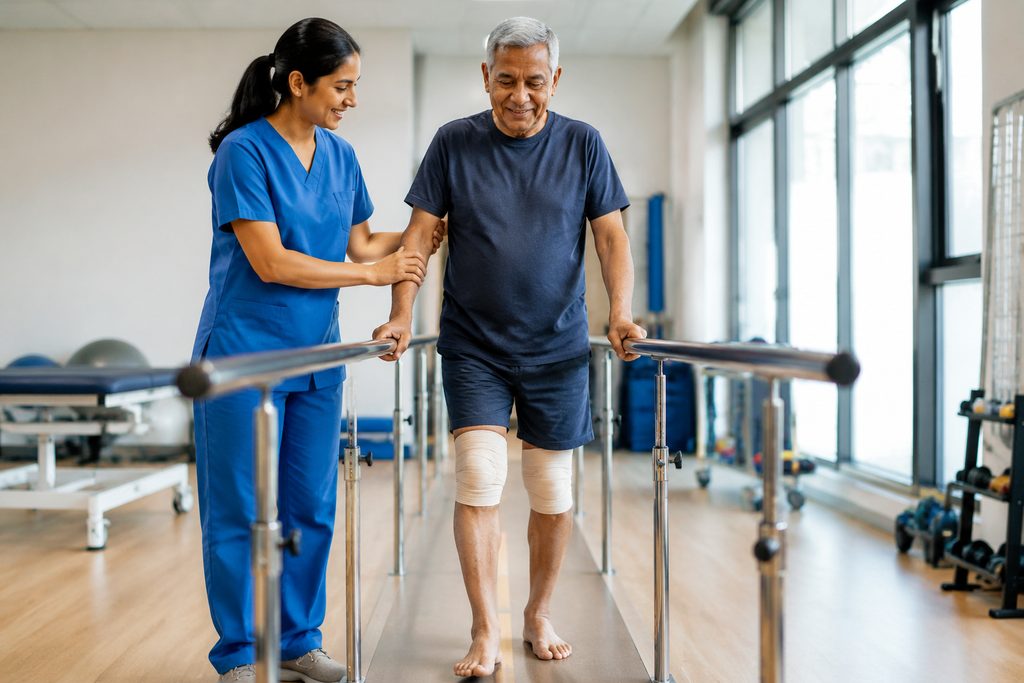
Another failure mode is expectation mismatch on recovery. Patients sometimes assume that because they flew to China for surgery, they will fly home in two weeks fully mobile. That is not how bilateral knee replacement works. You will leave the hospital using a walker, transition to crutches, and need supervised physical therapy for months. If you cannot arrange follow-up physiotherapy at home, the surgical result will suffer regardless of how good the surgeon was.
Is Bilateral Knee Replacement Safe in China? How to Evaluate a Hospital
The honest answer: it depends entirely on which hospital you choose. China’s hospital system is enormous — over 35,000 facilities — and quality varies dramatically. The relevant comparison is not “China versus the West.” It is “a top-ranked Chinese orthopedic center versus a mid-tier hospital anywhere.”
Here is what to look for when evaluating a hospital for double knee replacement in Beijing, Shanghai, or elsewhere:
Surgical volume. Orthopedic outcomes correlate strongly with how many of the same procedure a department performs annually. Top Chinese orthopedic centers perform several thousand knee replacements per year. Ask for the specific number. If the hospital cannot or will not tell you, that is information in itself.
Fudan ranking. The Fudan University hospital rankings are China’s most authoritative. For orthopedics, the specialty reputation list identifies the top 10 departments nationwide. Hospitals like Peking Union Medical College Hospital in Beijing and Shanghai Sixth People’s Hospital appear consistently. You can review our orthopedics department rankings to see which hospitals currently hold top positions.
Implant brand transparency. Ask which implant system will be used. Imported systems from Zimmer Biomet, Stryker, DePuy Synthes, and Smith+Nephew are standard at top Chinese centers. A hospital that cannot name the implant brand before surgery is not one you want operating on both your knees.
International department infrastructure. The best hospital for double knee replacement in Beijing will have a dedicated international ward with English-speaking nursing staff and case managers. This matters more than most patients realize. Post-operative pain management, medication instructions, and discharge planning all require clear communication. In a standard public ward, you will struggle without Chinese language ability.
One more consideration: staged replacement is sometimes the better answer, and a good surgeon will tell you so. If a hospital immediately agrees to bilateral surgery without reviewing your cardiac history, body mass index, and functional status, walk away. The decision to replace both knees at once should be made reluctantly, with evidence, not sold enthusiastically.
Practical Considerations: Records, Visa, Payment, and Follow-Up
Medical records. You need standing X-rays of both knees taken within the last 6 months, ideally weight-bearing views. Include any previous knee surgery records, even arthroscopy from years ago. Your medication list must include anticoagulants, diabetes medications, and anything cardiac-related. Missing records delay everything.
Visa. Medical travel to China uses the S2 visa, endorsed for medical treatment purposes. Your hospital must issue an official invitation letter confirming your appointment and treatment plan. The Chinese embassy or consulate in your country processes S2 applications, typically within 1 to 3 weeks. Family members accompanying you apply for their own S2 visas. Do not apply for an M visa — that is for commercial and trade activities, not medical care. Visa requirements change, so verify current rules with the embassy before applying.
Payment. Chinese public hospitals require pre-payment before surgery. The international department will give you a cost estimate after the in-person consultation, and you deposit funds before admission. Private international hospitals in cities like Shanghai and Beijing may accept direct insurance billing, but most public hospital international departments do not. Budget for out-of-pocket payment and reimbursement from your insurer afterward.
Language. Even in international departments, the surgical team may have limited English. A bilingual medical companion who can translate during pre-op consultations, be present on the day of surgery, and help with discharge instructions is worth the cost. Our companion service starts at $300 per day, and for a procedure this significant, we consider it essential rather than optional.
Follow-up at home. Your Chinese surgeon will want follow-up X-rays at 6 weeks, 3 months, and 12 months. You can send these digitally for review. But the daily work of recovery — physical therapy, wound care, mobility training — happens at home. Arrange a physiotherapist before you leave for China, not after you return. The best surgical result in the world deteriorates without proper rehabilitation.
Frequently Asked Questions
Most patients stay in the hospital for 5 to 10 days after simultaneous bilateral knee replacement. You will walk with a walker within the first 48 hours, transition to crutches or a cane over the following weeks, and typically walk without assistive devices by 3 to 6 months. Full recovery — including return to low-impact activities — takes 9 to 12 months for most patients. The first 6 weeks are the hardest, because both knees are healing simultaneously and you cannot favor one side.
No reputable hospital offers a fixed-price “package” for bilateral knee replacement that you can book sight unseen. What you can do is complete remote evaluation — written second opinion and video consultation — then arrive with a confirmed surgical plan and a scheduled in-person consultation. The surgery itself is booked after the surgeon examines you in person. Anyone offering a guaranteed surgery date and fixed price before reviewing your imaging is not operating through a legitimate hospital channel.
Simultaneous bilateral TKA carries a modestly higher risk of cardiovascular complications, blood clots, and blood transfusion compared to doing one knee at a time. The trade-off is a single anesthesia exposure, one hospital stay, and one recovery period instead of two. For patients under 70 without significant cardiac or pulmonary disease, the risk difference is small and many surgeons consider simultaneous replacement reasonable. For older or higher-risk patients, staging is the safer choice. A competent Chinese orthopedic surgeon will assess this individually.
Most Western insurance plans do not cover elective surgery in China unless you have a specific international or expatriate policy with out-of-network benefits. Some private international hospitals in China have direct billing arrangements with major insurers, but public hospital international departments generally require self-payment with reimbursement afterward. Check with your insurer before committing. If your policy excludes overseas elective surgery, the out-of-pocket cost in China may still be lower than your co-pay and deductible at home.
Your Next Step
Bilateral knee replacement in China is not a shortcut. It is a legitimate medical option at a fraction of Western prices, provided you choose a high-volume orthopedic center, complete proper pre-operative screening, and plan for months of rehabilitation. The double knee replacement cost China hospitals quote — roughly $18,000 to $45,000 depending on hospital tier — reflects real savings, but only you and a qualified surgeon can determine if simultaneous replacement is right for your body.
Our team at China Medical Services helps international patients navigate this process: translating records, coordinating written second opinions and video consultations with top orthopedic departments, arranging S2 visa documentation, and providing bilingual companionship during your hospital stay. We do not perform surgery, we do not promise outcomes, and we do not guarantee that any specific surgeon will agree to replace both knees at once. What we do is make the process transparent and manageable. If you are considering bilateral knee replacement in China, start with a conversation. Send us your imaging and let a Chinese orthopedic team tell you what they would actually recommend.
For more medical information and treatment options in China, visit chinamedservices.com (China Medical Services).
