Early Onset Scoliosis in Shanghai: A Parent’s Guide to Care
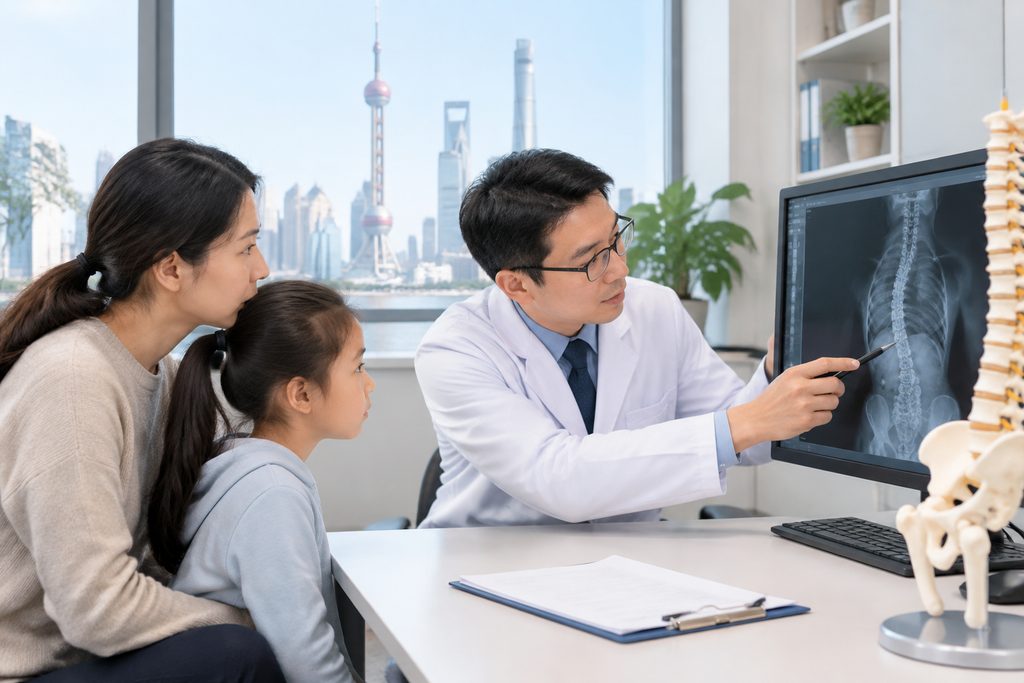
While a child in the UK can wait 18 weeks or longer just to see a pediatric orthopedic specialist, Shanghai’s top children’s hospitals review complex spinal cases within days — and a growing cast for infantile scoliosis typically costs a fraction of the same procedure in the United States. That gap is why families from Europe, the Middle East and Southeast Asia increasingly ask us about early onset scoliosis in Shanghai. The care is real, the surgeons are experienced, and the logistics are manageable. But the system works differently, and parents deserve a clear map before they book flights.
Early Onset Scoliosis in Shanghai: The Short Answer
Yes — Shanghai treats early onset scoliosis, and it does so at scale. The city is home to 18 hospitals on the Fudan ranking of China’s top 100, the second-highest concentration in the country after Beijing. Pediatric orthopedics here handles everything from infantile idiopathic curves to congenital and neuromuscular scoliosis, using serial casting, bracing, growth-friendly rods (including magnetically controlled growing rods) and, when necessary, fusion.
The complication is not capability. It is access. Public hospital outpatient slots cannot be reserved from overseas in the normal channel, and a surgeon will not schedule a procedure before seeing your child in person. That single rule reshapes the entire trip — and it is the reason most international families route through a hospital’s international department or a coordination service rather than trying to book directly.
Who This Is Right For — and Who It Isn’t
Shanghai makes sense for some families and not others. Being honest about that up front saves everyone time and money.
Families who typically benefit:
- Parents whose child has a confirmed or suspected curve and faces a long wait at home for a pediatric orthopedic opinion
- Children needing serial Mehta casting, where early and repeated intervention matters
- Families quoted very high prices for growing-rod surgery in their home country
- Expatriate families already living in China who want a Chinese-speaking specialist rather than a referral abroad
- Parents seeking a second opinion on a surgery already recommended elsewhere
Families who should think twice:
- Children in an acute medical crisis — stabilize first, travel later
- Cases where the treating physician at home says the curve is stable and observation is appropriate
- Parents who cannot commit to follow-up. Growth-friendly treatment means repeat visits over years, and abandoning that midway can be worse than not starting
- Anyone expecting a guaranteed surgery date before an in-person examination. That promise cannot honestly be made
The Options, Compared
Cost is usually the first question, so here is a realistic comparison. Figures are broad ranges in US dollars and vary by hospital, curve severity and whether one or multiple procedures are involved.
| Approach | Typical cost (USD) | Waiting time to specialist | Language support | Follow-up burden |
|---|---|---|---|---|
| Shanghai public hospital, standard channel | Lowest; casting often $3,000–8,000; growing-rod surgery $15,000–30,000 | Same-day queueing possible but no advance booking from abroad | Limited English; interpreter usually needed | Multiple return trips |
| Shanghai hospital international / VIP department | Roughly 1.5–2× the standard channel | Appointment can be coordinated in advance | English-speaking staff | Same clinical team, easier scheduling |
| Private international hospital in Shanghai | Highest in China; often 3–5× standard channel | Fast, appointment-based | Full English service, direct insurance billing | Good continuity, smaller pediatric spine volume |
| United States | Growing-rod surgery frequently $100,000+ | Weeks to months for pediatric orthopedics | Native English | Insurance-dependent |
| United Kingdom (NHS) | No direct charge, but waiting lists apply | Referral pathways can run into months | Native English | Free at point of care |
Which column fits you? If budget is the binding constraint and you can be flexible on dates, the public channel with a bilingual companion is the value play. If your child’s curve is progressing quickly and you need a confirmed appointment window, the international department is worth the premium. Private hospitals suit families with international insurance that settles directly. And if you are already in the UK or US with good coverage and a short wait, staying home is often the sensible answer.
Choosing a Hospital: What Actually Matters for a Child’s Spine
Parents search for “the best hospital,” but for early onset scoliosis the more useful question is which team sees enough young children with this specific problem. Volume matters. So does the availability of casting, since not every orthopedic department offers Mehta casting for infants.
Shanghai’s children’s hospitals and several large general hospitals with strong orthopedic departments handle pediatric spinal deformity. To compare institutions by specialty reputation rather than marketing claims, our department-by-department ranking of China’s top hospitals lists the leading centers in orthopedics and pediatrics. You can also browse our Shanghai hospital directory to see which facilities offer international departments and English-language services.
A few practical filters we suggest to families:
- Does the department routinely perform casting for children under three, or only bracing and surgery?
- Is there a pediatric anesthesiology team, not just a general one?
- Will you get a written treatment plan in English you can share with your doctor at home?
- How many follow-up visits per year will the plan require, and can any be done remotely?
What It Costs and How Long It Takes
Two numbers drive every family’s decision: money and time. Here is what we see in practice.
Costs. A first consultation at a public hospital’s international department typically runs a few hundred dollars including imaging. Bracing ranges widely depending on the device. Serial casting under anesthesia, when done in China, is generally far below Western pricing. Growing-rod insertion is the big-ticket item, and magnetically controlled rods cost more than traditional ones because of the implant itself. None of these figures include flights, accommodation or a companion, which for a two-week trip can add several thousand dollars.
If you want a remote opinion before traveling, our written second opinion service runs from $300–500, and video consultation with a specialty team is $100–300 for a standard hospital international department or $500–800 with a top specialist. Any consultation fee is credited in full toward on-the-ground coordination if you proceed within 90 days.
Timeline. A realistic sequence looks like this:
- Week 1–2: send records, receive a written or video opinion
- Week 2–3: visa documents prepared and submitted; S2 processing time varies by consulate
- Week 3–4: travel and in-person examination
- Then, and only then, does the surgeon confirm whether and when a procedure is scheduled
That last point is not bureaucracy for its own sake. A curve measured on an X-ray taken three months ago may look very different in person, and the treatment decision depends on it.
Practical Considerations: Visas, Records, Payment and Follow-Up
Start with the visa, because it is the most common source of delay. Medical travel to China uses the S2 visa, which covers short stays for medical treatment and private affairs; stays beyond 180 days fall under S1. Accompanying family members apply for S2 as well. Requirements shift, so confirm current details with the nearest Chinese embassy or consulate and bring the hospital’s supporting documents. One clarification worth stating plainly: the M visa is for commercial and trade activity and has nothing to do with medical treatment. If a website tells you otherwise, close the tab.
Records come next. Gather the original imaging — not just reports — plus growth charts, previous treatment notes and any genetic or neurological workup. Chinese specialists read English imaging reports routinely, but a translated summary of the clinical history speeds things up considerably.
On payment: public hospitals generally require prepayment, with insurance reimbursement handled afterward in your home country. Private international hospitals in Shanghai often bill insurers directly. Check your policy for overseas treatment coverage before you assume anything.
Language is the practical hurdle most families underestimate. A top Shanghai hospital may see more than 10,000 outpatients in a single day. Signage, queueing systems and pharmacy counters run in Chinese. A bilingual medical companion — from $300 per day for a half or full day — handles registration, queueing, payment, wayfinding and interpretation so you can focus on your child. Airport transfers run $200 round-trip if you would rather not navigate the city on arrival.
Follow-up deserves its own paragraph. Growth-friendly treatment is a multi-year commitment, and the surgeon who places a rod should generally be the one who lengthens it. Ask early how many return visits per year the plan requires, and whether any can be handled by video. Families who plan for this from the start have a far easier time than those who discover it after surgery.
Frequently Asked Questions
Not through the standard public channel — those slots are taken on the day, in person. Advance appointments are possible through a hospital’s international or VIP department, which is why most international families go that route. A coordination service can help secure that appointment, but the appointment itself is always subject to hospital availability.
Beyond medical fees, plan for flights, accommodation near the hospital, meals and a companion if you want one. For a two-week assessment trip, many families budget $4,000–8,000 in total non-medical costs, though this depends heavily on your origin city and how long you stay. Get a written estimate before committing.
That risk is real and should be discussed with the surgeon before any procedure. Curves sometimes progress despite casting, and rod complications occur everywhere in the world. Ask what revision options exist, what the plan B is, and how the team handles complications for patients who live abroad. A good department will answer these questions directly. If they deflect, take that seriously.
Your Next Step
The core message is simple: Shanghai offers genuine pediatric spine expertise at a fraction of Western prices, but the system rewards preparation over improvisation. Get a remote opinion first, understand the visa and follow-up realities, and only then book travel. We are China Medical Services — a coordination team, not a hospital. We do not diagnose or treat, and we cannot promise a particular surgeon or outcome. What we do is translate records, arrange consultations through official hospital channels, and put a bilingual companion beside you on the day. If you would like to talk through your child’s case with no obligation, start with a free consultation and we will tell you honestly whether Shanghai is the right move.
This article is for general information only and is not medical advice. Treatment decisions for early onset scoliosis should be made with a qualified pediatric orthopedic specialist who has examined your child.
For more medical information and treatment options in China, visit chinamedservices.com (China Medical Services).
