Endocrinology Hospitals in China: A Guide to Costs and Care
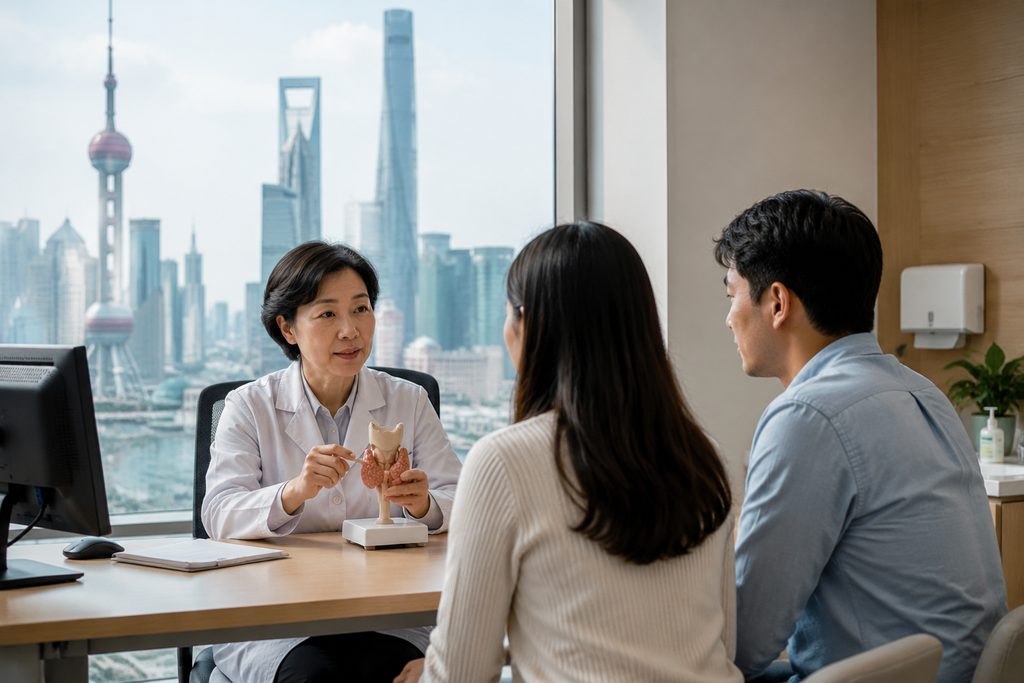
Endocrinology Hospitals in China: A Guide for International Patients
A patient in the United States waits an average of 26 days to see an endocrinologist, and in some metro areas that stretches past two months. At the same time, a single outpatient clinic day at a major Chinese tertiary hospital can process more than 10,000 visits. Those two numbers describe very different systems — and for anyone weighing endocrinology hospital China cost against speed of access, the comparison is worth understanding properly before booking anything.
China has roughly 35,000 hospitals. The top 5%, ranked by the Fudan University Hospital Rankings and JCI accreditation, include 340+ institutions across 37 cities. Endocrinology — diabetes, thyroid disease, pituitary and adrenal disorders, osteoporosis, obesity medicine — is one of the specialties where these hospitals carry real depth.
How This Actually Works, Step by Step
Here is the honest sequence. No marketing gloss.
Step 1 — You send your records. Existing lab work, imaging, medication history, discharge summaries if you have them. These get translated into Chinese by a medical translator, not a general one. Hormone panels and imaging reports have specific terminology that generic translation tools mangle.
Step 2 — A Chinese endocrinology team reviews the file. This produces a written second opinion: their read on your diagnosis, what additional testing they would want, and whether a treatment plan is realistic. Turnaround is typically 3–7 business days.
Step 3 — Video consultation, if you want one. You speak with the specialty team directly, explain your symptoms and goals, and hear their recommendations. This is where most patients decide whether traveling makes sense.
Step 4 — Appointment coordination. If you proceed, someone handles registration, the hospital medical card, and scheduling through the international department. Public hospital general outpatient queues cannot be reserved from overseas — that is simply how the system works. Surgery and inpatient admission require an in-person consultation first, in every case we have seen.
Step 5 — You arrive, and someone walks you through it. Bilingual accompaniment for registration, queuing, payment, lab collection, and interpretation during the consultation itself.
Which Endocrinology Hospitals in China Are Actually Strong
The Fudan specialty reputation rankings list a top 10 for each of 45 specialties. Endocrinology is not a small field in China — the country has the world’s largest diabetic population, estimated at over 140 million adults by the International Diabetes Federation. That volume shapes clinical experience in ways that matter.
Beijing concentrates the largest share of top-ranked hospitals — 21 of the Fudan Top 100 sit there, more than any other city. Shanghai follows with 18, Guangzhou with 10. For anyone searching for the best diabetes treatment hospital Beijing has to offer, the realistic shortlist runs through Peking Union Medical College Hospital, which handles complex endocrine and metabolic cases, and the major teaching hospitals attached to Peking University’s medical system.
Shanghai’s strength is similar in depth. Ruijin Hospital is historically associated with endocrine and metabolic research, and Zhongshan Hospital Fudan University covers the broader internal medicine spectrum. If you are trying to book endocrinologist appointment Shanghai slots from abroad, the practical route runs through the hospital’s international department rather than the standard outpatient system.
Worth knowing: the Fudan comprehensive Top 100 publishes only tiers — A++++ down to A, five levels — not individual national rankings. Anyone claiming a hospital is “number 3 in China” for endocrinology is inventing a number that does not exist. The specialty reputation lists do rank within a specialty, so “ranked among China’s top 10 for endocrinology” is a claim that can be checked.
A Realistic Timeline
Patients consistently underestimate the front end. Here is what the calendar actually looks like.
| Stage | Typical Duration | What Slows It Down |
|---|---|---|
| Record collection and translation | 3–10 days | Missing lab reports; handwritten notes needing clarification |
| Written second opinion | 3–7 business days | Complex cases referred to a second specialist |
| Video consultation scheduling | 1–2 weeks | Time zone gaps; specialist availability |
| S2 visa application | 1–3 weeks | Consulate backlog; incomplete hospital invitation documents |
| Appointment coordination | 1–3 weeks | Department-specific slots; international department capacity |
| Travel and arrival | 1–3 days | Flight availability |
| In-person consultation and testing | 2–5 days | Some hormone tests require fasting or multi-day protocols |
| Results and treatment decision | 3–10 days | Pathology turnaround if a biopsy is involved |
Add it up: a realistic door-to-consultation window is four to eight weeks. Anyone promising you a specialist appointment next week is either selling the VIP international channel at 1.5–2x the standard price, or overpromising. Both happen.
What Can Go Wrong — and What Happens Then
The appointment does not materialize. This is the most common failure, and it is why coordination services that guarantee a refund when a booking cannot be secured exist in the first place. Public hospital general outpatient slots genuinely cannot be reserved from overseas. If someone tells you otherwise, ask them exactly which department confirmed it.
Your case turns out to be more complex than the records suggested. A written opinion based on incomplete labs may shift once the Chinese team runs their own panel. That is not a bait-and-switch — it is medicine. Budget for the possibility that the plan changes after arrival.
Language breaks down at the wrong moment. Chinese tertiary hospitals are enormous. Signage is often Chinese-only. Lab collection points, payment windows, and imaging departments sit in different buildings. A patient navigating this alone, while unwell, is a bad plan. This is the single strongest argument for bilingual accompaniment.
Visa timing slips. S2 is the applicable short-stay category for medical treatment and private affairs, and it requires supporting documents from the hospital. S1 covers stays beyond 180 days. Consulate requirements change, so verify against the latest embassy guidance before you file. And a correction worth stating plainly: the M visa is for commercial and trade activity. It has nothing to do with medical treatment.
Payment surprises. Public hospitals require prepayment; insurance reimbursement happens afterward, in your home country, on your insurer’s terms. Private international hospitals frequently bill insurers directly. Confirm which model applies before you commit.
What Endocrinology Care in China Actually Costs
This is where the numbers get interesting. Same procedure, same standard of care, radically different price.
| Service | Typical China Range (USD) | Typical US Range (USD) |
|---|---|---|
| Endocrinologist consultation (public tertiary) | $30–150 | $300–600 |
| Endocrinologist consultation (private international) | $150–400 | $400–800 |
| Full hormone panel | $100–350 | $500–1,500 |
| Thyroid ultrasound | $50–150 | $300–800 |
| Thyroid surgery (uncomplicated) | $4,000–9,000 | $25,000–50,000 |
| Radioactive iodine therapy | $2,000–5,000 | $10,000–30,000 |
| Pituitary surgery (transsphenoidal) | $10,000–20,000 | $50,000–120,000 |
These figures vary by hospital and case complexity. They are reference ranges, not quotes. A complicated thyroid cancer resection with neck dissection costs more than a straightforward lobectomy. Private international hospitals sit at the upper end or above.
So when someone asks how much does thyroid surgery cost in China, the honest answer is a range, and the range depends on which hospital, which surgeon, and what the pathology shows. What we can say with confidence: for comparable surgical procedures, Chinese tertiary hospital pricing generally runs one-fifth to one-tenth of US pricing. That gap holds across cardiac surgery, oncology, and orthopedics — endocrinology is no exception.
Is Endocrinology Treatment in China Safe?
Fair question. The answer depends on what you mean by safe.
Top-tier Chinese hospitals perform volumes that most Western centers do not approach. Fuwai Hospital in Beijing performs over 14,000 cardiac surgeries a year — the highest volume globally. That kind of throughput builds procedural skill. The same logic applies in high-volume endocrine surgery centers, where thyroidectomies are routine rather than occasional.
Accreditation matters. JCI-accredited hospitals meet international patient safety standards, and a meaningful number of China’s private international hospitals hold that certification. Public tertiary hospitals are regulated by China’s National Health Commission and hold 三甲 (Tier 3A) status — the highest domestic classification — though the term itself is Chinese and the standards are domestic, not international.
Where the system is harder: continuity of care. Chinese public hospitals are not designed around a single coordinating physician the way Western systems often are. You may see a different doctor on follow-up. Discharge instructions may be brief. Getting your records in a format your home endocrinologist can use requires asking specifically.
Practical Considerations: Records, Visa, Payment, Follow-Up
Records. Bring everything, translated. Hormone panels with dates. Imaging on disc, not just the report. A medication list with generic names. If you have had prior thyroid or pituitary surgery, the operative notes matter enormously.
Visa. S2 for short-stay medical treatment; S1 if you expect to stay beyond 180 days. Accompanying family members apply under the same category. Processing runs one to three weeks in most consulates, sometimes longer. Do not book flights before the visa is in hand.
Payment. Public hospitals: prepay, then claim. Private international: often direct billing. Bring a card that works internationally, and confirm whether the hospital accepts it before arrival.
Follow-up. Ask for your discharge summary and lab results in English before you leave. Request copies of imaging. Your home endocrinologist will need to adjust medication based on what happened in China, and they cannot do that from a verbal account.
For patients weighing a medical tourism package China endocrinology arrangement, the realistic structure is staged: remote evaluation first, travel only after a plan exists. That sequencing reduces the risk of arriving to find the treatment you expected is not the treatment the hospital recommends.
Frequently Asked Questions
Not through the standard public outpatient system. General outpatient slots at Chinese public hospitals are allocated on the day, in person. What can be arranged in advance is a consultation through the hospital’s international or VIP department, which handles scheduling, English-language service, and typically costs 1.5–2x the standard fee. Coordination services can handle registration and the hospital medical card on your behalf.
Consultations run $30–150 at public tertiary hospitals versus $300–600 in the US. Thyroid surgery typically falls between $4,000 and $9,000 in China against $25,000–50,000 in the US. These are ranges — final pricing depends on the hospital, the complexity of your case, and whether complications arise. Always confirm a written estimate before committing.
At JCI-accredited and top-tier Fudan-ranked hospitals, clinical standards are high and surgical volumes are substantial. The genuine friction points are language, care continuity, and records transfer — not clinical capability. Bringing a bilingual companion and requesting English-language discharge documentation addresses most of it.
S2 is the applicable short-stay category for medical treatment and private affairs, and it requires supporting documents from the treating hospital. S1 applies for stays beyond 180 days. Accompanying family members use the same category. The M visa is for commercial and trade activity and is not used for medical treatment. Requirements shift, so check the latest embassy or consulate guidance before applying.
Reputable coordination services build refund terms into the arrangement — if a booking cannot be secured, the coordination fee is returned. What no service can promise is a specific named specialist or a specific surgical date. Public hospital scheduling is controlled by the hospital, not by any intermediary.
Your Next Step
The core message is simple: China’s top endocrinology hospitals offer genuine clinical depth at a fraction of Western pricing, but the system is not built for walk-in international patients. The gap between what is available and what you can actually access is bridged by preparation — records, visa timing, and someone who knows the hospital’s internal geography.
At China Medical Services, we connect international patients with 340+ top-ranked hospitals across 37 cities. We are not doctors and we do not provide medical advice. We handle records translation, appointment coordination through official international departments, bilingual accompaniment, and visa guidance — case management, not access-selling.
If you are considering endocrinology care in China, the sensible first move is a records review. Send what you have, get a written opinion back, and decide from there. You can start with a free consultation, or browse hospitals by specialty to see which centers handle your condition. No pressure either way — the information is yours to use.
For more medical information and treatment options in China, visit chinamedservices.com (China Medical Services).
