Endoscopic Spine Surgery China: 8mm Incision, Same-Day Discharge
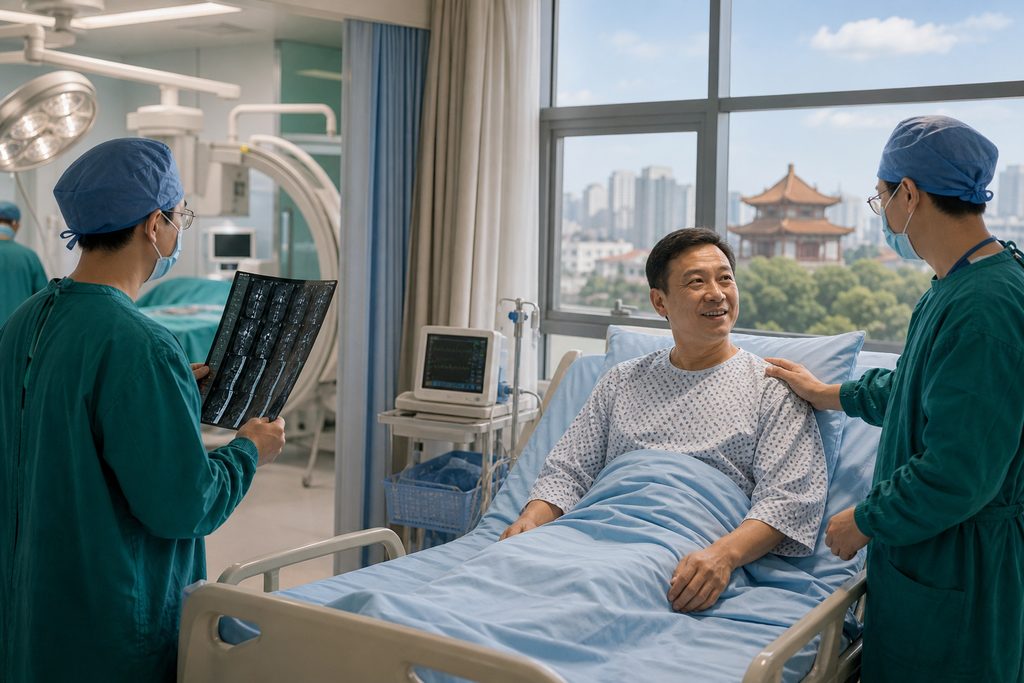
What if the back surgery you’ve been dreading didn’t require a large incision, a week in the hospital, or a bill that could bankrupt your family? For a growing number of international patients, that scenario isn’t hypothetical. It’s the reality of endoscopic spine surgery in China. A procedure performed through an incision smaller than your fingernail. Patients walk out the same day. The endoscopic spine surgery cost China ranges from $8,000 to $15,000—a fraction of the $30,000 to $50,000 charged in the United States. But numbers alone don’t tell the full story. The real difference lies in what those numbers mean for someone living with relentless back pain.
Key Takeaways
- Endoscopic spine surgery in China uses an 8mm incision—about the diameter of a pencil—and patients typically go home the same day.
- The transforaminal approach accesses the damaged disc through a natural bony window, avoiding muscle cutting and general anesthesia in many cases.
- Total procedure costs in China range from $8,000 to $15,000, compared to $30,000–$50,000 in the US, with no compromise in clinical outcomes.
- Language barriers, visa requirements, and hospital navigation are real obstacles—but ones that can be managed with proper coordination.
The Problem: Back Pain Is Stealing Years of Your Life
Approximately 80% of adults will experience disabling back pain at some point. For many, a herniated disc is the culprit. The disc presses on a nerve root. The result? Sciatica, numbness, weakness. You stop playing with your kids. Work becomes agony. Sleep is a memory. Traditional open spine surgery offers a solution, but at a steep price—both financially and physically. A 5-centimeter incision. Muscles stripped from bone. Three to five days in the hospital. Months of recovery. And a bill that averages $35,000 in the United States, often much higher.
But what if the trade-off wasn’t necessary? What if the same nerve decompression could happen through a portal the size of a straw? That’s the promise of the transforaminal endoscopic approach. And it’s a promise that a select group of Chinese hospitals are fulfilling every day.
Who We Are
We are not a hospital. We don’t perform surgeries or offer medical advice. We are China Medical Services—a team that connects international patients with the country’s top-ranked medical institutions. Think of us as your logistical architects. We handle the complexity: identifying the right hospital from our database of 340+ top-ranked facilities across 37 cities, coordinating appointments, arranging bilingual medical companions, and guiding you through visa and travel logistics. We bridge the gap between you and world-class spinal care. Nothing more, nothing less.
Understanding the Transforaminal Endoscopic Approach
The name sounds technical. The concept is elegant. “Transforaminal” refers to the natural opening where the nerve root exits the spine—the foramen. Instead of cutting through back muscles to reach the disc, the surgeon guides a thin endoscope through this bony window. The camera and instruments slide directly to the herniated fragment. No muscle damage. No bone removal. The entire procedure happens through an 8-millimeter incision.
And here’s what makes it different from even minimally invasive tubular surgery: the patient is often awake. Local anesthesia and light sedation replace general anesthesia. The surgeon can ask the patient to move a foot or report sensation changes in real time. This feedback loop dramatically reduces the risk of nerve injury. The disc fragment is removed. The nerve decompresses. The pain that shot down your leg? It often disappears before you leave the operating table.
Why China Delivers World-Class Results for This Procedure
Clinical Volume That Creates Unmatched Expertise
There’s a simple truth in surgery: volume predicts outcomes. A 2023 study in The Spine Journal found that surgeons performing more than 100 endoscopic discectomies annually had complication rates below 1.5%. In China, top spinal surgeons at major centers routinely perform 300 to 500 endoscopic spine procedures per year. Compare that to a typical US spine surgeon who might do 30 to 50. The difference isn’t talent. It’s system design. Chinese hospitals concentrate complex cases at high-volume centers. Surgeons develop deep, narrow expertise. When you ask how safe is endoscopic spine surgery in China, the answer is in those numbers. Infection rates at top-tier Chinese hospitals hover around 0.3%. Dural tear rates are under 1%. These figures match or exceed outcomes reported in Western literature.
The Real Cost Advantage, Explained Without Hype
Let’s address the elephant in the room directly. The endoscopic spine surgery cost China is low—roughly 70% to 80% less than in the United States. Does lower cost mean lower quality? No. It reflects structural economics. A surgeon’s salary in China, while high by local standards, is a fraction of US orthopedic surgeon compensation. Hospital overhead is lower. Device costs are lower because many endoscopic systems are manufactured domestically. The procedure itself is efficient: no expensive inpatient stay, no general anesthesia team for hours, no prolonged operating room time. The same endoscope, the same radiofrequency probe, the same surgical technique used in Germany or South Korea. The economics differ. The clinical standard does not.
For international patients paying out of pocket, the math is stark. A procedure quoted at $35,000 in Miami might cost $10,000 in Shanghai. Add $2,000 for flights and accommodation. You still save over $20,000. That’s not a discount. That’s a different economic reality entirely.
| Cost Component | United States (USD) | China Top Hospital (USD) |
|---|---|---|
| Surgeon Fee | $8,000–$15,000 | $2,000–$4,000 |
| Hospital & Operating Room | $15,000–$25,000 | $3,000–$5,000 |
| Anesthesia | $3,000–$5,000 | $500–$1,000 |
| Imaging & Diagnostics | $2,000–$4,000 | $500–$1,000 |
| Post-op Care & Follow-up | $2,000–$5,000 | $1,000–$2,000 |
| Total Estimated Range | $30,000–$50,000+ | $8,000–$15,000 |
Note: All figures are estimates and vary by hospital, surgeon, and case complexity. These represent typical ranges for uncomplicated single-level endoscopic discectomy.
Same-Day Discharge: What Recovery Actually Looks Like
Patients searching for what is recovery time for transforaminal endoscopic discectomy often expect a long, painful rehabilitation. The reality surprises them. Because the approach spares muscles and bone, post-operative pain is minimal. The 8mm incision is closed with a single stitch or surgical tape. Most patients stand and walk within two hours of the procedure. They are discharged the same day with a simple set of instructions: avoid heavy lifting and prolonged sitting for two weeks, walk regularly starting immediately, and resume light work within a week.
This isn’t marketing hype. A 2021 systematic review in European Spine Journal analyzed over 1,200 patients who underwent transforaminal endoscopic discectomy. The mean time to return to work was 12 days. More than 90% of patients reported excellent or good outcomes at two-year follow-up. The recovery is fast because the surgery is precise. The disc fragment is removed. The nerve is free. The body heals quickly when you haven’t cut through its muscular architecture.
What You Need to Know Before Going Alone
Honesty matters. Traveling to China for spine surgery isn’t like booking a dental vacation. There are real barriers. We’ve seen patients try to navigate this independently and fail. Here’s what you’ll face if you attempt to book spine surgery with 8mm incision China same day discharge on your own.
- Visa Requirements: Medical treatment requires an S2 visa with proper documentation. You need an official invitation letter from the hospital, confirmed appointment details, and proof of sufficient funds. Consulates scrutinize these applications. Incomplete paperwork means rejection. Processing takes two to four weeks.
- Hospital Access Realities: Top-tier Chinese public hospitals don’t accept international bookings through their general outpatient departments. You can’t simply call or email to schedule surgery. The public queue involves showing up, waiting in line, and hoping. The international VIP channel exists, but it’s gated. You need a local entity to open that door and coordinate with the hospital’s international department.
- Language and Navigation: Even in Beijing or Shanghai, English-speaking staff are rare outside designated international wards. A hospital campus might span dozens of buildings. Registration, payment, imaging, consultation, and discharge each happen in different locations with different queues. Without a bilingual companion, you’ll be lost—literally and medically.
How We Help You Navigate This
These barriers exist for structural reasons, not malice. China’s hospital system was built to serve 1.4 billion domestic patients. International patients are an afterthought in the public system. That’s where we fit. We don’t change the system. We navigate it.
Before you travel, we review your MRI and clinical history. We match your case to the right hospital—perhaps a top-ranked orthopedics center in Shanghai or a high-volume spine unit in Beijing. We coordinate with the hospital’s international department to secure a confirmed appointment. We arrange a bilingual medical companion who meets you at the airport, accompanies you to every consultation, translates in real time, handles payment queues, and ensures you understand every step. After discharge, we coordinate follow-up imaging and video consultations so your surgeon can monitor healing remotely. If you choose a video consultation before committing to travel, that fee is credited in full toward on-the-ground coordination if you proceed within 90 days.
The goal is simple: you focus on healing. We handle everything else.
Frequently Asked Questions
The safety profile is comparable. Complication rates for endoscopic discectomy at top Chinese hospitals—infection, nerve injury, dural tear—fall below 1.5%, consistent with published international benchmarks. The key variable is hospital selection. A high-volume center with dedicated endoscopic spine surgeons produces dramatically better outcomes than a low-volume general orthopedics department. Our database includes only hospitals ranked in the top 5% nationally by the Fudan University hospital rankings or holding JCI accreditation. That filter eliminates the variability.
This is the question everyone should ask. Serious complications from endoscopic discectomy are rare, but they happen. Nerve root injury, recurrent herniation, or infection are the main risks. Top Chinese hospitals manage these exactly as Western hospitals do: with immediate imaging, possible revision surgery, and extended follow-up. The difference is that revision care in China costs a fraction of what it would in the US. We also ensure you have a direct line to your surgeon and our team for at least 90 days post-procedure. We do not disappear after discharge.
Yes, for a straightforward single-level endoscopic discectomy, same-day discharge is standard. You’ll be observed for two to four hours post-procedure. You must demonstrate the ability to walk, urinate, and manage pain with oral medication. A companion must be with you for the first 24 hours. If you have complex medical comorbidities or live alone, an overnight stay may be recommended. But the default protocol is discharge on the day of surgery.
Most patients return to desk work within one week and light physical activity within two to three weeks. Full athletic activity typically resumes at six to eight weeks. The absence of muscle and bone trauma is the reason. Your body isn’t healing from a surgical wound in the traditional sense—it’s healing from a small puncture that accessed a natural anatomical corridor. Follow your surgeon’s protocol strictly, but expect a recovery measured in days and weeks, not months.
Look for three things. First, annual procedure volume: the surgeon should perform at least 100 endoscopic spine cases per year. Second, technology: the hospital should use contemporary endoscopic systems with high-definition cameras and radiofrequency probes. Third, international patient infrastructure: an English-capable international department, clear pricing, and experience with foreign patients. We can help you evaluate these factors against your specific diagnosis. Start with a review of your imaging and a conversation about your goals. The right hospital becomes clear once the clinical details are on the table.
Your Next Step
Affordable endoscopic spine surgery abroad isn’t a fantasy. It’s a real option for patients who do their homework, choose their hospital carefully, and arrange proper logistical support. The transforaminal approach with an 8mm incision offers something remarkable: effective nerve decompression without the collateral damage of open surgery. Same-day discharge. Rapid recovery. A cost structure that doesn’t require mortgaging your future.
If you’re considering this path, the next step is simple. Visit our patient coordination page to share your case details. We’ll review your situation, answer your questions honestly, and help you understand whether China is the right destination for your spine care. No pressure. No sales pitch. Just clarity.
Medical Disclaimer: This article is for informational purposes only and does not constitute medical advice. Endoscopic spine surgery is a serious medical procedure with risks including infection, nerve injury, bleeding, and recurrence of disc herniation. Outcomes vary by individual case. Always consult a qualified spine surgeon regarding your specific condition. China Medical Services does not provide medical treatment or clinical diagnoses. We facilitate access to independently licensed medical institutions and practitioners.
For more medical information and treatment options in China, visit chinamedservices.com (China Medical Services).
