Endoscopic Thyroid Surgery China: The Complete Guide to Scarless Neck Surgery
Key Takeaways
- Endoscopic thyroid surgery in China can be performed through the mouth or armpit, leaving absolutely no visible scar on the neck — a technique now refined across over 340 top-ranked Chinese hospitals.
- The endoscopic thyroid surgery cost in China typically ranges from $4,000 to $8,000 USD, roughly one-fifth to one-third of what patients pay in the United States for comparable scarless techniques.
- Not every thyroid nodule qualifies for these approaches. Tumor size, location, and pathology dictate candidacy — and a face-to-face surgical consultation in China is mandatory before any operation can be scheduled.
- Navigating a Chinese public hospital alone is extremely difficult without Mandarin fluency. A bilingual medical companion transforms what could be a chaotic experience into a coordinated, dignified journey.
What Exactly Is Endoscopic Thyroid Surgery Through the Mouth or Armpit?
Let’s strip away the medical jargon. A traditional thyroidectomy leaves a horizontal incision across the front of the neck — usually 4 to 8 centimeters long. It heals, but the scar is permanent. For many patients, that scar becomes a daily reminder of surgery. Endoscopic thyroid surgery solves this by relocating the incision to a hidden site: either inside the lower lip (the oral vestibular approach) or within a natural crease of the armpit (the transaxillary approach). The surgeon uses a high-definition endoscopic camera and specialized long instruments to reach the thyroid gland through a tunnel created under the skin. The gland comes out. The neck stays untouched. No scar. That is the core promise — and when done by an experienced surgical team, it delivers.
How is thyroid surgery done through the mouth, exactly? Three small incisions are made inside the lower lip, each about 5 to 11 millimeters. A camera port and two working ports are inserted. Carbon dioxide gas creates a working space beneath the platysma muscle. The surgeon dissects down to the thyroid, identifies and preserves the parathyroid glands and recurrent laryngeal nerves, and removes the diseased lobe or the entire gland. The specimen is extracted through one of the oral incisions. The mucosal cuts inside the mouth heal rapidly and invisibly. The axillary approach works on a similar principle — the incision hides in the armpit fold, and the endoscope travels across the chest to reach the neck. Both techniques belong to a family of operations called remote-access thyroidectomy. China has become one of the global leaders in refining and scaling these procedures.
The Problem: A Neck Scar Is Not a Minor Concern
Approximately 12% of the population will develop a thyroid nodule requiring evaluation at some point in their lives. A significant subset will need surgery. In the United States, over 150,000 thyroidectomies are performed annually. The standard open approach works. It is safe. But for a 28-year-old woman facing a visible scar across her throat for the rest of her life, or a professional whose career involves public-facing work, “safe” is not the full equation. The psychological burden of a conspicuous neck scar is well-documented. A 2018 study in the World Journal of Surgery found that patients who underwent scarless thyroidectomy reported significantly higher satisfaction with cosmetic outcomes compared to open surgery patients — without any difference in complication rates when procedures were performed at high-volume centers.
The problem compounds when patients search for scarless options in Western countries. Transoral endoscopic thyroidectomy is available in select academic medical centers in the US and Europe. But access is limited. Wait times stretch for months. Insurance coverage is inconsistent. And the out-of-pocket cost for a self-paying international patient can exceed $25,000 to $40,000. That price tag pushes scarless surgery out of reach for many. It is not that the technique does not exist in the West. It exists. It is just not widely accessible or affordable. This is precisely why a growing number of international patients are looking toward China.
Who We Are
We are not a hospital. We do not provide medical treatment, surgical procedures, or clinical diagnoses. China Medical Services functions as your logistical architects — we bridge the gap between you and China’s top-tier medical institutions. Our team has built a curated database of over 340 top-ranked hospitals across 37 cities, representing the top 5% of China’s more than 35,000 medical facilities as ranked by the Fudan University hospital rankings and JCI accreditation standards. We handle hospital matching, appointment coordination, bilingual medical companionship, visa guidance, and every practical detail that stands between you and a successful surgical journey. We do not sell surgery. We make it possible for you to access it safely and efficiently.
Why China Has Become a Global Destination for Scarless Thyroid Surgery
Surgical Volume Creates Technical Mastery
Scale matters in surgery. A surgeon who performs 200 thyroidectomies per year operates in a different league from one who performs 30. China’s top thyroid surgery centers handle volumes that are difficult to find anywhere else. At major hospitals in Shanghai and Beijing, a single dedicated thyroid surgeon may complete over 300 endoscopic thyroid procedures annually. That repetition breeds technical refinement. The learning curve for transoral endoscopic thyroidectomy is steep — published research estimates that a surgeon needs approximately 50 cases to achieve proficiency. Chinese surgical teams at high-volume centers have long since passed that threshold and operate in the realm of deep expertise. When you ask “is scarless thyroid surgery safe in China,” the answer depends entirely on where you go. At a top-10 otolaryngology or general surgery department, the safety profile mirrors the best international benchmarks. Complication rates for recurrent laryngeal nerve injury and hypoparathyroidism at these centers fall below 2%, consistent with published outcomes from leading institutions worldwide.
Technology Adoption Without Legacy Constraints
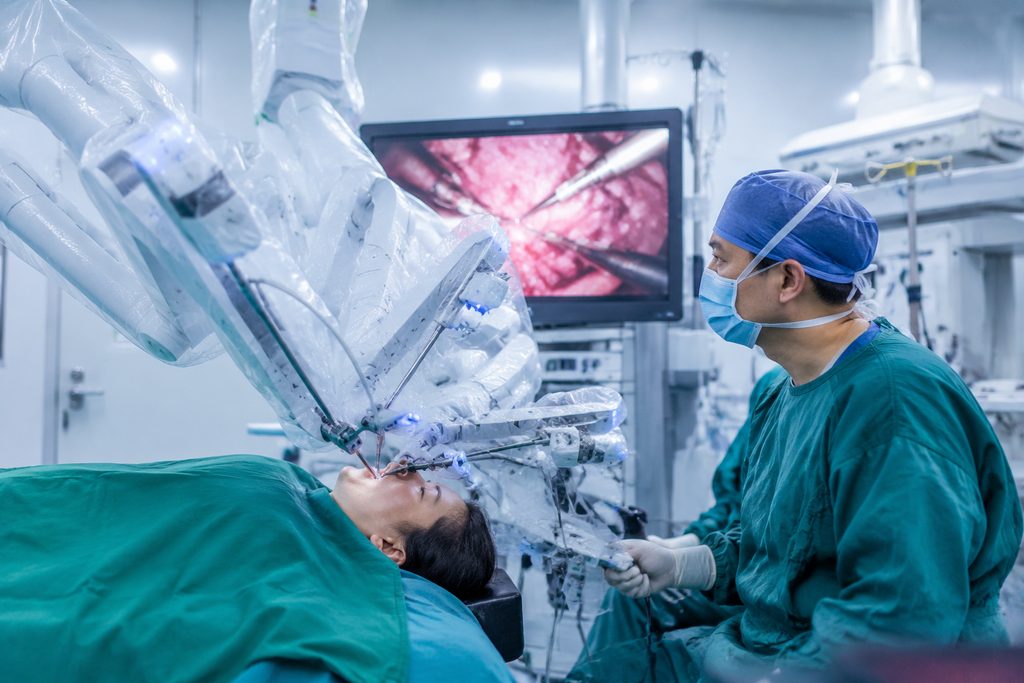
Chinese hospitals adopted endoscopic thyroid techniques rapidly and without the slow, cautious diffusion pattern seen in some Western health systems. The transoral endoscopic thyroidectomy vestibular approach (TOETVA) was first described in 2011. By 2016, Chinese surgical teams were already publishing large case series. Today, multiple centers have each accumulated over 1,000 TOETVA cases. The da Vinci robotic surgical system is also widely deployed for thyroid surgery in China, with robotic transaxillary thyroidectomy offered at several major hospitals. This technological density means patients have genuine choice — they can select the approach and the platform that best suits their anatomy and disease characteristics, rather than being limited to whatever single option happens to be available locally.
The Cost Equation Is Structural, Not a Compromise
Let’s address the obvious question directly. The endoscopic thyroid surgery cost in China is lower than in the United States — sometimes dramatically so. A scarless thyroid removal price abroad, specifically in China, typically falls between $4,000 and $8,000 USD for the hospital and surgical fees when using the public hospital international department pathway. That compares to $25,000 to $40,000 for a self-paying patient receiving the same procedure in the US. The gap exists for structural reasons: lower labor costs for surgical and nursing staff, higher patient throughput per operating room per day, and a hospital financing model that does not carry the same administrative overhead burden as American institutions. This is not discount surgery. It is surgery priced in a different economic environment. Clinical outcomes at China’s top-ranked hospitals are comparable to international standards — the cost difference reflects economics, not quality dilution.
Patients considering how to book endoscopic thyroidectomy China packages should understand that pricing varies by hospital tier, surgeon seniority, and whether the procedure uses conventional endoscopic instruments or the da Vinci robotic system. Robotic cases add approximately $3,000 to $5,000 to the total. Hospital international departments typically quote all-inclusive surgical packages that cover the operation, anesthesia, consumables, and a standard ward stay. Private rooms, VIP wards, and extended stays incur additional charges. Our team provides transparent, itemized cost estimates before any commitment is made — always with the caveat that final pricing is confirmed by the hospital after the in-person surgical consultation.
What You Need to Know Before Going Alone
We tell every prospective patient the same thing: the surgery itself is the easiest part. The logistics surrounding it are where most independent attempts fail. Here are the barriers you will face if you try to arrange this on your own.
- Visa Requirements Are Specific and Unforgiving: Medical treatment in China requires an S2 visa with a notation specifying the purpose of medical treatment. This is not a tourist visa. It is not an M business visa. The consulate will require a formal invitation letter from the Chinese hospital confirming your treatment arrangement. Without that letter — which public hospitals do not issue casually to unvetted international patients — the visa application stalls. Family members accompanying you also need S2 visas. Getting this wrong means denied entry. There is no workaround.
- Public Hospital Registration Is a System Built for Locals: China’s top public hospitals see over 10,000 outpatient visits per day. Registration is conducted in Mandarin through digital kiosks and apps that require a Chinese ID number or a local phone number. Specialist consultations book out within minutes of release. Walk-in registration for a surgical consultation with a senior thyroid surgeon is functionally impossible. The hospital international department or VIP channel is the only viable path for a foreign patient — and even then, coordination requires Mandarin fluency and familiarity with hospital protocols.
- Payment Is Prepaid and Insurance Reimbursement Is Retrospective: Chinese public hospitals operate on a prepayment model. You deposit funds at admission. The hospital deducts charges daily. If the deposit runs low, services pause until you top up. International insurance plans rarely offer direct billing with Chinese public hospitals. You pay out of pocket first, then file for reimbursement after returning home. Managing this cash flow and documentation trail without local assistance is exhausting and error-prone.
How We Help You Navigate This
These barriers are real. They exist for structural reasons, not because anyone is trying to make things difficult. Our role is to route around every single one of them.
Before you travel, we handle the hospital matching process. You share your diagnostic imaging, biopsy reports, and medical history. We translate these documents into clinical Chinese and submit them to the international departments of hospitals best suited to your case — including institutions ranked among China’s top 10 for otolaryngology and general surgery. We coordinate the invitation letter required for your S2 visa application. We confirm consultation dates and surgical scheduling windows. We provide clear, itemized cost estimates so you know what to expect before you board a plane.
During your stay, a bilingual medical companion — a Mandarin-English speaker trained in hospital navigation — accompanies you to every appointment. They register you, queue on your behalf, translate conversations with surgeons and nurses in real time, and handle payment deposits at hospital counters. They explain what is happening at every step. You focus on your health. They handle the friction. After discharge, we coordinate follow-up consultations, assist with obtaining medical records in English for your home physician, and remain available until you are safely back in your own country.
For patients who want a fully managed experience, our VIP end-to-end coordination service covers airport transfers, accommodation arrangements, and a dedicated case manager who oversees the entire journey. The choice is yours. Some patients need full support. Others only need hospital appointment coordination and a companion for the day of surgery. We adapt to what you actually need — no upselling, no unnecessary add-ons.
What Conditions Qualify for Scarless Endoscopic Thyroid Surgery?
Not every thyroid nodule is suitable for a remote-access approach. Surgeons evaluate candidacy based on several strict criteria. The thyroid gland diameter typically must be under 10 centimeters. Nodules should generally be smaller than 4 to 6 centimeters, depending on the specific technique and surgeon preference. Benign disease — multinodular goiter, Graves’ disease, follicular adenoma — is the most common indication. For thyroid cancer, the selection criteria tighten: papillary thyroid microcarcinoma under 1 to 2 centimeters with no evidence of extrathyroidal extension or lymph node metastasis may qualify at experienced centers. Larger cancers, aggressive histology, or evidence of lymph node involvement usually require an open approach for oncologic safety. A previous neck surgery or radiation to the neck often disqualifies a patient from the transoral approach due to scarred tissue planes. These determinations can only be made during an in-person surgical consultation with imaging review. No reputable surgeon will commit to a scarless approach based on overseas reports alone.
Finding the Best Hospital for Transoral Thyroidectomy in Shanghai and Beyond
Shanghai has emerged as a particular hub for endoscopic thyroid surgery in China. Several of the city’s top-tier hospitals have dedicated thyroid surgery units that perform high volumes of transoral and transaxillary cases. When patients ask us about the best hospital for transoral thyroidectomy Shanghai, we guide them toward institutions with documented case volumes and published outcomes — not marketing claims. The Fudan University hospital rankings include a specialty ranking for otolaryngology (ENT) and general surgery. Hospitals that rank among China’s top 10 in these specialties are natural starting points for a surgical consultation. Our department rankings database provides detailed information on which hospitals lead in thyroid-adjacent specialties.
Shanghai is not the only option. Beijing, Guangzhou, and Chengdu also host excellent thyroid surgery programs with experienced endoscopic surgeons. The right hospital for you depends on your specific diagnosis, your preferred surgical approach, your budget, and your travel logistics. A patient from Southeast Asia may find Guangzhou more convenient. A patient from the Middle East might prefer the international infrastructure in Shanghai. We factor all of this into our hospital matching process. Our Shanghai city page offers a deeper look at the medical infrastructure available there, including hospital profiles and practical information about staying in the city during treatment.
Frequently Asked Questions
You cannot know with certainty until a surgeon evaluates you in person. What we can do is arrange a remote video consultation with a specialist at a top Chinese hospital before you commit to travel. During that consultation — typically costing between $100 and $300 — the surgeon reviews your imaging and biopsy results and gives a preliminary assessment of whether a scarless approach is feasible. This is not a surgical guarantee. It is an informed opinion that helps you decide whether to proceed with travel. If you later come to China for surgery, that consultation fee is credited in full toward our coordination service.
Conversion from endoscopic to open thyroidectomy occurs in approximately 1% to 3% of cases at experienced centers, usually due to unexpected bleeding, difficult anatomy, or findings that suggest a more extensive cancer than anticipated. If conversion happens, the surgeon makes a standard neck incision. You will have a scar. This is a known risk disclosed during informed consent. The surgical team will have prepared for this possibility, and the conversion itself does not represent a failure — it represents a judgment call made in your best oncologic and safety interest. We recommend every patient mentally prepare for this possibility, even though it is statistically unlikely at a high-volume center.
Most patients stay in the hospital for 2 to 4 days after endoscopic thyroid surgery. The oral incisions heal quickly. Swelling in the neck and chin area peaks around day three and subsides over the following week. Surgeons typically advise waiting 7 to 10 days after discharge before taking a long-haul flight, primarily to ensure there are no delayed complications such as a seroma or hematoma. A follow-up appointment with the surgeon usually occurs around day 7 post-operation. You should plan for a total stay in China of approximately 14 to 18 days from arrival to departure. We help coordinate accommodation for the post-discharge waiting period and arrange your follow-up visit.
The hospital’s surgical package typically covers the operation, anesthesia, operating room consumables, and a standard multi-bed ward stay. Items often billed separately include preoperative imaging if repeat scans are required, pathology examination of the removed specimen, medications prescribed at discharge, and any single-room or VIP ward upgrade. These ancillary costs usually add $500 to $1,500 to the total. Our team provides a line-by-line estimate before you travel. We also advise budgeting for your companion’s daily fee, your accommodation, meals, and local transportation. Transparency about costs is a core part of our service. There should be no financial surprises.
Your Next Step
Endoscopic thyroid surgery through the oral or axillary approach is a remarkable option — when it is the right option for your specific case, performed by a surgical team with deep experience, at a hospital equipped to handle every contingency. China offers all three of those conditions at its top-tier medical centers, at a cost that makes the procedure accessible to patients who would otherwise be priced out of scarless surgery entirely. The challenge is not the surgery. The challenge is everything around it.
If you are considering this path, start with information — not commitment. Reach out for a free consultation. We will discuss your diagnosis, explain which hospitals and surgeons might be most appropriate for your case, and give you a clear, honest picture of what the process would look like from start to finish. No pressure. No sales pitch. Just the facts you need to make an informed decision about your own health.
For more medical information and treatment options in China, visit chinamedservices.com (China Medical Services).
