Endoscopy in China: Bleeding Risk Checks, Costs, and Safety
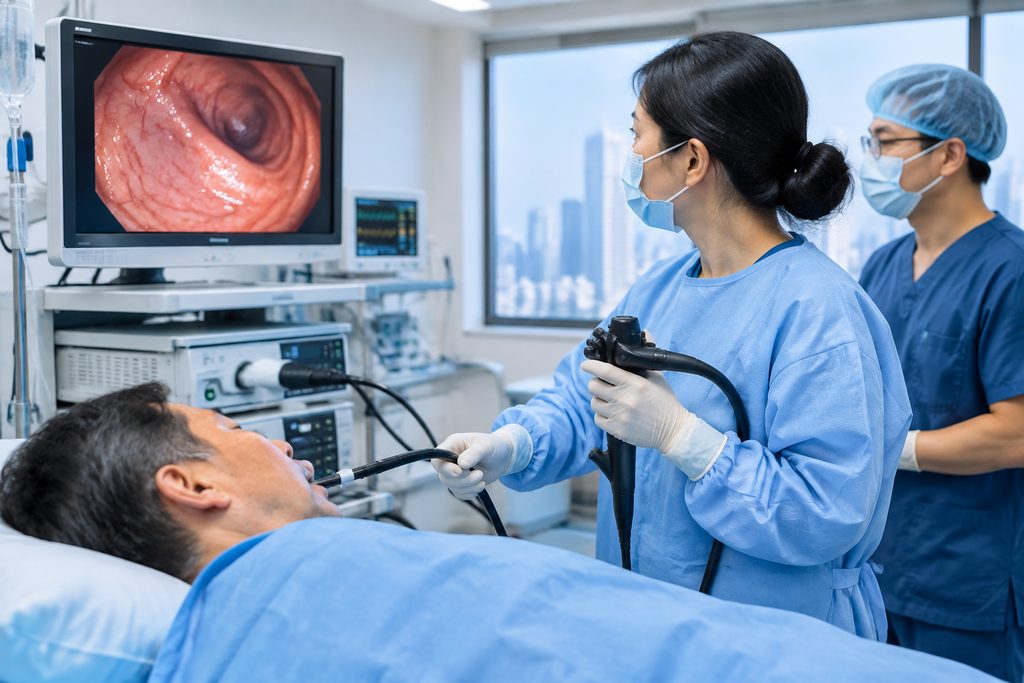
Key Takeaways
- Diagnostic endoscopy in China typically runs $200–$600 at top public hospitals — roughly one-tenth of US pricing — while therapeutic procedures cost more depending on complexity.
- Every accredited Chinese hospital performs a structured pre-procedure bleeding risk assessment: platelet count, coagulation panel (PT/INR, aPTT), medication review, and liver function testing.
- The real friction isn’t quality — it’s access. Most public hospital endoscopy slots cannot be reserved from overseas in advance, and same-week scheduling usually requires going through an international department.
- Understanding how bleeding risk is checked before you commit to travel is the single most useful piece of preparation a foreign patient can do.
The Problem: You Need Answers Before You Board a Plane
You’ve probably heard that medical care in China means cutting corners. The reality runs the other way — but the information gap is real, and it’s genuinely frustrating.
A patient in Texas or Manchester searching for endoscopy pricing finds almost nothing in English. Meanwhile, a diagnostic upper GI endoscopy in the United States averages $1,500–$2,700 at hospital outpatient facilities, according to publicly available cost data. In the UK, NHS waiting lists for routine endoscopy have stretched past 8–12 weeks in many regions. That’s the pain: you need the procedure, you need it checked properly, and the system in front of you is either slow or expensive. Or both.
So you start looking at China. And the first question that surfaces isn’t price. It’s safety. Specifically: how do Chinese hospitals check whether you’re at risk of bleeding during or after the procedure?
Why Chinese Hospitals Take Bleeding Risk Seriously
China performs more endoscopic procedures annually than any other country — a function of population scale and the density of high-volume gastroenterology departments. That volume shapes protocol. When a department runs dozens of endoscopies a day, standardized pre-procedure screening isn’t optional. It’s how the schedule survives.
What the pre-procedure bleeding check actually includes
Before any endoscopy — diagnostic or therapeutic — Chinese hospitals at the tertiary level (三级甲等, or “3A” grade) run a standard panel. This typically covers:
- Complete blood count with platelet count
- Coagulation profile: prothrombin time (PT), INR, activated partial thromboplastin time (aPTT)
- Liver function tests, since hepatic impairment affects clotting factor production
- Medication history — anticoagulants, antiplatelets, NSAIDs, herbal supplements
- For higher-risk cases: bleeding time, fibrinogen levels, and sometimes thromboelastography
This mirrors the pre-procedural assessment framework published by the American Society for Gastrointestinal Endoscopy (ASGE) and the European Society of Gastrointestinal Endoscopy (ESGE). Chinese tertiary hospitals follow comparable logic — the guidelines differ in language, not in principle.
How anticoagulant management is handled
If you take warfarin, a direct oral anticoagulant (DOAC), clopidogrel, or aspirin, the gastroenterology team will coordinate with your prescribing physician or cardiologist. Standard practice: warfarin is typically held 5 days before the procedure with bridging therapy considered for high thrombotic risk patients. DOACs are usually stopped 24–48 hours prior, adjusted for renal function. Aspirin for secondary prevention is often continued for diagnostic procedures.
These decisions are not made casually. In a top-tier hospital, the endoscopist, anesthesiologist, and often a hematology consultant review the case together when risk is elevated.
Sedation and monitoring standards
Conscious sedation with midazolam and/or propofol is standard. Cardiopulmonary monitoring — pulse oximetry, blood pressure, ECG — runs throughout. Resuscitation equipment and reversal agents sit in the room. This is not a bare-bones setup.
Endoscopy Cost China: What You Actually Pay
Here’s where the numbers get interesting. And where they get complicated.
Endoscopy cost China varies significantly by hospital tier, city, procedure type, and whether sedation is used. The table below reflects typical ranges at tertiary public hospitals and international departments. All figures are in USD and should be treated as estimates — final pricing depends on hospital and case complexity.
| Procedure | Public Hospital (3A) | International Dept / VIP | US Average |
|---|---|---|---|
| Diagnostic upper GI endoscopy (gastroscopy) | $200–$400 | $500–$900 | $1,500–$2,700 |
| Colonoscopy (diagnostic) | $300–$600 | $700–$1,200 | $2,000–$3,500 |
| Endoscopic biopsy (add-on) | $50–$150 | $150–$300 | $300–$600 |
| Therapeutic endoscopy (polypectomy, hemostasis) | $800–$2,500 | $1,500–$4,000 | $3,500–$8,000+ |
| Pre-procedure lab panel (CBC, coagulation, liver) | $30–$80 | $80–$200 | $200–$500 |
Add a bilingual medical companion at from $300/day if you need language support, and you’re still well under US pricing for the full episode of care. For a broader cost comparison across procedures, see our guide to China’s top-ranked hospitals.
Which Hospitals Lead for Endoscopy — and How to Choose
If you’re searching for the best hospital for endoscopy in Shanghai, the shortlist starts with Zhongshan Hospital (Fudan University), Ruijin Hospital, and Renji Hospital — all ranked among China’s top institutions for gastroenterology in the Fudan Specialty Reputation Rankings. Shanghai’s international departments at these hospitals handle foreign patients routinely.
For those looking to book endoscopy appointment in Beijing, Peking Union Medical College Hospital, Beijing Friendship Hospital, and the Chinese PLA General Hospital are consistently cited for digestive disease expertise. Each has an international medical department accustomed to overseas patients.
But here’s the honest part: the “best” hospital for you depends on what the endoscopy is for. A routine screening colonoscopy and a complex therapeutic ERCP for biliary obstruction are different problems requiring different subspecialists. Our department-by-department rankings can help you match the procedure to the right center.
Three practical criteria matter more than brand name:
- Does the hospital have a dedicated international department with English-speaking staff?
- Can they review your existing records remotely before you travel?
- Is the gastroenterology department high-volume for your specific procedure?
Booking, Visas, and the Logistics Nobody Explains
Here’s the structural reality that surprises most foreign patients: general outpatient endoscopy slots at Chinese public hospitals cannot be reserved from overseas in advance. You show up, register on the day, and queue. For a screening procedure, that’s manageable. For a therapeutic endoscopy that requires pre-procedure planning, it’s not.
The workaround is the hospital’s international department or VIP channel. This gives you a pre-scheduled appointment, English-speaking coordination, and a senior endoscopist. The cost runs roughly 1.5–2× the standard channel — still a fraction of Western pricing.
On the visa side: medical travel to China uses the S2 visa (annotated for medical treatment purposes), not the M visa. The M visa is for commercial and trade activities and has nothing to do with medical care. Accompanying family members also apply for S2. Stays exceeding 180 days require the S1 category. Requirements are subject to the latest embassy and consulate guidance, and supporting documentation from the treating hospital is typically required.
Payment structure matters too. Public hospitals require prepayment, with insurance reimbursement handled afterward. Private international hospitals — including United Family, Jiahui, and Parkway — often bill insurance directly. If you’re considering that route, our overview of JCI-accredited private hospitals covers what each offers.
What about the endoscopy medical tourism package China providers advertise? Be cautious. Legitimate coordination services arrange appointments, interpretation, and logistics. They do not sell “guaranteed” procedure slots or promise specific outcomes. Any provider doing the latter should be a red flag.
Frequently Asked Questions
At tertiary 3A hospitals and JCI-accredited international facilities, safety standards for endoscopy are comparable to Western benchmarks. Pre-procedure bleeding risk assessment, sedation monitoring, and resuscitation readiness follow international guideline frameworks. The variation in quality exists between hospital tiers — which is why choosing an accredited, high-volume center matters.
They run a standard panel: complete blood count with platelets, coagulation studies (PT/INR, aPTT), liver function tests, and a thorough medication review covering anticoagulants, antiplatelets, and supplements. For higher-risk patients, additional tests like fibrinogen or thromboelastography may be ordered, and a hematology consult is often involved.
At international departments and private hospitals, yes — English-speaking staff are available. At standard public hospital outpatient departments, communication is almost entirely in Mandarin, and the registration process is not designed for non-Chinese speakers. A bilingual medical companion can bridge that gap if you choose the public route.
For a diagnostic procedure through an international department, allow 2–4 weeks for appointment coordination, record review, and travel logistics. Therapeutic procedures requiring multidisciplinary planning may need 4–6 weeks. Visa processing times vary by consulate and should be checked against current guidance.
The gastroenterology team will either adjust your medication regimen, coordinate with your cardiologist or hematologist, or recommend an alternative diagnostic approach. In some cases, the procedure is deferred until risk is manageable. This is a safety decision, not a denial of care.
Your Next Step
The core message is simple: endoscopy in China is affordable, technically sound, and governed by the same bleeding-risk protocols you’d expect anywhere — but the access pathway requires navigation that most foreign patients can’t do alone. Understanding how hospitals check bleeding risk before endoscopy puts you in a position to ask the right questions and choose the right facility.
We are China Medical Services — a coordination service, not a hospital. We don’t provide diagnoses or clinical advice. What we do is connect international patients with 340+ top-ranked hospitals across 37 cities, arrange written second opinions from $300–$500, and provide bilingual medical companions from $300/day. If you’d like help identifying the right gastroenterology department for your situation, start with a free consultation at our patient services page — no pressure, just a conversation about what’s possible.
This article is for informational purposes only and does not constitute medical advice. Always consult a qualified healthcare provider regarding your individual condition and treatment options.
For more medical information and treatment options in China, visit chinamedservices.com (China Medical Services).
