Endoscopy Cost in China: What Foreign Patients Actually Pay in 2026
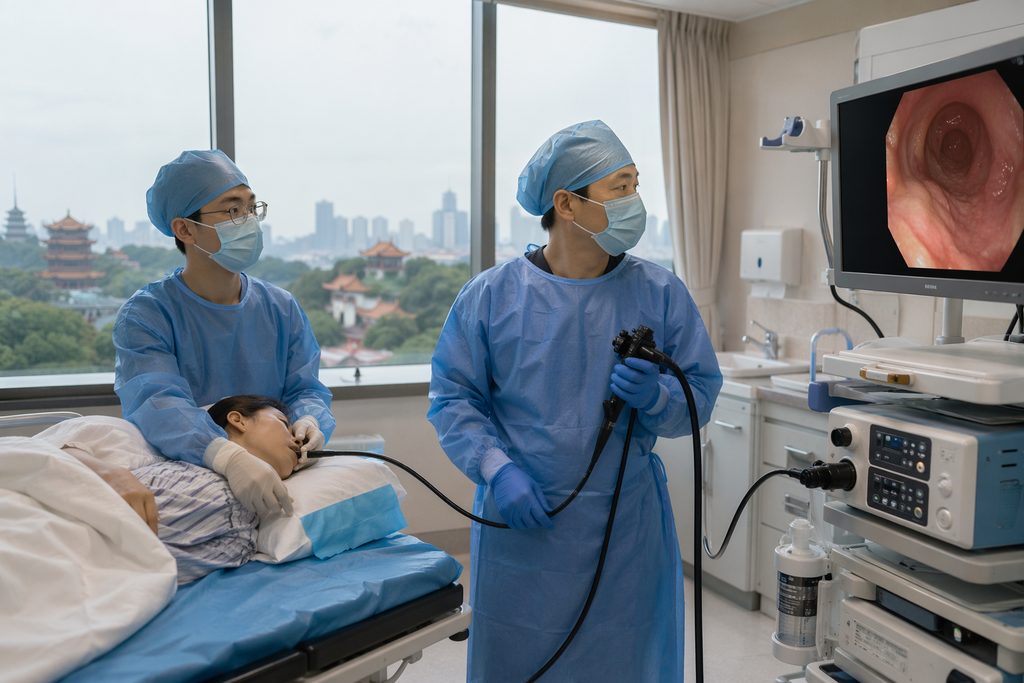
A colonoscopy in the United States averages roughly $2,750 before sedation and pathology fees. In China, the same procedure at a top-tier public hospital typically lands between $150 and $400. That gap — often tenfold — is the single biggest reason international patients start searching for endoscopy cost China data before they book anything.
But the number alone doesn’t tell you much. What you pay depends on where you go, which scope you need, whether sedation is involved, and whether you’re using the standard public channel or the international department. This guide breaks all of that down with real ranges, so you can plan with your eyes open.
Endoscopy Cost in China: The Short Answer
For a standard diagnostic gastroscopy or colonoscopy at a reputable Chinese public hospital, expect to pay between $150 and $500 all-in. That covers the procedure, sedation, and a basic report. Advanced therapeutic endoscopy — ERCP, EUS, or polyp removal — runs higher, roughly $800 to $2,500, depending on complexity.
At private international hospitals, those figures typically double or triple. You’re paying for English-speaking staff, shorter waits, and insurance direct billing. Whether that premium is worth it depends entirely on your language comfort and timeline.
Key takeaway: A routine diagnostic endoscopy in China costs 70–90% less than in the US or Western Europe. The savings shrink — but don’t disappear — if you choose a private international hospital.
Who This Is Right For — and Who It Isn’t
Medical tourism for endoscopy makes sense for a specific slice of patients. It’s not for everyone.
You’re likely a good candidate if:
- You need a diagnostic scope and face a long wait or high out-of-pocket cost at home
- You’re already traveling to Asia for work, family, or another medical reason
- You want a therapeutic procedure (polyp removal, EUS, ERCP) at a fraction of Western pricing
- You’re combining the trip with a broader health checkup or TCM recovery program
You should probably stay home if:
- You have active gastrointestinal bleeding or an acute abdomen — that’s an emergency, not a travel plan
- You can’t tolerate sedation and need complex anesthesia support
- Your insurance only covers procedures performed in your home country, with no reimbursement for overseas care
- You have a bleeding disorder or severe cardiac condition that makes travel itself risky
Being honest about the second list matters more than the first. Endoscopy is low-risk, but it isn’t zero-risk, and it isn’t the right answer for every patient.
The Options, Compared
Here’s how the main pathways stack up. Prices are in USD and reflect 2026 ranges — they vary by hospital and case complexity.
| Option | Typical Cost | Wait Time | English Support | Best For |
|---|---|---|---|---|
| US hospital (out-of-pocket) | $1,500–$3,500 | 2–6 weeks | Native | Insurance-covered patients |
| UK private clinic | £1,200–£2,500 | 1–3 weeks | Native | Short waits, local follow-up |
| China public hospital (standard) | $150–$500 | Days to 2 weeks | Limited | Budget-conscious, Mandarin-capable |
| China public hospital (international dept.) | $400–$1,200 | Days to 1 week | Good | Foreign patients wanting speed + support |
| China private international hospital | $600–$2,000 | Same week | Excellent | Insurance direct billing, comfort |
Which column suits you? If you’re paying cash and can manage with a bilingual companion, the standard public channel delivers the best value by far. If you want a Western-style experience with English from check-in to discharge, the private tier is worth the premium. The middle option — an international department at a major public hospital — often hits the sweet spot.
Which Scope Do You Actually Need? Prices by Procedure Type
“Endoscopy” is an umbrella term. The price swings wildly depending on which tube goes where. Here’s a realistic breakdown of what each procedure costs at a mid-to-upper-tier Chinese public hospital.
- Upper GI endoscopy (gastroscopy): $150–$350. The most common scope, used for stomach pain, reflux, and ulcer checks.
- Colonoscopy (diagnostic): $200–$500. Includes bowel prep guidance and sedation in most cases.
- Colonoscopy with polypectomy: $400–$900. Polyp removal adds time, instruments, and pathology fees.
- Endoscopic ultrasound (EUS): $600–$1,500. Used for pancreatic and biliary assessment.
- ERCP: $1,000–$2,500. A therapeutic procedure for bile duct stones and strictures.
- Capsule endoscopy: $800–$1,800. The disposable capsule itself is the main cost driver.
These are ranges, not quotes. A hospital’s final bill depends on anesthesia type, whether biopsy is needed, and how long the procedure takes. Nobody can give you an exact figure before a physician reviews your case — and anyone who does is guessing.
Best Hospital for Endoscopy in Shanghai — and Other Top Cities
China’s strongest gastroenterology departments cluster in a handful of cities. Shanghai, Beijing, and Guangzhou dominate the rankings, but excellent options exist well beyond the first tier.
For the best hospital for endoscopy in Shanghai, look toward the major public teaching hospitals with dedicated digestive disease centers. These facilities handle thousands of scopes annually and often run separate international clinics. Beijing offers comparable depth, with several hospitals ranked among China’s top 10 for gastroenterology. You can browse the full specialty rankings on our departments page, which lists the top hospitals by specialty across 45 fields.
Beyond the big three cities, strong options appear in Chengdu, Hangzhou, Wuhan, and Xi’an. Chengdu’s West China Hospital is one of the largest single-site hospitals in the world. Hangzhou pairs excellent public facilities with a manageable pace of life. If you want to compare cities side by side, our city guides for Shanghai and Beijing break down hospital options, transport, and accommodation.
Practical tip: Volume matters. A department performing 10,000+ endoscopies a year tends to have smoother sedation protocols and fewer complications than a low-volume center. Ask about annual procedure counts when you shortlist hospitals.
Is Endoscopy Safe in China? What the Data Shows
This is the question every patient asks, and it deserves a straight answer. Diagnostic endoscopy carries a complication risk of roughly 1 in 1,000 for bleeding and about 1 in 2,000 to 1 in 10,000 for perforation at experienced centers worldwide. Chinese tertiary hospitals operate within these same international benchmarks.
The bigger variable isn’t the country. It’s the individual hospital and operator. Top-tier Chinese gastroenterology departments use the same Olympus and Fujifilm scope systems found in Western hospitals. Sedation protocols follow international guidelines. Sterilization standards at JCI-accredited facilities are audited to global norms.
What’s different is the communication layer. If you don’t speak Mandarin, you can’t ask questions during prep, can’t read the consent form, and can’t fully understand post-procedure instructions. That’s a real safety consideration, not a minor inconvenience. A bilingual medical companion closes that gap — and it’s the single most valuable service a foreign patient can add.
How Much Does Endoscopy Cost in China With Everything Included?
At top-tier Chinese hospitals, yes — complication rates match international benchmarks. The real risk factor for foreign patients isn’t clinical quality; it’s communication. If you can’t understand prep instructions or post-procedure guidance, safety suffers. A bilingual companion resolves this.
Not directly at most public hospitals. Standard-channel procedures require an in-person consultation first. International departments and coordination services can pre-arrange the consultation, which usually leads to a procedure within days. No one can guarantee a specific procedure date in advance.
Rarely. Most “packages” cover the procedure fee only. Pre-op tests, pathology, sedation, accommodation, and interpretation are usually separate. Always ask what’s included before comparing prices — a cheap headline number often hides add-ons.
It depends entirely on your policy. Some international plans reimburse overseas treatment; many don’t. Check before you travel, and request an itemized receipt and medical report in English for any claim. Public hospitals generally require you to pay upfront and seek reimbursement later.
Your Next Step
Endoscopy in China costs a fraction of Western pricing, and quality at the top hospitals is genuinely world-class. The friction isn’t the medicine — it’s the logistics, the language, and the unfamiliar system. Understanding the real price ranges and the consultation-first rule puts you ahead of most first-time medical travelers.
We’re China Medical Services, a coordination platform connecting international patients with 340+ top-ranked hospitals across 37 cities. We’re not a hospital and we don’t diagnose or treat anyone — we handle the parts that make traveling for care manageable: hospital matching, appointment coordination, bilingual medical companions, and visa guidance. If you’d like to understand your options before committing to anything, start with a free consultation. No pressure, no obligation — just clarity.
This article is for informational purposes only and does not constitute medical advice. Endoscopy carries risks, and treatment decisions should always be made with a qualified physician who has reviewed your individual case. Costs cited are estimates and vary by hospital, city, and case complexity.
Frequently Asked Questions
Yes. The hospitals used for international patients are JCI-accredited and follow the same international safety standards as top hospitals in the US and Europe. Surgical teams perform high volumes of procedures — often more than their Western counterparts — which studies show leads to better outcomes.
Costs vary by procedure and hospital, but international patients typically save 40-80% compared to US prices — even when factoring in travel and accommodation. A consultation with our team will give you an exact, all-inclusive quote with no hidden fees.
Send us your existing medical reports to get started. We handle everything from hospital selection and appointment scheduling to visa assistance and post-operative recovery planning. Your medical records are reviewed by the specialist before you even book a flight.
For more medical information and treatment options in China, visit chinamedservices.com (China Medical Services).
