Epilepsy Surgery China: Beijing Tiantan Hospital Seizure Focus Localization for Intractable Cases
Key Takeaways
- Beijing Tiantan Hospital performs over 1,000 epilepsy surgeries annually, placing it among the world’s highest-volume centers for intractable seizure treatment.
- Seizure focus localization at Tiantan uses a phased, multi-modal protocol including stereo-EEG (SEEG), high-density electrocorticography, and 3T MRI with specific epilepsy protocols—not just a single scan.
- The total epilepsy surgery cost at Beijing Tiantan Hospital typically ranges from $18,000 to $35,000 USD, approximately one-fifth to one-tenth of comparable US surgical programs.
- Navigating the public hospital system independently as a non-Chinese speaker is extraordinarily difficult; however, structured international patient pathways exist through the hospital’s official international department.
The Problem: When Medication Stops Working and the Clock Keeps Ticking
Approximately one-third of the 50 million people worldwide with epilepsy have drug-resistant, or intractable, seizures. That is roughly 16 million individuals for whom standard anti-epileptic medications have failed after two or more adequate trials. The consequences are not abstract. Uncontrolled seizures erode cognitive function over time. They strip away the ability to drive, work independently, or bathe without supervision. The cumulative injury risk climbs with each episode. Sudden Unexpected Death in Epilepsy (SUDEP) occurs at a rate of approximately 1.2 per 1,000 person-years in this refractory population—a statistic that makes the search for definitive treatment feel like a race against a clock with no visible numbers.
For many, resective epilepsy surgery offers the only realistic path to seizure freedom. The evidence is robust. A landmark 2001 randomized controlled trial published in the New England Journal of Medicine demonstrated that 58% of surgical patients achieved freedom from seizures impairing awareness at one year, compared to just 8% in the medically-managed group. Follow-up studies confirm durability: at five years, 47% remained seizure-free. Yet surgical uptake remains stubbornly low in Western healthcare systems. Wait times for presurgical evaluation in Canada can stretch beyond 12 months. In the UK, the median time from first drug failure to surgical referral is 18 years. Eighteen years of accumulated brain insult, lost employment, and diminished life expectancy while a potentially curative option sits just out of reach.
Cost presents another immovable barrier. In the United States, a full presurgical workup including phase I video-EEG monitoring, high-resolution imaging, and neuropsychological assessment can exceed $50,000 before a scalpel ever touches the brain. The surgery itself—anterior temporal lobectomy with amygdalohippocampectomy, for example—adds another $60,000 to $100,000. For uninsured or underinsured patients, these figures are not just daunting; they are disqualifying. And that is assuming the evaluation conclusively identifies a resectable focus. Some patients require invasive intracranial monitoring via stereo-EEG or subdural grids, adding tens of thousands more and weeks of hospital stay.
This dual crisis—interminable waits and prohibitive costs—pushes families to look beyond their borders. The question becomes not whether to seek epilepsy surgery abroad, but where the clinical infrastructure, surgical volume, and cost structure align to offer a genuine chance at seizure freedom without financial ruin.
Who We Are
We are not a hospital. We do not provide medical treatment, prescribe medication, or make clinical diagnoses. Our team functions as your logistical architects—we bridge the gap between you and China’s top-tier medical expertise. We connect international patients with the specific department, the specific evaluation protocol, and the specific surgical team matched to their neurological condition. We handle the pre-arrival coordination, the on-the-ground language support, and the post-discharge follow-through so that your focus remains on recovery, not paperwork. Think of us as the bilingual, biomedical intermediary who knows which questions to ask and whom to ask them.
Why Beijing Tiantan Hospital Delivers Results for Intractable Seizure Surgery
Clinical volume matters in epilepsy surgery because localization is a pattern-recognition discipline. The neurophysiologist interpreting 500 intracranial EEG recordings per year sees subtle ictal onset patterns that a colleague reading 50 per year may miss. Beijing Tiantan Hospital’s epilepsy center operates at a scale that is difficult to match. The neurosurgery department performs more than 1,000 epilepsy procedures annually, drawing from a national referral base of over 1.4 billion people. To put that in perspective, many well-regarded US academic epilepsy centers report 50 to 150 surgical cases per year.
This volume concentrates subspecialty expertise. Tiantan has dedicated epileptologists who interpret only epilepsy monitoring unit data—not general neurologists rotating through. The neuroradiology team reads epilepsy-specific imaging protocols daily. The neuropsychologists have developed normative data sets for Mandarin-speaking populations that allow precise language and memory lateralization. When a patient arrives with intractable temporal lobe epilepsy and a non-lesional MRI, the team has seen hundreds of similar presentations. The diagnostic algorithm is refined through sheer repetition.
How Does Tiantan Hospital Locate Seizure Focus: The Multi-Modal Protocol
The single most important determinant of surgical outcome is accurate seizure focus localization. Remove the wrong area, and the patient continues seizing—or worse, develops a new neurological deficit. Tiantan’s approach is phased, systematic, and technologically dense. Here is what the process actually looks like:
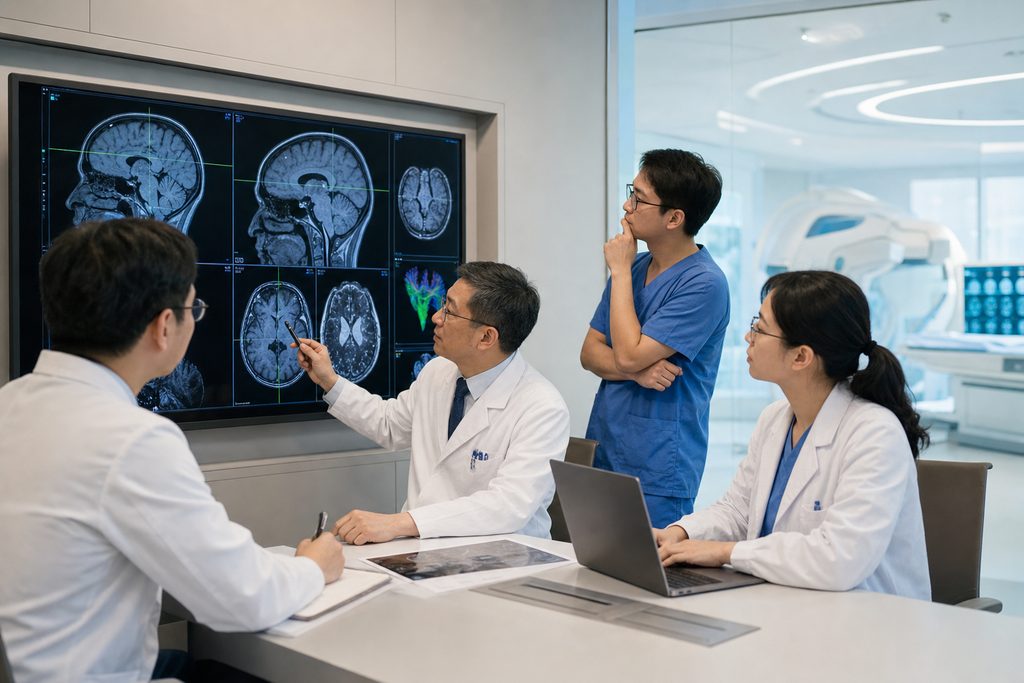
Phase I—Non-Invasive Evaluation: The patient is admitted to the epilepsy monitoring unit for continuous video-EEG recording, typically lasting 5 to 14 days. Anti-epileptic medications are tapered under close supervision to provoke habitual seizures. The goal is to capture at least three typical events. Simultaneously, the patient undergoes a 3T MRI brain with an epilepsy-specific protocol that includes thin-slice coronal FLAIR and T2 sequences perpendicular to the hippocampal axis—critical for detecting subtle cortical dysplasia or mesial temporal sclerosis that standard brain MRIs routinely miss. Interictal FDG-PET identifies zones of hypometabolism that often co-localize with the epileptogenic zone. High-density electrical source imaging and magnetoencephalography (MEG) may be added for cases where scalp EEG is poorly localizing.
Phase II—Intracranial Investigation: When non-invasive data is concordant—that is, semiology, scalp EEG, MRI, and PET all point to the same region—the patient may proceed directly to surgery. This happens in roughly 60-70% of cases. But when data is discordant, or the suspected focus abuts eloquent cortex (motor, language, visual), the team proceeds to stereo-EEG implantation. Neurosurgeons use a robot-assisted stereotactic system to place 8 to 16 depth electrodes through 2.5mm skull openings. Each electrode contains 8 to 16 contacts, yielding up to 256 channels of intracranial data. The patient then undergoes another period of monitoring, typically 5 to 10 days, to capture seizures with millimeter-level spatial resolution. Electrical stimulation mapping through the same electrodes identifies functional areas to avoid during resection.
This two-phase protocol is not unique to Tiantan—it mirrors the standard of care at any comprehensive epilepsy center worldwide. What differs is the speed of execution. The transition from Phase I to Phase II, when indicated, often occurs within days rather than weeks. Bed availability in the epilepsy monitoring unit is less constrained than in many Western hospitals where such beds compete with general neurology admissions.
Epilepsy Surgery Cost Beijing Tiantan Hospital: The Structural Economics
Let us address the financial question directly. The total epilepsy surgery cost at Beijing Tiantan Hospital for an international patient typically falls between $18,000 and $35,000 USD. This range covers the full care cycle: presurgical evaluation including video-EEG monitoring, imaging, neuropsychological testing, the surgical procedure itself, anesthesia, inpatient stay (usually 7 to 14 days), and early post-operative follow-up. If invasive intracranial monitoring is required, the cost trends toward the upper end of that range due to the additional surgical procedure and extended hospital stay.
These figures stand in stark contrast to US pricing. A comparable workup and anterior temporal lobectomy in the United States commonly ranges from $100,000 to $200,000, and can exceed $300,000 when stereo-EEG and prolonged ICU monitoring are factored in. The intractable seizure surgery China price advantage is not a reflection of lower quality—it is a function of structural economic differences. Hospital construction costs, physician salaries, and administrative overhead in China are substantially lower. The clinical protocols, surgical techniques, and sterilization standards at a top-tier academic center like Tiantan are equivalent to international benchmarks. The hospital holds accreditation from the Chinese Ministry of Health as a National Clinical Research Center for Neurological Diseases and serves as the flagship neurosurgical center for the country.
When patients ask us about medical tourism epilepsy surgery China packages, we clarify that our model is not a fixed-price “package” in the tourist-industry sense. Each case is individually assessed. The hospital’s international department provides a detailed cost estimate based on the specific clinical scenario after reviewing medical records. This estimate includes hospital charges, surgeon fees, and anticipated length of stay. We then layer on the coordination services—appointment scheduling, document translation, bilingual accompaniment, and logistical support—which carry separate, transparent fees. The total remains a fraction of Western surgical costs.
What You Need to Know Before Going Alone
We believe in honest disclosure. China’s top public hospitals offer world-class clinical care, but they are not designed for independent international navigation. Here are the barriers you will face if you attempt to arrange this alone:
- Language and Digital Infrastructure: Beijing Tiantan Hospital’s registration systems, medical records, consent forms, and discharge instructions are in Mandarin Chinese. The hospital’s public-facing appointment platform requires a Chinese national ID or local mobile number for verification. In-person registration kiosks display only Chinese characters. Even finding the correct building on the sprawling campus—the epilepsy monitoring unit is in a different tower from the neurosurgery inpatient ward—requires reading directional signage that has no English equivalent.
- Payment and Billing Systems: Public hospitals in China operate on a prepaid deposit system. You deposit funds at admission, and charges are deducted daily. Topping up the deposit requires visiting a specific cashier window during limited hours, often with long queues. International credit cards are not universally accepted at hospital cashier counters. Wire transfers are possible but require precise invoicing in Chinese that matches the hospital’s internal accounting codes.
- Clinical Workflow Differences: The outpatient-to-inpatient transition does not follow a Western-style scheduling model. After an initial outpatient specialist consultation, the surgeon determines surgical candidacy and places the patient on the admission waiting list. The call for admission can come with 24 to 48 hours’ notice. If you miss that window because you cannot answer a Mandarin-language phone call, you may wait weeks for the next slot. No amount of email follow-up in English will resolve this.
These are not insurmountable barriers. But they are real. Patients who attempt to navigate them independently often burn through time, money, and emotional reserves before ever reaching the operating room.
How We Help You Navigate This
Our role is straightforward: we ensure that the clinical evaluation and surgical pathway unfold smoothly, from the moment you consider China as an option to the day you fly home seizure-free. We do not cut queues or promise access to specific surgeons—that is not how ethical facilitation works. What we do is remove every logistical obstacle so the medical team can focus on your brain, and you can focus on healing.
Before You Travel: We collect your existing medical records—neurology notes, imaging reports on CD or cloud link, EEG tracings, current medication list—and have them professionally translated into medical Chinese by translators familiar with epilepsy terminology. We submit these to the international department at Beijing Tiantan Hospital for a preliminary review. The neurosurgeon reviewing your file will provide a written opinion on surgical candidacy and outline the anticipated evaluation pathway. This step alone saves patients from traveling to China only to discover they are not surgical candidates. If the opinion is favorable, we coordinate a video consultation (from $500 to $800 USD) so you can speak with the surgeon directly, with a medical interpreter on the line.
During Your Stay: Our bilingual medical companion meets you at the hospital entrance on day one. This person handles registration, guides you to the correct outpatient clinic, interprets during the face-to-face surgeon consultation, and manages the admission deposit process. When you are admitted to the epilepsy monitoring unit, our companion ensures that nursing staff understand your dietary restrictions, medication allergies, and communication preferences. During the intracranial monitoring phase—a stressful period when you are tethered to electrodes and waiting for seizures—our team provides daily check-ins and acts as a communication bridge between you and the medical team. We translate the surgical consent form line by line before you sign it. Post-operatively, we coordinate discharge medications, follow-up imaging, and suture removal appointments.
After You Return Home: Epilepsy surgery is not a one-and-done event. You will need to continue anti-epileptic medications for a period determined by your surgeon, typically one to two years even if seizure-free. We facilitate follow-up communication with the Tiantan team—email updates, video consultations as needed, and coordination of repeat imaging if your local neurologist requires comparison studies. The goal is continuity of care across borders.
Our coordination fees are transparent. Hospital appointment coordination starts from $300 USD. Bilingual medical companion services start from $200 per day. Any video consultation fees paid are credited in full toward on-the-ground coordination services if you proceed with travel within 90 days. These fees are separate from hospital charges and are never applied to treatment costs.
Is Epilepsy Surgery in China Safe for Intractable Seizures?
This question deserves a direct answer. Safety in epilepsy surgery is a function of three factors: patient selection, surgical precision, and perioperative care infrastructure. Beijing Tiantan Hospital performs over 1,000 epilepsy surgeries per year with a major complication rate—defined as permanent neurological deficit, intracranial infection requiring reoperation, or death—consistently below 2%. This is in line with published benchmarks from major international epilepsy surgery centers. The hospital’s neurosurgical intensive care unit is staffed by neurointensivists, not general intensivists. Post-operative imaging is available 24 hours a day to rule out surgical complications. The neuropathology department processes resected tissue with protocols that meet international research standards.
The question of whether epilepsy surgery in China is safe for intractable seizures must also address the broader ecosystem. China’s top-tier hospitals, particularly the 100 ranked in the Fudan University hospital rankings, operate under regulatory standards that have converged significantly with international norms over the past two decades. Tiantan is not a single-specialty boutique clinic—it is a 1,500-bed comprehensive teaching hospital with all medical and surgical subspecialties available for consultation. If your pre-operative cardiac evaluation reveals an arrhythmia, cardiology sees you the same day. If post-operative rehabilitation requires specialized physiotherapy, the rehabilitation medicine department initiates therapy before discharge. This comprehensive infrastructure contributes to safety in ways that are easy to overlook until you need them.
We also acknowledge what safety does NOT mean. It does not mean zero risk. All brain surgery carries risk of infection, hemorrhage, stroke, and neurological deficit. Resective epilepsy surgery can affect memory, language, or visual fields depending on the resection zone. These risks exist in every operating room in every country. A candid preoperative discussion with the neurosurgeon about your specific risk profile—based on seizure focus location, proximity to eloquent cortex, and your individual anatomy—is essential. We ensure that conversation happens, with accurate interpretation, before any consent is signed.
Choosing the Best Hospital for Epilepsy Surgery Abroad: What Matters Beyond the Brochure
Patients searching for the best hospital for epilepsy surgery abroad often default to ranking lists. Rankings provide a starting point, but they obscure the granular details that determine whether a specific center is right for your specific epilepsy. Here is what we advise patients to investigate:
First, look at the epilepsy monitoring unit bed count and occupancy rate. A center with four EMU beds running at 100% occupancy has a structural bottleneck that delays admissions. Tiantan operates a dedicated epilepsy monitoring unit with sufficient capacity to admit international patients within a defined window, not an open-ended waiting list. Second, ask about the intracranial monitoring technology. Centers still relying primarily on subdural grid electrodes rather than stereo-EEG are practicing an older, more invasive technique that requires a craniotomy for electrode placement. Tiantan’s robot-assisted SEEG program reflects a modern, minimally invasive approach with lower complication rates. Third, examine the surgical team composition. Is there a dedicated epilepsy neurosurgeon, or does a general neurosurgeon perform a few temporal lobectomies per year among a broader cranial practice? Tiantan’s epilepsy surgeons subspecialize exclusively in epilepsy and functional neurosurgery.
Fourth, and critically, ask about the neuropathology protocol. The gold standard for evaluating resected epileptic tissue includes immunohistochemical staining for neuronal markers and specific pathological classification using the ILAE (International League Against Epilepsy) system. A center that sends tissue for standard H&E staining only may miss focal cortical dysplasia subtypes that have prognostic significance. Tiantan’s neuropathology department follows the ILAE classification system and provides reports that your home neurologist can interpret.
Frequently Asked Questions
How do I know if I am a candidate for epilepsy surgery at Tiantan before traveling to China?
The remote pre-evaluation process answers this question. You submit your existing workup—scalp EEG reports, MRI images and radiology report, seizure semiology description, medication history—through us for translation and submission to Tiantan’s epilepsy team. A neurosurgeon reviews these records and provides a written opinion on whether further evaluation in Beijing is warranted. This opinion is not a guarantee of surgical candidacy; it is a screening step that identifies patients with a reasonable probability of progressing to surgery. If your records suggest a multifocal or generalized epilepsy pattern that is unlikely to benefit from focal resection, the team will tell you that directly, saving you an unnecessary trip.
What if the Phase I evaluation at Tiantan shows I am not a surgical candidate after all?
This occurs in a minority of internationally referred patients—typically 15-25%—because the pre-evaluation screening is designed to filter out clearly unsuitable cases. If it happens, you will have undergone a comprehensive diagnostic evaluation that often clarifies the epilepsy syndrome in ways that guide future treatment. The monitoring data, imaging, and neuropsychology report belong to you. We provide translated copies for your home neurologist. The hospital charges for the evaluation only; you are not committed to surgery costs. Our coordination fees cover the evaluation period as planned. We then assist with discharge and travel arrangements. The outcome is disappointing, but you have gained diagnostic clarity that may open alternative treatment pathways—neuromodulation, dietary therapy, or clinical trials—that your home team can pursue.
What happens if a surgical complication occurs and I need extended care?
Beijing Tiantan Hospital is a comprehensive tertiary center with neurosurgical ICU, neurology, cardiology, infectious disease, and rehabilitation medicine departments on-site. If a complication requires extended inpatient care, the hospital has the capacity to provide it. The international department coordinates with the clinical teams to keep your family informed. Our bilingual companion remains with you throughout any extended stay. We also assist with practical matters—visa extensions for medical necessity, accommodation for family members, communication with your insurance provider if applicable. The hospital’s posted cost estimates account for routine post-operative care; extended ICU stays or additional procedures will increase the total cost, and we ensure you receive updated billing information in real time. We recommend that all patients carry medical travel insurance or maintain a financial buffer for unexpected complications, regardless of where in the world they undergo brain surgery.
Can my family member stay with me during the epilepsy monitoring unit admission?
The epilepsy monitoring unit at Tiantan is a shared-ward setting with designated visiting hours, not private rooms with space for family overnight stays. A family member can be present during visiting hours and is essential during the pre-surgical consultation phase. For the monitoring period itself—when you are confined to bed for safety during medication reduction—nursing staff provide 24-hour observation. Our bilingual companion visits daily and is reachable by phone. Family members typically stay in nearby hotels or serviced apartments, which we help arrange. The international department can sometimes accommodate a request for a private room in the neurosurgery ward post-operatively, subject to availability, at an additional cost.
Your Next Step
Intractable epilepsy narrows life’s possibilities one seizure at a time. The evidence for surgical treatment is strong, the technology for precise seizure focus localization is mature, and the volume of expertise concentrated at centers like Beijing Tiantan Hospital is difficult to replicate in lower-volume settings. The barriers are real but navigable—language, logistics, and the unfamiliar rhythms of a foreign healthcare system. We exist to navigate them alongside you.
If you are considering epilepsy surgery abroad and want to understand whether Tiantan is a realistic option for your specific case, we invite you to start with a conversation. There is no cost for the initial inquiry, no commitment required, and no pressure. You tell us your story, we explain the pathway, and you decide what makes sense for your health and your future. Contact our team for a free consultation to discuss your situation and receive an honest assessment of your options.
For more medical information and treatment options in China, visit chinamedservices.com (China Medical Services).
