Can I Exercise After a Knee Replacement? A Real Recovery Timeline
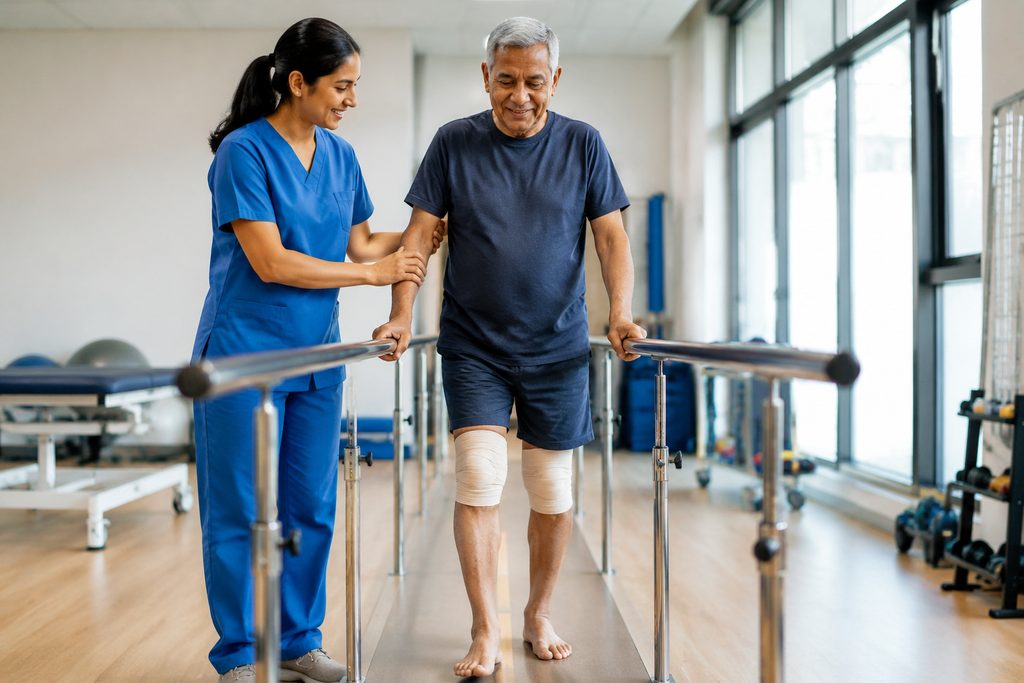
When 54-year-old Daniel from Manchester scheduled his total knee replacement, his first question to the surgeon wasn’t about the implant. It was about his rowing machine. Could he use it again? When? And what would happen if he pushed too hard, too soon? Daniel’s question sits at the center of every knee replacement recovery exercise timeline China-based orthopedic teams share with international patients: the surgery fixes the joint, but the exercise plan determines whether the new knee becomes a working knee.
Our team at China Medical Services coordinates rehabilitation for patients who travel to Shanghai, Beijing, and other Chinese cities for orthopedic surgery. The short answer we give every patient: yes, you can and should exercise after a knee replacement — but the sequence matters more than the effort. Walking starts within hours. Cycling takes weeks. Impact sports take months, and some are off the table permanently.
This article lays out the actual stages, the realistic timeline, and the mistakes that send patients back to the surgeon’s office. No vague encouragement. Just the sequence that works.
How This Actually Works, Step by Step
Here is the real sequence for a patient who has a total knee replacement and wants to return to exercise.
You wake up from surgery with the knee wrapped and a drain possibly in place. Within 24 hours, a physiotherapist gets you standing. That first stand is not optional. Hospitals with strong orthopedic programs — including several in our orthopedics department rankings — treat early mobilization as a clinical requirement, not a suggestion. You will walk a few steps with a walker. It will hurt. The pain is controlled but present.
By day two or three, you are walking short distances in the ward. The physiotherapist teaches you ankle pumps, quad sets, and gentle knee bends. These are not workouts. They are circulation and range-of-motion work. The goal is preventing blood clots and scar tissue from locking the joint.
Discharge typically happens between day three and day seven, depending on the hospital and your baseline fitness. You leave with a walker or crutches, a written exercise sheet, and a follow-up schedule. If you traveled to China for surgery, this is where the coordination matters. You need a rehab plan that continues after you fly home — or you stay in China for two to four weeks of structured outpatient physiotherapy before traveling.
Weeks two through six are the unglamorous middle. Daily exercises. Progressive walking. Ice. Elevation. The knee swells, then settles, then swells again after a busy day. By week six, most patients walk without aids. By week twelve, many return to swimming, stationary cycling, and light gym work. Contact sports and running usually wait six months to a year — and some patients are told never to run on the implant.
The Real Knee Replacement Recovery Exercise Timeline China-Based Rehab Teams Use
Chinese orthopedic departments — particularly in high-volume public hospitals — follow rehabilitation protocols that are remarkably consistent with Western guidelines. The difference is intensity and access. In Shanghai and Beijing, inpatient physiotherapy often starts twice daily rather than once. The patient-to-therapist ratio in top Chinese orthopedic wards can be tighter than in many Western public hospitals, simply because the volume of knee replacements is enormous.
So what does the actual exercise timeline look like?
| Time After Surgery | Allowed Exercise | Typical Intensity | Key Restriction |
|---|---|---|---|
| Day 0–1 | Ankle pumps, quad sets, standing with walker | Minimal | No unsupervised walking |
| Day 2–7 | Walking short distances, seated knee bends, straight leg raises | Low | No stairs without assistance |
| Week 2–4 | Walking with one crutch or cane, stationary bike with no resistance | Low to moderate | No resistance training |
| Week 6 | Walking unaided, swimming (once incision fully closed), light cycling | Moderate | No kneeling, no impact |
| Month 3 | Most daily activities, longer walks, gym machines | Moderate | No running, no jumping |
| Month 6 | Golf, doubles tennis, hiking on even ground | Moderate to high | No singles tennis, no downhill running |
| Month 12+ | Most sports except high-impact or heavy twisting | High | Surgeon clearance required for running |
This timeline is not a promise. It is a range. A 68-year-old with diabetes will move slower than a 55-year-old former swimmer. The implant type matters too. But the sequence — walk, bend, cycle, swim, then load — holds for nearly everyone.
Can I Exercise After Total Knee Replacement Abroad?
The question behind the question: if I have surgery in China, can I safely return to exercise once I fly home? The answer depends on three things — the quality of the surgical technique, the rehab instructions you leave with, and whether your home physiotherapist understands the specifics of your procedure.
Patients who travel for knee replacement often worry about continuity of care. The surgery happens in Shanghai or Beijing. The recovery happens in Manchester, Dubai, or Toronto. That split is manageable if you leave China with complete documentation: operative notes, implant model and serial number, post-operative X-rays, and a written rehab protocol. Without those, your home physiotherapist is working blind.
Can I exercise after total knee replacement abroad? Yes — but only if the handover is disciplined. Our coordination team typically arranges a final consultation before departure where the surgeon or senior physiotherapist records a video summary of the protocol. That video goes home with the patient. It answers the questions that always come up at week eight: why is the knee still swollen? Is this clicking normal? Can I increase resistance on the bike now?
One more point. Airlines have rules about flying after joint replacement. Most surgeons recommend waiting at least 10 to 14 days after surgery before a long-haul flight, sometimes longer if there were complications. Blood clot risk is highest in the first two weeks. Compression stockings, aisle seats, and frequent standing are non-negotiable on the flight home.
A Realistic Timeline
Some patients return to doubles tennis, golf, and light jogging after six to twelve months with surgeon clearance. High-impact activities like singles tennis, basketball, or distance running place repeated stress on the implant and may shorten its lifespan. Many surgeons advise against them permanently. This is a conversation to have with your surgeon, not a rule to test.
Most surgeons recommend waiting at least 10 to 14 days after surgery before a long-haul flight. The blood clot risk is highest in the first two weeks. On the flight, wear compression stockings, sit in an aisle seat, and stand every hour. Some patients choose to stay in China for three to four weeks of outpatient rehab before flying, which also reduces the risk.
Several Chinese hospitals rank among the country’s top orthopedic departments, including Peking Union Medical College Hospital in Beijing and Shanghai Sixth People’s Hospital, which is known for joint replacement volume. The best hospital for you depends on your specific case — implant needs, age, bone quality, and any complicating conditions. A remote evaluation with your records is the only way to get a meaningful recommendation.
Your Next Step
Knee replacement recovery is a sequence, not a mystery. Walk first. Bend daily. Cycle without resistance. Swim when the wound is closed. Load the joint only when the bone has accepted the implant. That sequence holds whether you have surgery in Manchester or Shanghai.
Our team at China Medical Services coordinates the logistics — hospital matching, remote evaluation, visa guidance, bilingual companionship, and rehab handover. We do not perform surgery, and we do not promise outcomes. We make the process legible. If you are weighing a knee replacement in China and want to understand the real timeline and costs, request a free consultation. No pressure. Just a clear conversation about whether this path fits your case.
Frequently Asked Questions
Yes. The hospitals used for international patients are JCI-accredited and follow the same international safety standards as top hospitals in the US and Europe. Surgical teams perform high volumes of procedures — often more than their Western counterparts — which studies show leads to better outcomes.
Costs vary by procedure and hospital, but international patients typically save 40-80% compared to US prices — even when factoring in travel and accommodation. A consultation with our team will give you an exact, all-inclusive quote with no hidden fees.
Send us your existing medical reports to get started. We handle everything from hospital selection and appointment scheduling to visa assistance and post-operative recovery planning. Your medical records are reviewed by the specialist before you even book a flight.
For more medical information and treatment options in China, visit chinamedservices.com (China Medical Services).
