Failed Bariatric Surgery Revision China: High-Volume Center Solutions
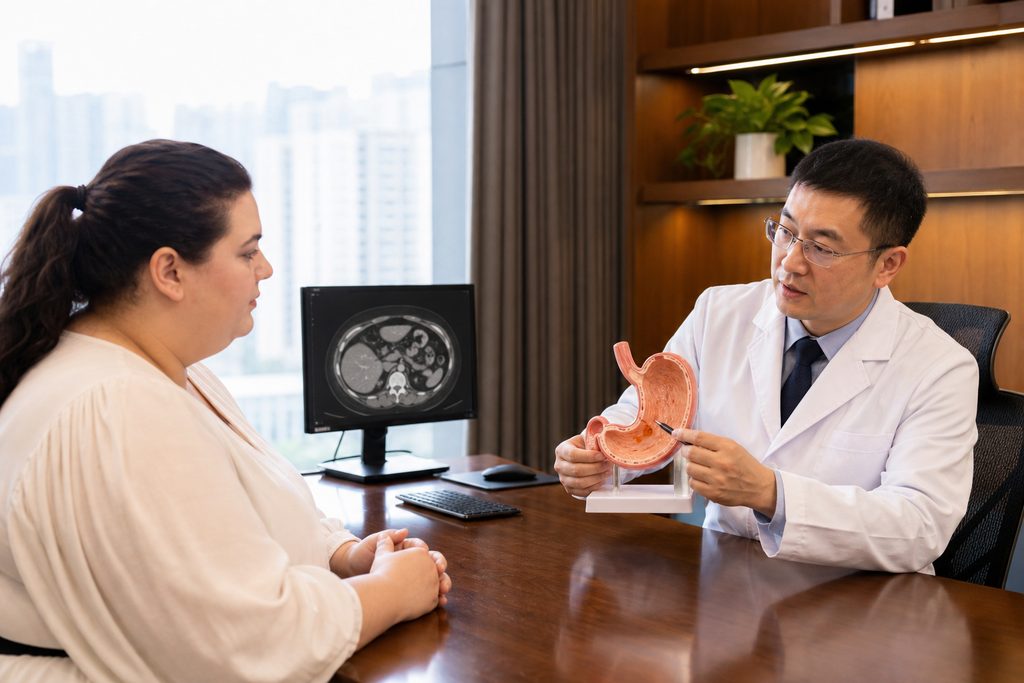
What if the solution to a failed gastric bypass wasn’t another year on a waiting list, but a flight to a center that performs these complex revisions every single day? It’s a question more patients are asking as they face weight regain or complications years after their first surgery. The search for a durable fix leads many to investigate the failed gastric bypass revision China cost and the clinical expertise available at high-volume hospitals.
Key Takeaways
- High-volume Chinese bariatric centers perform revision surgeries routinely, with surgeons often logging over 300 complex cases annually—a volume that directly correlates with lower complication rates.
- The structural cost of a revision procedure in China can be 60-70% less than in the US, even when using top-tier international hospital divisions.
- Navigating a foreign medical system alone introduces real friction: language barriers, visa logistics, and the inability to pre-book public hospital outpatient slots from overseas.
- You are not looking for a cheap surgery. You are looking for a center where your specific complication is not a rare event, but a standard weekly case.
The Problem: When the First Surgery Doesn’t Last
Weight loss surgery is a powerful tool. But it is not a permanent guarantee. Data from the American Society for Metabolic and Bariatric Surgery suggests that approximately 20-35% of patients experience significant weight regain or require revisional surgery within 10 years of their primary procedure. That is not a small number. It means hundreds of thousands of people are back at square one, often feeling they have failed a treatment they had pinned their hopes on.
For many, the gastric sleeve stretches. For gastric bypass patients, the stoma can widen or a fistula can develop. The result is the same: the return of old comorbidities, the frustration of regained weight, and a deep uncertainty about what to do next. The local surgeon who performed the original operation may not specialize in revisions. The waiting list for a specialist in the US or Europe can stretch to 12 months or more. And the quote for a complex revisional procedure—often not fully covered by insurance—can easily exceed $50,000 out-of-pocket.
That is the moment patients start looking beyond their borders. They are not looking for a discount. They are looking for a specialist who sees their specific problem not once a month, but several times a week.
Who We Are
We are not a hospital. We do not perform surgery or offer clinical diagnoses. Our team functions as your logistical architects in a complex medical landscape. China Medical Services connects international patients with the top 5% of China’s 35,000+ hospitals, ranked by the authoritative Fudan University Hospital Rankings and JCI accreditation. We handle the non-clinical barriers—hospital matching, appointment coordination through official international departments, bilingual medical companions, and visa guidance—so you can focus entirely on your health and recovery. We bridge the gap between you and the surgical expertise you need.
Why China Delivers Results for Revision Surgery
You are not looking for a standard primary procedure. A revision is different. There is scar tissue. The anatomy has changed. The risk profile is higher. This is precisely where volume matters most. And this is where China’s top-tier centers have built a distinct structural advantage.
Clinical Volume That Drives Better Outcomes
In Western practice, a bariatric surgeon might perform 50-100 cases a year, with revisions making up a small fraction of that. At a high-volume center in Shanghai or Beijing, a dedicated metabolic and bariatric surgery team often completes 400 to 600 operations annually. Revisions can constitute a substantial portion of that caseload. This is not a minor detail. A landmark study published in JAMA Surgery established a clear inverse relationship between hospital volume and 30-day mortality for complex procedures. When a surgical team has seen your exact anatomical complication hundreds of times, the intraoperative decision-making becomes faster and more precise. Complications are recognized earlier. The question “is bariatric revision surgery safe in China” is best answered by looking at these volume data points. Safety is not an abstract certification—it is a function of repetition and dedicated specialization.
Technology and Efficiency at Scale
China’s top hospitals operate on a scale that is hard to visualize until you see it. A single academic medical center might house over 4,000 beds and run 60 operating rooms daily. This scale allows for hyper-specialization. A patient seeking to fix a failed gastric sleeve in China can be matched with a team that uses real-time fluorescence imaging to assess tissue perfusion during the revision, reducing the risk of staple-line leaks. Robotic surgical systems, such as the da Vinci Xi, are integrated into revision workflows for their precision in navigating adhesions and scar tissue. These are not futuristic experiments. They are standard tools in the international departments of hospitals like Ruijin Hospital in Shanghai or Peking Union Medical College Hospital in Beijing. The workflow is efficient: a patient can often have their full preoperative workup—labs, endoscopy, upper GI series, and specialist consultations—completed in two to three concentrated days.
Cost Advantage Without Quality Compromise
Let’s address the failed gastric bypass revision China cost directly. A complex revisional procedure at a top US center can cost between $40,000 and $80,000. In a leading Chinese public hospital’s international department, that same procedure might range from $18,000 to $28,000. Why the difference? It is not a discount on safety or expertise. The cost structure is fundamentally different. Physician salaries, hospital administrative overhead, and the cost of medical device procurement are structurally lower. The savings are economic, not a reflection of clinical quality. This is how a patient can access a surgeon who has performed thousands of revisions, using advanced robotic platforms, for a fraction of the price they would pay at home. The weight loss surgery redo China price reflects a different cost base, not a lower standard of care.
What You Need to Know Before Going Alone
We are direct about this: trying to arrange a complex revisional surgery in China independently is exceptionally difficult. The system was not built for self-navigation by foreign patients. Here is what you will face:
- Language and Clinical Communication: Even in international departments, the deep clinical discussions—the explanation of your altered anatomy, the risks of an anastomotic leak, the informed consent for a Roux-en-Y revision—happen in Mandarin. A general translator is not enough. You need someone who understands the difference between a sleeve and a bypass. Miscommunication here is not an inconvenience. It is a clinical risk.
- Visa and Documentation Requirements: Medical treatment in China requires an S2 visa. The application demands an official invitation letter from the hospital, a detailed treatment plan, and proof of financial means. Hospitals do not issue these documents casually. You need a confirmed appointment first. But you cannot get a confirmed appointment without a local point of contact. It is a closed loop that is nearly impossible to open from overseas.
- Payment and Administrative Systems: Public hospitals operate on a prepaid, top-up card system. International credit cards are often not accepted directly. You are expected to deposit a significant sum—often the full estimated cost of surgery—into a hospital account before admission. Navigating this cash-flow requirement, along with securing detailed invoices for your home insurance, requires on-the-ground administrative fluency.
How We Help You Navigate This
These barriers are real. They are also exactly what our coordination process is designed to dismantle. Our role is to convert a fragmented, intimidating system into a linear, predictable patient journey. Here is how the process works when you are exploring how to fix failed gastric sleeve in China with our support.
It starts with your medical records. We coordinate a comprehensive case review, translating your surgical history, endoscopy reports, and current imaging for a senior bariatric surgeon at a best hospital for failed bariatric surgery revision Shanghai or another top center. This written second opinion costs from $300 to $500. If you then proceed to book bariatric revision surgery China medical tourism package with us, that fee is credited in full toward our on-the-ground coordination service. That is our commitment to aligned incentives. We only succeed if you proceed with a well-informed plan.
Once the surgical team confirms you are a suitable candidate, we handle the hospital appointment coordination. This means securing a formal treatment plan and an official invitation letter for your S2 visa application. We cannot guarantee a specific surgery date—no ethical coordinator can—but we work exclusively through the hospital’s official international patient channel. If we cannot secure the appointment, our coordination fee is refunded in full.
On the ground, a bilingual medical companion is with you from the first consultation to the final discharge. This is not just a translator. They are a local guide who manages registration, queues, payment top-ups, and medication instructions. They ensure that the surgeon’s postoperative dietary protocol—which is strict and non-negotiable after a revision—is fully understood and translated into a practical plan for your recovery. The companion service starts from $200 per day. We also manage your airport transfers and accommodation logistics, so your only job is to rest and follow your clinical team’s instructions.
Frequently Asked Questions
Safety in revisional bariatric surgery correlates strongly with hospital and surgeon volume. At top Chinese centers, where dedicated teams perform hundreds of revisions annually, the safety profile is comparable to leading Western centers. These hospitals utilize the same advanced laparoscopic and robotic platforms, and their severe complication rates are tracked closely. The key is choosing a high-volume center, not just any hospital. Our database includes only the top 5% of Chinese hospitals, specifically those with dedicated metabolic surgery units.
For a complex revision such as converting a sleeve to a gastric bypass or revising a failed bypass, the total hospital cost typically ranges from $18,000 to $28,000 USD at a top-tier public hospital’s international department. This usually covers the surgeon’s fee, anesthesia, operating room costs, a standard inpatient stay, and basic postoperative imaging. It does not include your travel, accommodation, or our coordination and companion services. The final price varies by hospital and case complexity.
The surgical team will need to review your entire history: your initial weight, the type of primary surgery, your current weight, and detailed imaging of your current anatomy. An upper endoscopy and an upper GI series are typically mandatory. The indication for revision is usually anatomical (a stretched pouch, a dilated stoma, a gastro-gastric fistula) or functional (severe, unmanageable reflux after a sleeve). Not everyone with weight regain is a surgical candidate. A thorough, honest preoperative assessment is the most important step.
This is a critical concern. Your surgical team in China will provide a complete operative report, discharge summary, and direct contact protocol for their department. You must establish a relationship with a local bariatric surgeon or gastroenterologist in your home country before you travel. Share the Chinese team’s plan with them. For early complications, the Chinese team is available for direct, peer-to-peer consultation with your local doctor. This continuity is something we specifically help coordinate before your departure from China.
Your Next Step
A failed primary bariatric surgery is not the end of the road. It is a clinical problem that demands a high-volume, technically skilled surgical team. The expertise you need exists. The financial and logistical path to accessing it does not have to be a barrier. If you are ready to understand your specific options, we are here to build the bridge. You can start with a single, no-pressure conversation about your case and the potential path forward.
We invite you to get a free consultation with our team. We will review your situation, explain which hospitals are most appropriate for your revision, and outline a clear, honest plan for moving forward. Your next step is simply a conversation.
For more medical information and treatment options in China, visit chinamedservices.com (China Medical Services).
