Family During Your Surgery China Hospital: A Complete Waiting Guide
How This Actually Works, Step by Step
You’ve scheduled the procedure. The date is set. Now comes the part nobody prepares you for — the hours when your family member disappears behind those double doors. The question that keeps coming up: can family stay with you during surgery China? The short answer is no, not in the operating room itself. But the longer answer involves a system of waiting areas, real-time updates, and support infrastructure that most international patients don’t know exists until they’re standing in it.
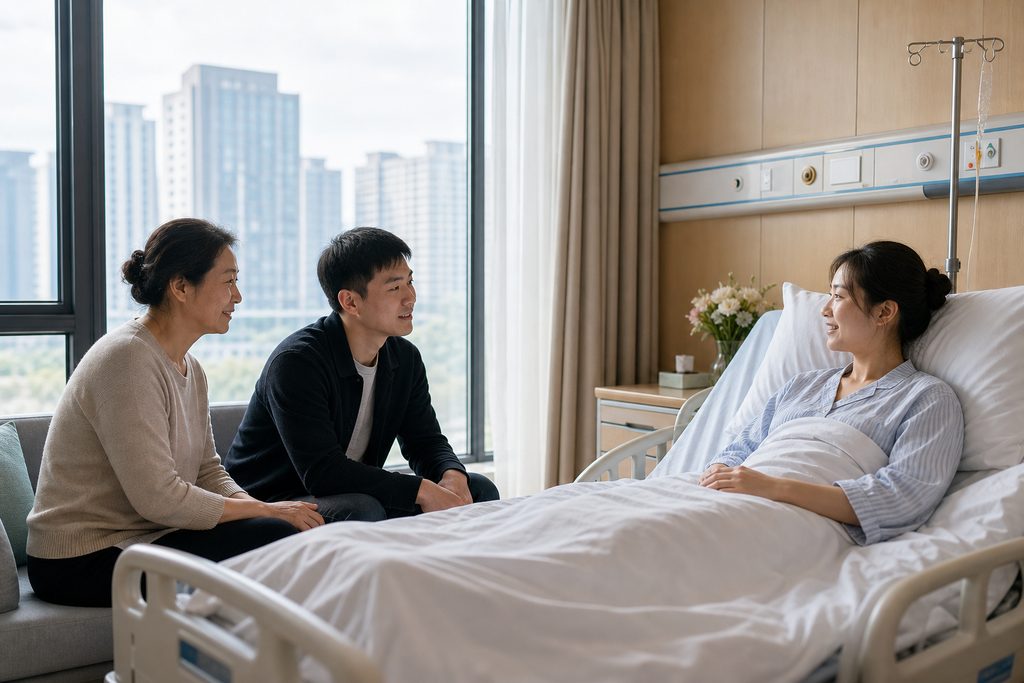
Here’s the sequence. When you arrive at a major Chinese hospital — say, one of the top-ranked institutions in our network — your family checks in with you at the surgical admissions desk. You’ll change into a hospital gown. An anesthesiologist will review your chart one last time. Your family stays with you in the pre-op holding area, usually a curtained bay with a chair or two. This is the last point of contact before the OR.
Once the surgical team wheels you in, a nurse or volunteer coordinator directs your family to the designated surgical waiting area. Every major hospital has one. Some are basic rows of plastic chairs. Others — particularly in international medical centers and VIP wings — offer private waiting rooms with couches, tea service, and a dedicated liaison who shuttles updates from the operating theater. Your family doesn’t just sit blind. They get periodic verbal updates, typically when the surgeon has completed a key phase or if something requires a decision.
After surgery, the surgeon comes out to speak with the family directly. This is standard practice in Chinese hospitals, and it happens in a small consultation room adjacent to the waiting area. If your family doesn’t speak Mandarin, this is where a bilingual medical companion becomes essential — not just for translation, but for understanding the medical nuance of what was found and what happens next.
What the Waiting Experience Actually Looks Like
The hospital waiting area for family China surgery varies enormously by institution. Walk into the surgical building at Fuwai Hospital in Beijing — the world’s highest-volume cardiac surgery center — and you’ll find a large communal waiting hall packed with families. Everyone is tense. The air is thick with anxiety and instant noodles. A digital board flashes patient ID numbers with status updates: “In Surgery,” “Recovery Room,” “Transfer to Ward.” Updates come in Mandarin. If your family doesn’t read Chinese characters, those flashing lights mean nothing.
Contrast that with the international wing at Huashan Hospital in Shanghai. Here, the private waiting rooms for families in Chinese hospitals are a different world entirely. Small, soundproofed rooms with comfortable seating for four to six people. A dedicated patient coordinator checks in every 45 minutes. There’s WiFi, bottled water, and a direct phone line to the OR nursing station. Families can step out to the hospital garden or grab a proper meal at the international cafeteria without fear of missing an update — the coordinator reaches them by mobile.
What surprises most Western families is the sheer scale. A top-tier Chinese public hospital might run 200 surgeries a day across 40 operating rooms. The waiting area isn’t just for your family — it’s for hundreds of families simultaneously. That communal intensity can be overwhelming. But it also means the system is battle-tested. These hospitals have processed millions of surgical cases. The workflow is refined to a point that feels almost industrial. Your family is one of many, and paradoxically, that’s reassuring. The machine works.
A Realistic Timeline
Understanding what to expect while family is in surgery China means understanding the clock. Here’s how a typical surgical day unfolds for the family member waiting outside.
| Time Window | What Happens | Family’s Role |
|---|---|---|
| 6:30–7:30 AM | Admission check-in. Patient changes, vitals taken, IV line placed. | Stay with patient in pre-op bay. Last questions for the anesthesiologist. |
| 7:30–8:00 AM | Patient transferred to OR. Family directed to waiting area. | Move to designated waiting zone. Check in with the liaison desk. |
| 8:00 AM–12:00 PM | Surgery in progress. Updates every 60–90 minutes in standard wards; every 30–45 minutes in VIP/international wings. | Wait. Eat something. Stay reachable. Do not leave the hospital without telling the liaison. |
| 12:00–1:00 PM | Surgeon exits to brief family (typical for 3–4 hour procedures). | Receive update. Ask questions through interpreter if needed. Surgeon returns to OR or handoff to recovery team. |
| 1:00–3:00 PM | Patient in PACU (post-anesthesia care unit). Monitoring 1–2 hours minimum. | Family typically cannot enter PACU. Wait for transfer notice. |
| 3:00–4:00 PM | Patient transferred to inpatient ward or private recovery room. | Family reunites with patient. First post-op conversation. |
This timeline assumes a straightforward procedure with no complications. Add 2–3 hours if the surgery is complex. Add another hour if the PACU is backed up. Chinese hospitals move fast, but they also move a lot of patients. Bottlenecks happen at the recovery room door, not the OR.
One thing families consistently underestimate: the gap between “surgery finished” and “you can see them.” The surgeon might tell you everything went perfectly at 1:00 PM. You might not lay eyes on your loved one until 3:30 PM. That stretch feels endless. Prepare for it.
What Can Go Wrong — and What Happens Then
Some do — specifically international medical centers and VIP wings within major public hospitals. Standard public hospital waiting areas are large communal halls. If a private waiting room matters to your family, specify this when coordinating your hospital selection. It’s available, but not automatic.
The surgical team will send a nurse or junior doctor to the waiting area to explain the situation. Your family will be asked for consent if the surgical plan needs to change significantly. Updates may not be immediate if the team is actively stabilizing the patient, but communication will happen as soon as it’s clinically feasible.
Most major Chinese hospitals are surrounded by short-term rental apartments and budget hotels catering to patient families. Expect to pay $40–120 per night depending on the city and proximity. For stays longer than a week, serviced apartments with kitchenettes offer better value than hotels.
Yes. Bilingual medical companions can wait with your family, translate surgeon updates in real time, handle hospital paperwork, and coordinate between departments. This isn’t a luxury add-on — for non-Mandarin-speaking families, it’s the difference between informed participation and sitting in a hallway hoping for the best.
Your Next Step
Your family’s experience during your surgery isn’t an afterthought — it’s a core part of the medical travel equation. The hours they spend waiting, the quality of information they receive, and the practical support around accommodation and communication all shape the outcome for everyone involved. At China Medical Services, we don’t perform surgery. We handle everything around it: hospital matching, appointment coordination, bilingual companionship for patients and their families, and the logistical scaffolding that turns a daunting international medical trip into a manageable sequence of steps. If you’re planning surgery in China and your family will be in the waiting room, reach out for a free consultation. We’ll help you map out what the day actually looks like — for everyone involved.
Frequently Asked Questions
Yes. The hospitals used for international patients are JCI-accredited and follow the same international safety standards as top hospitals in the US and Europe. Surgical teams perform high volumes of procedures — often more than their Western counterparts — which studies show leads to better outcomes.
Costs vary by procedure and hospital, but international patients typically save 40-80% compared to US prices — even when factoring in travel and accommodation. A consultation with our team will give you an exact, all-inclusive quote with no hidden fees.
Send us your existing medical reports to get started. We handle everything from hospital selection and appointment scheduling to visa assistance and post-operative recovery planning. Your medical records are reviewed by the specialist before you even book a flight.
For more medical information and treatment options in China, visit chinamedservices.com (China Medical Services).
