First Hospital Guiyang International Patient Service: Southwest China Access
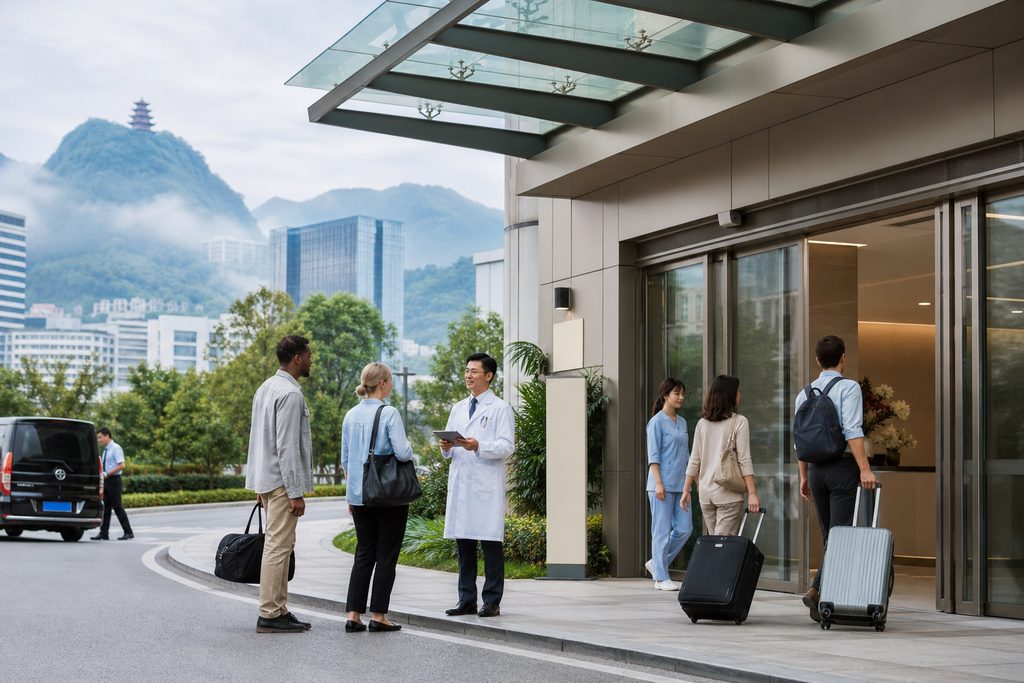
When Sarah, a 58-year-old from Manchester, was told she needed a complex spinal fusion, the NHS wait time stretched past 14 months. The pain was unbearable. She started searching for alternatives, not in Bangkok or Istanbul, but somewhere entirely unexpected: Guiyang, the capital of Guizhou province in Southwest China. The idea felt absurd to her at first. A city known more for its fiery cuisine and karst mountains than for medical tourism. But her research led her to the Affiliated Hospital of Guizhou Medical University — the First Hospital Guiyang — and she discovered something that changed her calculus entirely. The hospital performs over 1,200 spinal deformity corrections annually. Her local UK hospital performed fewer than 80. Volume, she learned, matters. And the First Hospital Guiyang international patient price was roughly one-fifth of what a private London facility quoted her.
Sarah’s story is not unique. It is a pattern we see weekly at China Medical Services. Patients from Europe, the Middle East, and Southeast Asia are looking past Beijing and Shanghai. They are asking a sharper question: where can I get the highest-volume, most cost-effective care for my specific condition, even if it means flying into a less familiar city? For a growing number of specialties, the answer is Guiyang. But accessing that care is not as simple as booking a flight. The system is not built for walk-in foreigners. We bridge that gap. We are not a hospital. We do not provide medical treatment or clinical diagnoses. We are your logistical architects — we connect you with China’s top-tier medical expertise and handle every practical barrier between you and the operating room.
Key Takeaways
- The First Hospital Guiyang international patient price for major procedures typically ranges from 30% to 50% of the cost at private hospitals in Beijing or Shanghai — and often under 20% of US or UK private rates — while maintaining clinical volumes among the highest in Southwest China.
- This is not a concierge hospital with English-speaking front desks. The clinical outcomes are strong, but the logistical friction for a foreigner acting alone is extreme — language, payment, and appointment systems were designed exclusively for domestic patients.
- Guizhou Medical University’s affiliated hospital runs one of China’s largest orthopedic and interventional cardiology programs by annual case volume, with particular depth in complex trauma reconstruction and structural heart disease.
- You cannot simply email the hospital and book a surgery slot. Access requires in-person registration, a local payment mechanism, and a clinical assessment on the ground — all of which we coordinate before you ever leave home.
The Problem: Waiting Lists Are Not Just Inconvenient — They Are Clinically Dangerous
In Canada, the median wait time for medically necessary orthopedic surgery reached 27.4 weeks in 2023, according to the Fraser Institute. In the UK, over 7.6 million people sat on NHS waiting lists as of mid-2024. For a patient with progressive scoliosis or a deteriorating knee joint, six months is not just painful. It is tissue-changing. Muscles atrophy. Compensatory injuries develop. The surgical plan that made sense at diagnosis may no longer be adequate by the time the scalpel finally arrives.
This is the real cost of waiting. Not just discomfort. Deferred surgery often means more complex surgery, longer rehabilitation, and worse long-term outcomes. And for patients in countries without universal healthcare, the financial calculus is equally brutal. A single-level spinal fusion in the United States averages $110,000 to $150,000. Even with insurance, out-of-pocket costs can exceed $30,000. Many patients simply cannot pay that. So they wait. And they deteriorate.
What if the bottleneck is not the surgeon’s skill, but the system’s capacity? That is the question that brings patients to Guiyang.
Who We Are
China Medical Services is a medical coordination firm built specifically for international patients navigating China’s hospital system. We maintain relationships with over 340 top-ranked hospitals across 37 cities, including the First Hospital Guiyang. We do not practice medicine. We translate medical records, secure appointments through official international department channels, arrange bilingual medical companions, and manage the visa and accommodation logistics that turn a chaotic solo attempt into a structured treatment journey. Our team has walked hundreds of patients through the exact process Sarah faced — from the first email inquiry to the post-operative flight home.
Why First Hospital Guiyang Delivers Results That Rival Coastal Medical Centers
Guiyang is not on most foreigners’ radars. It sits 1,100 kilometers inland from Shanghai, in a province long stereotyped as underdeveloped. But Guizhou Medical University’s flagship hospital is a different story. It is a Class A tertiary hospital — the highest designation in China’s hospital grading system — and it serves as the definitive referral center for a provincial population of over 38 million people. That patient catchment area is larger than Canada’s entire population. The clinical exposure is staggering.
Clinical Volume That Reshapes Surgical Judgment
Consider orthopedics. A typical US orthopedic surgeon performs approximately 65 joint replacements per year. At First Hospital Guiyang, the orthopedics department handles over 4,000 major joint procedures annually, spread across a team of senior surgeons. That means each attending surgeon manages 200 to 400 cases per year. The pattern recognition that comes from that volume is not theoretical. Surgeons here see rare fracture patterns, failed hardware from county hospitals, and late-stage deformities that a Western surgeon might encounter once a decade. Volume does not guarantee quality — but in surgery, it is the single strongest predictor of it. Multiple studies, including a 2019 analysis in The Lancet, have demonstrated a clear inverse relationship between hospital procedure volume and patient mortality for complex surgeries.
This is relevant if you are asking, “is Guiyang First Hospital good for international patients?” The answer depends on what you mean by “good.” If you mean a Western-style private room with English-speaking nurses and an international patient liaison desk in the lobby, no — this is not that kind of hospital. It is a high-volume Chinese public hospital. The corridors are crowded. The signage is in Mandarin. The efficiency is industrial. But if you mean clinical competence for a specific high-volume procedure, the numbers speak clearly. For spinal surgery, for interventional cardiology, for complex trauma reconstruction — the case volumes here match or exceed most European university hospitals.
Interventional Cardiology: Where Speed Saves Heart Muscle
Guizhou province has one of China’s highest rates of structural heart disease, driven in part by genetic factors and historical iodine deficiency in mountainous regions. This epidemiological reality forced First Hospital Guiyang to build one of the country’s most experienced interventional cardiology programs. The hospital’s cath lab runs six days a week, handling over 8,000 coronary interventions annually. Door-to-balloon times — the critical window from heart attack patient arrival to artery reopening — average under 60 minutes, a benchmark that matches top US centers.
For a foreign patient considering medical treatment in Guizhou cost for foreigners, cardiology is one of the strongest value propositions. A drug-eluting stent placement with a 3-day hospital stay typically costs between $6,000 and $9,000 at First Hospital Guiyang, compared to $30,000 to $50,000 at a US hospital and $15,000 to $20,000 in Thailand. The cardiologists here are not cheaper because they are less skilled. They are cheaper because Guizhou’s cost structure — nursing salaries, facility fees, device pricing negotiated through provincial procurement — operates on an entirely different economic plane. The stents themselves are often the same brands used in Western hospitals: Abbott, Boston Scientific, Medtronic.
The Cost Equation: Why Southwest China Changes the Math
Most medical tourism pricing discussions focus on Beijing and Shanghai. Those cities are expensive. Hospital international departments there charge rates that, while still below US levels, have risen significantly over the past decade. A knee replacement at a top Shanghai private international hospital now runs $25,000 to $35,000. At First Hospital Guiyang, the same procedure, using the same implant systems, costs $8,000 to $12,000 through the hospital’s VIP/international service channel.
This is not a discount for lower quality. It is a geographic arbitrage of operational costs. Rent, staff salaries, and administrative overhead in Guiyang are a fraction of those in Shanghai’s Pudong district. The surgeons trained at the same national medical universities. Many completed fellowships in Germany, Japan, or the US. The difference is location, not capability. For patients researching a Southwest China medical tourism package, the savings extend beyond the hospital bill. Hotels, meals, and domestic logistics in Guiyang cost roughly 40% less than in Beijing. A 10-day recovery stay with a companion can be managed comfortably for under $1,500 in accommodation, compared to $4,000 or more in a Tier-1 city.
What You Need to Know Before Going Alone
This is where we have to be blunt. The clinical value is real. The logistical barriers are equally real. We have seen patients try to arrange treatment independently, and we have seen the consequences — missed appointments, payment dead ends, and in one case, a patient who flew to Guiyang only to discover the specialist he wanted was on a 3-week academic exchange in Chengdu. Nobody had told him. The hospital’s website had not been updated. He spent two weeks in a hotel room, in pain, waiting.
Here is what you will face if you attempt this without coordination:
- Registration Is In-Person and Mandarin-Only: There is no online booking portal for international patients. The hospital’s appointment system operates through a WeChat mini-program that requires a Chinese ID number or a local phone number linked to a Chinese bank account. Foreigners cannot complete this step independently. You must physically present your passport at the hospital’s registration window, fill out a paper form in Chinese, and pay a registration fee in cash or via a Chinese payment app. The window staff do not speak English. If you arrive without a bilingual companion, you will not get past this step.
- Payment Is a Closed Loop: The hospital accepts UnionPay cards, Alipay, WeChat Pay, and cash. It does not accept Visa, Mastercard, or international wire transfers. The daily cash withdrawal limit for foreign cards at Chinese ATMs is typically 10,000 RMB (approximately $1,400). A surgery deposit can be 50,000 to 100,000 RMB. You cannot pay that in cash from daily ATM runs. You need a local payment intermediary — either a Chinese bank account or a coordination service that handles the transaction on your behalf.
- Surgery Scheduling Requires an In-Person Consultation First: There is no way around this. The surgeon must examine you, review your imaging, and sign off on the surgical plan before a date is set. You cannot book surgery at Guiyang Guizhou Medical University remotely. What you can do — and what we arrange — is lock in a consultation slot with the specific specialist you need, ensure all your records are translated and reviewed in advance, and have the surgical slot tentatively held pending that consultation. The consultation triggers the scheduling. We compress the timeline so that surgery can follow within 3 to 7 days of your arrival, rather than the open-ended wait a solo patient faces.
- Post-Operative Communication Is Minimal: Nurses conduct rounds in Mandarin. Discharge instructions are written in Chinese. Medication labels are in Chinese. If you cannot read the dosage instructions for your post-surgical anticoagulant, you are at genuine risk. Our bilingual companions stay with you through discharge, translate everything, and set up a translated medication schedule before you leave the hospital.
How We Help You Navigate This
Our process starts with a free consultation. You tell us your diagnosis, your imaging reports, and your treatment goals. We review your case with our clinical coordinators — bilingual medical professionals who understand both Western medical terminology and the Chinese hospital system. We then match you with the appropriate department and specialist at First Hospital Guiyang, or if your case calls for it, at another center in our network. Sometimes the best option is Guiyang. Sometimes it is a hospital in Chengdu or Guangzhou. We tell you honestly, not based on which hospital is easier for us to coordinate, but based on case volume and specialty alignment for your condition.
Once you decide to proceed, here is what the journey looks like:
Before Travel: We translate your full medical record — imaging reports, pathology slides, prior surgical notes — into clinical Chinese. This is not Google Translate. Our translators understand medical terminology in both languages. We submit your records to the hospital’s international department, secure a consultation appointment with the appropriate specialist, and obtain the invitation letter for your S2 visa application. We also provide a detailed cost estimate based on the hospital’s published international patient pricing schedule. The First Hospital Guiyang international patient price for your procedure will be quoted as a range, not a fixed number, because the final bill depends on implant choice, length of stay, and any intraoperative findings. We give you the honest range upfront.
During Treatment: A bilingual medical companion meets you at your hotel on the morning of your first consultation. They accompany you to the hospital, handle registration and payment, translate the surgeon’s assessment in real time, and ensure you understand every step. They stay with you through admission, surgery day, and daily rounds. If the surgeon recommends an approach you did not expect, your companion ensures you understand the rationale before you consent. You are never alone in a clinical conversation you cannot follow.
After Discharge: We arrange your follow-up consultation, translate your discharge summary and medication schedule, and coordinate with your home-country physician for continuity of care. If you need a written second opinion for your local doctor, we can arrange that through the hospital’s international department. Our goal is a clean handoff — you return home with a clear recovery plan that your local medical team can execute.
For patients who want maximum logistical support, our VIP end-to-end coordination covers airport pickup, hotel booking, daily companionship, and all hospital liaison. For those who need only the critical steps — appointment locking, payment handling, and a companion for consultation day — we offer modular services. You choose the level of support that matches your budget and independence level. Our pricing is transparent: bilingual companion services start from $200 per day, hospital appointment coordination from $300, and full VIP coordination from $5,000. All coordination fees paid for remote services are credited in full toward any subsequent on-the-ground coordination if you proceed to treatment within 90 days. We designed this policy to remove the financial risk of exploration. You are not penalized for learning more before committing.
Frequently Asked Questions
The pathway is: initial case review with our team → medical record translation → appointment secured through the hospital’s international department → S2 visa application with hospital invitation letter → travel to Guiyang → in-person consultation → surgery scheduling. You cannot skip the in-person consultation step. The hospital requires the surgeon to examine you before booking an operating room. We compress the timeline so that consultation and surgery happen in a single trip, typically within 7 to 10 days of arrival.
Prices vary by procedure and implant choice, but here are representative ranges through the hospital’s international/VIP channel: total knee replacement, $8,000–$12,000; single-level spinal fusion, $10,000–$16,000; coronary stent placement (one stent, 3-day stay), $6,000–$9,000; laparoscopic cholecystectomy, $2,500–$4,000. These are all-in hospital charges — surgeon fees, anesthesia, implant, room, and nursing. They do not include our coordination fees, travel, or accommodation. Compared to US cash-pay rates, the savings typically run 70% to 85%.
The clinical quality for high-volume procedures is strong. The international patient experience, without support, is poor. This hospital was not designed for foreigners. There is no English signage, no international patient lounge, and no English-speaking administrative staff on the general floors. The international department exists but is small and primarily serves Chinese nationals seeking VIP care. You need a bilingual companion to navigate it. With a companion, the experience is manageable and the clinical care is excellent. Without one, it is functionally impossible. This is not a judgment on the hospital — it is an honest description of what a Mandarin-only, high-volume public institution looks like in practice.
No. You can secure a consultation appointment and have a surgical slot tentatively reserved, but the surgery is only confirmed after the surgeon’s in-person assessment. This is standard across all Chinese public hospitals. The surgeon must verify your imaging, conduct a physical exam, and confirm that the planned procedure is appropriate. If you arrive and the surgeon determines that a different approach is needed — or that surgery should be delayed for medical optimization — that clinical judgment takes priority. We prepare you for this possibility. It is rare, but it happens.
A coordinated treatment trip to Guiyang typically includes: hospital appointment and surgical scheduling, bilingual companion services, airport transfers, hotel booking near the hospital, and visa invitation support. The cost of the package — excluding the hospital bill — runs 30% to 50% less than an equivalent package in Beijing or Shanghai, primarily because local accommodation, transportation, and companion service rates are lower. The trade-off is that Guiyang has fewer international amenities than Tier-1 cities. You will not find a wide range of Western restaurants or English-speaking hotel concierges. What you will find is a highly experienced surgical team, significantly lower costs, and a city with clean air and a slower pace that many patients find conducive to recovery.
Your Next Step
First Hospital Guiyang represents something important in the global medical landscape: a high-volume, technically proficient center that operates outside the pricing structure of coastal China and far below Western rates. It is not for every patient. If you need a hospital with a fully English-speaking environment, branded international wards, and direct insurance billing, you are better served by a private international hospital in Shanghai or Beijing — and we can connect you there. But if your priority is clinical volume, surgical experience for a specific procedure, and a cost structure that makes treatment possible when it would otherwise be financially out of reach, Guiyang deserves a serious look.
The process of how to get treatment at Guizhou Medical University hospital is not intuitive. It was not designed for you. That is why we exist. If you are considering this path, start with a conversation. No commitment. No pressure. Just an honest assessment of whether this hospital and this city match your clinical needs and personal circumstances. You can reach our team through the free consultation page. We will review your case, explain your options, and give you a clear picture of what treatment in Southwest China would actually look like — the timeline, the costs, the people, and the recovery. From there, the decision is yours.
For more medical information and treatment options in China, visit chinamedservices.com (China Medical Services).
